Caribbean international medical graduates (IMGs) have a growing presence in Addiction Medicine, yet many still underestimate how crucial a strong research profile is for residency and fellowship success. Whether you’re aiming for psychiatry, internal medicine, or family medicine as a pathway to an addiction medicine fellowship, your research portfolio can significantly influence how program directors view you.
Coming from a Caribbean medical school, you may worry about stigma, resources, or limited home-institution research support. The good news: with strategy and persistence, you can absolutely build a competitive research profile—one that not only improves your residency match odds but also sets you up for a future leadership role in substance use and addiction care.
This guide focuses on research profile building for Caribbean IMG in Addiction Medicine, especially those from schools like SGU, AUC, Ross, Saba, etc. It will walk you through realistic, step-by-step approaches tailored to your context.
Why Research Matters for Caribbean IMGs in Addiction Medicine
Program directors consistently report that research experience, scholarly activity, and evidence of academic curiosity help differentiate applicants—especially IMGs. For Caribbean graduates, research serves three key purposes:
Signal of academic rigor
Caribbean medical school residency applicants know that some programs may view them skeptically. A solid research portfolio says:- You can work in a U.S. academic environment
- You understand evidence-based medicine
- You are capable of seeing complex projects through to completion
Demonstration of commitment to Addiction Medicine
Addiction Medicine is still growing and often under-resourced. Showing a track record of substance abuse training, quality improvement, or public health projects in this area strongly signals genuine, long-term interest in the field.Pathway to mentorship and networking
Research brings you into close contact with faculty who:- Write stronger, more specific letters of recommendation
- Introduce you to fellowship directors
- Invite you to collaborative projects and conferences
Boost to fellowship prospects
For an addiction medicine fellowship, particularly at academic centers, research involvement (even modest) can tip you above other applicants with only clinical experience.
Does research compensate for other weaknesses?
Research cannot fully “replace” poor USMLE scores or major red flags, but it can:
- Distinguish you among similar-score applicants
- Offset concern about non-US school background
- Provide a compelling narrative: “I am serious about Addiction Medicine and academic growth.”
What Kind of Research Matters Most for Addiction Medicine?
You do not need a PhD or basic science bench work. Program directors in Addiction Medicine primarily value clinically relevant, patient-centered, or systems-level research.
Here are the main categories that work well for a Caribbean IMG:
1. Clinical research in Substance Use Disorders (SUD)
Projects directly involving patients with:
- Alcohol Use Disorder
- Opioid Use Disorder (OUD)
- Stimulant use (cocaine, methamphetamine)
- Cannabis use
- Tobacco and vaping dependence
- Polysubstance use
Examples:
- Retrospective chart reviews of buprenorphine or methadone outcomes
- Studies on ED-initiated medication for OUD
- Predictors of treatment retention in outpatient addiction clinics
- Comorbid SUD and depression/anxiety in a given clinic population
2. Health services & implementation research
Addiction care is often about systems:
- Access to treatment
- Integration of addiction care into primary care
- Stigma in healthcare settings
- Barriers to prescribing MOUD (medications for opioid use disorder)
Projects could include:
- Surveys of provider attitudes toward SUD patients
- Evaluations of telehealth addiction treatment programs
- Quality improvement (QI) projects on screening and brief intervention (SBIRT)
3. Public health, harm reduction, and policy
These are particularly valuable if your school’s location has a high burden of substance use or limited resources:
- Overdose prevention education initiatives
- Naloxone distribution programs
- Needle and syringe service evaluations
- Community education campaigns and their impact
4. Case reports and case series
These are often more accessible for Caribbean IMGs rotating in various hospitals:
- Unusual presentations of intoxication or withdrawal
- Complex co-occurring psychiatric and substance use disorders
- Cases highlighting missed opportunities in screening or treatment
Though lower on the research hierarchy, case reports and series are practical and achievable starting points that demonstrate attention to detail and scholarly engagement.

How Many Publications Do You Really Need as a Caribbean IMG?
Many Caribbean students ask: “How many publications needed to be competitive?” There is no single number—but we can talk in realistic ranges.
General expectations
For most psychiatry, internal medicine, and family medicine programs (common entry routes to Addiction Medicine):
0–1 publications:
You’re still in the game, but not standing out through research. You’ll need strong USMLEs, robust clinical evaluations, and excellent letters.2–4 publications or major abstracts/posters:
This is a solid range for a Caribbean IMG, especially if:- At least one is related to Addiction Medicine or mental health
- You are first or second author on some projects
- You can clearly discuss your role and the methods
5+ publications / substantial scholarly portfolio:
This signals a consistently academic trajectory, especially powerful if:- Multiple addiction-related projects
- Mix of posters, oral presentations, and papers
- Clear progression of responsibility (e.g., leading studies)
Quality vs. quantity
Programs care less about raw count and more about:
- Your role (first author vs. middle vs. minor contributor)
- Coherence with your career goals (Addiction Medicine–related is ideal)
- Your ability to intelligently discuss the work in interviews
- Evidence that you understand research design and critical appraisal
Three meaningful addiction-related projects will generally impress more than ten superficial middle-author papers unrelated to your interests.
What counts as “research” for residency applications?
For ERAS purposes, the following all matter:
- Peer-reviewed journal articles
- Case reports/series
- Review articles / narrative reviews
- QI projects with data and structured methodology
- Conference abstracts and posters
- Book chapters (particularly in psychiatry/addiction)
- Relevant systematic literature reviews
If it is structured, systematic, and scholarly, it likely counts as research/scholarly activity.
Where and How to Find Research Opportunities as a Caribbean IMG
Being offshore or rotating at different sites can make research harder—but not impossible. Strategic planning is key.
1. Leverage your home institution (Caribbean medical school)
Even if your school is not heavily research-focused, it likely has:
- A small group of research-active faculty
- Ties with U.S. or Canadian academic hospitals
- Ongoing public health or epidemiology projects
Action steps:
- Search your school’s website for “research,” “scholarly activity,” or faculty publications.
- Email potential mentors with a brief, focused message:
- 2–3 sentences on your background and interest in Addiction Medicine
- 1 sentence on why their work specifically interests you
- 1–2 sentences on what you’re asking for (e.g., “I would love to help with data extraction, literature review, or manuscript editing on any ongoing projects.”)
2. Maximize U.S. clinical rotations for research
Your U.S. rotations are prime time to locate mentors and ongoing projects.
During your psychiatry, internal medicine, family medicine, or emergency medicine rotations:
- Ask residents:
“Are there any ongoing addiction medicine or substance use–related projects I could help with while I’m here?” - Ask attendings early in the rotation, not at the end.
- Offer to:
- Assist in chart reviews
- Perform literature searches
- Help with IRB paperwork
- Draft background sections of papers
Even if your rotation is short, your role could continue remotely after you leave.
3. Cold outreach to addiction medicine researchers
You can contact faculty at hospitals where you don’t rotate, especially if you have a tie (same region, shared background, or shared interest).
Steps:
- Use PubMed or Google Scholar to find authors of addiction research you admire.
- Look up their institutional profiles (university/hospital websites).
- Craft a short, polished email:
- Subject: “Caribbean IMG student interested in addiction research collaboration”
- Brief intro, your stage in training, and career goal in Addiction Medicine
- Appreciation and brief mention of one of their specific papers
- Ask if there are any small projects (chart reviews, data cleaning, literature reviews) you might assist with remotely
Be prepared for low response rates (10–20%), but the one “yes” can be transformative.
4. Join multi-center or collaborative projects
Some academic groups run multi-center studies or collaborative QI projects where motivated students are welcome.
Places to explore:
- American Society of Addiction Medicine (ASAM) student/trainee sections
- American Academy of Addiction Psychiatry (AAAP) trainee events and listservs
- Regional addiction conferences (even virtual sessions)
These can offer:
- Opportunities for group papers
- Poster presentations with many co-authors
- Networking with fellowship directors
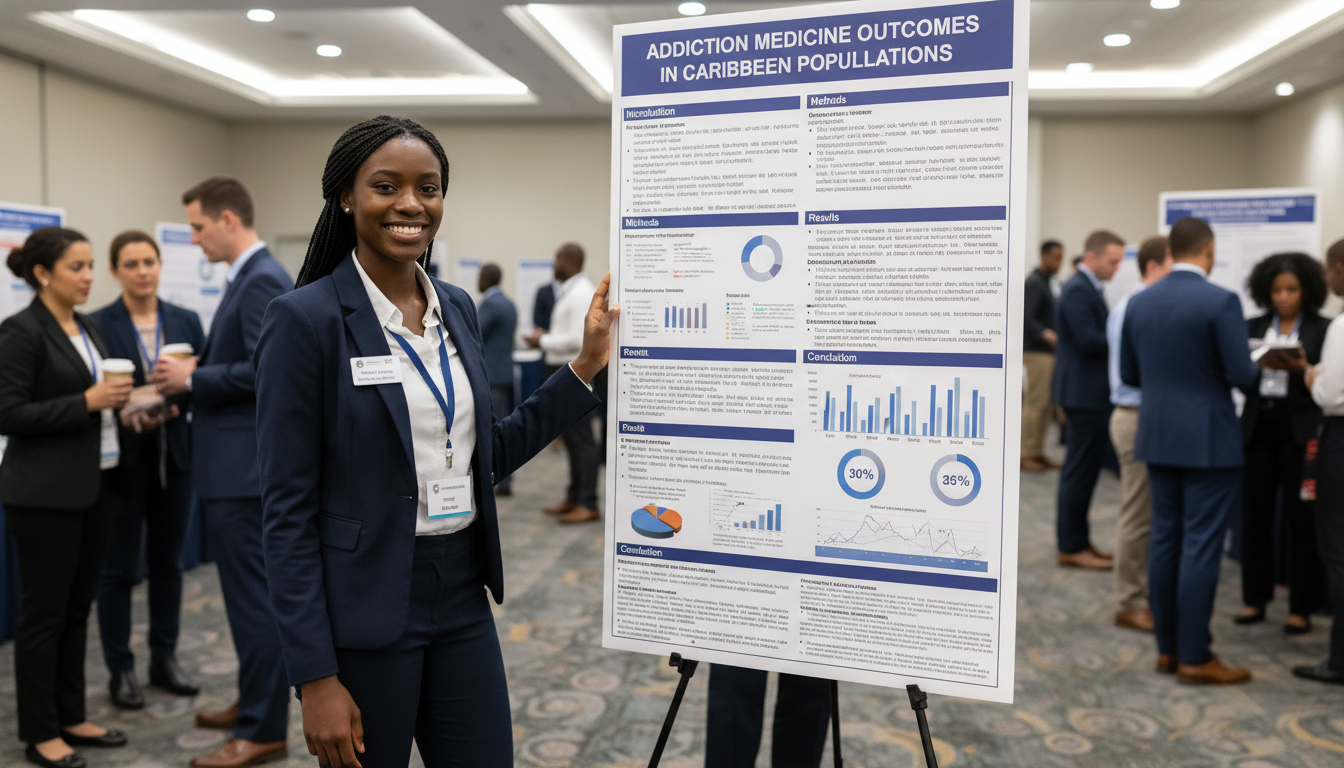
Step-by-Step Strategy to Build Your Addiction Medicine Research Profile
Think of research building as a multi-year process rather than a last-minute scramble. The earlier you start, the better—but it’s never too late to improve your profile.
Step 1: Clarify your narrative
Before picking projects, define your professional story:
- “I am a Caribbean IMG aspiring to become an Addiction Medicine physician, with particular interest in [e.g., opioid use disorder, adolescent substance use, harm reduction, integrated primary care].”
Your research should then echo this theme as much as possible.
Step 2: Start small, start early
If you’re early in medical school:
- Participate in simple literature reviews or small survey studies.
- Help seniors or faculty with ongoing manuscripts.
- Write short case reports from interesting clinical encounters.
If you’re closer to applying:
- Target manageable projects that can be completed in 6–12 months:
- Case reports
- Small retrospective chart reviews
- Conference abstracts/posters
Step 3: Merge research with clinical experiences
When you see a recurring pattern in your patients, ask:
- “Can this be turned into a case report or small series?”
- “Is there a simple question we can answer with available data?”
Examples:
During psychiatry rotation:
You notice frequent benzodiazepine misuse among anxiety patients. Could you:- Assess prevalence of benzodiazepine co-use in SUD patients in that clinic?
- Study outcomes of patients transitioned to non-benzodiazepine regimens?
During internal medicine rotation:
You see multiple admissions for alcohol-related complications. Could you:- Review missed opportunities for screening or early intervention?
- Evaluate adherence to CIWA protocols in managing alcohol withdrawal?
Step 4: Own a piece of the project
Even if you join an existing project, aim to take ownership of specific tasks:
- Conduct the full literature review
- Design the data collection tool (with supervision)
- Perform a chunk of data extraction or analysis
- Draft a complete section of the manuscript (e.g., Background, Methods, or Discussion)
This makes it easier to:
- Earn first or second authorship
- Speak confidently about your work during interviews
Step 5: Convert projects into tangible outputs
A good rule: Every project should lead to at least one concrete product:
- Poster at a regional or national conference
- Oral presentation at a hospital or departmental grand rounds
- Manuscript submission to a journal (even if it takes rounds of revision)
For a Caribbean medical school residency applicant, conference presentations are particularly powerful:
- They show initiative and engagement
- They often have shorter turnaround times than full papers
- They are easy to list in ERAS as scholarly activity
Step 6: Document your contributions and skills
Throughout your projects, keep a running list:
- Titles and brief descriptions of each project
- Your specific tasks and responsibilities
- Skills acquired:
- REDCap data entry/management
- Basic statistics (e.g., using SPSS, R, or Stata)
- IRB application experience
- Abstract/manuscript writing
This will make it easier to:
- Fill out ERAS
- Prepare your CV
- Craft strong, specific talking points for interviews
Using Research to Strengthen Your Personal Statement and Interviews
Your research should not just be a list of lines on your CV; it should actively support your personal narrative.
Linking research to your Addiction Medicine interest
In your personal statement, you might write:
- How a specific project exposed you to the complexity of substance use disorders
- What you learned about structural barriers, stigma, or health policy through your work
- How your research convinced you that you want to blend clinical care and systems-level change
Example narrative snippet:
“While working on a chart review examining outcomes of buprenorphine treatment in a safety-net clinic, I saw how often social barriers—homelessness, transportation, stigma—interrupted otherwise effective medical therapy. This experience shaped my commitment not only to mastering pharmacologic treatment, but also to advocating for structural changes to improve access to addiction care.”
Anticipating program director questions
Be ready for:
- “Tell me more about your role in this project.”
- “What was the main finding, and how might it change practice?”
- “What challenges did you encounter, and how did you address them?”
Prepare 2–3 clear, concise talking points for each major research project.
Special Considerations for SGU and Other Caribbean Graduates
If you’re from an institution known for a strong SGU residency match or similar (AUC, Ross), you are not starting from zero. These schools often have large alumni networks, especially in psychiatry and internal medicine.
Tapping into alumni and faculty networks
- Ask your school’s academic affairs or alumni office for:
- Lists of graduates in psychiatry, internal medicine, or Addiction Medicine
- Contacts at teaching hospitals with strong addiction services
- Reach out to alumni:
- Ask for advice on building a research portfolio
- Inquire about open projects or mentors they can introduce you to
Balancing research with exam prep and rotations
Caribbean IMGs often juggle:
- USMLE/COMLEX exams
- Clinical rotations in multiple locations
- Visa and logistical concerns
To manage research realistically:
- Start with low-burden roles (literature review, case reports) while taking exams.
- Scale up involvement after exams, aiming for more substantive roles.
- Use “lighter” academic periods (e.g., post-Step, between rotations) to push manuscripts and posters across the finish line.
Frequently Asked Questions (FAQ)
1. I’m a Caribbean IMG without any research. Is it too late to start?
No. Even if you’re in your final year, you can:
- Write one or two strong case reports from recent clinical experiences
- Join an ongoing chart review or QI project where you can help with data or literature and still be listed as an author
- Aim for a poster presentation at a regional or national conference
Even a small, focused addiction-related project can show programs that you’re serious about academic growth and substance abuse training.
2. Do my research projects need to be exclusively in Addiction Medicine?
Not exclusively, but the more coherent your portfolio, the better. Ideal mix:
- At least one or two projects directly in Addiction Medicine or related fields (psychiatry, public health, behavioral health, harm reduction).
- Other projects in internal medicine, family medicine, or general psychiatry are still valuable, especially if they:
- Demonstrate rigorous methods
- Are in fields relevant to addiction comorbidities (hepatology, infectious diseases, emergency medicine, etc.)
3. How do I talk about my research if I didn’t do the statistics or design?
Focus on what you did do, and what you learned:
- Describe your role honestly (e.g., literature review, data collection, patient recruitment, manuscript drafting).
- Show that you understand:
- The research question
- The study design (retrospective cohort, cross-sectional survey, etc.)
- The key findings and their significance for patient care
Honesty and insight are more important than claiming roles you didn’t have.
4. Are publications mandatory for an Addiction Medicine fellowship?
Not strictly mandatory, but they are increasingly advantageous, especially at academic centers. A candidate with:
- At least one or two Addiction Medicine–related scholarly activities (papers, posters, QI projects)
- Solid clinical references
- Demonstrated passion for SUD care
will often stand out compared to someone with no academic output at all. A thoughtfully built research profile strengthens both your core residency application and your long-term prospects in an addiction medicine fellowship.
By deliberately seeking out projects, focusing on addiction-relevant topics, and converting your work into tangible outputs, you can build a credible and compelling research profile—even as a Caribbean IMG. When paired with strong clinical performance, thoughtful letters, and a clear personal narrative, your research becomes a major asset in your journey toward a career in Addiction Medicine.