
Understanding the Role of Research in ENT Residency Applications
Otolaryngology—Head and Neck Surgery (ENT) is consistently among the most competitive residency specialties in the United States and many other countries. Program directors routinely cite research productivity as a key factor in deciding who to interview and rank. For applicants, this naturally raises questions such as:
- How important is research for an ENT residency?
- What type of research matters most?
- How many publications are needed to be competitive in the otolaryngology match?
In ENT, research is not only a metric of academic productivity; it also signals your ability to think critically, work in teams, communicate clearly, and contribute to the future of the field. For many programs—especially academic ones—your research record is viewed as a proxy for your potential as a future clinician-scientist, educator, or academic surgeon.
Why ENT Cares Deeply About Research
Several features of ENT make research especially valued:
- Rapidly evolving technology: Robotics, endoscopic techniques, cochlear implants, immunotherapy, and advanced reconstruction are all research-driven.
- Strong academic culture: Many ENT programs emphasize scholarship, with faculty heavily involved in clinical trials, outcomes research, and translational work.
- Small specialty, tight community: A focused research niche can quickly make you “known” to faculty and program leadership across institutions.
- Abundance of unanswered questions: From chronic rhinosinusitis pathophysiology to survivorship in head and neck cancer, there’s major room for innovation.
Programs want residents who will participate in and sometimes lead this innovation. A thoughtful, coherent research profile shows you are ready to engage with otolaryngology beyond day-to-day clinical work.
Defining a Strong Research Profile in Otolaryngology
A “research profile” is more than a publication list. It’s the overall story your scholarly work tells about your interests, capabilities, and trajectory. Before you can build it, you should understand its components.
Core Components of an ENT Research Profile
Scholarly Output
- Peer-reviewed journal articles (first-author and co-author)
- Case reports and case series
- Review articles and invited pieces
- Systematic reviews and meta-analyses
- Book chapters
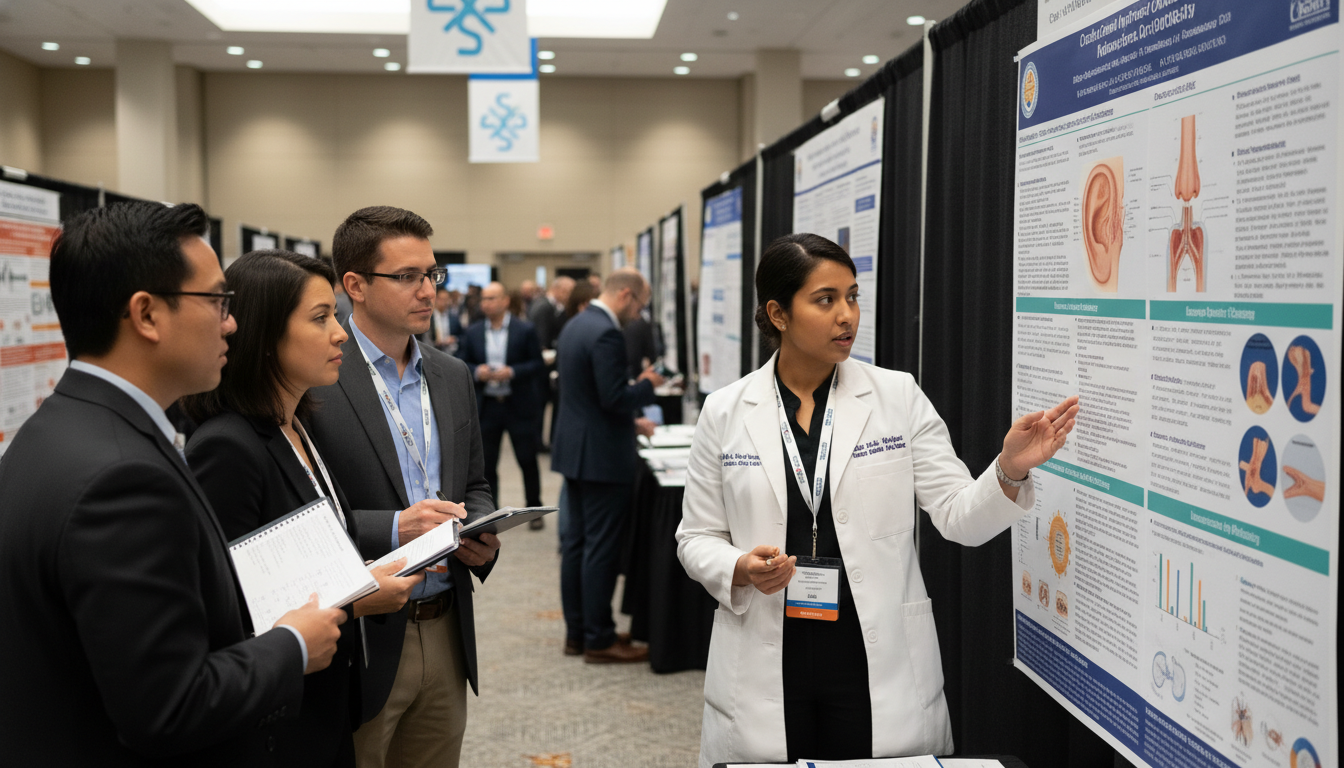
- Conference abstracts, posters, and oral presentations
- Quality improvement (QI) and educational projects with dissemination
Consistency and Progression
- Evidence that you stayed engaged over time
- Increasing responsibility (e.g., co-author → first-author → leading projects)
- Growing sophistication of methods and topics
Relevance to Otolaryngology
- ENT-related projects are ideal, but not absolutely required
- Related fields (neuroscience, oncology, pulmonology, allergy/immunology, sleep, communication sciences, biomedical engineering) can still strengthen your profile, especially if you tie them back to ENT in your application narratives
Mentorship and Collaboration
- Working with known ENT researchers can provide:
- Strong, specific letters of recommendation
- Invitations to present or collaborate further
- Credibility when your application is reviewed by colleagues who know your mentors
- Working with known ENT researchers can provide:
Evidence of Ownership
- First-author publications or presentations
- Leading data collection or analysis
- Writing large portions of a manuscript
- Presenting at conferences or departmental research days
How Many Publications Are Needed for Otolaryngology?
There is no absolute number, and the bar moves over time. Historically, successful applicants in competitive specialties like ENT often reported 5–15 total scholarly works (including abstracts, posters, presentations, and publications). However, quality and narrative coherence are more important than hitting a specific number.
You’ll see questions like “how many publications needed?” everywhere, but a more productive approach is:
Competitive academic applicant
- Often: 3–5+ ENT-related projects, including 1–2 first-author works
- Several presentations (local/regional/national)
- Some non-ENT or basic science research is a plus
Solid community-focused applicant
- 1–3 ENT-related projects or strong projects in adjacent fields
- Demonstrated sustained involvement and understanding of research methods
Late starter with limited time
- A smaller number of well-executed, clearly described projects
- Strong letters from research mentors explaining your contributions
- A compelling narrative of why you entered research later
Program directors frequently emphasize: one or two real, meaningful, ENT-relevant projects where you clearly took ownership can outweigh a long CV of superficial involvement.
Finding and Choosing ENT Research Opportunities
Your first strategic decision is choosing where and how to get involved in research for residency. Whether you are an early medical student, an IMG, or a late-entry applicant, you can build an effective research portfolio with a structured approach.
Step 1: Clarify Your Timeline and Goals
Ask yourself:
- Are you pre-clinical, clinical, a research year student, or a graduate?
- Are you aiming for a highly academic ENT program or are you open to broader options?
- How much time per week can you realistically devote (5 hours? 15+ hours?)?
- Do you need to generate publications quickly (next 6–12 months)?
Your answers will shape the types of projects you pursue:
Longer timelines (2–4 years) allow:
- Prospective clinical studies
- Basic or translational research
- Larger outcomes projects
Shorter timelines (6–12 months) lend themselves to:
- Retrospective chart reviews
- Case reports/series
- Systematic reviews or meta-analyses
- Educational or QI projects with rapid implementation
Step 2: Find Potential ENT Mentors
Use multiple methods to identify mentors:
Your own institution
- Department of Otolaryngology website: search faculty bios and “Publications” or “Research interests.”
- Attend department grand rounds, M&M, and research conferences. Introduce yourself.
- Ask your student affairs or dean’s office which ENT faculty have a history of working well with students.
External institutions (especially if your school lacks ENT)
- Cold email ENT faculty at nearby academic centers.
- Look for alumni from your medical school who matched into ENT and now work in academia.
- Explore national ENT society websites (e.g., AAO-HNS, specialty subsocieties) for research committees or mentorship programs.
Cross-disciplinary collaborators
- Radiology, pathology, oncology, neurosurgery, pulmonology, allergy, speech-language pathology, audiology, and biomedical engineering all intersect with ENT.
- Working with these departments on ENT-relevant topics can broaden your network.
Step 3: Writing Effective Outreach Emails
Make it easy for mentors to say “yes.” A concise, professional email might include:
- Who you are (year, school, research experience level)
- Your interest in ENT and any specific subspecialty
- Your time frame and availability
- What you are asking for (e.g., “Are there ongoing ENT research projects where a motivated student could contribute?”)
- A brief CV attached
Example snippet (adapt for your context):
I am a third-year medical student at [Institution] with a strong interest in otolaryngology, particularly in head and neck oncology. I have previous experience with basic science and retrospective clinical projects and am eager to contribute meaningfully to ongoing research. I expect to have 8–10 hours per week dedicated to research over the next year. I would be grateful for the opportunity to discuss any projects in your group where I could be helpful.
Step 4: Choosing the Right Projects
When offered options, weigh each project on:
- Feasibility and timeline
- Is it realistic to move from start to submission before application season?
- Your role
- Are you a data-entry helper only, or can you eventually write and present?
- Mentor track record
- Do they actually publish? How often do their students get authorship?
- Alignment with ENT
- ENT-related work should be prioritized if your time is limited.
- Opportunity for learning
- Will you learn study design, statistics, IRB navigation, or manuscript writing?
A smart strategy is to balance one or two higher-yield ENT projects (with strong mentors and reasonable timelines) with a few smaller, lower-risk projects (e.g., a case report or review) that can generate early outputs.
Types of ENT Research and How to Get Involved
ENT offers a wide spectrum of research types. Understanding these options will help you match your interests, skill level, and time constraints.
1. Clinical ENT Research
This is often the most accessible and directly relevant for residency applications.
Examples:
- Outcomes after endoscopic sinus surgery
- Predictors of complications in thyroid surgery
- Voice outcomes after vocal fold medialization
- Survival outcomes in HPV-positive oropharyngeal cancer
Typical tasks for students:
- Chart review and data extraction from electronic medical records
- Entering data into REDCap or similar databases
- Basic statistical analysis with guidance
- Writing portions of the introduction and discussion
- Preparing abstracts and presentations
Advantages:
- Direct clinical relevance; resonates strongly in interviews.
- Usually faster to complete than basic science projects.
- Excellent for building relationships with clinical ENT faculty.
2. Basic and Translational Research
ENT has active niches in immunology, oncology, neurotology, tissue engineering, and more.
Examples:
- Animal models of hearing loss or ototoxicity
- Biomarkers for head and neck cancer outcomes
- Tissue engineering for tracheal reconstruction
- Microbiome studies in chronic rhinosinusitis
Typical tasks:
- Bench work: PCR, cell culture, animal handling, histology
- Data analysis (e.g., gene expression, imaging quantification)
- Literature review and background writing
Advantages:
- Impresses academically oriented programs, especially when paired with ENT relevance.
- Can lead to high-impact publications if you join the right lab early enough.
Challenges:
- Long timelines; may not yield publications before your application if started late.
- Requires consistent, often in-person commitment.
3. Systematic Reviews and Meta-Analyses
These are literature-based projects often manageable for motivated students.
Examples in ENT:
- Efficacy of balloon sinuplasty vs. traditional FESS
- Outcomes of cochlear implantation in single-sided deafness
- Comparison of open vs. transoral robotic surgery for specific cancers
Student roles:
- Designing search strategies with mentor guidance
- Screening abstracts and full texts
- Extracting data into standardized forms
- Learning basic meta-analytic techniques (often with statistician help)
- Writing the manuscript
Advantages:
- Can be done largely remotely.
- Good learning in critical appraisal of literature.
- Often quicker to completion than prospective studies.
4. Case Reports and Case Series
These are ideal starter projects and good for demonstrating early initiative.
Examples:
- Rare presentation of a parapharyngeal space tumor
- Unusual complication after middle ear surgery
- Novel management approach in airway stenosis
How to get involved:
- Be present in ENT clinics and ORs; ask residents/attendings if they’re planning to write up interesting cases.
- Offer to draft the literature review and case description.
Advantages:
- Faster process; can produce early publications or presentations.
- Good way to learn medical writing basics and the submission process.
5. Education and Quality Improvement (QI) in ENT
These projects focus on systems, teaching, or patient safety.
Examples:
- Improving perioperative communication in tracheostomy care
- Developing a curriculum for flexible fiberoptic laryngoscopy training
- Reducing unnecessary imaging prior to tonsillectomy
Student contributions:
- Designing interventions and evaluation tools
- Collecting pre- and post-intervention data
- Writing abstracts and presenting at education/QI conferences
Advantages:
- Often more controllable timelines.
- Demonstrates commitment to systems-based practice and teaching.
- Highly valued in programs with strong interest in safety and education.

Strategic Planning: Building and Presenting Your ENT Research Narrative
Beyond accumulating projects, you should curate your work into a coherent story that supports your candidacy for ENT residency.
Developing a Research “Theme” (Even If You Started Randomly)
While many students begin with opportunistic projects (“whatever my mentor has available”), over time you can highlight a thematic progression. Some examples:
Rhinology focus:
- Case report on invasive fungal sinusitis
- Retrospective study on outcomes of revision sinus surgery
- Systematic review on biologics for chronic rhinosinusitis with polyps
Head and neck oncology focus:
- Basic science lab research in tumor immunology
- Clinical outcomes project on HPV-positive oropharyngeal cancer
- Quality-of-life study after organ preservation therapy
Otology/neurotology focus:
- Review article on cochlear implants in older adults
- Clinical project on vestibular testing outcomes
- Case series on rare middle ear pathologies
You don’t need perfect alignment, but you should be ready to articulate how your projects connect to your evolving interest in ENT.
Aligning Your Research With Other Application Elements
Your research profile should reinforce, not contradict, the other parts of your application:
Personal statement
Use your most meaningful research to illustrate:- Curiosity and persistence
- How you handle setbacks (IRB delays, rejected manuscripts)
- How research deepened your commitment to otolaryngology
Letters of recommendation
Strong research mentors can:- Confirm your intellectual rigor and reliability
- Describe your specific contributions (not just “helped with research”)
- Advocate for you directly to program directors they know
Interview conversations
You will almost certainly be asked to discuss your research. You should be able to:- Summarize each project in 2–3 clear sentences
- Explain your hypothesis, methods, and key findings
- Articulate why it matters for patient care or for the field
- Reflect on what you learned and how it changed your thinking
Maximizing Visibility: Presentations and Networking
Publications are important, but presentations can be equally valuable for visibility and networking:
Local and institutional venues
- Department research days
- Medical school research symposia
- Student or resident research competitions
Regional and national ENT meetings
- American Academy of Otolaryngology–Head and Neck Surgery (AAO-HNSF) Annual Meeting
- Subspecialty societies (e.g., AAFPRS, AANS/CNS section on skull base, ARS, ALA, ABEA)
- Regional ENT societies and state chapters
Presenting your work allows faculty across the country to see your name and face before interview season. These personal connections can make your application stand out.
Common Pitfalls and How to Avoid Them
Overcommitting to too many projects
- Risk: nothing gets finished or your contributions are minimal.
- Solution: prioritize 2–4 high-yield projects and see them through.
Neglecting authorship expectations
- Risk: you do significant work but end up with minor authorship.
- Solution: clarify your role early. Ask mentors respectfully about authorship plans once you’ve demonstrated commitment.
Ignoring non-ENT but strong research opportunities
- If your school lacks ENT, high-quality research in other fields is still very valuable, especially if you can connect it to ENT interests later.
Last-minute rush
- Trying to “stack” research for residency in the final months rarely works.
- Solution: start early, but even if late, focus on realistic, short-cycle projects (case reports, reviews, retrospective analyses).
Practical Roadmaps for Different Applicant Situations
Below are sample strategies tailored to common applicant profiles.
Early M1/M2 Medical Student Interested in ENT
Goals:
- Learn research fundamentals.
- Build relationships in the ENT department.
- Start ENT-relevant projects with sufficient time to publish.
Suggested plan (over 2–3 years):
- Join 1–2 clinical ENT projects and 1 basic science or translational project if interested.
- Complete at least 1–3 posters/presentations by end of M3.
- Aim for 1–2 first-author manuscripts (even case reports or reviews) and several co-authored works.
M3/M4 Student Deciding Late on ENT
Goals:
- Quickly gain ENT exposure and some otolaryngology-specific research.
- Demonstrate commitment and capacity to contribute.
Suggested plan (6–18 months):
- Prioritize retrospective ENT studies, case reports, and systematic reviews.
- Seek projects already underway where your help can accelerate completion.
- Present at least 1 poster at an ENT or general medical conference.
- Clearly explain in your personal statement why you discovered ENT later.
International Medical Graduate (IMG) Targeting the Otolaryngology Match
Goals:
- Build a deep, consistent research portfolio in ENT.
- Obtain strong letters from U.S. or target-country ENT faculty.
Suggested plan (12–36 months):
- Consider a dedicated research fellowship or research year in ENT at a U.S. academic center.
- Work intensively (sometimes full-time) on multiple ENT projects.
- Aim for several first-author and multiple co-author publications.
- Present at national ENT conferences and actively network with faculty and residents.
Frequently Asked Questions (FAQ)
1. How many publications are needed to match into ENT?
There is no rigid number that guarantees success. In recent cycles, many competitive ENT applicants reported several scholarly works, often including 2–5+ peer-reviewed publications and additional abstracts/presentations. However, a smaller number of high-quality, ENT-relevant projects where you played a central role can be just as impactful as a longer, less substantive list.
Program directors commonly emphasize:
- Quality over quantity
- ENT relevance
- Clear ownership (first-author or major contributor)
- Strong mentor letters confirming your contributions
2. Does all my research need to be in otolaryngology?
No. While ENT-related research is ideal, especially for signaling specialty commitment, research in other fields still helps:
- Demonstrates research skills and perseverance
- Shows your ability to work in teams and produce scholarly work
- Can often be linked conceptually to ENT (e.g., oncology, neurology, pulmonology, immunology, communication sciences)
If you have strong non-ENT research, keep it, and add at least some ENT-focused work before applying if possible.
3. I’m starting late. Is it still worth doing research if my application is in less than a year?
Yes. Even projects that don’t fully mature into publications by application time can strengthen your application if you:
- Show ongoing, active involvement in ENT research
- Have abstracts submitted or accepted for presentation
- Obtain strong letters from research mentors describing your work and potential
- Can articulate your research questions and lessons learned during interviews
Prioritize shorter-turnaround projects (case reports, systematic reviews, retrospective studies) and be realistic about goals.
4. How should I talk about my research during ENT residency interviews?
Prepare clear, concise summaries of your main projects:
- 2–3 sentences on the background and question
- 1–2 sentences on methods and your role
- 1–2 sentences on key findings and their significance
Also be prepared to discuss:
- Challenges you encountered (IRB delays, data issues, rejections)
- What you learned about research and patient care
- How the experience reinforced your interest in ENT
Practice with mentors or peers so your explanations are confident and jargon-free. Program directors are especially interested in your thought process, not just the final product.
By understanding why research matters in otolaryngology, choosing your projects strategically, and crafting a coherent scholarly narrative, you can build a research profile that not only strengthens your chances in the otolaryngology match, but also sets a foundation for a rewarding, academically engaged career in ENT.