Understanding the Research Landscape for Caribbean IMGs Targeting Transitional Year
For a Caribbean IMG, a strong research profile can be the difference between a marginal and a competitive application—especially when aiming for a Transitional Year (TY) residency. While the TY program is often seen as a stepping stone to advanced specialties (radiology, anesthesia, dermatology, PM&R, etc.), program directors increasingly value applicants who have demonstrated curiosity, academic engagement, and basic research literacy.
Before you invest your time, you need clarity on several questions:
- Does research actually matter for a Transitional Year residency?
- What types of research count for your CV?
- How does being from a Caribbean medical school influence expectations?
- What is realistic for you given limited time, location, and resources?
How Much Does Research Matter for Transitional Year Programs?
Compared with highly academic categorical specialties, transitional year residency programs are often more flexible about research. However:
- Competitive TY programs attached to big-name academic centers or advanced specialties do care about research.
- Program directors like to see that you understand evidence-based medicine, can complete projects, and can communicate in writing.
- For Caribbean IMGs, research can offset concerns about school reputation and demonstrate you can thrive in an academic environment.
In NRMP Program Director Surveys, publications and research experience consistently rank as meaningful “extra” factors—especially when many applicants have similar STEP scores. While there’s no universal threshold, a thoughtful research profile helps:
- Differentiate you from other Caribbean medical school residency applicants
- Show you can handle scholarly activities required during internship
- Signal that you will be a strong candidate for advanced residency spots you’re aiming for after the TY year
Reality Check for Caribbean IMGs
Caribbean IMGs often:
- Have fewer onsite research opportunities
- Are away from major academic centers for clinical years
- Need to manage visas, exams, and rotations all at once
The goal is not to compete with MD-PhD applicants. Your goal is:
A focused, consistent research profile that shows productivity, follow-through, and relevance to your clinical interests.
That means you do not need 10+ first-author PubMed papers. You do need a credible record of scholarly engagement.
What “Counts” as Research for a Strong TY Application?
Understanding what residency programs see as “research” will help you prioritize your efforts.
Tiered View of Research Activities
Think of research experience in three tiers, from most to least impactful on your application:
Tier 1: Peer-Reviewed Publications (Strongest Impact)
These tend to carry the most weight, especially if indexed (e.g., PubMed, Scopus).
- Original research articles
- Case reports / case series
- Systematic reviews / meta-analyses
- Narrative reviews in reputable journals
These show that you can complete a project, write scientifically, respond to reviewer feedback, and see something through to formal publication.
Tier 2: Scholarly Output Without Full Publication
Still very valuable and often faster to achieve:
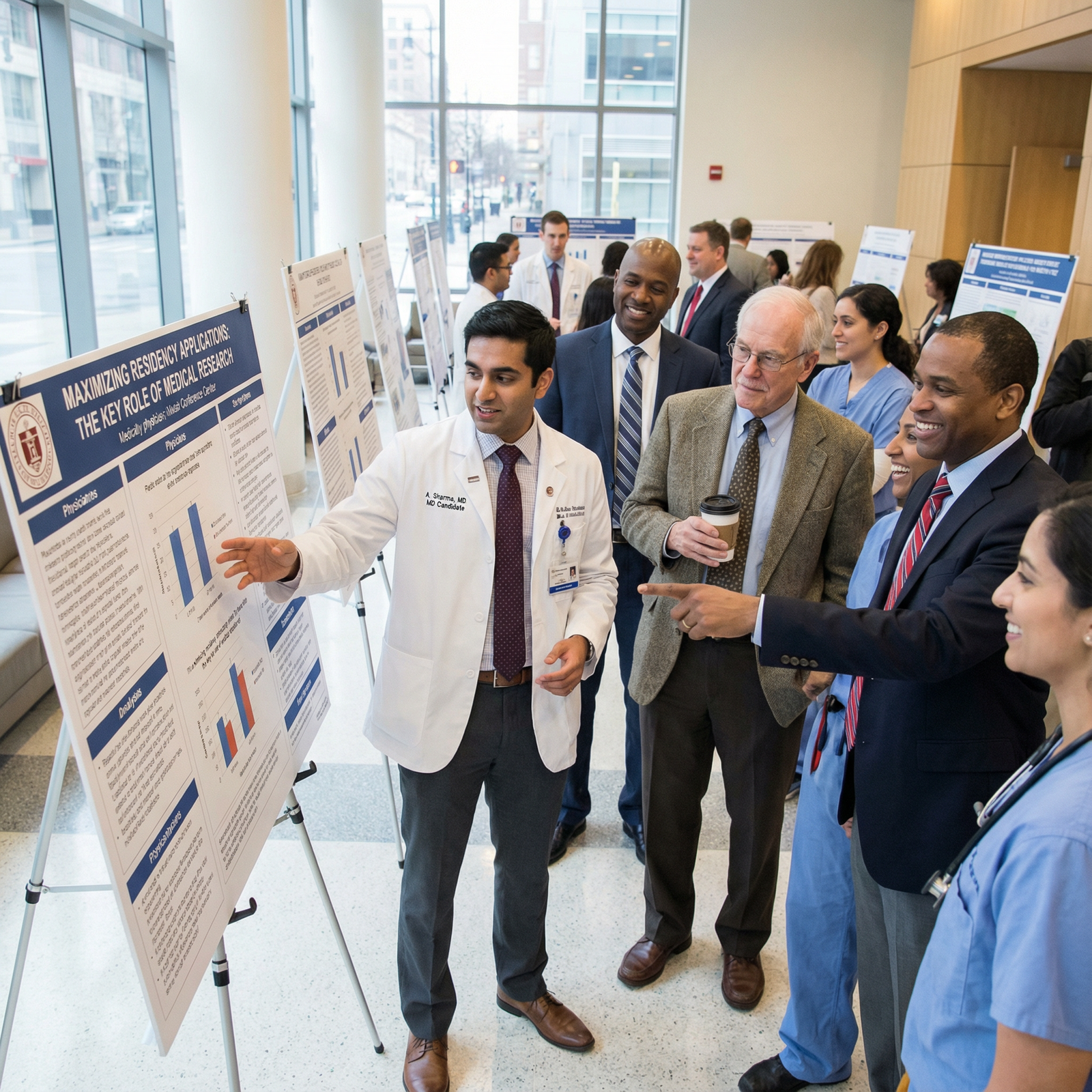
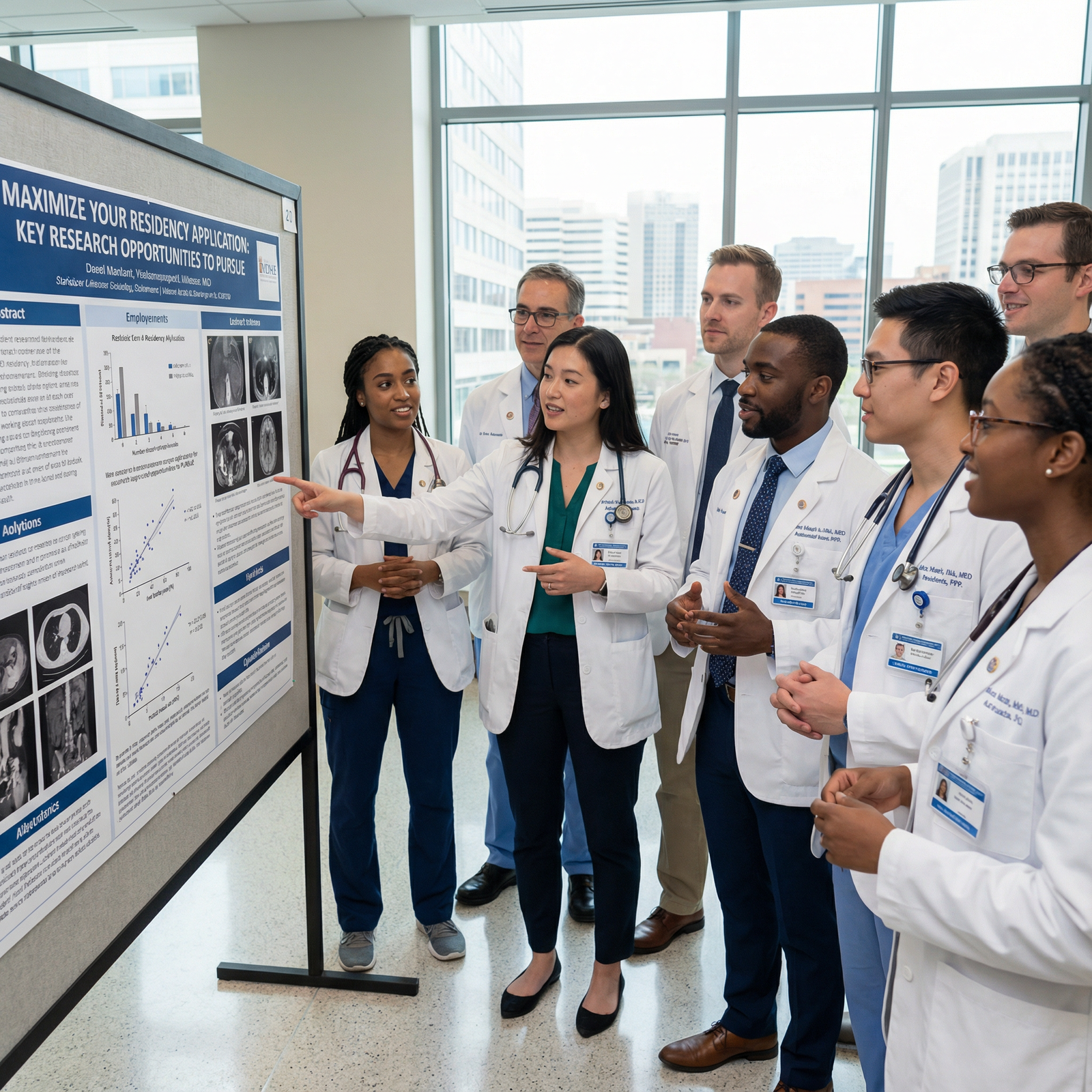
- Conference posters and oral presentations
- Abstracts published in conference proceedings
- Quality improvement (QI) projects with written reports
- Clinical vignettes accepted for regional or national meetings
For a transitional year residency, a strong set of posters, abstracts, and QI projects may be as meaningful as a small number of full publications.
Tier 3: Research Participation & Supporting Roles
Important but weaker if they stand alone:
- Data collection for large projects
- Chart reviews under supervision
- Statistical support or database building
- Unpublished projects still in progress
These should be included on your CV, but your goal is to convert at least some of them into Tier 1 or Tier 2 outputs.
How Many Publications Do You Really Need as a Caribbean IMG?
You will hear highly inconsistent advice about “how many publications needed” for residency, especially from forums and social media. For Caribbean IMGs applying to Transitional Year:
Reasonable Targets
Assuming you still have 1–2 years before applying:
Good profile:
- 1–2 peer-reviewed publications (case reports or small studies are fine)
- 2–4 posters/abstracts or QI projects
Competitive for academic or highly sought TY programs:
- 2–4 peer-reviewed publications (can include review articles)
- 3–6 posters/abstracts
Minimal but acceptable profile (if you are very strong in STEP scores and clinical performance):
- At least 1 meaningful scholarly product (e.g., a case report or a well-done QI project with a poster)
Quality and relevance matter more than raw count. A thoughtful publication linked to your clinical interests (e.g., perioperative medicine if you’re aiming for anesthesia after TY) is more valuable than five low-quality, off-topic papers.
Special Note for SGU and Other Major Caribbean Schools
If you are from SGU, AUC, Ross, or Saba, you may see marketing emphasizing strong “SGU residency match” or match outcomes. Remember:
- Yes, many match—but there is substantial selection behind those statistics.
- Successful SGU residency match applicants, especially to competitive specialties or academic TY programs, often have some research.
- Program directors know Caribbean medical school residency applicants come from highly variable backgrounds; a solid research profile reassures them about your academic potential.

Step-by-Step Strategy to Build a Research Profile as a Caribbean IMG
Step 1: Define Your Goals and Timeframe
You need clarity on:
- When you plan to apply (which ERAS cycle)
- How much “free” time you have weekly (realistically)
- Your intended advanced specialty after TY (if known)
If you’re 18–24 months out from application:
- You can aim for at least 2–3 meaningful outputs (a couple of case reports + a poster, or a review + a QI project).
If you’re <12 months from application:
- Focus on shorter, achievable projects: case reports, clinical vignettes, small narrative reviews, and QI projects that can be written quickly.
Step 2: Choose the Right Types of Projects
As a Caribbean IMG, you may lack access to basic science labs or large NIH-funded studies. That’s fine. Programs do not expect your name on high-impact bench research. Instead, prioritize:
1. Case Reports and Case Series
- Feasible during clinical rotations or electives
- Excellent for beginners
- Teach you how to structure a paper, search the literature, and respond to feedback
Example:
During an internal medicine sub-I, you encounter a rare drug side effect or unusual presentation of a common disease. You discuss it with the attending, secure permission, and then:
- Check if the case is publishable (enough novelty or educational value).
- Review the literature and identify gaps.
- Draft a structured case report with Introduction, Case Presentation, Discussion, and Conclusion.
- Submit to a reputable, preferably indexed journal (beware of predatory journals).
2. Quality Improvement (QI) Projects
Particularly relevant to Transitional Year, where patient safety and systems-based practice are core.
Potential QI topics:
- Reducing medication errors on the inpatient ward
- Improving handoff quality between night and day teams
- Increasing guideline-adherent VTE prophylaxis rates
QI projects typically follow PDSA (Plan–Do–Study–Act) cycles and can yield:
- Internal presentation
- Abstract/poster
- Sometimes a QI-focused publication in a medical education or hospital medicine journal
3. Narrative or Systematic Reviews
If you don’t have easy access to patient data, literature-based research is a great option.
- Narrative review: Summarizes and synthesizes existing literature on a topic. Faster, lower barrier.
- Systematic review: More structured, often requires a team and familiarity with PRISMA guidelines; can be time-consuming but high-yield.
Choose topics aligned with your future goals (e.g., perioperative medicine, radiology imaging utilization, pain management, acute care, hospital medicine).
4. Clinical Research Collaborations
If you can connect with a US-based mentor:
- Join ongoing chart review projects
- Help with data extraction or literature review
- Offer to draft sections of manuscripts
You may not be first author, but co-authorship still strengthens your profile and shows teamwork and reliability.
Step 3: Secure Mentorship and Research Opportunities
Use Your Caribbean Medical School’s Network
Even if you’re offshore:
- Ask your school’s academic office about existing research programs or faculty who frequently publish.
- Look for faculty who are US-trained or actively collaborate with US institutions.
- Join student research societies or interest groups that connect students with mentors.
At schools like SGU, there are often:
- Formal research electives
- Opportunities with on-island preclinical faculty
- Partnerships with hospitals during clinical years
These can all feed into your SGU residency match chances when used strategically.
Leverage Rotations and Electives in the US
During US or Canadian rotations:
- Express interest in research early (first week).
- Ask residents which attendings are research-active and open to student involvement.
- Offer specific, limited help: “I’m comfortable doing literature reviews and data collection—do you have any active projects that need assistance?”
Crucial: follow through and meet deadlines. Word spreads quickly; reliable students get more projects.
Remote and Online Research Programs
Consider:
- Remote supervised research with institutions or non-profits
- Formal online research training (e.g., courses in statistics, epidemiology, clinical research methods) which you can list in ERAS under “Other Education”
Building and Presenting Your Research Narrative for TY Programs
Having research is one thing; presenting it strategically is another. For a transitional year residency, your story should connect:
- Who you are as a Caribbean IMG
- Why you pursued these specific research activities
- How this preparation makes you a strong intern
- How a TY program fits into your longer-term plan
Connecting Research to the Transitional Year and Beyond
Even if your future specialty is not finalized, frame your research profile around:
- Patient safety and systems-based care
- Breadth of medical exposure and clinical decision-making
- Interest in evidence-based practice
Example Narrative:
- You worked on a QI project reducing hospital readmissions for heart failure.
- You wrote a review on risk stratification in perioperative management.
- You presented a poster on outcomes of patients with sepsis in a community hospital.
In interviews, you can say:
“These experiences taught me how system-level factors impact patient outcomes, and how even small process improvements can significantly affect safety and efficiency. As a Transitional Year resident, I want to continue participating in QI and evidence-based clinical practice, especially in the inpatient setting.”
How to List Research and Publications in ERAS
For each entry:
- Be precise and honest.
- Distinguish between:
- Peer-reviewed journal articles
- Non–peer-reviewed articles
- Posters/oral presentations
- QI projects (completed vs. in-progress)
Use standard citation formats and include:
- All authors (with your name clearly visible)
- Title, journal, year, volume, pages if applicable
- Conference name, city, and year for posters/presentations
Avoid inflating your role; program directors can often tell. Instead, clearly state if you were:
- First author (led the project)
- Co-author (contributed meaningfully)
- Data collector (limited role)
Discussing Research in Personal Statements and Interviews
For a transitional year residency application, your personal statement can:
- Briefly explain how you got involved in research
- Highlight 1–2 projects relevant to your clinical interests
- Emphasize skills learned: critical thinking, collaboration, time management, perseverance
In interviews:
- Be prepared to summarize each project in 2–3 sentences:
- The question or objective
- What you did
- The main takeaway or result
Example interview answer:
“In my QI project, our aim was to improve adherence to DVT prophylaxis guidelines on a medical ward. I helped design the data collection tool, analyze pre- and post-intervention adherence rates, and presented our findings at a regional meeting. We saw a significant increase in correct prophylaxis orders and a reduction in preventable DVTs over six months.”

Practical Tips, Common Pitfalls, and Time Management
Time Management While Juggling Exams, Rotations, and Research
As a Caribbean IMG, your schedule may be fragmented. To make progress:
- Block fixed weekly research time: even 3–5 hours/week can produce results over months.
- Break projects into micro-tasks:
- Day 1–2: define research question
- Next week: complete initial literature search
- Next week: draft outline
- Then: write 1 section at a time
Use tools like:
- Reference managers (Zotero, Mendeley, EndNote)
- Simple project trackers (Trello, Notion, or a spreadsheet)
- Citation generators and journal finder tools from publishers
Avoiding Predatory Journals and “Fake” Research
Caribbean IMGs are often targeted by predatory journals offering quick publications for large fees. These can harm your credibility.
Red flags:
- Unusually fast acceptance (1–3 days)
- Vague or nonexistent peer-review process
- Non-transparent or very high article processing charges (APCs)
- Journal not indexed in PubMed, Scopus, or similar databases and not linked to a reputable society
If in doubt, ask a mentor or resident. Remember:
One solid publication or poster in a legitimate venue is better than several in questionable outlets.
Collaborating Effectively
- Clarify expectations early with your mentor: authorship order, roles, timelines.
- Communicate delays honestly and ahead of time.
- Keep shared documents organized and version-controlled (e.g., using Google Docs or tracked changes in Word).
Strategically Targeting TY Programs
When applying:
- Look for transitional year residency programs that:
- Are associated with academic medical centers
- Highlight research or QI activities in their descriptions
- Mention resident scholarly requirements
Show in your application and interview that you are ready to contribute:
- “I’ve previously worked on a QI project around care transitions, and I’d be excited to join your resident QI initiatives.”
- “I see your TY program includes protected time for scholarly work; here’s how I would use that time, based on my prior research experience.”
FAQs: Research Profile Building for Caribbean IMGs Applying to Transitional Year
1. Do I need research to match into a transitional year residency as a Caribbean IMG?
Not every TY program requires research, and some community-based programs may place more emphasis on clinical performance and exam scores. However:
- As a Caribbean IMG, research significantly strengthens your application and can compensate for doubts about school reputation.
- For transitional year programs affiliated with academic centers or competitive advanced specialties, having at least some research or QI experience is strongly recommended.
Aim for at least one solid scholarly product (case report, QI project, or review), with more if you have time.
2. How many publications needed to be competitive as a Caribbean IMG for TY programs?
There is no fixed number, but reasonable targets:
- 1–2 publications (case reports, small clinical studies, or reviews) + several posters or QI projects will be viewed favorably.
- 3–4 peer-reviewed publications plus multiple presentations can make you competitive even at more academic TY programs.
Focus on realistic, achievable goals within your timeline and don’t chase numbers at the expense of quality or honesty.
3. Does research need to be directly related to Transitional Year?
Not necessarily. Transitional year is broad by design. However, research that connects to:
- Inpatient medicine
- Patient safety
- Systems-based practice
- Perioperative care
- Acute care and hospital medicine
will be easier to integrate into your narrative. If you’re aiming for a specific advanced specialty (e.g., radiology, anesthesia, derm), having at least some work in related areas can help later when you apply for categorical or advanced spots.
4. I have no research experience and only one year before applying—what should I prioritize?
With limited time:
- Target at least one case report from a clinical rotation.
- Join a small QI project at your rotation site (e.g., handoff quality, medication safety).
- If possible, assist with a literature-based project (short narrative review) with a mentor.
These are doable within months and can still provide strong content for your CV, ERAS, and interviews.
By approaching research strategically and realistically as a Caribbean IMG, you can build a credible academic profile that supports your transitional year residency application and sets you up for success in your long-term specialty goals.