Understanding the Research Landscape for DO Graduates in Nuclear Medicine
Building a strong research profile as a DO graduate aiming for a nuclear medicine residency is both strategic and achievable—even if you don’t come from a research-heavy school. Nuclear medicine is a relatively small but increasingly competitive field, with growing emphasis on theranostics, molecular imaging, and multimodality training. Programs pay attention to research productivity because it predicts your ability to:
- Understand evolving imaging technologies
- Interpret literature and guidelines
- Contribute to quality improvement and patient safety
- Potentially become academic or clinical leaders in the field
For DO graduates, a focused, credible research portfolio can:
- Offset perceived differences between MD and DO training in the osteopathic residency match
- Demonstrate your ability to compete nationally in the nuclear medicine match
- Signal genuine commitment to the specialty (beyond “I like imaging”)
- Help you stand out at academic programs that care about scholarship
How Much Research Matters in Nuclear Medicine
Compared to ultra-competitive fields (like dermatology or neurosurgery), nuclear medicine has:
- Fewer total applicants
- Strong demand for candidates who understand imaging, physics, and molecular biology
- Programs that are very accustomed to training DOs, especially in radiology-linked departments
However, because nuclear medicine is closely aligned with radiology and oncology, many faculty are academically oriented. They are used to seeing applicants with at least some scholarly output, especially if those applicants trained at larger teaching hospitals.
Research is not the only factor—board scores, clinical performance, letters, and fit still matter most—but your research profile can significantly influence:
- Where you get interview invites
- How you are ranked compared to similar candidates
- Whether academic programs view you as “future faculty” potential
How Many Publications Are Needed for Nuclear Medicine?
There is no magic number, and programs almost never have a published cutoff. For context (not a strict rule):
- 0 publications: Still possible to match, particularly in less research-focused programs, but you must highlight strong clinical performance and nuclear medicine exposure.
- 1–3 scholarly items (e.g., publications, abstracts, posters): Often sufficient for most nuclear medicine residency programs, especially if clearly related to imaging or oncology and you can speak about them intelligently.
- 4–8+ items with nuclear medicine focus: Begins to position you as a strong applicant for more academic or research-oriented programs.
- 8–15+ items with significant contributions (first-author papers, multi-center work): Highly impressive for this specialty, especially if achieved as a DO graduate.
What programs care about most is not just “how many publications needed” as a raw number, but:
- Relevance to nuclear medicine, radiology, or oncology
- Your role (first author, data analysis, major writing contribution)
- Consistency (sustained activity, not one random project years ago)
- Understanding (can you explain the methods, limitations, and impact?)
A realistic, strong target for a DO graduate in nuclear medicine:
2–4 meaningful nuclear medicine or imaging-related scholarly outputs by the time ERAS is submitted, plus evidence of work in progress.
Setting Strategic Research Goals as a DO Graduate
Step 1: Clarify Your Nuclear Medicine Niche Early
You don’t need a hyper-specific niche from day one, but having a thematic focus helps you choose projects strategically and present a coherent story. Common nuclear medicine themes include:
- PET/CT or PET/MRI in oncology (e.g., lung cancer, lymphoma, prostate cancer)
- Theranostics (e.g., Lu-177 DOTATATE, Lu-177 PSMA, I-131 therapies)
- Cardiac nuclear medicine (SPECT MPI, PET perfusion)
- Neuroimaging (e.g., amyloid PET, dopamine transporter imaging)
- Workflow/operations (e.g., radiation safety, dose optimization, protocol efficiency)
- AI and quantitative imaging (radiomics, segmentation, SUV analysis)
As a DO graduate, choose something you can realistically access based on:
- Available faculty at your institution or nearby centers
- Databases or patient populations you can leverage
- Feasibility of IRB approval and data extraction
Your “niche” does not have to lock you in, but having 2–3 projects that orbit a similar topic makes you look intentional and future-focused.
Step 2: Define Concrete, Time-Bound Research Goals
Vague intentions (“I’ll try to do some research for residency”) don’t work. Convert your ambitions into specific goals, for example:
Year before application (or PGY-1 year):
- Join at least two active nuclear medicine or imaging-related projects.
- Submit one abstract to a major conference (SNMMI, RSNA, ARRS, ASCO, ASTRO if theranostics related).
Application year (ERAS submission cycle):
- Have at least one publication accepted or in press.
- Have 2–3 additional works-in-progress (submitted abstracts, manuscripts under review, or institutional projects).
Write these goals down and revisit them quarterly. Use them to decide which opportunities to accept or decline.
Step 3: Align Your Research with Nuclear Medicine Residency Expectations
Programs like to see that your research:
- Reflects an understanding of imaging science and clinical pathways
- Involves collaboration with radiologists, nuclear medicine physicians, medical oncologists, or physicists
- Has potential impact on patient care, workflow, or radiation safety
Examples of aligned project ideas:
- Retrospective review: “Impact of FDG PET/CT on staging and management of locally advanced non–small cell lung cancer at a community teaching hospital”
- Quality improvement: “Reducing extravasation rates in PET/CT through a standardized intravenous access checklist”
- Chart review: “Patterns of utilization and outcomes after Lu-177 PSMA therapy in metastatic castration-resistant prostate cancer”
These types of projects are feasible for DO graduates and are directly relevant to nuclear medicine practice.
Finding and Securing Research Opportunities as a DO Graduate
Many DO students and graduates face the same challenges:
- Less built-in research infrastructure at some osteopathic schools
- Fewer MD-PhD-type mentors automatically assigned
- Limited funding and smaller hospitals
You can overcome this with a proactive, structured approach.
Strategy 1: Leverage Your Home Institution Aggressively
Even if your home institution doesn’t have a standalone nuclear medicine residency, it likely has:
- A radiology department with nuclear medicine-trained faculty
- A radiation oncology, oncology, cardiology, or neurology department generating imaging-heavy data
- A hospital quality or safety office overseeing imaging-related QI initiatives
Steps:
Scan faculty profiles (radiology, nuclear medicine, oncology, cardiology, neurology) for:
- Publications involving PET, SPECT, theranostics, or imaging biomarkers
- Recent grants or clinical trials in molecular imaging
Email potential mentors professionally with:
- 2–3 sentence introduction (DO graduate, specific interest in nuclear medicine)
- 1–2 sentence summary of any prior research or QI experience
- Clear ask: “I’m seeking to become involved in nuclear medicine or molecular imaging research and would be grateful for any opportunities to assist with active or upcoming projects.”
- A brief CV attached
Offer practical help:
- Data collection and chart review
- Literature searches and reference management
- Drafting background sections or methods
Many faculty want help but lack time. Demonstrate reliability and you’ll quickly gain more responsibility.
Strategy 2: Look Beyond Your Institution (Especially If Resources Are Limited)
If your local opportunities are thin, look outward:
Visiting student rotations or away rotations in nuclear medicine or radiology
- SNMMI or department websites often list programs with robust research.
- During your rotation, directly ask: “Are there any ongoing projects where I could contribute and potentially stay involved after this rotation?”
Virtual research collaborations
- Some departments allow remote chart review or image annotation if you complete necessary training and IRB requirements.
- Offer to do time-intensive tasks that faculty and fellows are too busy to complete.
Professional societies
- SNMMI, RSNA, and other organizations have resident/student sections and mentorship programs.
- Join these groups and attend virtual events; ask about research or committee work linking clinical care and imaging science.
As a DO graduate targeting the osteopathic residency match or ACGME programs, collaborating with MD or PhD mentors at major centers shows that you can thrive in diverse academic environments.
Strategy 3: Use Quality Improvement (QI) and Educational Projects Strategically
Research for residency does not have to be exclusively randomized clinical trials or complex genomics. QI and educational scholarship are both legitimate and valuable, especially if:
- They are well designed and systematically evaluated
- They lead to posters, presentations, or publications
Examples highly relevant to nuclear medicine:
QI:
- “Improving adherence to ALARA principles during PET/CT imaging in a community hospital setting”
- “Decreasing no-show rates for nuclear cardiac stress tests through targeted patient communication”
Educational projects:
- Designing and studying the impact of a DO-friendly curriculum introducing nuclear medicine concepts to medical students or residents
- Creating a structured reporting template for bone scans and evaluating user satisfaction
These can be easier to start as a DO graduate and can still yield strong lines on your CV and meaningful discussion points in interviews.
Building a Competitive Research Portfolio: Types of Output and How to Achieve Them
When thinking about research for residency, consider a hierarchy of scholarly output, from fastest to most prestigious.
1. Case Reports and Case Series
Pros:
- Fastest route to a publication, especially in nuclear medicine where rare tracer uptake patterns and theranostic responses are common.
- Great way to learn about imaging-pathology correlation.
Cons:
- Lower prestige than original research.
- Many journals receive large volumes of case reports.
Action steps:
- Notify faculty when you see unusual or textbook-worthy cases during rotations (e.g., rare metastasis pattern on PET, unusual uptake on bone scan).
- Offer to write the draft: introduction, case description, brief discussion, and literature review.
- Aim for journals like Clinical Nuclear Medicine, Nuclear Medicine Communications, or specialty imaging case journals.
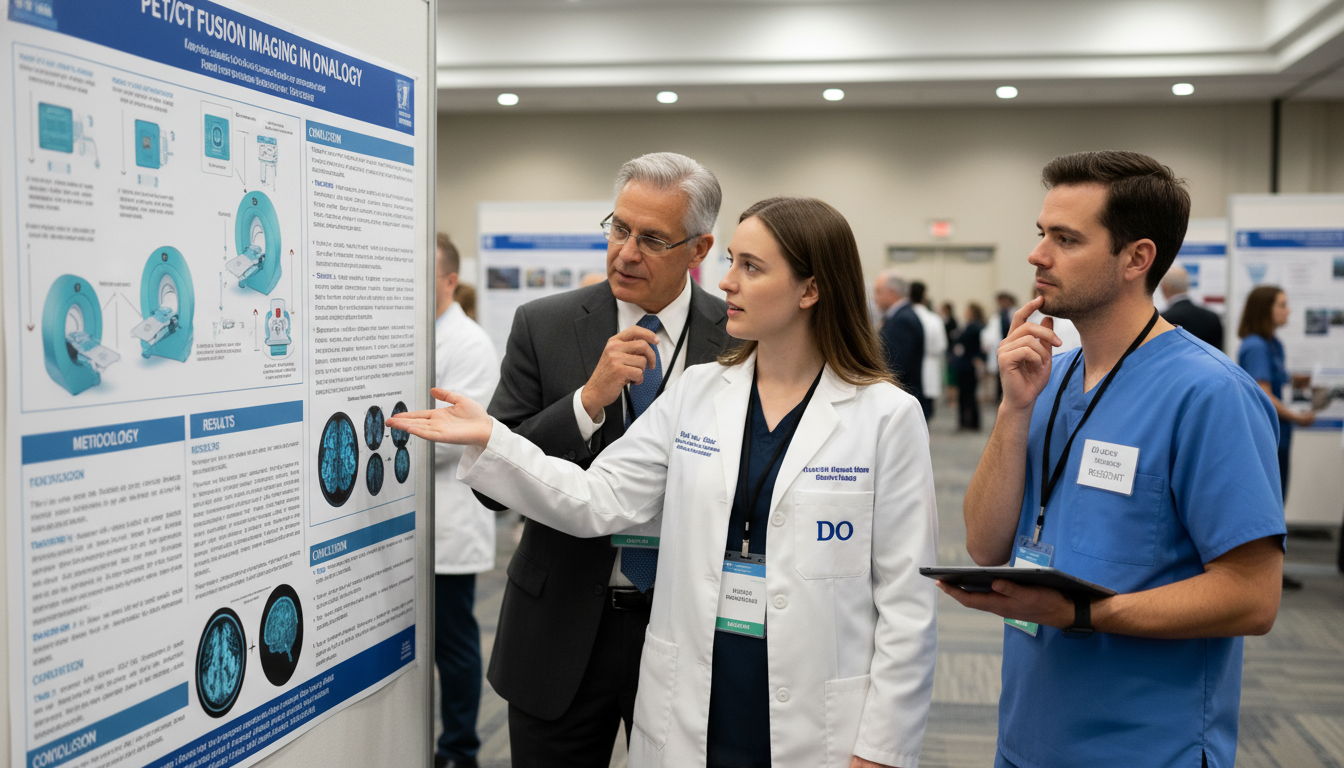
2. Abstracts and Posters
Pros:
- More accessible than full manuscripts.
- Perfect for nuclear medicine match applications—shows active engagement and often leads to networking.
Cons:
- May not always turn into manuscripts without sustained effort.
Action steps:
- Aim to submit to SNMMI, RSNA, or relevant subspecialty conferences (e.g., ASCO, ASTRO if theranostics-focused).
- For each project you join, ask early: “Is there a plan to submit an abstract to a meeting?”
- Volunteer to prepare the abstract draft and poster layout.
Even 2–3 conference presentations can significantly strengthen your application.
3. Original Research Articles
Pros:
- Highest impact on your CV and credibility.
- Strong differentiator for nuclear medicine residency, especially academic programs.
Cons:
- Time-consuming; may take 6–18 months from idea to acceptance.
Action steps:
Start with retrospective chart or imaging studies, which are feasible for DO graduates:
- Compare outcomes before and after implementing a new PET/CT protocol.
- Investigate the diagnostic yield of bone scans versus FDG PET in specific cancer subtypes.
Ensure solid methodology:
- Work with a biostatistician early.
- Use standardized definitions and inclusion criteria.
Plan for manuscript writing from the beginning:
- Keep a shared document of key findings, tables, and figures.
- Break writing into manageable sections (methods, results, discussion).
Even one good first- or co-first-author original paper with nuclear medicine relevance is a substantial asset.
4. Reviews, Book Chapters, and Educational Content
Pros:
- Great way to demonstrate depth of knowledge.
- Particularly helpful if you lack access to large patient datasets.
Cons:
- Often by invitation; may require backing from a mentor.
- Time-intensive and sometimes slower to publish than case reports.
Action steps:
- Ask mentors if any review projects are ongoing or if there are educational manuscripts in progress (e.g., “Approach to indeterminate pulmonary nodules on PET/CT”).
- Offer to handle literature searches, figure preparation, or drafting sections.
Presenting Your Research Effectively in the Application and Match
Your research profile must be clear and compelling in ERAS, on your CV, and during interviews.
Organizing Research in Your Application
Prioritize relevance to nuclear medicine:
- List nuclear medicine, radiology, oncology, and QI projects first.
- Group unrelated projects (e.g., basic science from early years) lower down unless very high impact.
Accurately categorize each item:
- Published/accepted manuscripts
- Articles under review
- Submitted abstracts and conference presentations
- Institutional or ongoing projects
Avoid exaggeration:
- Do not claim “in preparation” for ideas that have not been started.
- Be honest about your level of involvement.
For each major project, be able to clearly explain:
- Research question and why it matters in nuclear medicine
- Study design and key methods
- Main findings and limitations
- How it might influence practice or future research
Framing Your Role as a DO Graduate
Programs may ask specifically about your experience as a DO conducting research. Prepare to address:
- What barriers you faced (e.g., fewer built-in resources)
- How you overcame them (initiative, collaboration, self-education in statistics)
- How this experience prepared you for nuclear medicine residency (resilience, adaptability, narrative-based osteopathic training integrated with evidence-based imaging)
Use this to your advantage: many PDs respect applicants who create opportunities rather than waiting for them.
Interview Scenarios and How to Respond
Common nuclear medicine interview questions related to research:
“Tell me about your most significant research project.”
- Briefly (60–90 seconds) describe the clinical problem, study design, key result, and your specific role.
“How do you see research fitting into your future career as a nuclear medicine physician?”
- Even if you plan a primarily clinical career, outline how you want to:
- Contribute to protocol optimization or QI
- Participate in theranostic trials or registry studies
- Mentor future students and residents
- Even if you plan a primarily clinical career, outline how you want to:
“What challenges did you face in your research and how did you address them?”
- Highlight problem-solving (IRB delays, data issues, statistical challenges) and teamwork.
Your goal is not to sound like a full-time scientist, but like a thoughtful clinician who understands and values research as part of modern nuclear medicine practice.
Practical Timeline and Action Plan for DO Graduates
If You Are 18–24 Months Before Applying
- Identify nuclear medicine–interested mentors in radiology/oncology.
- Join at least one active project and one QI or educational initiative.
- Begin learning basic statistics (e.g., online courses, institutional workshops).
If You Are 12 Months Before Applying
- Push ongoing projects toward abstract submission and manuscript drafting.
- Submit at least one abstract to SNMMI or another major meeting.
- Consider a nuclear medicine away rotation at a research-oriented center.
- Ensure your CV accurately reflects ongoing and completed work.
If You Are 6 Months Before Applying
- Finalize abstracts and posters; aim for at least one accepted presentation.
- Submit any near-complete manuscripts for publication—being “under review” still counts.
- Request letters of recommendation from research mentors who know your work well.
- Prepare polished summaries of each project for interview discussions.
If You Are Close to ERAS Submission With Minimal Research
Even if you feel late, you can still improve your profile:
- Focus on short-term wins:
- Case reports with nuclear medicine relevance
- Local QI initiatives with rapid implementation and preliminary results
- Emphasize in your personal statement and interviews:
- Why you want nuclear medicine specifically
- How your osteopathic perspective complements imaging-centered care
- Your concrete plans to engage in research during residency
Programs know that not all DO graduates have equal access to research; what they look for is trajectory and seriousness.
FAQs: Research Profile Building for DO Graduates in Nuclear Medicine
1. As a DO graduate, can I realistically match into nuclear medicine without publications?
Yes, it is still possible, especially in programs that emphasize clinical training over research. However, having at least one or two nuclear medicine or imaging-related scholarly items (a case report, poster, or QI project) will markedly strengthen your chances and broaden the range of programs likely to interview you. If you have no research at all, you must strongly highlight other strengths: board scores, strong letters, and clear specialty commitment.
2. How many publications are needed to be competitive for the nuclear medicine match?
There is no fixed number, but aiming for 2–4 meaningful scholarly outputs by the time you apply is a realistic and competitive target for most programs. These do not all need to be full original research papers; a combination of case reports, abstracts, posters, QI projects, and one solid manuscript (published or under review) can be very powerful, especially when clearly tied to nuclear medicine.
3. I don’t have a nuclear medicine department at my DO school. What should I do?
Look for related mentors in radiology, oncology, cardiology, neurology, or radiation oncology—any field where imaging is central. Seek projects involving PET/CT, SPECT, or theranostics, even if labeled as “oncology” or “cardiology” research. Consider away rotations or virtual collaborations at larger centers with nuclear medicine divisions, and use national societies (like SNMMI) to identify mentors willing to work with external DO graduates.
4. Does basic science or bench research help my nuclear medicine application?
Yes, especially if it relates to imaging, radiopharmaceuticals, or cancer biology. However, clinical and imaging-based projects generally translate more directly to nuclear medicine practice. If your existing basic science work is in a different area (e.g., immunology, microbiology), still include it—it proves you can think scientifically and complete projects—but try to add at least one clinically relevant, imaging-focused project before applying.
A carefully planned, honest, and focused research profile can transform your application as a DO graduate, helping you stand out in the nuclear medicine residency match. By targeting feasible projects, aligning your work with the specialty’s needs, and clearly articulating your contributions, you can present yourself as a motivated, evidence-minded future nuclear medicine physician—regardless of where you started.