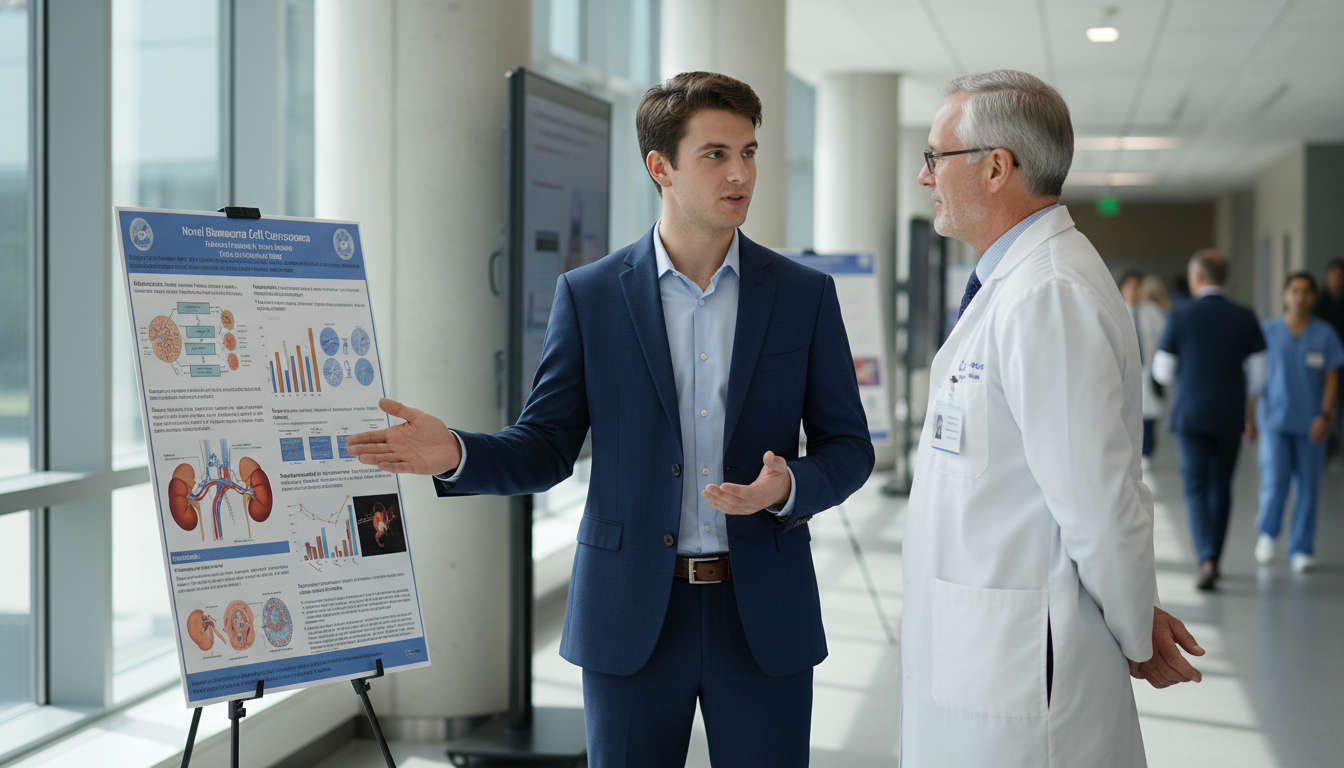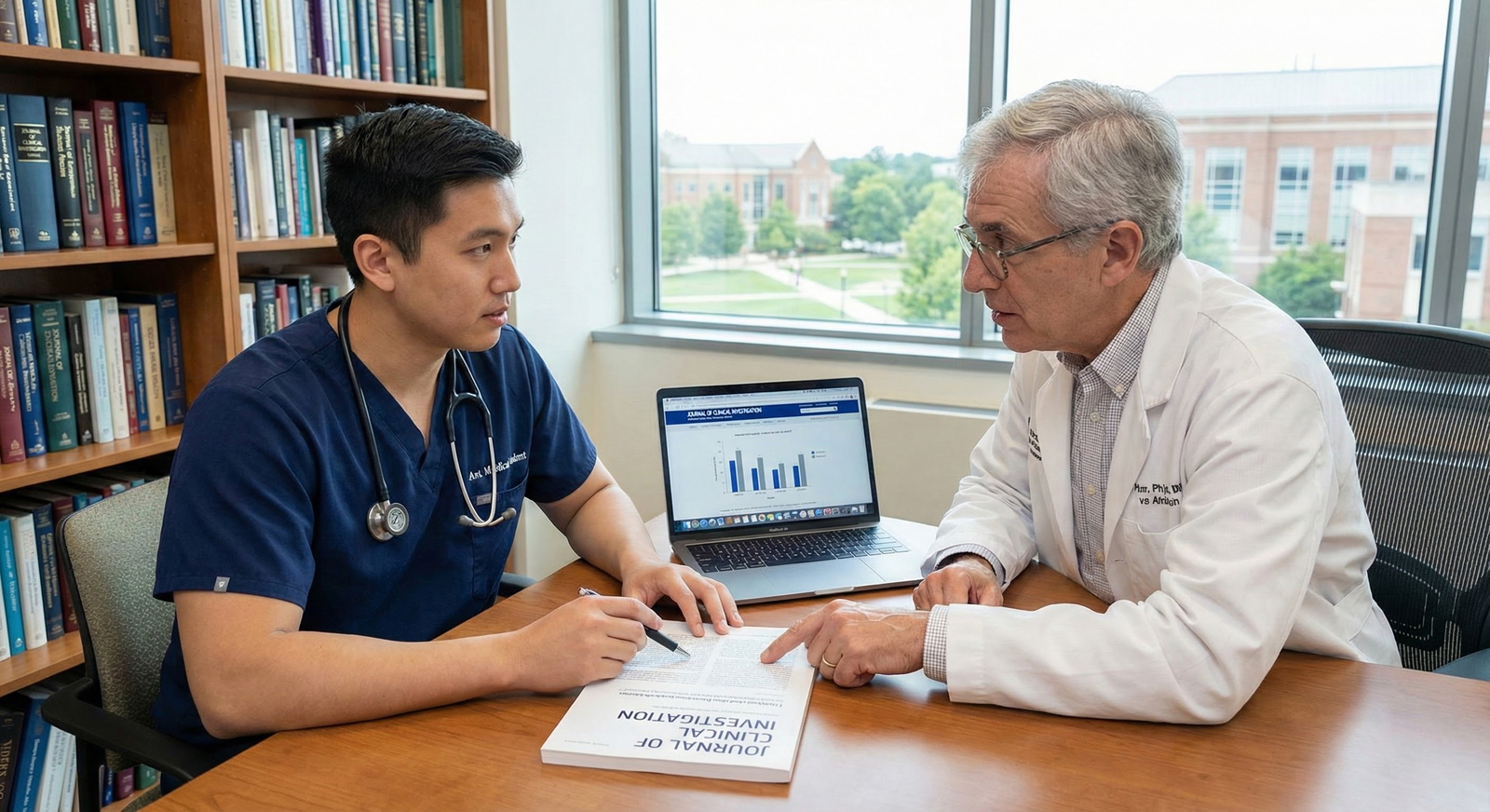
Why Research Matters in Vascular Surgery Residency Applications
Vascular surgery is among the most research-driven surgical specialties. As endovascular technology, imaging, and device innovation rapidly evolve, training programs look for applicants who can interpret evidence, contribute to the literature, and adapt to new data. Your research profile is one of the clearest signals that you can do this.
For both integrated vascular program applicants and those applying via the independent pathway after general surgery, research is more than a “nice to have”:
- It differentiates you in a relatively small but competitive applicant pool.
- It demonstrates persistence, curiosity, and the ability to finish complex projects.
- It builds technical skills in study design, statistics, and critical appraisal.
- It connects you with mentors and future advocates who can write strong letters.
- It shows commitment to vascular surgery as a career, especially if your work is specialty-focused.
Program directors often review your research for residency just as carefully as your scores and clinical grades. Strong projects and well-crafted explanations of your work in your application and interviews can substantially influence how you are ranked.
How competitive is research in vascular surgery?
The exact numbers change year to year, but typical patterns include:
- Many matched applicants to vascular surgery residency (integrated) have:
- Multiple abstracts, presentations, or manuscripts.
- At least 1–3 vascular-focused scholarly activities.
- Top-tier programs often see applicants with:
- Several publications for match, including first-author papers.
- Evidence of longitudinal research involvement, sometimes including a dedicated research year.
You do not need a PhD or a dozen randomized trials, but you do need a coherent, credible research story: how you got involved, what you actually did, what you learned, and how it shaped your interest in vascular surgery.
Understanding Expectations: How Many Publications Do You Really Need?
One of the most common questions is: “How many publications needed for vascular surgery residency?” The honest answer: there is no universal cutoff. Programs look at your research profile in context—with an emphasis on quality, relevance, and trajectory.
Interpreting “how many publications needed”
Think of your research profile as a blend of four components:
- Quantity – Total number of publications, abstracts, and presentations.
- Quality – Impact of the work: peer-reviewed journals, national meetings, rigorous methods.
- Relevance – Connection to vascular surgery or related fields (cardiovascular, imaging, devices).
- Role – Your level of involvement: first/second author, data analysis, writing, presenting.
For integrated vascular surgery residency applicants (medical students)
A reasonable target range:
- Solid, competitive profile (most programs):
- 2–5 total scholarly products (can include papers, posters, oral presentations).
- At least 1–2 vascular or cardiovascular-focused projects.
- More research-heavy profile (for research-strong or “top tier” programs):
- 4–10+ scholarly products, with some peer-reviewed publications.
- Clear, longitudinal involvement with one or more vascular research groups.
- At least 1 first-author or co-first-author publication or oral presentation.
For independent vascular surgery applicants (after general surgery)
Expectations are generally higher:
- Multiple vascular-related projects, ideally with published manuscripts.
- Clear productivity during residency (e.g., QI projects, multi-institutional studies, database analyses).
- Evidence that you can balance clinical duties with research and still finish projects.
When “fewer but deeper” beats “more but superficial”
Programs often prefer:
- 2–3 substantial, completed projects with clear impact and your strong contribution
over - 10+ superficial listings where you cannot articulate your role or the project’s significance.
If you must choose, prioritize:
- Depth: stay with a project from conception to final product.
- Ownership: push at least one project where you are central to design, analysis, or writing.
- Relevance: pick topics that fit vascular surgery themes (PAD, aneurysms, carotid disease, venous thromboembolism, limb salvage, aortic dissection, endovascular techniques).
Types of Research That Count for Vascular Surgery
Research in vascular surgery is diverse. You do not need to do basic science if that’s not your strength; clinical research, quality improvement, and education projects can be just as valuable if executed well.

1. Clinical research: the backbone of most vascular portfolios
Most students and residents build their research profile around clinical vascular projects:
Retrospective chart reviews
Example: Reviewing 10 years of institutional data to compare limb salvage rates after open vs endovascular revascularization in critical limb ischemia.Prospective observational studies
Example: Following a cohort of patients undergoing carotid stenting vs endarterectomy and tracking perioperative outcomes.Database studies
Example: Using VQI (Vascular Quality Initiative) or NSQIP to analyze outcomes after TEVAR vs open repair of thoracic aneurysms.
These can be turned into:
- Abstracts and posters at regional or national vascular meetings.
- Manuscripts in specialty journals (e.g., Journal of Vascular Surgery).
Actionable tip: Ask potential mentors what data is already collected and where quick, achievable projects exist. Many divisions have prospective registries waiting to be analyzed.
2. Basic and translational vascular science
Ideal if you are at a research-heavy institution or considering an academic career:
- Animal models of aneurysm or arterial injury.
- Vascular graft and stent development.
- Mechanisms of atherosclerosis, neointimal hyperplasia, or thrombosis.
These projects often take longer and are more complex but can produce high-impact publications. Make sure you:
- Clarify time commitment and realistic timelines early.
- Pair basic science with at least one clinical or outcomes project so you have short- and long-term outputs.
3. Outcomes, health services, and disparities research
Increasingly important in vascular surgery:
- Evaluating access to limb salvage in underserved populations.
- Studying amputation rates by region, insurance status, or race/ethnicity.
- Analyzing cost-effectiveness of different vascular interventions.
These projects appeal to programs interested in health policy, value-based care, and equity. They also lend themselves to impactful conference presentations and policy briefs.
4. Quality improvement and implementation projects
Vascular patients are high-risk and benefit from strong systems of care. QI projects may include:
- Reducing contrast-induced nephropathy in endovascular procedures.
- Improving postoperative anticoagulation adherence after bypass.
- Standardizing carotid stenosis workup to reduce delays to intervention.
Well-designed QI projects can:
- Show up in your application as both research and leadership.
- Lead to institutional changes and internal awards.
- Sometimes be written as a brief report or “innovation” paper.
5. Education, simulation, and curriculum development
If you enjoy teaching or simulation:
- Creating a simulation curriculum for endovascular wire and catheter skills.
- Assessing the impact of an ultrasound-guided access workshop for students or residents.
- Developing digital modules for PAD screening in primary care.
These projects show creativity and a commitment to training the next generation—qualities academic programs value highly.
Step-by-Step Strategy to Build a Strong Research Profile
Think of building your research profile as a multi-year process. Whether you are a pre-clinical student, clinical student, or general surgery resident, the framework is similar.

Step 1: Clarify your time horizon and goals
Ask yourself:
- When am I applying? (MS4 for integrated, PGY-4/5 for independent?)
- How much time per week can I realistically commit?
- Am I aiming for:
- A strong but balanced application for a range of programs, or
- A research-intensive profile for top academic centers?
Your answers will guide:
- Whether to aim for multiple smaller projects or fewer in-depth ones.
- Whether a dedicated research year makes sense.
Step 2: Identify vascular-focused mentors and research groups
Mentorship is critical. Strong vascular mentors can:
- Help you choose feasible, relevant projects.
- Introduce you to statisticians, collaborators, and conference networks.
- Write powerful letters emphasizing your research potential.
Practical approaches:
- Attend vascular surgery conferences, morbidity and mortality (M&M), or journal clubs.
- Email faculty whose work interests you with a focused message:
- 2–3 sentences on your background.
- 1–2 sentences on your interests in vascular surgery.
- Explicit offer of time and effort (e.g., “I can commit ~5–8 hours/week”).
- Ask to meet to discuss ongoing project needs.
- Ask residents/fellows: “Who consistently gets projects to publication?” and “Who is a good mentor for students/residents?”
Step 3: Choose projects strategically
Early on, prioritize projects that are:
- Feasible within your timeline (6–18 months).
- Supported by existing data or infrastructure.
- Aligned with a mentor who has a track record of publishing with trainees.
Good “starter project” ideas:
- Retrospective review from an existing database.
- Secondary analysis of a previously collected cohort.
- Well-defined QI project with clear metrics.
As you gain experience, you can add:
- Larger database studies (VQI, NSQIP, Medicare data—often needing biostatistical support).
- Prospective or multi-center projects.
- More complex manuscripts, systematic reviews, or meta-analyses.
Step 4: Learn basic methods and statistics early
You don’t need to be a statistician, but you must understand:
- Study designs (cohort, case-control, RCT, cross-sectional).
- Basic statistics (p-values, confidence intervals, regression, survival analysis).
- Bias, confounding, and limitations of retrospective work.
Action steps:
- Take advantage of institutional short courses or workshops.
- Ask your mentor for recommended introductory texts or online resources.
- Volunteer to help with data cleaning and basic analysis to learn by doing.
Being able to explain your methods clearly in interviews is essential. Program directors listen for whether you truly understand your own projects.
Step 5: Drive projects to completion
Many students help start projects that never reach publication. Your goal is to become someone who finishes.
Practical tactics:
- At project outset, define:
- Concrete deliverables (abstract, manuscript, presentation).
- A realistic timeline with checkpoints (e.g., “data collection done by X date”).
- Schedule regular check-ins (e.g., monthly meetings) with your mentor.
- Ask, explicitly: “What would it take for this to become a publishable manuscript?”
- Volunteer for the tasks that move a project from “analysis done” to “paper submitted,” such as:
- Writing the introduction and methods.
- Creating tables and figures.
- Responding to reviewer comments.
Step 6: Aim for layered outputs from each project
From one solid project, you can often generate multiple outputs:
- Abstract → poster presentation → national meeting.
- Oral presentation → institutional research day.
- Full manuscript → journal publication.
- Spin-off questions → follow-up analyses.
This approach helps you grow your publications for match count without diluting quality or overextending yourself with entirely new topics.
Presenting Your Research Effectively in the Application and Interview
Doing the research is only half the battle. The other half is articulating your work convincingly to vascular surgery programs.
On ERAS and your CV
When listing your research:
- Be honest and specific about your role:
- “Data collection and first draft of manuscript” is better than vague “involved in project.”
- Accurately label status:
- “Published,” “In press,” “Accepted,” “Under review,” or “In preparation.”
- Avoid inflating “in preparation” items; limit these to works with:
- Completed analyses.
- Active manuscript drafting with mentor involvement.
For integrated vascular program applications, highlight:
- Vascular-related projects in the top positions on your list.
- Any first-author or oral presentations.
- Awards from surgery or vascular conferences.
In your personal statement
Use your research to:
- Illustrate how you discovered vascular surgery (e.g., working on limb salvage or aneurysm research).
- Highlight your growth: what skills you learned, how you faced challenges, how you improved.
- Connect research themes to your envisioned career path (academic vascular surgeon, outcomes researcher, innovator in endovascular techniques, etc.).
Keep it narrative, not a second CV.
During interviews
Be prepared for questions like:
- “Tell me about your most significant research project.”
- “What was your specific role in this work?”
- “What challenges did you face, and how did you address them?”
- “What did you learn from this project that will make you a better vascular surgeon?”
To answer well:
- Practice a 2–3 minute explanation of your primary project:
- Clinical problem and why it matters.
- Study design and key methods in plain language.
- Main findings and limitations.
- Impact and next steps.
- Avoid memorizing jargon; speak as if explaining to a smart colleague outside your field.
Remember: they are not only evaluating the project—but your integrity, clarity of thought, and enthusiasm for inquiry.
Special Considerations: Research Years, Away Rotations, and Late Starters
Should you take a dedicated research year?
A research year can be beneficial if:
- You discovered vascular surgery or research later and need time to build a credible portfolio.
- You are aiming for highly academic programs or dual-training pathways.
- You want to explore a future in NIH-funded research, outcomes research, or device development.
Pros:
- Time to complete multiple projects and achieve peer-reviewed publications.
- Deeper relationships with vascular faculty and research groups.
- Greater clarity about your long-term academic interests.
Cons:
- Extra year of training and living costs.
- Not always necessary for applicants to community- or clinically-focused programs.
If you take a research year:
- Choose a mentor or group with a track record of trainee success.
- Aim for at least 2–3 meaningful vascular projects that will reach submission before you apply.
Using sub-internships and away rotations strategically
Away rotations at vascular programs are not just for clinical impressions:
- Ask about active research projects and whether short, well-defined roles are possible.
- Join ongoing QI, retrospective, or educational studies that can be continued remotely after the rotation.
- Ensure expectations are realistic; you may not complete a full project in 4 weeks, but you can start something substantive.
If you’re starting late
If you’re late in building your research for residency:
- Prioritize smaller, focused projects with clear endpoints.
- Consider:
- Case reports or small case series of interesting vascular pathologies.
- Brief retrospective studies with limited variables and narrow scopes.
- Joining an ongoing project where data is already collected.
Even 1–2 well-executed, vascular-related projects can make a difference if you can discuss them insightfully.
FAQs: Research Profile Building for Vascular Surgery Applicants
1. How many publications needed to be competitive for vascular surgery residency?
There is no strict number, but a realistic target for an integrated vascular program applicant is:
- 2–5 scholarly outputs, with at least 1–2 related to vascular or cardiovascular topics.
- A stronger, research-intensive profile might include 4–10+ outputs, including peer-reviewed manuscripts and national presentations.
Programs look most closely at relevance, quality, and your personal role rather than a simple count.
2. Do all my research projects need to be in vascular surgery?
No. It’s common to have early research in other fields (e.g., internal medicine, radiology, basic science). However:
- Try to develop at least a few clearly vascular-focused projects—they signal genuine specialty interest.
- When discussing non-vascular research, connect transferable skills (study design, data analysis, writing) to how they will help you as a vascular surgeon.
3. Is it okay to list projects that are “in progress” on my application?
Yes, but with caution:
- Only list “in preparation” if:
- Data collection and analysis are substantially complete.
- A manuscript draft is actively being worked on with your mentor.
- Clearly label the status (e.g., “Manuscript in preparation,” “Submitted to Journal X”).
- Be ready to explain details and your role; avoid listing vague or speculative future ideas.
4. I’m not at a big research institution. Can I still build a strong research profile?
Yes. Many successful applicants come from community or less research-intensive schools. Strategies include:
- Partnering with motivated vascular surgeons who may have clinical questions but limited time.
- Focusing on practical clinical, QI, or education projects that are feasible with smaller datasets.
- Collaborating virtually with researchers at other institutions.
- Attending regional vascular meetings and joining multi-center or trainee-led research collaboratives.
Your goal is not to replicate the output of a major research powerhouse, but to demonstrate curiosity, initiative, and follow-through within your setting.
By approaching research as a multi-year, strategic process—rather than a last-minute checkbox—you can build a vascular surgery–focused profile that is authentic, productive, and compelling to program directors. Your research experience should not only improve your application but also shape you into a thoughtful, evidence-driven surgeon ready to advance the field.