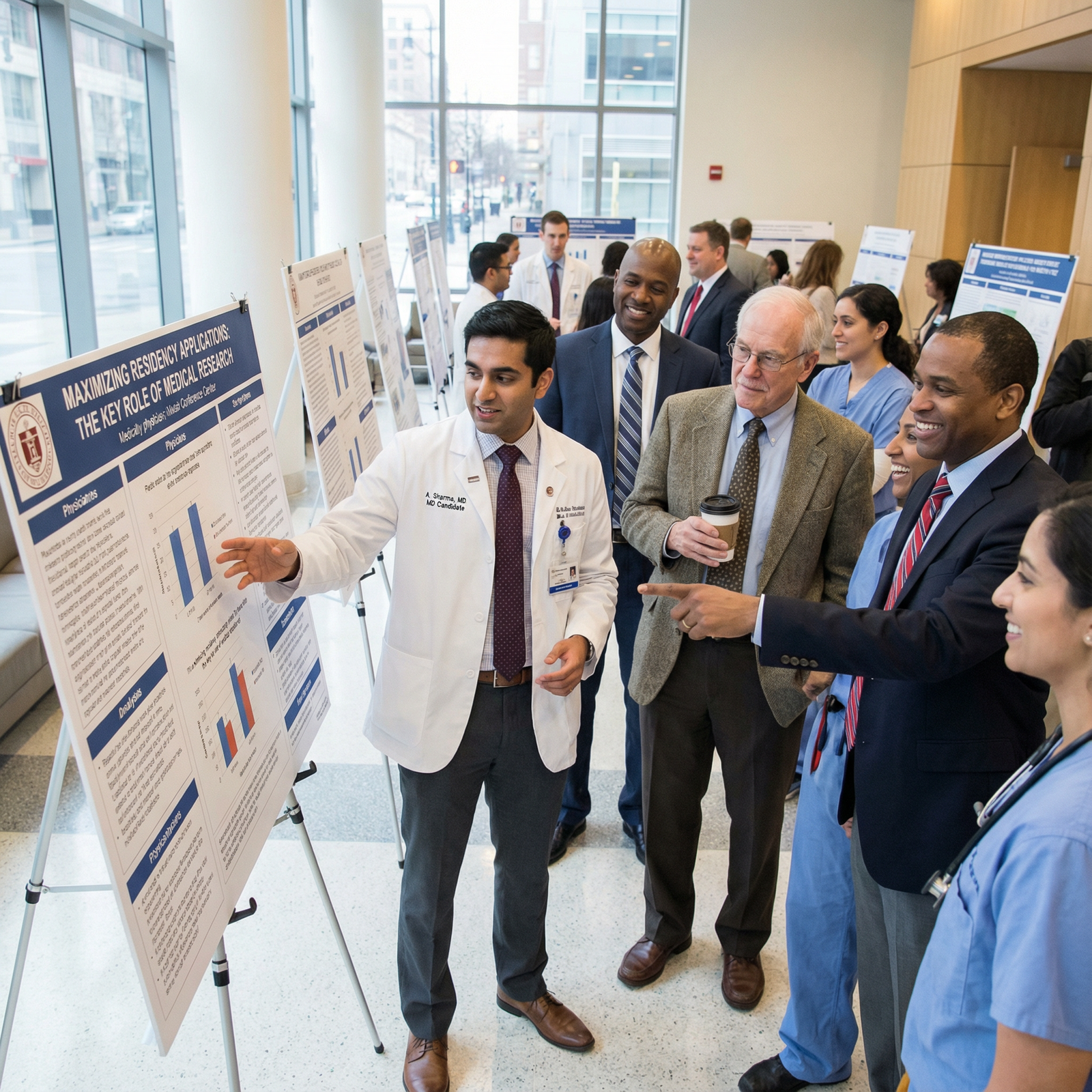
Introduction: How Research Shapes Your Residency Application
When residency application season approaches, almost every medical student asks the same question: “What will actually make my application stand out?” Beyond strong grades, solid board scores, and meaningful clinical skills, Research Experience has become a key differentiator—especially in competitive specialties and academic programs.
Medical Research is no longer just “nice to have” on residency applications. For many programs, it is one of the clearest signals of your initiative, intellectual curiosity, and long-term potential as a clinician and scholar. Even if you do not plan an academic career, research can open doors, strengthen your network, and deepen your understanding of evidence-based practice.
This article breaks down:
- Why research matters for Residency Applications
- Which types of research experience are most beneficial
- How research enhances your clinical skills and career trajectory
- Concrete strategies to highlight your research in ERAS, your CV, personal statement, and interviews
- Practical tips for getting started, even with limited time
- Frequently asked questions that applicants commonly face
By the end, you’ll not only understand how research is evaluated by programs—you’ll know how to leverage your own research experience to present a compelling, cohesive application.
Why Research Matters in Residency Applications
A Powerful Differentiator in a Crowded Field
Residency programs routinely review hundreds—sometimes thousands—of applications from students who all have:
- Strong grades
- Passing or high board scores
- Good clinical evaluations
- Some volunteer and leadership experience
In this environment, research helps you stand out because it demonstrates qualities that are harder to show through grades alone:
Analytical and critical thinking:
Designing a study, analyzing data, and interpreting results all require you to think beyond memorization. Programs see research experience as evidence that you can:- Approach complex clinical problems systematically
- Critically appraise literature
- Integrate data into patient care decisions
Intellectual curiosity and passion for inquiry:
Choosing to participate in Medical Research suggests that you:- Care about why things work the way they do
- Are interested in improving care, not just delivering it
- Are willing to wrestle with uncertainty and incomplete evidence
This mindset is highly valued, particularly in academic centers and research-oriented programs.
Persistence and resilience:
Research often moves slowly. Projects stall, IRB approvals delay timelines, manuscripts need multiple revisions. Successfully seeing a project through shows:- Long-term commitment
- Ability to manage setbacks
- Follow-through—an essential trait in residency
How Program Directors View Research Experience
Different specialties and programs weigh research differently:
Highly competitive, academic, or tertiary-care specialties
(e.g., Dermatology, Radiation Oncology, Plastic Surgery, Neurosurgery, ENT, some Internal Medicine subspecialty-leaning tracks)- Often expect or strongly prefer research experience
- May place value on first-author publications, conference presentations, and specialty-specific projects
- Use research as a marker of suitability for academic or subspecialty careers
Moderately competitive or community-focused specialties
(e.g., Family Medicine, Psychiatry, Pediatrics, many community Internal Medicine programs)- Typically do not require research, but see it as a strong plus
- May especially value Quality Improvement (QI), clinical outcomes, or public health projects that directly relate to patient care
Importantly, it’s not only about the number of publications. Program directors often care more about:
- The depth of your involvement
- Your ability to explain the project and your role
- The skills and insights you gained
- How well the research aligns with your story and specialty choice
Research as a Tool to Build Clinical Skills and Professional Identity
Strengthening Clinical Reasoning and Evidence-Based Practice
Research is not just about labs or data—it can sharpen your clinical skills in meaningful ways:
Improved literature appraisal:
When you’ve been involved in study design and data analysis, you better understand:- What makes a trial strong or weak
- How to interpret p-values, confidence intervals, and bias
- Why some findings apply to your patient and others don’t
Better diagnostic and therapeutic reasoning:
Research often requires:- Identifying gaps in knowledge or care
- Formulating hypotheses
- Deciding which variables matter most
This mirrors clinical reasoning, where you must prioritize differential diagnoses and management options based on limited information.
Comfort with guidelines and evolving evidence:
Engaging in research makes it more natural to:- Question guidelines when new data emerge
- Incorporate new therapies based on trial results
- Adapt to practice changes during your career
Programs know that physicians who understand research are better equipped to provide evidence-based, up-to-date care.
Translating Research into Improved Bedside Care
Even if your project is not directly clinical, the skills translate:
Communication with patients:
Explaining a study to participants or lay audiences can make you better at:- Simplifying complex medical information
- Obtaining informed consent
- Discussing risks, benefits, and uncertainty
Teamwork and interdisciplinary collaboration:
Research often includes:- Physicians, statisticians, nurses, coordinators, and sometimes community partners
- Learning to communicate across disciplines
- Navigating team dynamics and shared goals
These are the same skills you will use daily in multidisciplinary care teams during residency.
Networking in Medicine and Career-Building
Research offers some of the richest networking opportunities in medicine:
Mentorship:
By working closely with attending physicians or physician-scientists, you gain:- Insight into career paths and subspecialty choices
- Honest feedback on your strengths and areas to improve
- Potential long-term sponsors who can advocate for you
Letters of Recommendation (LORs):
A research mentor who has watched you over months or years is often able to write:- Detailed, specific letters about your work ethic and character
- Strong, personalized endorsements that stand out to residency selection committees
Conference exposure:
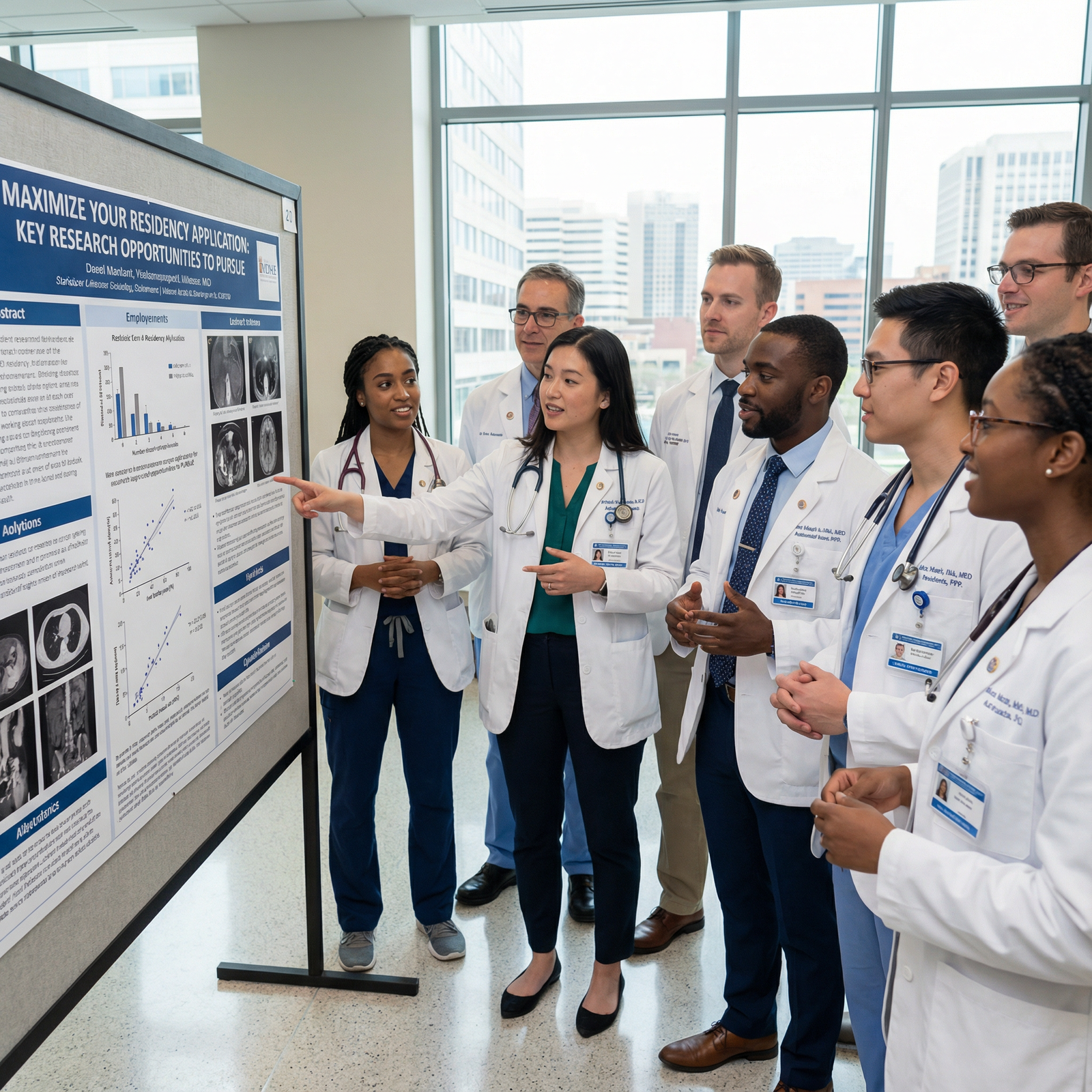
Presenting posters or talks at regional or national meetings allows you to:- Meet residents and faculty from programs you may apply to
- Ask about their training environments and research opportunities
- Be remembered by name and face when your application arrives
These relationships can be pivotal, particularly if you are aiming for research-heavy programs or academic career tracks.

Types of Research Experiences That Strengthen Residency Applications
You do not need to be a bench scientist or have an MD-PhD to benefit from research. Many forms of scholarly activity can significantly boost your application. The key is understanding what each type offers and how to align it with your goals.
1. Basic Science and Translational Research
What it is:
Lab-based studies that explore fundamental biological mechanisms (e.g., molecular pathways, genetics, pharmacology). Translational research bridges bench findings with clinical applications.
Benefits for residency applicants:
- Demonstrates intellectual rigor and comfort with complex scientific concepts
- Often leads to peer-reviewed publications if involvement is long enough
- Signals strong potential if you are considering a physician-scientist or academic career
Example:
You spend a year investigating a gene involved in cardiomyopathy, leading to a first-author paper. For an applicant targeting Internal Medicine with plans for Cardiology fellowship, this clearly aligns your interests and suggests potential for future translational work.
Tips for success:
- Expect a longer timeline; basic science projects often take months to years
- Clarify your role and expectations up front with your PI
- Ask early about opportunities for authorship, abstracts, or posters
2. Clinical Research
What it is:
Research involving patients or clinical data, such as:
- Clinical trials
- Observational studies
- Retrospective chart reviews
- Outcomes research
Why programs value it:
- Directly connected to patient care and clinical questions
- Often easier to discuss during interviews in the context of real-world practice
- Shows familiarity with informed consent, data collection, and human subjects protections
Example:
You help conduct a retrospective study on outcomes of heart failure patients admitted to your institution. You extract data from charts, collaborate on analysis, and present a poster at a national cardiology conference. This experience showcases clinical relevance, data skills, and initiative.
Clinical research is especially compelling if it matches your intended specialty (e.g., oncology research for Internal Medicine, surgical outcomes research for General Surgery).
3. Public Health and Population Health Research
What it is:
Research examining health trends and outcomes at the population level, including:
- Epidemiology
- Health disparities
- Health policy
- Community-based participatory research
Why it’s valuable:
- Demonstrates awareness of social determinants of health
- Aligns with the growing emphasis on population health and preventive care
- Particularly appealing to programs in Primary Care, Pediatrics, Family Medicine, Psychiatry, and any setting focused on community engagement
Example:
You evaluate the impact of a community outreach program on hypertension screening rates in underserved neighborhoods and present your findings to local health leadership. This highlights your commitment to health equity and systems-level thinking.
4. Case Reports, Case Series, and Quality Improvement (QI)
These are sometimes underestimated but can be high-yield and achievable, especially with time constraints.
Case Reports and Case Series
- Focus on unique, rare, or educational patient cases
- Help develop skills in:
- Literature review
- Clinical reasoning
- Scholarly writing
Example:
You encounter a rare presentation of an autoimmune disease during your rotation, collaborate with your attending to write a case report, and present it at a regional conference. For many students, this is a first, accessible step into scholarly activity.
Quality Improvement (QI) Projects
- Aim to improve processes, safety, or outcomes in healthcare systems
- May involve:
- Reducing ED wait times
- Improving vaccine administration rates
- Decreasing hospital-acquired infections
Why QI is highly valued:
- Direct impact on patient care and hospital operations
- Demonstrates that you:
- Identify problems
- Implement change
- Measure outcomes
Example:
You join a QI team to reduce medication errors on an inpatient ward by standardizing handoff protocols. The project decreases errors by 25% over six months. This experience is extremely relevant to all residency programs because QI is built into modern training.
5. Educational, Simulation, and Curriculum Research
Less commonly discussed, but very relevant if you’re interested in Medical Education:
- Designing and studying new curricula, simulations, or teaching interventions
- Evaluating learner performance or competency-based assessments
For students interested in roles as future program directors or educators, this type of research is a strong signal of future contributions.
How to Strategically Integrate Research into Your Residency Application
Building a Compelling Research Narrative
Your goal is not just to list research—it is to tell a coherent story:
In your personal statement, consider:
- How did you first become interested in research?
- What questions were you trying to answer?
- What skills did you gain (e.g., critical appraisal, teamwork, persistence)?
- How did these experiences influence your specialty choice or career vision?
Keep the focus on:
- Your growth and reflection
- How your research experience will make you a better resident and physician
Avoid overly technical jargon; instead, emphasize why the question mattered and what you learned.
Presenting Research on Your CV and ERAS Application
Create a clear, organized “Research Experience” section:
- For each project, include:
- Project title and type (e.g., clinical trial, QI, basic science)
- Institution and dates
- Mentor(s)
- Your role and responsibilities (e.g., data collection, analysis, manuscript drafting)
- Outcomes: posters, presentations, publications, submitted manuscripts
Use active verbs like “designed,” “analyzed,” “co-authored,” “implemented,” rather than passive phrases like “exposed to” or “observed.”
For publications and presentations:
- Follow a standard citation format
- Distinguish clearly between:
- Published
- In press
- Under review
- Submitted
- In preparation (use this sparingly and only when close to submission)
Transparency builds trust; overinflating your role can backfire during interviews.
Maximizing Letters of Recommendation from Research Mentors
Letters from research mentors can be some of the strongest in your application, because they often:
- Know you over a longer time frame than clinical evaluators
- See you in:
- Problem-solving mode
- Leadership roles
- Collaborative settings
To secure effective LORs:
- Ask early—ideally several months before deadlines.
- Provide:
- Your CV
- Personal statement draft
- List of programs/specialties
- A brief summary of your contributions to the project
- Politely ask if they feel able to write you a strong and supportive letter.
- Keep them updated with your match progress—mentors can become important long-term advocates.
Preparing to Discuss Research During Residency Interviews
You should be able to confidently and clearly discuss any project listed on your CV. Interviewers commonly ask:
- “Tell me about your research.”
- “What was your role in this project?”
- “What did you learn from this experience?”
- “How might you want to continue research in residency?”
Prepare by:
Practicing a 2–3 minute summary for each major project:
- The clinical or scientific question
- Study design and methods (briefly)
- Your role
- Key findings (if available)
- How it influenced your perspective on medicine
Being honest about:
- Limitations or negative results
- Projects that did not lead to publication
Enthusiasm, clarity, and honesty matter more than having a long publication list.

Practical Tips for Gaining Research Experience as a Busy Medical Student
Finding Opportunities
Use your institution’s resources:
- Check departmental websites for faculty interests and recent publications
- Attend research seminars or grand rounds
- Ask senior students or residents who is supportive of student involvement
Cold email effectively:
- Keep messages concise
- Identify a specific paper or project of theirs you found interesting
- Briefly describe your background, interests, and available time
- Offer to help with specific tasks (chart review, data cleaning, literature review)
Balancing Research with Academics and Clinical Rotations
Be realistic about your bandwidth; overcommitting can harm:
- Your grades
- Your well-being
- The quality of your contributions
Start with:
- Smaller, well-defined roles (e.g., data entry, chart review)
- Projects with clear timelines and expectations
Consider:
- Dedicated research time (e.g., scholarly year, elective block) if your school allows
- Summer research between M1 and M2
When You Have “Minimal” or “No” Research
Not everyone will have extensive research, and that’s okay—especially in less research-focused specialties or community-based programs. You can still:
Highlight scholarly or analytic experiences such as:
- QI projects
- Community projects with outcome tracking
- Senior theses or capstones
- Educational projects with measurable impact
Emphasize:
- Critical thinking
- Initiative
- Interest in staying engaged with the medical literature
Programs understand that access to formal research varies between schools and regions. What matters is how you frame your experiences and your willingness to grow.
FAQ: Research and Residency Applications
1. Do I need research experience for every residency program?
No. Research is not mandatory for all residency programs, but it becomes increasingly important for:
- Highly competitive specialties
- Academic and university-based programs
- Applicants considering subspecialty fellowships or academic careers
Community-based or less research-intensive programs may prioritize strong clinical performance, professionalism, and fit over research experience. That said, any meaningful research can still enhance your application and strengthen your skills.
2. What type of research experience is most valuable for residency applications?
There is no single “best” type, but programs tend to value:
- Clinical research most consistently, due to its direct relevance to patient care
- Quality Improvement projects, because they show you can improve real-world systems
- Specialty-aligned research, which signals focused interest (e.g., orthopedic outcomes research for Orthopedics)
Basic science, public health, and educational research are also valuable, particularly when they:
- Demonstrate depth of involvement
- Lead to scholarly products (posters, presentations, publications)
- Connect logically to your specialty choice or long-term goals
3. How can I gain research experience if my time and resources are limited?
Consider:
Shorter, well-defined projects such as:
- Case reports
- Retrospective chart reviews
- Discrete portions of a larger QI project
Joining a project that is already underway, where:
- IRB approval exists
- Data collection has started
- You can help with analysis, writing, or presentation preparation
Use summers, lighter rotations, or elective time strategically. Communicate openly with mentors about your schedule so expectations stay realistic.
4. Can I list research on my CV if it’s not published or is still in progress?
Yes—with transparency. It is acceptable to list:
- Ongoing projects (clearly labeled as “in progress”)
- Manuscripts “submitted” or “under review”
- Posters and presentations at local, regional, or national meetings
Avoid overstating your accomplishments. Do not label something as “accepted” or “published” unless it truly is. Honesty is crucial; misrepresentation can be easily discovered and severely damage your credibility.
5. Will research help if I already know I want a clinically focused, non-academic career?
Yes. Even if you plan a primarily clinical career, research experience can benefit you by:
- Improving your ability to interpret new studies and guidelines
- Preparing you to participate in practice-based QI initiatives
- Boosting your competitiveness for residency and, later, fellowships
- Providing tools to lead or contribute to changes in your practice environment
You do not need to continue publishing throughout your career, but having done research once can shape you into a more thoughtful, evidence-based clinician.
Engaging in Medical Research is more than a checkbox on Residency Applications—it is an investment in your development as a critical thinker, collaborator, and future leader in medicine. Whether your experience is extensive or limited, framing it thoughtfully and authentically can significantly elevate your application and help you match into a program where you will thrive.