Understanding the Research Landscape for US Citizen IMGs in Global Health
For a US citizen IMG or American studying abroad, global health can be both an exciting passion and a strategic career path. But global health residencies and international medicine–focused programs are often highly competitive, and your research profile is one of the most important ways you can stand out.
Programs that offer a global health residency track or strong international health curriculum tend to value applicants who:
- Show sustained interest in global health (not a last-minute add-on)
- Understand basic research principles (even if you’re not planning a research career)
- Have some tangible output: posters, presentations, or publications for match
- Can contribute to ongoing projects once in residency
As a US citizen IMG, you face additional challenges:
- Limited access to home-institution mentors in the US
- Fewer structured research opportunities at some international schools
- Less familiarity with US-style academic expectations and timelines
The good news: you can build a strong, credible research profile from abroad with intentional planning. You don’t need dozens of randomized controlled trials or a first-author NEJM paper. You do need:
- A strategic plan
- A few well-chosen mentors
- Consistent, demonstrable output over time
This guide will walk you through how to do that specifically for global health–oriented residency applications.
What Programs Actually Want: Quality Over Quantity
One of the most common questions is: “How many publications are needed?” There’s no universal number. Program directors rarely screen applicants purely by a publication count. Instead, they look for:
1. Evidence of Academic Curiosity
Programs want residents who:
- Ask good questions
- Seek evidence to answer them
- Can interpret data critically
This doesn’t require a PhD; it requires participation and reflection.
2. Alignment With Global Health and International Medicine
For global health–oriented residencies, the content of your work matters:
- Work on health disparities, infectious diseases, refugee health, maternal-child health, non-communicable diseases in low-resource settings, etc.
- Projects addressing social determinants of health
- Research involving underserved populations, within or outside the US
Even if the setting isn’t strictly “international,” a clear global or equity lens is valuable.
3. Progression and Commitment Over Time
Programs look for a trajectory:
- Early medical school: basic involvement (data collection, assisting a senior student or faculty)
- Mid medical school: more ownership (poster, case report, abstract submission)
- Later years: more advanced roles (manuscript writing, leading a small project, presenting at conferences)
A single “summer of research” is less compelling than multi-year, evolving engagement.
4. Tangible Output
You don’t need 10 PubMed-indexed papers, but you do need something concrete to show:
- Peer-reviewed publications (original research, reviews, case reports)
- Conference posters or oral presentations
- Institutional presentations (student symposia, research days)
- Quality improvement (QI) projects with documented outcomes
Think of your research profile as a portfolio rather than a single line item.
How Many Publications Are Enough for Global Health–Focused Applicants?
The phrase “how many publications needed” is misleading on its own. For a US citizen IMG interested in global health:
- 1–2 peer-reviewed publications (even as middle author) + several posters/abstracts is solid.
- 3–5 total scholarly products (papers, posters, abstracts, conference presentations, QI projects) is often competitive for many IM/FM/peds programs with global health tracks.
- For especially research-heavy programs, or academic internal medicine programs, having 2–3 first- or co-first-author works can help, but this is not mandatory for all.
What matters at least as much as the count:
- Relevance to global or international medicine
- The role you played (did you actually contribute meaningfully?)
- Your ability to explain the project clearly in interviews and essays
If your school or setting makes formal publication difficult, posters and abstracts still count and can meaningfully strengthen your application.
Strategic Steps to Build a Global Health Research Profile as an IMG

Step 1: Clarify Your Global Health Niche
Programs are more impressed by coherent interest than by scattered unrelated projects. Think about:
- Geographic interests: Sub-Saharan Africa, Latin America, South Asia, refugee populations in Europe or the US
- Thematic interests: infectious diseases, maternal health, mental health, NCDs in LMICs, health systems strengthening, climate and health, migrant health
- Populations: refugees, urban poor, rural communities, Indigenous communities
Example:
You’re an American studying abroad in the Caribbean and interested in internal medicine with a global health focus. A coherent niche might be: non-communicable diseases in resource-limited settings or hypertension and diabetes care in underserved populations.
Use your niche to guide:
- Which mentors you seek
- Topics you choose for literature reviews or projects
- Conferences you target (global health, infectious disease, primary care, etc.)
Step 2: Secure Mentors in Both Your School and the US
As a US citizen IMG, your goal is dual mentorship:
Home Institution Mentors (Abroad)
- Start by identifying faculty with any research activity: look at their publications on PubMed, ResearchGate, or school website.
- Ask about:
- Ongoing projects you can join
- Simple tasks you can handle remotely (literature reviews, data entry, chart review, drafting methods sections)
- Emphasize your interest in global health to align their ideas with your goals.
US-Based Mentors
- Use connections:
- Undergraduate institution alumni in medicine
- Family or friends who work in hospitals or public health
- US-based attendings you meet on away rotations or observerships
- Reach out to:
- Departments with a global health residency track
- Global health centers (many academic medical centers have them)
- Approach with:
- A concise email
- A 1-page CV
- Clear, modest ask (e.g., “I’m looking to assist with data abstraction or literature reviews on global health–related projects.”)
- Use connections:
Mentor tip: You’re not asking for them to “make a project for you” but to plug into existing work and learn.
Step 3: Start With Achievable Project Types
You don’t need to jump into randomized trials. Early wins build confidence and your CV.
High-yield, accessible options for IMGs:
Case Reports and Case Series
- Identify interesting or unusual presentations in your clinical rotations.
- Emphasize global health angles:
- Imported infections
- Tropical diseases
- Diseases of poverty or neglected conditions
- Delayed presentations due to access issues
- Target journals that accept case reports or global health–focused case series.
Narrative Reviews and Mini-Reviews
- Topics like:
- “Hypertension management in low-resource primary care settings”
- “Global burden and management of rheumatic heart disease”
- “Barriers to diabetes care among refugee populations”
- Collaborate with a mentor who can guide structure and journal selection.
- Topics like:
Retrospective Chart Reviews
- Example: “Prevalence and outcomes of diabetic foot ulcers in [Hospital X] in [Country/Region].”
- Needs:
- Institutional permission and ethics review (IRB/ethics committee)
- Clear data collection form
- Basic statistical support (often accessible through your institution or collaborating US mentor)
Survey-Based Projects
- Topics: provider knowledge, attitudes toward global health, burnout in rural clinics, vaccination hesitancy.
- Use standardized, validated tools when possible; collaborate with a method-savvy mentor.
Quality Improvement (QI) with a Global Health Lens
- Example: Implementing a simple checklist to improve tuberculosis screening rates in a clinic.
- QI counts as “research-like” activity and can be presented locally or at conferences.
The best project is the one you can complete. A modest finished project > an ambitious unfinished one.
Step 4: Build a Realistic Research Timeline Around Your Curriculum
As an American studying abroad, your med school structure may differ from US schools. Map your schedule:
- Pre-clinical years: More flexible for literature reviews, data work, and basic research skills courses.
- Clinical years: Better for case reports, QI projects, and clinically anchored studies.
- USMLE prep periods: Avoid starting new intensive projects; maintain only light tasks.
Example timeline for a 4-year IMG program:
- Year 1–2:
- Join a senior student or faculty member’s ongoing project.
- Complete 1 poster and possibly co-author 1 review or case report.
- Year 3:
- Identify 1–2 clinical cases for case reports (global or underserved population angle).
- Submit to a conference or case-report journal.
- Year 4:
- Finalize at least one manuscript or abstract.
- Present locally or regionally.
- Use your work to support your personal statement and interview stories.
Align your efforts with US residency timelines: aim to have visible outputs by the time you submit ERAS, even if some projects are “in progress.”
Maximizing Impact: Turning Work Into Posters, Abstracts, and Publications
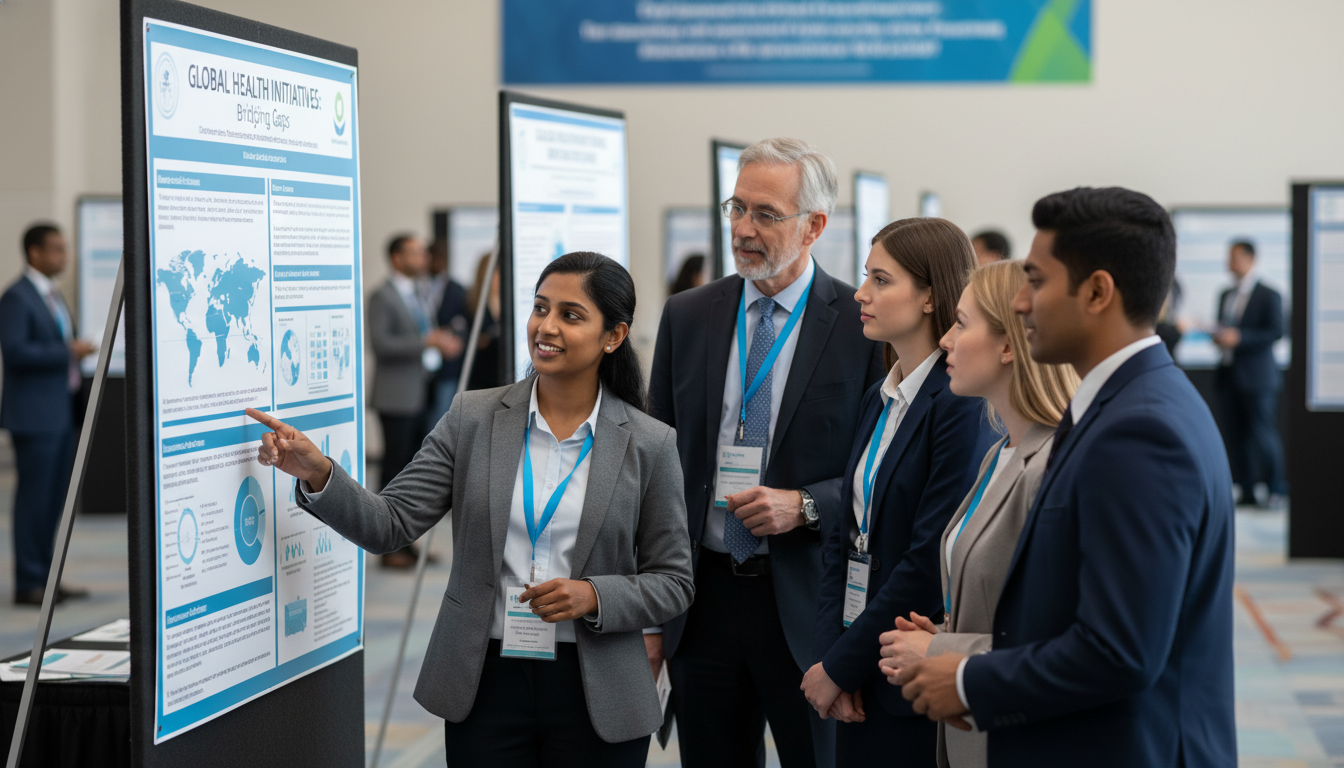
Where and How to Present Your Global Health Work
Your goal is to move each project along the scholarly pipeline:
Local and Institutional Venues
- Your school’s research day or global health day
- Hospital departmental meetings
- These are fantastic for early experience and CV building.
Regional and National Conferences Look for events focused on:
- Global health
- Internal medicine, family medicine, pediatrics with global tracks
- Infectious disease, public health, tropical medicine
Examples (subject to change; always verify current offerings):
- Consortium of Universities for Global Health (CUGH) annual meeting
- American Society of Tropical Medicine and Hygiene (ASTMH) conference
- American College of Physicians (ACP) or AAFP conferences with global health sessions
- International conferences in your medical school’s region
Abstract tips:
- Emphasize the global or equity angle in the title and background.
- Highlight implications for low-resource or underserved settings.
- If your project is small, be honest about its limitations but clear about its insights.
Choosing Journals for Global Health–Related Work
For global health and international medicine topics, consider:
- Journals specifically focused on global health (e.g., those centered on global public health, tropical medicine, or health equity)
- Specialty journals with global or underserved care sections
- Case-report–friendly journals for unique presentations
Look for:
- Reasonable acceptance rates
- Clear instructions for authors
- Indexing in known databases if possible (PubMed, Scopus)
Work closely with mentors on:
- Selecting target journals
- Responding to reviewer comments
- Avoiding predatory journals (those that charge high fees with minimal or no peer review)
Making Your Role Clear—And Credible
In your CV and ERAS:
- List all research experiences, even if not yet published, under “Research Experience.”
- For each item, specify:
- Your role (data collection, analysis, first author, co-author)
- Project type (retrospective chart review, QI, case report, etc.)
- Status (completed, in preparation, submitted, accepted)
In interviews, be transparent:
- Don’t exaggerate your role.
- Be ready to explain:
- The research question
- Methods in basic terms
- Main findings
- Limitations
- How this changed your view of global health or clinical care
Authentic, thoughtful discussion often impresses more than the raw number of publications.
Using Research to Strengthen Your Global Health Story
Your research portfolio is not separate from your personal narrative; it should reinforce it.
Integrating Research Into Your Personal Statement
For a global health–oriented residency:
Highlight how you became interested in global health:
- Family background
- Experiences living or training abroad
- Observations of health inequity or system limitations
Describe specific research experiences that:
- Deepened your understanding of global health challenges
- Taught you to interpret evidence in low-resource contexts
- Connected you with mentors or communities
Show trajectory:
- “I started with a small project on X, which led to a deeper involvement in Y…”
- Avoid listing every project; select 1–2 meaningful ones in detail.
Link to your future goals:
- Joining a global health residency track
- Continuing research on health disparities, implementation science, or international collaborations
Using Research Stories in Interviews
Common global health–related interview questions:
- “Tell me about a research project you worked on and what you learned.”
- “How have your global health experiences prepared you for our residency?”
- “What challenges did you face doing research as an IMG or in a low-resource setting?”
Prepare 2–3 STAR stories (Situation, Task, Action, Result):
Example:
- Situation: “At my Caribbean medical school, we saw many patients with poorly controlled diabetes but limited access to specialists.”
- Task: “With a local mentor, I helped design a retrospective chart review to understand baseline control and follow-up.”
- Action: “I led data collection for 150 patients and contributed to the analysis and abstract writing.”
- Result: “We found high rates of missed follow-ups and medication interruptions. We presented the results at a regional conference and used them to advocate for a nurse-led follow-up program. This taught me how data can drive system-level change—one of the reasons I’m drawn to your global health residency track.”
This kind of story shows:
- Clinical awareness
- Systems thinking
- Commitment to international medicine
- Practical problem-solving
Practical Tips and Common Pitfalls for US Citizen IMGs
Practical Tips
Leverage Your Unique Position
- Training abroad gives you exposure to health systems and diseases many US students never see.
- Frame your projects as bridging perspectives between your host country and the US.
Document Everything
- Maintain a running list of:
- Project titles
- Roles
- Dates
- Mentors and their contact information
- Abstract and poster copies
- This makes ERAS completion and interview prep much easier.
- Maintain a running list of:
Take Free or Low-Cost Research Skills Courses
- Many institutions and online platforms offer:
- Intro to biostatistics
- Epidemiology
- Global health research methods
- These not only improve your skills but also signal seriousness in your CV.
- Many institutions and online platforms offer:
Network Deliberately in Global Health
- Join professional societies with student or trainee memberships.
- Attend virtual conferences and Q&A sessions.
- Reach out to presenters whose work aligns with your interests.
Common Pitfalls to Avoid
Chasing Quantity Without Substance
- 8 shallow, unrelated projects are less impactful than 2–3 meaningful, global health–relevant works you can discuss deeply.
Starting Too Late
- If you begin in your final year, you might not have time to convert work into tangible outputs before applications.
- Start with small projects early and build a track record.
Not Securing Proper Ethics/IRB Approval
- Even for chart reviews or QI, you often need review or documentation.
- Skipping this can make work unpublishable and appear unprofessional.
Falling for Predatory Journals
- Be cautious of:
- Very rapid “acceptance”
- High fees
- Poor website quality and unclear peer-review processes
- Ask mentors before submitting.
- Be cautious of:
Underestimating the Value of “Small” Outputs
- Posters, local conferences, and small case reports all add up.
- Don’t wait for the “perfect” project to start; progress builds momentum.
FAQs: Research Profile Building for US Citizen IMGs in Global Health
1. As a US citizen IMG, is it okay if most of my research is not in US populations?
Yes. For global health and international medicine, work done in your training country can be a strength. Emphasize:
- What the local context taught you about resource limitations and health systems
- How those lessons apply to underserved communities in the US
- Any cross-national or comparative insights
Programs value applicants who can adapt knowledge across settings.
2. Do I need basic science research, or is clinical/global health research enough?
For most global health–oriented residencies (internal medicine, family medicine, pediatrics), clinical, health systems, public health, or implementation research is more directly relevant than bench science. Basic science can help if you’re truly interested in it, but it’s not mandatory. Depth and relevance to global health are more important than the specific type.
3. How many publications are needed to match into a global health residency track?
There is no fixed number. Many successful applicants have:
- 1–2 peer-reviewed publications (case report, review, or original research), and/or
- Several conference posters and abstracts
A strong global health research portfolio includes evidence of sustained involvement, relevant topics, and the ability to clearly discuss your work, rather than a specific publication count.
4. I started research late. Is it still worth doing anything now?
Yes. Even late in medical school, you can:
- Complete 1–2 case reports or brief reviews
- Present a small QI or chart-review project locally or regionally
- Get involved with an ongoing US-based global health project in a limited role (e.g., data cleaning, literature review)
Be realistic about scale, focus on completion, and emphasize what you learned and how it prepared you for global health–oriented residency training. Even modest, well-executed work is better than none—and can still strengthen your application narrative.
By approaching research strategically—anchored in your global health interests, supported by good mentorship, and focused on completing achievable projects—you can build a compelling research profile as a US citizen IMG. This not only improves your chances of matching into programs with a global health residency track, but also prepares you to be a thoughtful, evidence-informed physician working in diverse, international, and underserved settings.