Why Research Matters So Much in Diagnostic Radiology for US Citizen IMGs
For a US citizen IMG (American studying abroad), a strong research profile is often the single most powerful way to close the gap with US MD applicants in competitive specialties. Diagnostic radiology is research-heavy by nature; programs expect applicants to be comfortable with data, technology, imaging interpretation, and lifelong learning. Your research record is one of the clearest ways to demonstrate that.
Program directors in radiology consistently rank:
- Scholarly activity (research, presentations, publications)
- Evidence of interest in radiology
- Letters from academic/research mentors
as key factors, especially when an applicant’s training is outside the US.
For a US citizen IMG, research provides:
- Credibility – Shows you can function in a US academic environment despite training abroad.
- Commitment – Demonstrates sustained interest in radiology, not a last-minute specialty choice.
- Connections – Access to mentors who can write US-based letters and advocate for you.
- Conversation material – Something to discuss in interviews that shows depth and curiosity.
In short, if you want to maximize your chances in the diagnostic radiology match, a thoughtful, strategic approach to research for residency is essential—not optional.
Understanding “Research” for the Radiology Residency Match
Before you start hunting for positions, it helps to understand how program directors think about research for residency candidates—and what “counts” toward your profile.
Types of Research That Matter in Diagnostic Radiology
Diagnostic radiology is broad, and so are the types of scholarly activities that are valued. The following are all relevant:
Clinical Research
- Retrospective chart or imaging reviews (e.g., CT findings in appendicitis).
- Prospective observational studies involving imaging protocols.
- Outcomes research (e.g., impact of AI-based triage tools on reporting times).
Imaging-Focused Projects
- Studies involving CT, MRI, ultrasound, nuclear medicine, or interventional radiology.
- Radiomics, imaging biomarkers, or AI-based image analysis.
- Protocol optimization, radiation dose reduction, or workflow improvements in radiology departments.
Basic/Translational Research
- Less common for medical students, but valuable if connected to imaging (e.g., contrast agents, molecular imaging, animal imaging studies).
Quality Improvement (QI) / Educational Projects
- Projects to improve report quality, communication with clinicians, or critical result notification systems.
- Development of radiology teaching tools, curricula, or online modules.
Case Reports and Case Series
- Particularly useful early on. Radiology thrives on interesting imaging findings.
- Best when they include:
- High-quality images
- A concise literature review
- A clear educational message
Non-Radiology Research
- Still valuable, especially if:
- Methodologically sound
- Published or presented at a conference
- You can later “bridge” this experience to radiology in your personal statement and interviews.
- Still valuable, especially if:
What “Counts” on Your ERAS Application
ERAS allows you to list:
- Peer-reviewed journal articles
- Other articles (non–peer reviewed, blogs, newsletters, etc.)
- Abstracts, posters, and presentations
- Book chapters
- QI and educational projects
- Leadership roles in research or academic organizations
All of these contribute to your overall research profile. But program directors will especially focus on:
- Peer-reviewed publications
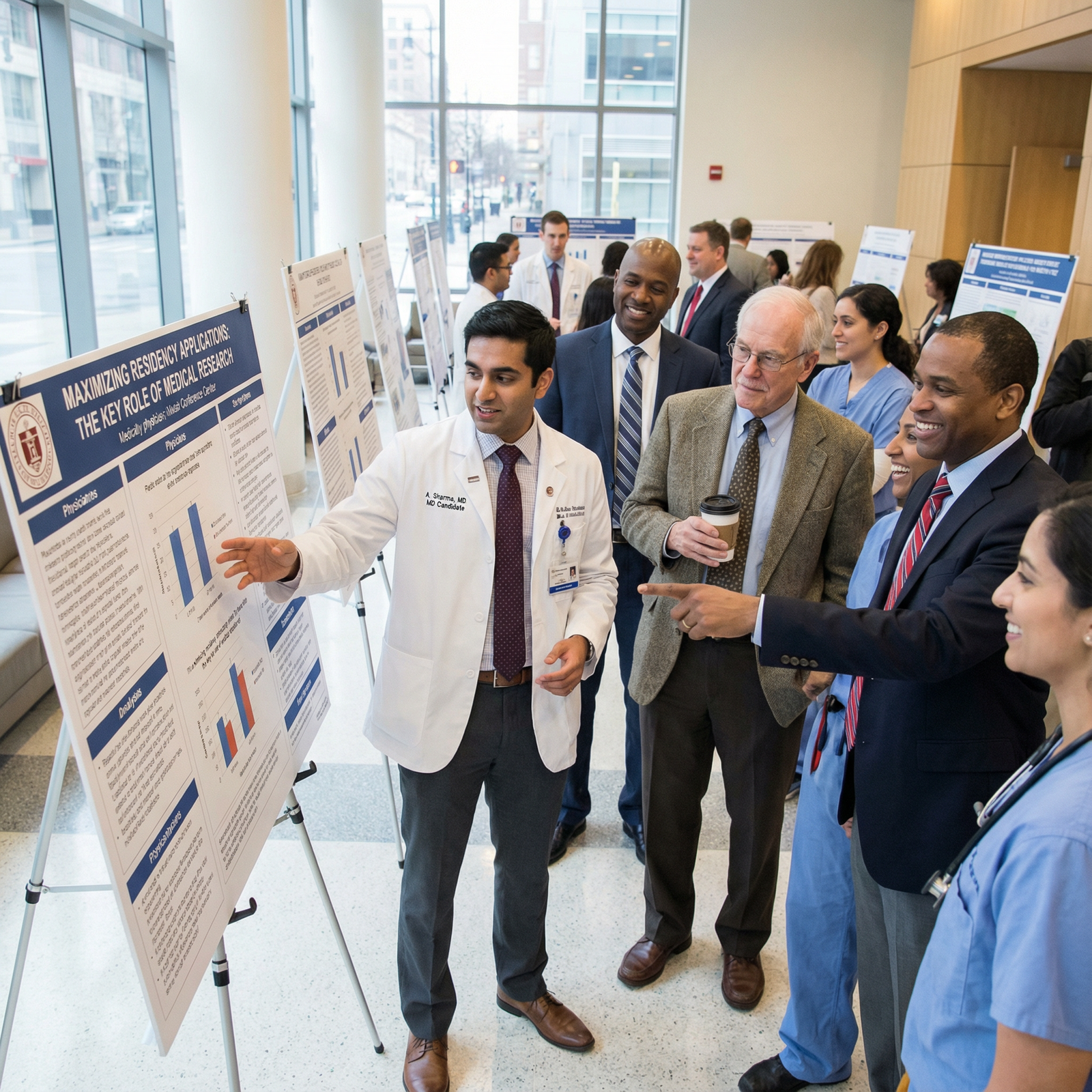
- National presentations
- Radiology-specific work
- Consistency and trajectory (research over time, not just 1–2 rushed projects before applying)
How Many Publications Do You Really Need as a US Citizen IMG?
A common anxiety point is: “How many publications are needed to match into radiology?” There is no magic number, and programs differ in how they weigh research, but for a US citizen IMG in diagnostic radiology, you should aim higher than the minimum.
General Benchmarks for Competitive Radiology Applicants
These are rough guidelines, not hard cutoffs, assuming a mix of posters, abstracts, and papers:
Minimal but acceptable (particularly with other strong areas like high Step scores and strong US letters):
- 1–3 abstracts/posters
- 0–1 publications
Solid for a US citizen IMG:
- 3–6 total scholarly items
- At least 1–2 radiology-related
- At least 1 peer-reviewed publication (even if not first-author)
Strong/Competitive for academic-leaning or top-tier programs:
- 6+ scholarly items
- Several radiology-specific abstracts/posters
- 2–4+ peer-reviewed publications
- Evidence of increasing responsibility (first- or second-author roles)
This doesn’t mean you must publish four papers to match. It means that, compared to US MDs, American students studying abroad typically need a stronger research resume to get the same level of attention, especially at university programs.
Quality vs. Quantity
Programs prefer:
- 1–2 well-designed, completed, radiology-related projects
over - 10 minor, poorly executed abstracts with minimal involvement from you.
Be ready to:
- Explain your exact role in each project.
- Discuss study design, limitations, and implications.
- Reflect on what you learned and how it shaped your interest in radiology.
If you cannot confidently present or defend a project in an interview, reconsider putting your name on it—or at least be honest about your specific contribution.
Finding and Securing Research Opportunities as a US Citizen IMG
This is often the hardest step for a US citizen IMG: getting in the door. You may be studying in a country with limited infrastructure for research, or where faculty are unfamiliar with US-style residency expectations. That’s why you often need to intentionally bridge yourself back into the US academic system.

Pathways to Start Research
1. At Your Current Medical School (Non-US)
Even if it’s not a research powerhouse, start where you are:
- Identify any faculty affiliated with radiology, internal medicine, oncology, neurology, or surgery—specialties that often use imaging heavily.
- Ask who is involved in publications, QI projects, or conference presentations.
- Attend any student research meetings, journal clubs, or electives.
You might not find “radiology research” directly, but:
- Work in oncology or neurology that includes imaging outcomes.
- Collaborate on case reports with radiologists involved in your clinical rotations.
- Offer to help gather data, perform chart reviews, or do basic statistics under supervision.
2. US-Based Radiology Departments
This is critical if your school lacks strong research culture. Options include:
Formal research fellowships or visiting research positions
- Typically 6–24 months of full-time research.
- Often unpaid or minimally paid; you’ll need to consider visa and financial logistics.
- Look for positions at academic centers known for radiology: large teaching hospitals, university medical centers.
Informal arrangements via networking
- Use:
- Alumni from your school who matched into radiology.
- US mentors from previous observerships or electives.
- Online radiology interest groups, webinars, or conferences.
- Ask directly if they know of:
- Ongoing projects that need help.
- Residents or fellows who are looking for motivated students.
- Use:
Cold-emailing faculty
- Target radiologists whose work interests you:
- Search PubMed for “diagnostic radiology” + “your area of interest.”
- Check radiology department profiles on US medical school websites.
- Focus on faculty who:
- Are mid-career (more likely to be actively publishing).
- Have multiple recent papers or are running clinical trials.
- Are involved in resident or student education.
- Target radiologists whose work interests you:
Sample email framework (keep it concise and professional):
- Who you are: “I am a US citizen IMG in my [X] year at [School/Country], planning to apply to diagnostic radiology.”
- What you want: “I am very interested in imaging-based research and was wondering if you have any ongoing projects where I could assist remotely or in person.”
- Why them: “I read your recent paper on [Topic] and found [specific point] particularly compelling.”
- Your skills: Briefly list:
- Prior research experience (if applicable)
- Comfort with Excel, basic statistics, or any software
- Willingness to do time-consuming tasks (data entry, literature review)
- Attach CV and unofficial transcript if appropriate.
3. Remote or Online Radiology Research
Remote work became more accepted during and after COVID. Some components can be done from abroad:
- Literature reviews and drafting manuscripts
- Data collection from de-identified databases (if allowed by IRB and institution)
- Image labeling for AI projects (under supervision)
To improve your chances:
- Complete an online course in basic research methods or statistics (Coursera, edX, etc.).
- Learn reference management tools (Zotero, Mendeley) and basic SPSS/R coding.
4. Conferences and Professional Organizations
Involvement with:
- RSNA (Radiological Society of North America)
- ARRS (American Roentgen Ray Society)
- ACR (American College of Radiology)
can help you:
- Find calls for abstracts.
- Identify faculty who regularly mentor student projects.
- Attend virtual sessions where you can ask questions and network.
Even if you cannot travel, virtual attendance and abstract submission can still add to your profile.
Step-by-Step: Building a Strong Research Portfolio for Radiology
Once you secure a position or mentor, the question becomes: How do I translate this into a compelling research profile for the diagnostic radiology match?

Step 1: Clarify Your Research Timeline and Goals
As a US citizen IMG, your timeline might differ from US MD students. Map backwards from your intended application cycle.
If you are 2–3 years away from applying:
- Focus on learning research methods.
- Get involved in at least one substantial project.
- Aim for 1–2 publications and several abstracts by the time you apply.
If you are 1–1.5 years away:
- Prioritize projects with a realistic chance of completion:
- Case reports and series
- Retrospective chart or imaging reviews
- Short QI projects
- Coordinate timelines to submit abstracts to 1–2 major meetings.
- Prioritize projects with a realistic chance of completion:
If you are less than 1 year away:
- Focus on:
- Finalizing and submitting existing work.
- Getting your name on abstracts/posters you can realistically complete.
- You may also plan to continue research into your interview season—a sign of ongoing commitment.
- Focus on:
Step 2: Choose Projects Strategically
For each potential project, ask:
Is it radiology-relevant?
- Best: direct imaging research or radiology QI projects.
- Acceptable: non-radiology clinical work, if you can explain how it developed your research skills.
Is the scope realistic for your timeline?
- A large, multi-year trial may not be ideal if you have 12 months before ERAS.
- A well-defined retrospective review or case series often is.
Will you have meaningful authorship?
- Aim for future first- or second-author work where possible.
- It’s fine to be middle author on large group projects—but balance this with some leadership experiences.
Who are the co-authors and mentors?
- A US-based radiologist or recognized researcher strengthens:
- Letters of recommendation
- Your credibility
- Your network
- A US-based radiologist or recognized researcher strengthens:
Step 3: Develop Core Research Skills (Even as an IMG Abroad)
A structured approach will make you more valuable to mentors and efficient in projects:
Literature Search Skills
- Use PubMed, Google Scholar, and institutional access when available.
- Learn how to:
- Define a focused research question.
- Use Boolean operators and filters.
- Identify key landmark papers.
Data Management and Basic Statistics
- Excel proficiency: data cleaning, filters, pivot tables.
- Basic stats: p-values, confidence intervals, t-tests, chi-square tests.
- Optional but helpful: introductory R, Python, or SPSS.
Scientific Writing
- Read high-quality radiology journals (Radiology, AJR, European Radiology).
- Practice writing:
- Abstracts
- Case reports
- Short communication sections (Methods/Results)
- Ask mentors or senior residents to review your drafts and give feedback.
Step 4: Converting Work into Tangible Outputs
The value of a project is measured by how it appears on your ERAS and CV:
Publications
- Aim for peer-reviewed journals whenever feasible.
- Preprints and non-indexed journals are acceptable but less impactful.
- Early in your journey, even small case reports and letters to the editor help.
Posters and Oral Presentations
- Submit abstracts to:
- RSNA, ARRS, AUR, regional radiology societies
- Specialty-specific or multi-disciplinary conferences (oncology, neurology, etc.)
- Being first author on a poster at a major meeting signals both initiative and exposure.
- Submit abstracts to:
Institutional Presentations
- Grand rounds, departmental research days, or radiology case conferences at your institution.
- Even if they don’t appear as “national,” you can list them on ERAS.
Educational Products
- If you develop teaching files, online radiology modules, or curated image collections, these can be listed as educational scholarship—especially if they are used by others.
Step 5: Presenting Your Research Story in the Application
Your research profile is not just a list—it’s a story that supports your choice of radiology.
Personal Statement
- Highlight a small number of key projects.
- Emphasize:
- What questions interested you.
- How imaging played a role.
- How your research perspective will inform you as a future radiologist.
CV / ERAS
- Use clear, specific titles and descriptions.
- Example:
- “Retrospective analysis of CT findings in acute mesenteric ischemia and correlation with clinical outcomes.”
- Under “Your Role,” specify:
- Data collection, literature review, statistical analysis, manuscript drafting.
Interviews
- Prepare 2–3 projects you can discuss at length:
- Objective
- Methods
- Key findings
- Limitations
- What you learned and how it influenced your career goals
- Prepare 2–3 projects you can discuss at length:
Program directors often use your research to gauge both your analytic skills and your authenticity regarding radiology interest.
Common Pitfalls and How to Avoid Them as a US Citizen IMG
There are some recurring mistakes that American students studying abroad frequently make when building a research profile.
1. Starting Too Late
Waiting until the last 6–9 months before ERAS:
- Limits the scope of what you can realistically complete.
- Makes your interest in radiology appear last-minute.
- Reduces your ability to secure strong research-based letters.
Solution:
Begin exploring and joining projects 2–3 years before your planned match, if possible. If you’re already late, focus on smaller, high-yield outputs and clearly plan ongoing projects post-application.
2. Overcommitting to Too Many Projects
Juggling 6–8 active projects can lead to:
- Missed deadlines
- Superficial involvement
- Burnout and frustration
Solution:
Aim for:
- 1–2 primary projects (where you are deeply involved)
- 1–3 secondary projects (data entry, smaller contributions)
Regularly reassess your capacity and communicate clearly with mentors.
3. Neglecting Radiology-Related Work
All research counts, but if none of your work is imaging-focused, interviewers may wonder why you chose radiology.
Solution:
Even if you start in non-radiology research:
- Add at least 1–2 radiology-centered projects, case reports, or QI efforts.
- Shadow radiology and partner with radiologists for imaging-centric cases.
4. Poor Documentation and Communication
Losing track of:
- Versions of manuscripts
- Data files
- Author contributions
can jeopardize submissions and relationships.
Solution:
Use:
- Version control (e.g., dated filenames, Google Docs or shared drives).
- Clear email communication summarizing tasks, deadlines, and progress.
- Organized folders for each project (data, drafts, figures, presentations).
5. Ethical and Authorship Issues
Being added/removed from authorship lists or disputes over credit can be serious.
Solution:
- Clarify authorship expectations when you join a project.
- Uphold strict standards of data integrity and plagiarism avoidance.
- When in doubt, ask your mentor how to properly handle sensitive data or text reuse.
FAQs: Research Profile Building for US Citizen IMG in Diagnostic Radiology
1. As a US citizen IMG, do I absolutely need US-based research to match into radiology?
Not absolutely, but it helps significantly. Strong, methodologically sound research from your non-US institution is still valuable. However, US-based research:
- Connects you to US mentors and letter writers.
- Shows you can adapt to US academic culture.
- Is more familiar to program directors reviewing your diagnostic radiology match application.
If possible, try to have at least one US-based project or collaboration on your CV.
2. How many publications are needed for a competitive radiology residency as an IMG?
There is no fixed number, but for a US citizen IMG:
- A solid target is:
- 1–2 peer-reviewed publications (radiology-related if possible)
- Several abstracts/posters (3–6+ total scholarly items)
- More is helpful if:
- Quality is maintained
- You can clearly articulate your role and the project’s impact
Programs care more about depth, relevance, and your ability to discuss your work than just the raw count.
3. What if my research is not directly related to radiology?
Non-radiology research can absolutely still strengthen your application by showing:
- Analytical skills
- Persistence
- Teamwork and project management
In your application and interviews:
- Emphasize the skills you learned (study design, statistics, critical appraisal).
- Explain how those skills translate into being a better radiologist.
- Then, try to add at least one clearly imaging-related project to show specific commitment to radiology.
4. Is it better to delay my application to do a dedicated research year?
For many US citizen IMGs targeting diagnostic radiology, a dedicated research year in the US can be a strategic advantage, especially if:
- Your school provides limited research opportunities.
- Your current research output is minimal.
- You’re aiming for academic or university-based programs.
However, delaying a year has costs (time, finances, visas), so consider it if:
- You can secure a legitimate, structured research position with good mentorship.
- You are likely to gain both publications and strong letters out of it.
- You use the time for additional observerships, networking, and US clinical exposure.
By approaching research profile building deliberately—starting early, choosing projects wisely, and converting your work into tangible outputs—you can transform being a US citizen IMG into an advantage rather than a liability. Your research story can showcase resilience, curiosity, and a genuine, well-informed commitment to diagnostic radiology, all of which residency programs value highly.