Understanding the Research Landscape for US Citizen IMGs in Orthopedic Surgery
If you are a US citizen IMG or an American studying abroad aiming for orthopedic surgery residency, your research profile can be the difference between a strong ortho match and a disappointing outcome. Orthopedic surgery is consistently among the most competitive specialties in the NRMP Match. Program directors want evidence that you can think critically, handle complex scientific literature, and contribute to the academic side of the field.
For US citizen IMGs, research often plays an even larger role because it can:
- Compensate for weaker elements in your application (e.g., lower Step scores, fewer US rotations).
- Demonstrate commitment to orthopedic surgery despite training abroad.
- Provide US-based mentors who can write strong letters of recommendation.
- Help you integrate into academic networks that drive interviews and opportunities.
This article will walk through how to strategically build a research profile tailored to orthopedic surgery residency as a US citizen IMG, including realistic pathways, timelines, types of projects, and what “enough” research actually looks like.
What Orthopedic Programs Look For in a Research Profile
Before investing time, you need to understand how residency programs think about research for ortho applicants.
Why Orthopedic Surgery Cares About Research
Orthopedic surgery is highly academic:
- Many departments are ranked based on research productivity and grant funding.
- Faculty promotions often depend on publications and scholarly work.
- Evidence-based practice is central to surgical decision-making.
Program directors use research to assess whether you:
- Can read and apply scientific literature.
- Have the discipline to complete long-term projects.
- Work well in teams and academic environments.
- Will contribute to the department’s academic mission as a resident.
Types of Research That Count
Almost any properly structured research can be valuable, but some forms carry more weight for an orthopedic surgery residency application:
Most valuable for ortho:
- Clinical orthopedic surgery projects (fracture outcomes, joint replacements, sports injuries, spine, trauma, pediatrics, oncology, hand).
- Quality improvement (QI) projects in orthopedic departments.
- Systematic reviews and meta-analyses of orthopedic topics.
- Basic science or biomechanics related to bone, cartilage, tendons, implants, or musculoskeletal biology.
Also valuable, especially if ortho options are limited:
- Musculoskeletal radiology projects.
- Physical medicine & rehabilitation (PM&R) projects focusing on musculoskeletal disease.
- General surgery or trauma research.
- Epidemiology or public health work relevant to injuries, falls, or musculoskeletal disease.
Less ideal but still acceptable (especially if early):
- Purely unrelated specialties (e.g., dermatology, psychiatry) with no musculoskeletal connection.
- Non-clinical projects (e.g., medical education, informatics) distant from ortho.
When possible, steer your portfolio toward musculoskeletal or surgical topics over time.
How Many Publications Are Needed for an Ortho Match?
One of the most common questions: “How many publications needed to be competitive?”
There is no absolute number, but trends matter:
- Matched US MD ortho applicants often report double-digit publications/abstracts/posters by the time they apply.
- As a US citizen IMG, you generally want to aim toward the higher end of scholarly activity to offset IMG status.
Realistic targets for a US citizen IMG aiming for orthopedic surgery:
- Minimum viable profile:
- 3–5 total scholarly outputs (abstracts/posters/papers),
- At least 1–2 clearly orthopedic or musculoskeletal.
- More competitive profile:
- 6–12+ total scholarly items,
- Several with your name near the front (1st–3rd author),
- At least 3–5 in clearly orthopedic topics.
- Research-year or “research-heavy” profile:
- 10–20+ total items,
- Multiple full-length peer-reviewed publications,
- Clear ortho focus and strong US-based mentors.
Remember: productivity and trajectory matter more than a single number. Program directors look for consistency, increasing responsibility, and completion of projects—not isolated one-off efforts.
Getting Started: Strategic Planning for a US Citizen IMG
Before trying to join every possible project, step back and build a plan based on your situation.
Step 1: Map Out Your Timeline
Your strategy depends on where you are in training:
Preclinical (Years 1–2 of med school abroad):
- Focus: Foundational skills, early involvement, flexible exploration of fields.
- Goal: Start with simpler projects (case reports, retrospective chart reviews, literature reviews).
Clinical years (Years 3–6, depending on your school):
- Focus: Stronger orthopedic alignment, more advanced projects, US connections.
- Goal: Produce tangible outputs (abstracts/posters/papers) before ERAS.
Postgraduate (Gap year / research year):
- Focus: High-volume productivity and deep immersion.
- Goal: Build a strong ortho portfolio and networks at US institutions.
Create a simple timeline backward from your planned application year, including deadlines for:
- Abstract submissions (e.g., AAOS, specialty societies).
- Manuscript drafts.
- Letters of recommendation.
- ERAS opening and submission.
Step 2: Define Your Research Brand
For an ortho match, being “the trauma guy/gal,” “the sports injuries person,” or “the spine outcomes researcher” is more memorable than “does random research.”
Ask:
- Which ortho subspecialty genuinely interests you? Trauma, sports, arthroplasty, spine, hand, pediatrics, oncology, foot & ankle?
- What type of methods do you like? Clinical outcomes, imaging, biomechanics, big data, systematic reviews?
A “brand” does not lock you in forever, but focusing your research for 2–3 years helps you:
- Build deeper knowledge.
- Network within a specific community.
- Speak more convincingly during interviews about your work.

Finding and Securing Research Opportunities as a US Citizen IMG
As an American studying abroad, your biggest challenge is often access: getting US-based mentors and orthopedic projects when you are physically outside the US. This is solvable with a structured approach.
Strategy 1: Cold Emailing Orthopedic Faculty Effectively
Cold emailing is one of the most powerful tools if done well.
Identify targets:
- US academic ortho departments (especially those you’d love to match at).
- Faculty with active publications in your area of interest.
- Early- and mid-career faculty may be more available than department chairs.
Use a structured, concise email:
Subject ideas:
- “US citizen IMG seeking remote orthopedic research opportunity”
- “Prospective ortho applicant interested in [specific topic] research”
Body (customize for each faculty):
- 1–2 sentences: Who you are (US citizen IMG, school, year).
- 1 sentence: Your interest in orthopedic surgery and their specific work.
- 2–3 sentences: Your relevant skills (stats, coding, languages, previous projects) and time available.
- 1 sentence: A very specific ask (e.g., “Would you be open to me assisting on a retrospective outcomes project or data collection for one of your ongoing studies?”).
- Attach your CV and, if available, a 1-page research summary.
- Volume and persistence:
- Expect many to ignore you; this is normal.
- Sending 40–60 high-quality, personalized emails can yield a handful of serious opportunities.
- Follow up once politely after 7–10 days.
Strategy 2: Leverage Your US Citizen Status
Being a US citizen IMG can be an advantage:
- You don’t need visa sponsorship for electives, sub-internships, research fellowships, or residency.
- Departments feel more comfortable investing in you, knowing that visa issues are minimal.
Highlight this explicitly in your emails and conversations:
“As a US citizen studying medicine abroad, I will not require visa sponsorship for research positions or residency.”
Strategy 3: Remote and Hybrid Research Models
Because you may not be in the US full-time, focus on projects that can be done remotely, such as:
- Systematic reviews and meta-analyses.
- Retrospective chart reviews (with secure remote access where possible).
- Database studies using large datasets (NSQIP, NIS, institutional registries).
- Survey-based research.
- Image-based measurements (radiographic analyses) when access can be granted.
Agree on:
- Communication frequency (e.g., weekly or biweekly Zoom).
- Clear deliverables and timelines.
- Authorship expectations.
Strategy 4: Formal Research Fellowships and “Research Years”
Many US orthopedic departments offer 1–2-year research fellowships for students and graduates, often including:
- Full-time research work.
- Opportunities for clinical shadowing and networking.
- Multiple publications and conference presentations.
- Strong letters from orthopedic faculty.
As a US citizen IMG, this can be an ideal bridge between your foreign medical school and the US system.
Key tips:
- Apply early (12–18 months before you want to start).
- Emphasize your commitment to ortho and your willingness to work hard.
- Confirm that IMGs (especially from outside the US) are accepted.
Building a Strong, Tangible Research Portfolio
Simply “doing research” is not enough; you must translate effort into outputs that show on your CV and ERAS application.
Types of Output That Strengthen Your Ortho Application
From highest impact to moderate:
First- or second-author publications in peer-reviewed journals
- Especially orthopedics or musculoskeletal-related.
- Clinical or outcomes studies, systematic reviews, meta-analyses, or translational research.
Co-author publications
- Show you can be a reliable team member.
- Important for volume and breadth.
National conference presentations and abstracts
- AAOS, AOSSM, OTA, POSNA, AAHKS, NASS, etc.
- Poster or podium presentations both count.
Regional or institutional conferences
- Departmental research days.
- State or regional ortho meetings.
Case reports and technical notes
- Lower-impact but valuable early on, especially if clearly ortho-focused.
Non-ortho but methodologically strong projects
- These show research skill even if not directly musculoskeletal.
Aim to build a balanced mix: some higher-impact ortho publications plus several supportive outputs that show consistent productivity.
How Many Projects to Take On at Once?
Common mistake: taking on too many projects and finishing none.
- Early stage (first year of research engagement):
- 1–2 main projects + 1 simpler project (case report or small review).
- Later stage (if experienced or in a research year):
- 3–5 active projects at various stages: data collection, analysis, manuscript drafting.
Always prioritize completion over sheer number of starts. In interviews, program directors care about finished work and what you did.
Authorship Position: What Matters?
For orthopedic surgery residency applications:
- First author:
- Very valuable, especially on ortho topics.
- Shows leadership in idea, execution, and writing.
- Second or third author:
- Still strong; reflects meaningful contribution.
- Middle author:
- Helpful for volume and showing you can be part of big teams.
- Less impressive alone, but good as part of a larger body of work.
Try to secure at least 2–3 first- or second-author manuscripts or major abstracts by the time you apply, ideally with orthopedic relevance.
Maximizing Impact: Presentations, Networking, and Interview Readiness
Strong research for residency is not just about CV lines; it is about relationships, reputation, and how convincingly you can discuss your work.
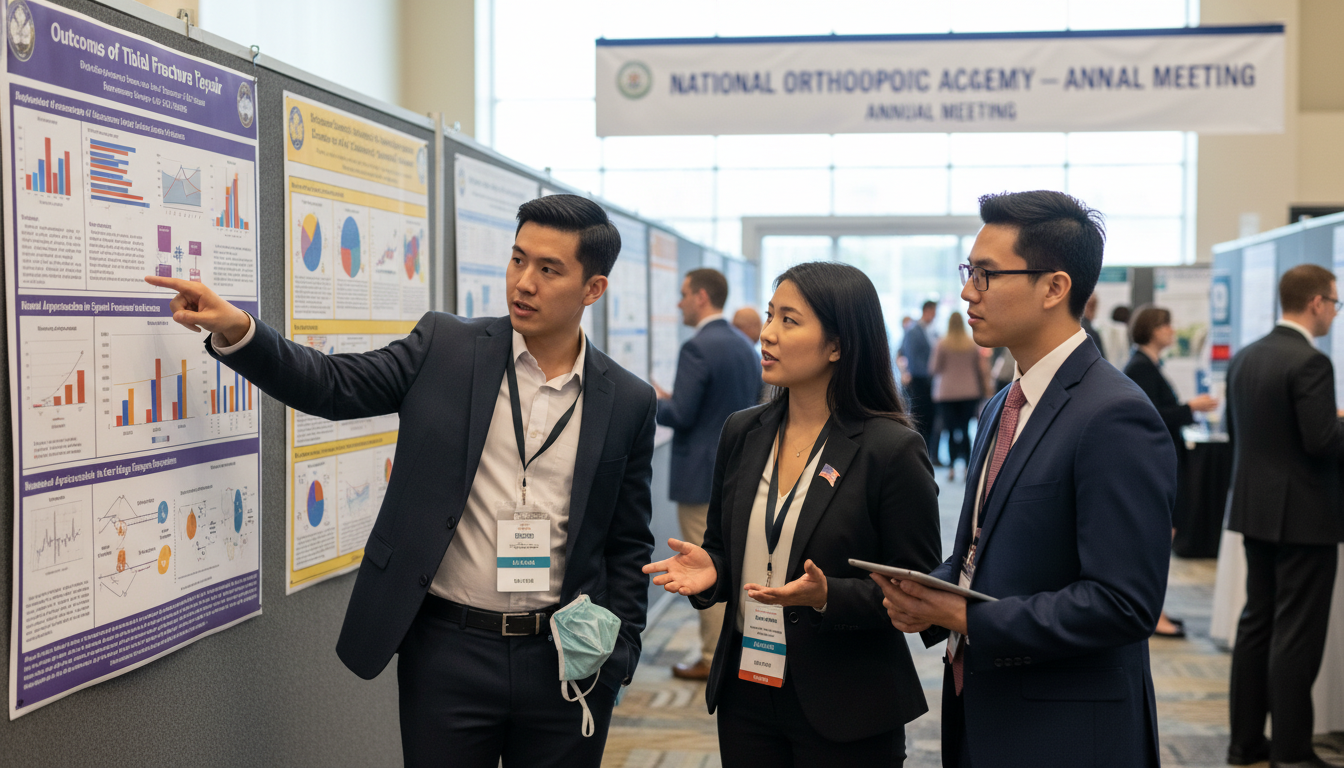
Presenting at Ortho Conferences
Submitting to national or subspecialty meetings is critical:
- Target:
- AAOS (American Academy of Orthopaedic Surgeons).
- Subspecialty societies (AOSSM, OTA, POSNA, AAHKS, etc.).
- Regional ortho societies and institutional research days.
Benefits:
- Demonstrates active engagement in the ortho community.
- Offers direct networking with residents and faculty.
- Gives you concrete experiences to discuss during interviews.
If travel is hard, consider:
- Virtual presentations when offered.
- Sharing posters digitally on professional profiles (e.g., LinkedIn, ResearchGate).
Building Relationships for Letters of Recommendation
Your research mentors are often your strongest letter writers, especially when US-based and well-known in orthopedics.
To earn strong letters:
- Show reliability: meet deadlines, communicate clearly.
- Take initiative: suggest analyses, draft sections, come with ideas.
- Understand your projects deeply: background, methods, limitations.
Ask for letters:
- After you’ve worked with them for several months and have clear contributions.
- With a summary of your work together and your broader CV.
- Politely but early enough for them to write thoughtfully.
A powerful letter from a respected US orthopedic surgeon can offset other weaknesses in your application as a US citizen IMG.
Preparing to Discuss Your Research in Interviews
You will almost certainly be asked about your research at ortho interviews.
Be ready to:
Clearly explain:
- The question or hypothesis.
- Study design (retrospective/prospective, database used, etc.).
- Your exact role (data collection, analysis, drafting, etc.).
- Key findings and their implications for practice.
Anticipate follow-up:
- Limitations of the study.
- How you would improve it in a future project.
- How this research changed your understanding of orthopedics.
Practice 1–2 minute summaries of your main projects, tailored to:
- A general surgeon.
- An orthopedic researcher.
- A non-surgical faculty member.
Confidence and depth in these discussions strongly signal that your research is genuine, not just checkbox activity.
Common Pitfalls and How to Avoid Them as a US Citizen IMG
Many US citizen IMGs interested in orthopedic surgery repeat the same mistakes. Being aware of these will save you time and frustration.
Pitfall 1: Waiting Too Long to Start Research
If you begin research only 6–9 months before applying:
- It is hard to convert projects into abstracts or publications in time.
- Your experience may look shallow or rushed.
Solution: Start as early as possible, ideally 1.5–3 years before your intended application date, even if projects are small at first.
Pitfall 2: Spreading Yourself Too Thin
Juggling 8–10 projects sounds impressive but often leads to:
- Missed deadlines.
- Incomplete manuscripts.
- Frustrated mentors.
Solution: Focus on a few projects where you can take meaningful roles and bring them to completion. Depth beats superficial quantity.
Pitfall 3: No Orthopedic Focus
A portfolio of 10–15 publications in non-ortho fields is less persuasive for an orthopedic surgery residency.
Solution: Transition your focus over time toward musculoskeletal topics. Even if you start in other fields, intentionally pivot to ortho-oriented research as you approach application.
Pitfall 4: Lack of US-Based Mentors
Working only at your home institution abroad:
- May limit letter strength.
- May not be recognized by US programs as heavily.
Solution: Actively seek US-based orthopedic collaborations. Use cold emails, research fellowships, and connections from US clinical rotations.
Pitfall 5: Overstating Your Role
Program directors can sense when an applicant inflates their involvement.
Solution: Be honest about your contributions. It is better to be a clearly defined co-author than to claim ownership of work you barely touched.
FAQs: Research Profile Building for US Citizen IMG in Orthopedic Surgery
1. As a US citizen IMG, how many publications do I realistically need for an orthopedic surgery residency?
There is no fixed number, but aiming for 6–12+ total scholarly outputs (publications, abstracts, posters) with at least 3–5 orthopedic-focused items is a strong target. For those doing a dedicated research year, 10–20+ total items is common. Quality (first/second authorship, ortho relevance) and trajectory matter more than a specific count.
2. Does research have to be in orthopedic surgery, or will any research help my ortho match?
Non-ortho research still helps, especially early in your career, because it shows basic research skills and productivity. However, as you get closer to ERAS, you should deliberately shift toward orthopedic or musculoskeletal topics. At the time of application, programs prefer to see that at least a substantial portion of your research is clearly relevant to orthopedic surgery.
3. Is a dedicated research year necessary for a US citizen IMG applying to orthopedic surgery?
Not strictly necessary, but often highly beneficial. For US citizen IMGs with limited prior research or weak US connections, a research year at a US orthopedic department can:
- Accelerate your publications for match.
- Provide strong US letters of recommendation.
- Expand your ortho network. If your profile is already strong (multiple ortho publications, good scores, US rotations), you may not need it, but many IMGs find it to be a game-changer.
4. How can I find research mentors if I’m an American studying abroad with no US contacts?
Use a systematic approach:
- Search US academic ortho departments and identify faculty with interests aligned to yours.
- Send personalized cold emails highlighting that you are a US citizen IMG (no visa issues), your interest in orthopedics, and your research skills.
- Attach your CV, offer specific help (data collection, literature review, basic stats), and request remote involvement.
- Apply for formal orthopedic research fellowships posted on department websites or via professional networks. Persistence and volume matter—many students secure opportunities only after dozens of well-crafted outreach emails.
By understanding what orthopedic programs value, starting early, focusing strategically, and emphasizing completion and orthopedics-specific work, you can build a research profile that significantly strengthens your chances as a US citizen IMG aiming for an orthopedic surgery residency.