Understanding Match Day and Why It Matters
Match Day is one of the most anticipated milestones in a medical student’s journey. It’s the culmination of years of hard work, board exams, clinical rotations, personal statements, interviews, and ranking decisions. On this day, you find out where you will begin your residency training—and, in many ways, where the next phase of your life will unfold.
This guide walks you through every aspect of Match Day and Match Week: what to expect, how to prepare, how to manage different outcomes (including not matching), and how to navigate the emotions of the day. It is designed for U.S. MD and DO students, as well as international medical graduates (IMGs), applying through the National Resident Matching Program (NRMP).
We will also clarify the match week timeline, answer the common question “when is Match Day?”, and give you specific, practical strategies to make the most of this high‑stakes week.
The Match Week Timeline: From Monday Email to Friday Celebration
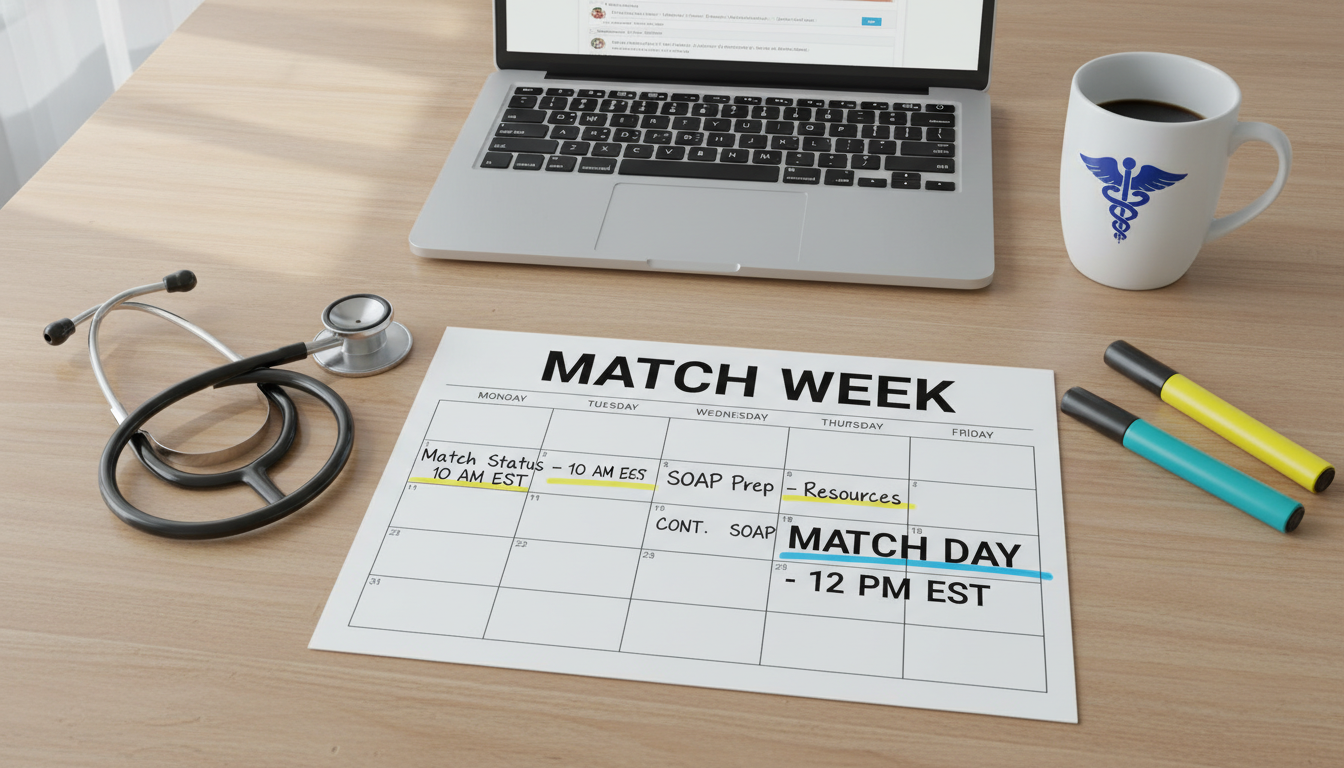
Before you think about celebrations and logistics, you need a clear understanding of the Match Week timeline. Match Week is typically the third week in March and includes Match Day Friday, but each day has specific, time‑sensitive events.
When Is Match Day?
- Match Day (NRMP Main Residency Match):
- Usually the third Friday in March
- Results are released at 12:00 PM (noon) ET
- Confirm the exact date and time on the NRMP website each year.
- DO students participating in the NRMP (rather than the now‑discontinued independent AOA match) follow the same Match Day schedule.
Match Day is the public, celebratory event, but most of the real logistical work—and stress—happens earlier in Match Week.
Monday: “Did I Match?” Email
Time: 10:00 AM ET
On Monday of Match Week, the NRMP releases a simple but life‑defining result:
- You receive an email (and/or can log into your NRMP account) with one of two messages:
- “Congratulations! You have matched.”
- “You did not match to any position.” (or “You partially matched” for advanced positions without a prelim year, etc.)
If you matched, you will not yet know where—that’s revealed on Friday. If you did not match or partially matched, you become eligible for the Supplemental Offer and Acceptance Program (SOAP).
Action steps for Monday if you matched:
- Take a breath. You have secured a residency position.
- Confirm your contact information is up to date on ERAS and NRMP in case programs need to reach you.
- Finalize your Match Day ceremony plans (family, friends, travel).
Action steps for Monday if you did not match:
- Meet with your dean’s office or advisor immediately (many schools schedule mandatory SOAP meetings at 10:30–11:00 AM).
- Organize your documents:
- Personal statements for backup specialties (if applicable)
- Updated CV
- Revised list of programs and specialties for SOAP
- Clarify your priorities: Are you open to a different specialty, a prelim year, or only categorical positions?
Monday Afternoon–Tuesday: SOAP Application Window
After learning on Monday that you are eligible for SOAP, you will:
- Receive access to the list of unfilled programs via NRMP.
- Use ERAS to apply to SOAP‑participating programs.
- There are strict limits on the number of applications (e.g., up to 45 unique programs total; confirm the current year’s rules).
- You cannot contact programs directly; they must initiate contact.
Key points:
- Work systematically with your dean’s office or advisor:
- Identify programs that realistically fit your profile.
- Adjust your personal statement to align with SOAP choices.
- Upload any tailored documents before the application window closes.
Tuesday–Thursday: SOAP Interviews and Offers
Throughout these days:
- Programs review SOAP applications, often on a very compressed timeline.
- They may contact you through:
- ERAS messaging
- Phone calls
- Virtual interviews (often short, focused on fit and readiness)
Offer rounds happen on a strict, pre‑scheduled timeline (usually four rounds across Wednesday–Thursday). In each round:
- Programs extend offers to applicants.
- You can accept or reject an offer within a defined timeframe (often 2 hours).
- Once you accept a SOAP offer, your participation in SOAP ends.
If you do not receive or accept an offer in a given round, you may still receive an offer in later rounds.
By Thursday evening:
- SOAP concludes.
- You will know if you:
- Matched to a position through SOAP, or
- Remain unmatched and will need to plan a reapplication strategy.
Friday: Match Day Ceremony and Results
Time: 12:00 PM ET (for NRMP Main Match results)
On Friday:
- At exactly noon Eastern Time, NRMP releases match results.
- You can:
- Log into your NRMP account to see your program (or programs, if prelim + advanced).
- Open your school’s official Match Day envelope or email.
- Many schools hold a formal ceremony with:
- Brief speeches
- Envelopes handed out simultaneously
- Announcements or slideshows of matches
- Celebratory photos with classmates and family
If you matched via SOAP, your result is typically already known before Friday; however, many SOAP‑matched students still attend ceremonies and celebrate their success.
Emotional Preparation: Managing Stress, Expectations, and Outcomes
The technical details of Match Week are straightforward; the emotions are not. Students describe this week as a rollercoaster—from fear to relief to joy (or disappointment). Preparing mentally and emotionally is as important as any logistical step.
Normalizing the Emotions of Match Day
Common feelings leading up to Match Day:
- Anxiety and dread (“What if I don’t match?”)
- Imposter syndrome (“Everyone else is more competitive than me.”)
- Survivor’s guilt (for those who match when close friends do not)
- Pressure from family expectations (“They’re flying in; what if I don’t get what I hoped for?”)
These reactions are widespread and do not predict your actual outcome. Acknowledging them early can prevent you from feeling blindsided.
Setting Realistic Expectations
Go into Match Week with clarity:
- The Match is not a moral judgment. It is a numbers‑based algorithm that tries to optimize program and applicant preferences.
- Highly competitive specialties and geographic “hot spots” can make outcomes unpredictable, even for strong applicants.
- Many excellent physicians:
- Matched at their second, third, or later choice.
- Trained outside their ideal region or institution.
- Needed a reapplication year before ultimately succeeding.
Approach Match Day hoping for the best but emotionally prepared for any rank on your list to become your new reality.
Planning for Different Scenarios
Before Match Week begins, privately explore three possible outcomes:
You match at a top‑choice program
- How will you celebrate?
- Who do you want to tell first?
You match, but not in your top few choices
- How will you reframe the narrative? (e.g., new city, new opportunities, unique strengths of that program)
- Who can help you process initial disappointment constructively?
You do not match (or partially match)
- Who are your immediate support people: family, friends, mentors?
- Do you have a plan for how to respond practically (SOAP, reapplication, alternative paths)?
Thinking through these in advance can lessen the shock and help you respond, not react.
Emotional Coping Strategies During Match Week
- Set boundaries on social media:
- Consider muting or limiting time on platforms where classmates post outcomes and celebrations.
- Create a calm environment:
- Keep your physical space clean and organized.
- Prepare comfort items: favorite food, playlist, a walk route, or a friend to call.
- Schedule check‑ins:
- Ask a close friend or partner to check in by phone or text at key points (Monday morning, midweek, Friday).
- Use your school’s resources:
- Student wellness services
- Peer support groups
- Faculty mentors who have seen many match cycles
Practical Planning for Match Day: Logistics, Celebrations, and Next Steps
Once you understand the Match Week timeline and prepare emotionally, the next step is planning the practical details of Match Day itself.
Deciding How You Want to Receive Your Results
You typically have multiple ways to see your match results:
- At the official ceremony (envelope opening)
- Online via your NRMP account
- Email (depending on your school’s tradition)
Ask yourself:
- Do you want to open your results privately first, then share publicly?
- Are you comfortable reacting in front of a crowd if the result is not what you hoped?
- Who do you want beside you when you open the result?
Many students choose to:
- Check online at noon ET in a quiet corner with one or two close people, then
- Open the envelope on stage or at their seat for symbolic participation.
There is no right or wrong approach—only what feels safest and most authentic for you.
Planning Who Will Attend Match Day
Decide early who to invite:
- Family: parents, partners, siblings, children, extended relatives
- Friends: classmates, non‑medical friends, mentors
- Logistics:
- Does your school limit the number of guests?
- Will guests travel from out of town (flights, hotels)?
- Is the event streamed online for those who cannot attend?
If you are particularly anxious:
- Consider inviting only a small number of people in person.
- Let others watch via live stream or save celebrations for later in the day.
What to Wear and Bring
While dress codes vary, aim for professional but comfortable:
- For most students:
- Business casual or semi‑formal attire
- White coat if your school includes it in the ceremony
- Bring:
- Phone (with charger or battery pack)
- Printed list of programs on your rank list (for context if needed)
- A small notepad or your notes app to jot down questions or logistics once you know your program
- Tissues (for yourself or others—tears can be happy or sad)
Remember that the day typically includes photos:
- Consider outfits and grooming you’ll feel good about in pictures that may resurface for years.
Planning the Celebration
Depending on your result and personality, celebrations can be large or intimate:
- Immediate post‑ceremony:
- Group photos, school receptions, class gatherings.
- Later in the day:
- Dinner with family or friends.
- A quiet night in if you feel emotionally drained.
Reserve a plan that can scale up or down:
- If you match at your dream program, you might expand plans spontaneously.
- If the outcome is more complicated, having an option for a low‑key evening is helpful.

If You Don’t Match: A Calm, Step‑by‑Step Response
A complete Match Day guide must address a difficult but important reality: some applicants do not match. If this happens to you, it is painful—but it is also survivable. Many applicants successfully match on a second attempt and go on to fulfilling careers.
Immediate Steps on Monday if You Don’t Match
Allow yourself to feel
- Take 30–60 minutes to process the news.
- Reach out to a trusted person (partner, friend, mentor) to talk.
Contact your advisor or dean
- Most schools have pre‑planned structures for SOAP support.
- Schedule an urgent meeting to:
- Review your application (scores, letters, specialty choice, number of interviews).
- Discuss realistic SOAP and future options.
Clarify your priorities
- Are you willing to:
- Switch specialties?
- Accept a preliminary or transitional year position?
- Consider a broader geographic range?
- What is non‑negotiable for you (e.g., must be in the U.S., specific visa needs, etc.)?
- Are you willing to:
Navigating SOAP Strategically
To approach SOAP effectively:
- Organize quickly:
- Update your personal statement to reflect broader interest if needed.
- Create alternative versions if applying to more than one specialty.
- Target programs carefully:
- Focus on those whose typical applicant profiles align with yours (step scores, clinical experience, visa policies).
- Consider programs where you have any prior connection (electives, mentors, geographic ties).
- Stay responsive:
- Keep your phone on and close.
- Respond promptly and professionally to emails and interview requests.
- Prepare a concise “SOAP interview pitch”:
- Why this specialty or program?
- What you learned from your medical school journey.
- How you handle challenges and setbacks.
If You Remain Unmatched After SOAP
By Thursday evening, if you still do not have a position:
Acknowledge the loss
- This is a major disappointment and deserves time to grieve.
- Talk with mentors, friends, family, or a counselor.
Meet with a dedicated advisor
- Review your entire application honestly:
- Academic performance and exam scores
- Specialty competitiveness and application strategy
- Number and quality of interviews
- Identify what needs to change before reapplying:
- Additional clinical experience or sub‑internships
- Research or publications
- USMLE/COMLEX score improvement (if still possible)
- Specialty change to one better aligned with your profile
- Review your entire application honestly:
Outline a year‑long plan
Options might include:- Research fellowships or post‑doctoral positions
- Preliminary year (if obtained outside the match/through off‑cycle openings)
- Teaching, public health, or administrative roles in medicine
- Additional degrees or certificates (MPH, MS) when strategically appropriate
Not matching is a detour, not an endpoint. Many physicians who were once unmatched later describe the experience as formative, strengthening their resilience and clarity of purpose.
After Match Day: Preparing for Residency
Whether you matched via the main Match or SOAP, the period after Match Day shifts from anxiety to planning. You now know where you’ll be—use the remaining months of medical school wisely.
Understanding Your Match Outcome
Once you see your match result:
- Confirm:
- Program name
- Specialty (categorical vs. preliminary vs. advanced)
- Program location and institution
- Carefully read communications from:
- Your matched program (welcome email, onboarding instructions)
- Your medical school (graduation requirements, clearance checklists)
Contacting Your New Program
Within a few days (or immediately, if they reach out first):
- Respond warmly and professionally to any welcome messages.
- If you do not hear from them promptly, it is acceptable to send a brief email:
- Introduce yourself.
- Express enthusiasm for joining.
- Ask about next steps and important dates (orientation, contract signing, paperwork).
Housing, Relocation, and Logistics
Residency often involves relocating, sometimes across the country.
Key tasks:
- Determine your move timeline:
- Residency usually starts July 1, with orientation in late June.
- Research housing around your program:
- Commute time, safety, cost, parking
- Ask current residents for recommendations.
- Budget planning:
- Moving expenses
- Security deposits
- Interim housing if needed
- Licensing and paperwork:
- State medical license or training license (program will guide you).
- Background checks, drug screening, occupational health clearance.
- Immunization records and titers.
Maximizing Your Final Months of Medical School
Use the time between Match Day and residency to:
- Finish strong academically:
- Complete graduation requirements.
- Stay engaged on rotations; your habits now carry into internship.
- Focus on wellness:
- Prioritize sleep, exercise, and relationships.
- Take a restorative break if possible (within financial and academic constraints).
- Build skills for residency:
- Practice note‑writing and presentations.
- Review core topics in your specialty (or in internal medicine for prelims).
- Familiarize yourself with common inpatient medications and orders.
Residency is demanding; entering it as rested, prepared, and supported as possible will set you up for success.
FAQs About Match Day and Match Week
1. When is Match Day each year, and does it ever change?
Match Day for the NRMP Main Residency Match is typically the third Friday in March at 12:00 PM ET. While the exact calendar date varies each year, the structure remains consistent. Always confirm the current year’s date on the NRMP website or through your school’s announcements. Some specialties or fellowship matches have separate match days and timelines (often through NRMP or other organizations), so verify for your specific match.
2. What is the difference between Match Day and Match Week?
- Match Week is the entire sequence from Monday to Friday:
- Monday: You learn whether you matched.
- Monday–Thursday: SOAP occurs for unmatched/partially matched applicants.
- Friday: Match Day—when you find out where you matched.
- Match Day refers specifically to Friday of Match Week, when the actual program assignments are released and celebrated.
3. Can I find out where I matched before the Match Day ceremony?
Yes. On Match Day Friday at 12:00 PM ET, you can log into your NRMP account from any device and see your match result immediately. Many students check their result online before (or instead of) opening their envelope at the ceremony. Your school may also send email notifications at or shortly after noon. The timing is synchronized so that regardless of method, results are available at the same moment nationwide.
4. What if I’m unhappy with where I matched? Can I change programs?
In almost all cases, Match results are binding. The NRMP Match Participation Agreement prohibits “trading” positions or backing out to pursue another matched spot. If you’re disappointed:
- Give yourself time to process.
- Research your program’s strengths and the city’s opportunities.
- Talk to residents or alumni about their experiences.
In rare instances of extreme hardship, there are formal waiver processes through NRMP, but these are uncommon and not intended for preference changes. Most physicians ultimately find value in the program where they train, even if it was not their initial top choice.
Match Day is a powerful, emotional, and complex milestone. By understanding the match week timeline, preparing for a range of outcomes, and planning both the logistics and emotional aspects of the day, you can navigate this transition with intention. Whether you match at your first choice, another excellent program, or need to take a different path for a year, Match Week does not define your worth as a future physician—it simply marks the beginning of the next chapter in your career.