

The worst retirement mistake hospitalists make is pretending their income is stable when it absolutely is not.
You’re dealing with swings from shift differentials, nocturnist pay, bonuses, locums, picking up extra weekends, maybe even sudden cutbacks. That up‑and‑down income makes retirement planning feel like trying to save on a moving treadmill. But you can build a solid plan—if you stop using “normal” W‑2 logic and set this up like a small business.
Here’s how to do it, step by step, if you’re a hospitalist with variable year‑to‑year income.
1. Get Clear on What Kind of Hospitalist You Are (Financially)
Before we touch retirement accounts, you need to know which bucket you’re in, because the rules and options change a lot.
| Setup Type | Typical Status | Key Retirement Options |
|---|---|---|
| Employed group | W-2 | 401(k)/403(b), match, maybe 457(b) |
| Academic hospital | W-2 | 403(b), 457(b), pension/hybrid possible |
| Private group | W-2 or K-1 | 401(k)/profit-sharing, maybe cash balance |
| Locums-heavy mix | 1099 + W-2 | Solo 401(k), SEP-IRA, backdoor Roth |
| Full 1099 | Self-employed | Solo 401(k), SEP-IRA, defined benefit |
If you are:
- Mainly W‑2: your variation is often from bonuses, RVUs, and extra shifts.
- Mixed W‑2/1099: you’ve got a “base job” plus side gigs.
- Mainly 1099: you’re running a one-person practice whether you like it or not.
That status matters because it affects your max contribution limits and what levers you have each year.
If you’re not sure, pull your last tax return and current paystub:
- W‑2 from an employer = employee accounts (401(k), 403(b), 457(b)).
- 1099‑NEC or Schedule C income = you can be both employer and employee for some accounts.
2. Build a “Floor and Upside” Strategy Instead of One Fixed Savings Goal
Trying to say “I will save $X every single year” is insane for most hospitalists. The income is lumpy. Your plan needs to be too—but in a controlled way.
Set two annual targets:
- Floor contribution: the minimum you will save even in a “bad” year.
- Upside contribution: the extra amount you save when the money is flowing.
Concrete example:
- Floor: $20,500 every year into your 401(k)/403(b) (2025 employee limit; adjust for current year).
- Upside: extra $10k–$80k into employer side of Solo 401(k) or profit-sharing / taxable brokerage, depending on how the year goes.
Then you tie your savings rate to your actual income, not a fantasy number.
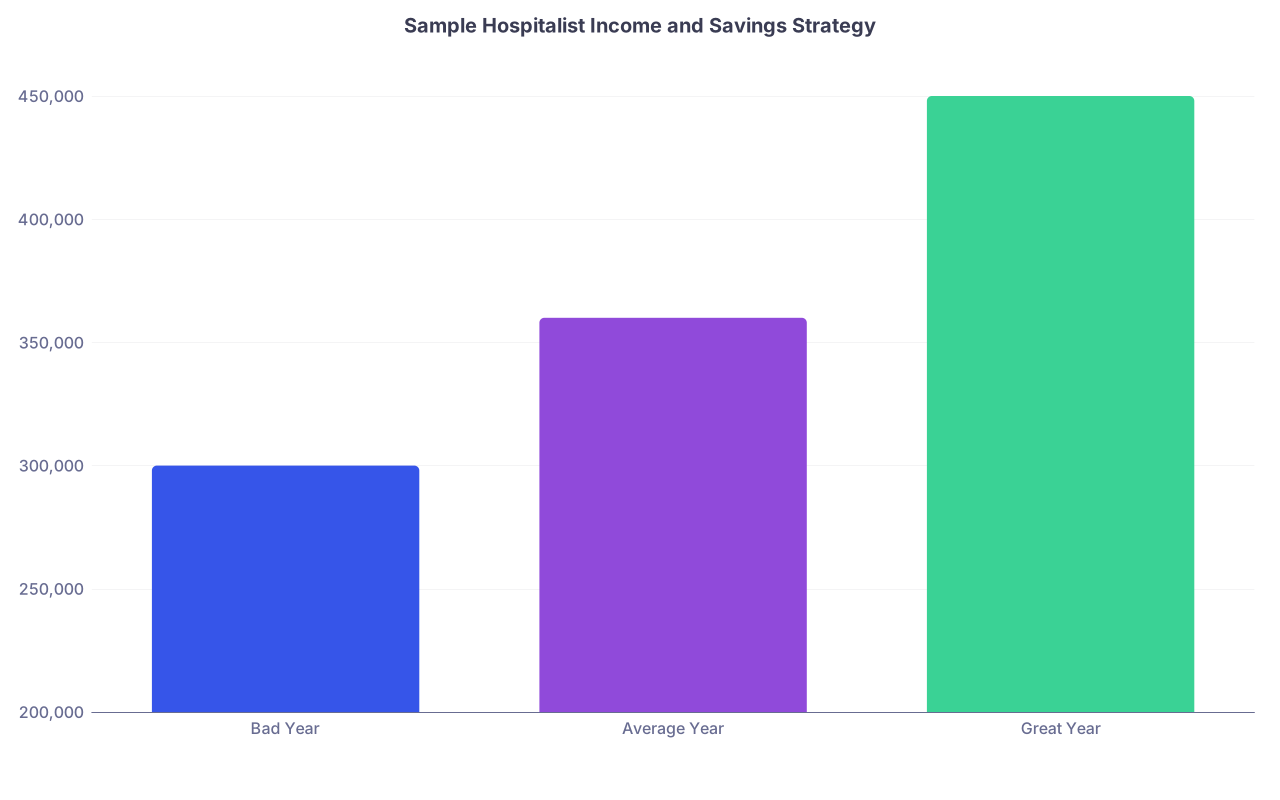
| Category | Value |
|---|---|
| Bad Year | 300000 |
| Average Year | 360000 |
| Great Year | 450000 |
For example:
- Bad year (cut staffing, fewer shifts): hit your floor only.
- Average year: floor + maybe 50% of upside.
- Great year (lots of extra call, locums, bonuses): max everything you legally can.
The key is deciding these tiers before the year starts so you’re not guessing every month.
3. Use the Right Retirement Accounts in the Right Order
You’ve got more tools than you think. The problem is most hospitalists only use one or two.
Step 1: Max your main employer plan (401(k) or 403(b))
Non‑negotiable: you should be trying to hit the employee deferral limit each year if at all possible.
- 401(k)/403(b) employee limit (under 50): check current IRS limit (e.g., $23,000 range).
- Over 50: you get catch‑up contributions.
Employee contributions are per person, not per job. If you have two W‑2 hospital jobs with 401(k)s, your combined employee deferral across them still can’t exceed the annual limit.
Step 2: If you have a 457(b), treat it as a second major bucket
Academic and some large systems offer a 457(b). Huge opportunity.
- 457(b) limit is separate from the 401(k)/403(b) limit.
- Means you can potentially double your tax‑advantaged savings at one employer.
But you need to know: is it governmental or non‑governmental? That matters for risk and rollover options.
Step 3: Add IRA/Backdoor Roth IRA
For most high‑earning hospitalists, you won’t qualify for direct Roth IRA contributions. Use the backdoor if you can:
- Contribute to a non‑deductible traditional IRA.
- Convert to Roth shortly after.
- Avoid having large pre‑tax IRA balances (roll pre‑tax IRAs into an employer plan if available to keep the pro‑rata mess away).
Step 4: For 1099 or locums income, use a Solo 401(k) (not just a SEP)
If you have meaningful 1099 income, a Solo 401(k) is almost always better than a SEP‑IRA for you:
- You can do employer contributions (up to 20% of net self‑employment income).
- Total across all 401(k) type plans is capped, but the employer side for 1099 work is separate from the employee deferral you used at your W‑2.
Roughly, with 1099 net income of $200k, you can usually put ~$37–40k in employer contributions through a Solo 401(k) (exact number depends on calculations and current limits).
A SEP‑IRA messes up the backdoor Roth. Solo 401(k) avoids that if structured right.
Step 5: Use a taxable brokerage for overflow
Once your tax‑advantaged accounts are stuffed, the leftover goes into a plain taxable brokerage:
- Flexible.
- Good for early retirement bridge (before 59½).
- Great for long‑term capital gains rates.
Order of funding in a “great year” might look like:
- 401(k)/403(b) to employee limit.
- 457(b) to limit (if you decide it’s safe enough for you).
- Backdoor Roth IRA.
- Solo 401(k) employer contributions from 1099.
- Taxable brokerage.
4. Turn Unpredictable Income into a Predictable System
Let me walk you through a structure that actually works on the ground.
Use a “base salary” autopilot
Step one: decide what monthly income you “pretend” you make, even if you actually make more.
Example: You gross $380k, but it bounces between $320k and $430k. After taxes and benefits, say you’re taking home around $18k–22k a month.
You set your household budget off a pretend net income of $15k/month.
- You route $15k/month into your main checking for bills, mortgage, etc.
- Anything above that goes to a separate “variable income” or “profit” account.
Now you’re living like you have a stable $15k/month. The variability lives in that profit account, not in your day‑to‑day lifestyle.

| Step | Description |
|---|---|
| Step 1 | Total Paychecks |
| Step 2 | Primary Checking |
| Step 3 | Profit Account |
| Step 4 | Living Expenses |
| Step 5 | Debt Payments |
| Step 6 | Retirement Contributions |
| Step 7 | Tax Savings for 1099 |
| Step 8 | Extra Savings or Fun |
Decide ahead how you’ll use the “profit” bucket
Once a quarter, you look at the balance of the profit account and follow a rule you’ve already set, like:
- 50% to additional retirement/investment (Solo 401(k) employer, taxable).
- 25% to future big expenses (home repairs, cars, kids’ college).
- 25% to “we worked our asses off” lifestyle upgrades (vacation, etc.) — guilt‑free.
Bad year? That account never fills up. You still hit your floor savings via automatic monthly contributions.
Good year? You pile a lot into retirement without needing to renegotiate your lifestyle every paycheck.
5. Handle Taxes Like a Pro (Especially If You Have 1099 Income)
Variable income kills hospitalists who ignore taxes. The IRS does not care that your night shifts got cut Q4.
If you have any meaningful 1099 or locums income:
- Open a separate “tax” savings account.
- Skim 25–35% of every 1099 payment into that account immediately.
- Pay quarterly estimates like clockwork.

| Category | Value |
|---|---|
| Taxes | 30 |
| Retirement | 40 |
| Spending | 30 |
Example: You get a $10,000 locums check.
- $3,000 → tax account.
- $4,000 → Solo 401(k) employer contribution (or set aside for it).
- $3,000 → your main checking/profit account for life stuff.
Also, understand how your filing status and brackets interact with Roth versus pre‑tax decisions:
- If you’re regularly in the highest brackets, pre‑tax is usually king.
- If your income is very up‑and‑down, you can sometimes do partial Roth conversions in low‑income years (e.g., you cut back to 0.6 FTE for six months).
This is where a good CPA who understands physicians pays for themselves. Not the $150 tax shop that just inputs numbers into TurboTax.
6. Protect the Downside First: You’re One Injury Away from Disaster
Retirement planning is pointless if one accident wipes you out.
As a hospitalist with fluctuating income, you’re more likely to “stretch” financially in good years. That increases your risk if something goes wrong.
You need three pillars nailed down:
Disability insurance
Own‑occupation, long‑term, decent benefit size. If your group policy is weak, strongly consider supplemental individual coverage. This is non‑optional for someone whose hands, back, and brain are the entire business model.Term life insurance
If anyone depends on your income (kids, spouse, aging parents), you need enough coverage to replace you financially. The amount should factor in college, mortgage, and your partner’s ability (or inability) to maintain lifestyle without you.Emergency fund
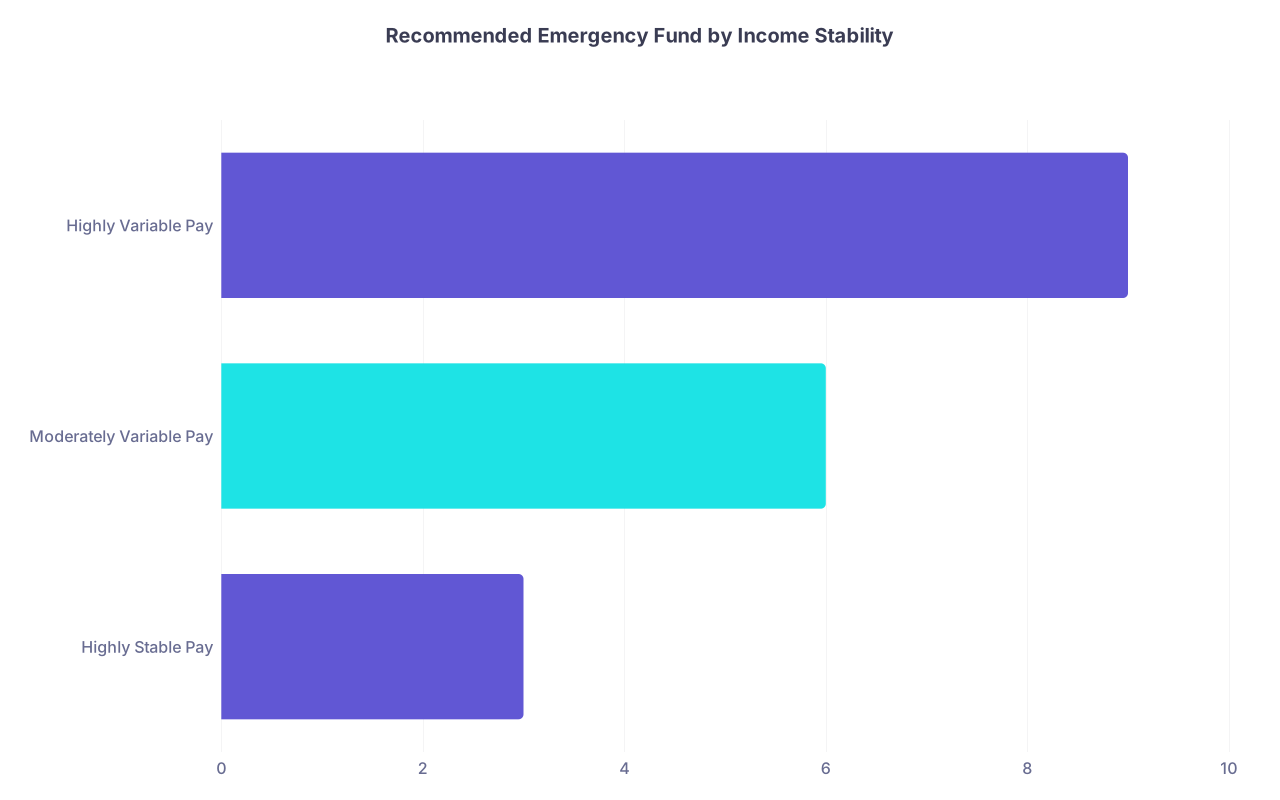
With variable income, three months is weak. Six months is the floor, 9–12 months is reasonable—especially if you’re the main earner and your job situation is volatile.
| Category | Value |
|---|---|
| Highly Stable Pay | 3 |
| Moderately Variable Pay | 6 |
| Highly Variable Pay | 9 |
Numbers above are months of expenses, not income.
7. Translate “I Work a Ton” Into “I Can Actually Retire”
Let’s talk about the endgame: how this all adds up.
As a hospitalist, your peak earnings window is usually quite strong. The tragedy is how many people torch it on lifestyle inflation, constant house upgrades, and cars they barely see because they’re at the hospital.
You need three numbers:
Target annual spending in retirement
Not what you make now. What you actually expect to spend. Many hospitalists land in the $120k–$200k/year range in today’s dollars.Your “enough” portfolio number
Rough rule: multiply that annual spending by ~25.
Spend $160k/year → you’re targeting around $4 million in investments (not counting home equity).Years left in high‑earning mode
Be honest. Are you really doing full‑tilt 7‑on/7‑off at age 65? Probably not. Maybe you’ve got 10–15 “heavy” years, then a slow glide‑path.
Once you have that, you back into what you need to save on average. Variable year‑to‑year is fine as long as your 5‑year rolling average hits the target.
8. A Concrete Example: 40‑Year‑Old Hospitalist With Variable Income
Let me walk this out with real numbers.
You: 40 years old, W‑2 hospitalist. Base salary $260k, plus RVU/bonus/extra shifts. Actual income: $320k–$420k most years.
Married, spouse earns $70k W‑2. Two kids. Some 1099 locums that varies from $0–$60k/year.
You want to retire or at least semi‑retire by 60 with $160k/year after tax in today’s dollars.
Here’s a realistic structure:
- Employer 403(b): You contribute the full employee limit each year (auto‑deducted from paycheck).
- Employer 457(b) (governmental): In average and good years, you also max this. In bad years, you might only do half.
- Backdoor Roth IRA: For you and your spouse, automatic each January.
- Solo 401(k): Any year with >$20k of 1099 net income, you do employer contributions with a target of at least 20% of that.
You set your base household net income at $14k/month. Everything above that flows into the profit account. Each quarter you:
- Make sure tax accounts are funded.
- Top up 457(b) or Solo 401(k) based on how strong the quarter was.
- Put the rest into taxable brokerage or high‑priority goals (paying off a 6–7% loan early is often smarter than getting fancy with investments).
Run those numbers over 15–20 years with even moderate investment returns, and you’re in “work is optional” territory.
Not by accident. By system.
9. Legal and Structural Stuff You Should Not Ignore
You’re in the “Financial and Legal” bucket, so let’s hit the boring but necessary pieces you probably keep avoiding.
At a minimum, you need:
- A will.
- Healthcare proxy / medical power of attorney.
- Financial power of attorney.
- Beneficiary designations set correctly on all retirement accounts and insurance.
- If you have kids: guardians named, and ideally a basic revocable living trust if state law or property situation makes that smart.
Do not put this off. I’ve seen attendings in their 50s still “meaning to get to it.” Then someone gets sick, and suddenly everyone’s scrambling.
For 1099 or side‑gig work
Consider:
- Setting up an LLC or S‑Corp only if your CPA says the tax/administrative tradeoff makes sense.
- Keeping business and personal finances cleanly separated (business checking for locums income and business expenses).
The legal entity won’t save you from malpractice—that’s what your coverage is for—but it can simplify taxes and retirement account setup.
10. When to Bring in Professionals (and What to Watch For)
You do not have to do this alone. You also do not need to hand 1% of your assets every year to the first “wealth manager” who buys you lunch.
Where outside help is valuable:
- A fee‑only, fiduciary financial planner who understands physicians and variable income.
- A solid CPA who has multiple physician clients with 1099 income and small retirement plans.
Red flags to avoid:
- People pushing whole life or “retirement” annuities as their first move.
- Advisors who cannot clearly explain 457(b) risks or backdoor Roth mechanics.
- Anyone who shrugs at your 1099 income and says, “We’ll just see what the refund looks like.”
You want someone who talks to you about:
- Savings rate bands (floor and upside).
- Tax buckets: pre‑tax, Roth, taxable.
- Order of withdrawals in retirement.
- What happens if you cut your hours by 30% at age 52.
If they never ask about your call schedule or burnout risk, they don’t actually get hospitalists.
FAQs
1. What if I’m already in my late 40s and haven’t saved much yet? Is it too late as a hospitalist with variable income?
No, but you’ve lost the luxury of being casual. The advantage you still have is relatively high earning potential for the next 10–15 years. You’ll likely need a higher savings rate—think 25–35% of gross in good years. That means aggressively maxing every tax‑advantaged account you have (401(k)/403(b), 457(b), Solo 401(k) if applicable) and then dumping extra into taxable. You’ll also need to be ruthless about lifestyle creep: smaller home upgrades, fewer car swaps, maybe delaying some big discretionary goals. The combo of high income, structured saving, and smart investing can still get you to a solid, if not luxurious, retirement.
2. Should I prioritize paying off my student loans or maxing retirement accounts if my income swings a lot?
If your loan rates are high (6–7% or more), throwing extra toward them in your good income years makes sense, but not at the expense of completely ignoring retirement. At minimum, I’d still aim to get your employer match (if any) and ideally hit a basic floor retirement contribution annually. Then, in high‑income years, split the excess between accelerated loan payoff and retirement. If you’re in any kind of forgiveness program, the math changes—often you’ll want to prioritize retirement and pay the minimum required on loans.
3. How often should I adjust my retirement plan given my unstable income?
You don’t need to constantly tinker. Once your system is in place (base income, profit account, planned savings tiers), most hospitalists do well with:
- A quick monthly check to confirm autopayments and contributions are happening.
- A quarterly review to decide how much of the profit bucket goes to retirement vs. other goals.
- An annual deep dive to adjust targets, verify contribution limits, and account for any big life changes (new job, divorce, move, etc.).
The variability is in your deposits, not your system. The system should stay fairly stable year to year.
4. What if I plan to cut back from full‑time hospitalist work in my 50s—how does that change my retirement planning now?
It actually makes now more critical. Think of your current full‑time years as your “prime savings window.” You’re trying to front‑load your retirement while your income is highest, so that later you can scale back without panicking. Practically, that means higher savings rates in your 40s, more aggressive use of tax‑advantaged accounts, and likely building a decent taxable brokerage account to serve as a bridge if you stop full‑time work before 59½. When you model your plan, don’t assume you’ll work full‑throttle until 65; assume a gradual ramp‑down and save like that’s the reality—because for most hospitalists, it is.
Key points to walk away with:
- Stop pretending your income is stable; build a system that has a savings floor and upside tied to how the year actually goes.
- Use all your tools—401(k)/403(b), 457(b), Solo 401(k), backdoor Roth, taxable—not just one or two, especially if you have 1099 income.
- Protect the downside (insurance, legal basics, emergency fund) and front‑load your savings while you’re still willing to grind 7‑on/7‑off, because that window does not stay open forever.


