
Your primary residence is a lifestyle choice, not a retirement strategy. Treating it like your 401(k) with granite countertops is how high-income physicians end up “asset rich, cash poor” at 62 and quietly panicking.
Let’s go straight at the myth: “My house will take care of me in retirement.” No, it will not. And the data from actual retirees, actual housing markets, and actual physician balance sheets is brutally clear about why.
The Core Problem: A House Doesn’t Pay You
Your house does three things very well: it gives you shelter, it gives you status, and it eats cash.
What it does not do by default is produce income.
The fundamental retirement equation is simple: you stop working, something else has to send you cash every month for the next 20–40 years. That “something else” can be:
- A diversified portfolio (stocks, bonds, real estate funds)
- A pension (if you still live in that fairy tale world)
- Rental properties that other people live in
- Part-time work
Your primary residence is none of those.
I’ve sat with physicians in their late 50s who had:
- $2.5M house
- $300k in retirement accounts
- $40k in taxable investments
And they’d say the same line: “But our house is our big asset.”
Asset, yes. Retirement plan, no.
The Illiquidity Trap
You cannot sell 7% of your kitchen to cover living expenses. Your house is a giant, indivisible, illiquid asset. To get money out, you have to:
- Sell and move
- Borrow against it
Both have costs. And both assume the housing market is feeling generous right when you need cash.
That’s not a plan. That’s a hope.
What The Data Actually Shows About Housing As “Investment”
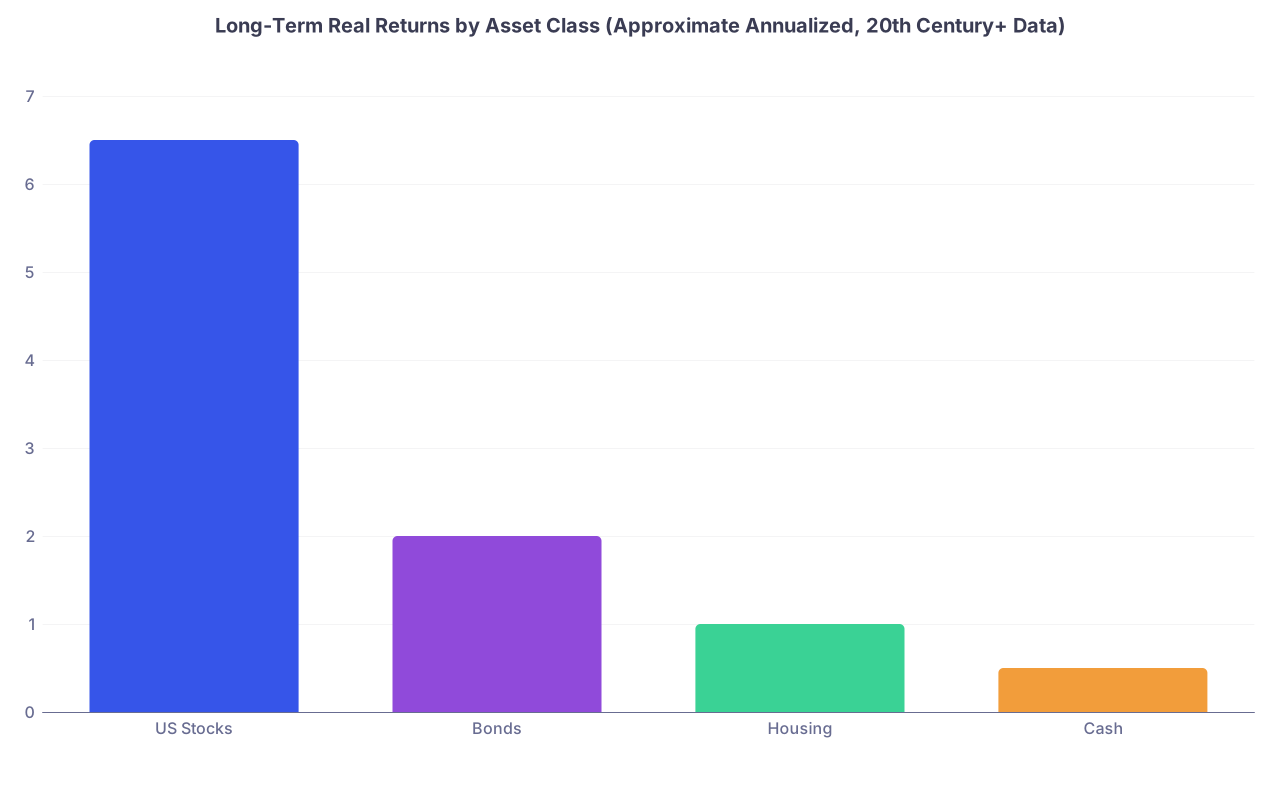
Let me ruin a popular cocktail-party fantasy: houses do not generate the kind of real (inflation-adjusted) returns people think they do.
| Category | Value |
|---|---|
| US Stocks | 6.5 |
| Bonds | 2 |
| Housing | 1 |
| Cash | 0.5 |
These are ballpark long-term real returns, based on data from sources like Robert Shiller (for housing) and historical market returns:
- US stocks: ~6–7% real
- Bonds: ~2% real
- Housing: ~1% real
- Cash: basically zero
The appreciation of your primary home largely tracks inflation plus a little extra. The big “gains” people brag about are often just inflation and leverage dressed up as genius.
Example: The Fake Win
You bought a house for $800k. Twenty years later, it’s “worth” $1.6M. You feel like a genius.
Nominal gain: $800k
Annualized return: about 3.5%
Inflation over many 20-year periods? Often 2–3% per year.
Your real gain? Maybe 0.5–1.5% per year, before transaction costs, maintenance, taxes, and insurance.
And those costs are not rounding errors.
The Real Cost Of That “Retirement Plan” You Live In
A high-end physician house is a cash-flow black hole.

Let’s run a fairly typical upper-middle-class physician scenario.
- $1.5M house
- 20% down ($300k), $1.2M mortgage
- 4.5% interest rate on a 30-year mortgage
- Property taxes: 1.25% of value (~$18,750/year)
- Insurance: $3,500/year
- Maintenance/repairs: rule-of-thumb 1–2% of value/year → say 1.5% = $22,500/year
Just rough numbers, but:
Mortgage payment (P&I): around $6,080/month ≈ $73,000/year
Taxes + insurance + maintenance: ~$44,750/year
Total annual cash outflow: about $118,000
None of that is income-producing. It’s all consumption.
Yes, some goes to principal. Yes, some of this may be deductible sometimes. That’s not the point. The point is: this is not a productive retirement asset. It’s an expense.
Now compare that to what the same $300k down payment could be doing in a boring, globally diversified portfolio for 25 years at 5–6% real returns.
At 5.5% real over 25 years, $300k becomes roughly $1.17M in today’s dollars. Liquid. Diversified. Able to throw off $40–50k/year in sustainable withdrawals.
Your house gives you a place to sleep. The portfolio gives you a paycheck.
“I’ll Just Downsize Later” – Will You?
This is the physician equivalent of “I’ll start eating healthy next month.”
The story: “We’ll enjoy the big place now, then sell at 65, downsize, and unlock a million in equity.”
Sometimes that happens. More often, life punches holes in that script.
Here’s what I’ve seen repeatedly in physician families:
- The “big house” becomes the family headquarters. Adult kids, grandkids, holidays. People get emotionally trapped.
- One partner clings to the house because it represents stability/identity.
- The market is weak right when you want to sell. Suddenly that $2M “Zestimate” is a $1.5M reality after agent fees and a year on the market.
- Health issues appear and moving becomes logistically brutal.
Even when downsizing happens, the math rarely looks as pretty as the fantasy.
| Item | Amount |
|---|---|
| Sell original home | $2,000,000 |
| Agent fees (5%) | -$100,000 |
| Closing/repairs/concessions (~2%) | -$40,000 |
| Remaining mortgage payoff | -$600,000 |
| Net cash from sale | $1,260,000 |
| Purchase smaller home | -$900,000 |
| Moving/renovation costs | -$60,000 |
| Actual investable equity freed | $300,000 |
That $300k is useful, sure. But it’s not some magic $2M retirement engine you’ve been counting on in your head.
And you had to move, shrink your space, and go through logistical hell to get it.
Counting on “future downsizing” as a primary retirement pillar is procrastination wearing a spreadsheet.
The Physician-Specific Trap: Income Masks Bad Planning
Physicians are uniquely vulnerable to the “my house is my retirement plan” delusion for one simple reason: they can afford the payments. For decades.
When you’re bringing in $350–700k, a $8–10k/month housing burn feels tolerable. You still max your 401(k). You still take the trips. It “works.”
Until it doesn’t.
Your high income allows you to:
- Overspend on housing for years
- Underfund truly productive retirement accounts
- Convince yourself you’re “doing fine” because you’re not in visible distress
You wake up at 55 with:
- A great house
- A solid, but not overwhelming, retirement portfolio
- A lifestyle calibrated to high burn
- 10–15 years max to cram for retirement
That’s when the “house is my backup plan” narrative shows up. It’s not a plan. It’s a patch for 20 years of misallocation.
What Actually Works For Retirement – Boring, But Real
Let me flip this around: what does work if you want to retire with options?
It’s not complicated, but it is annoyingly unsexy:
- Primary residence: comfortable but deliberately not maximal
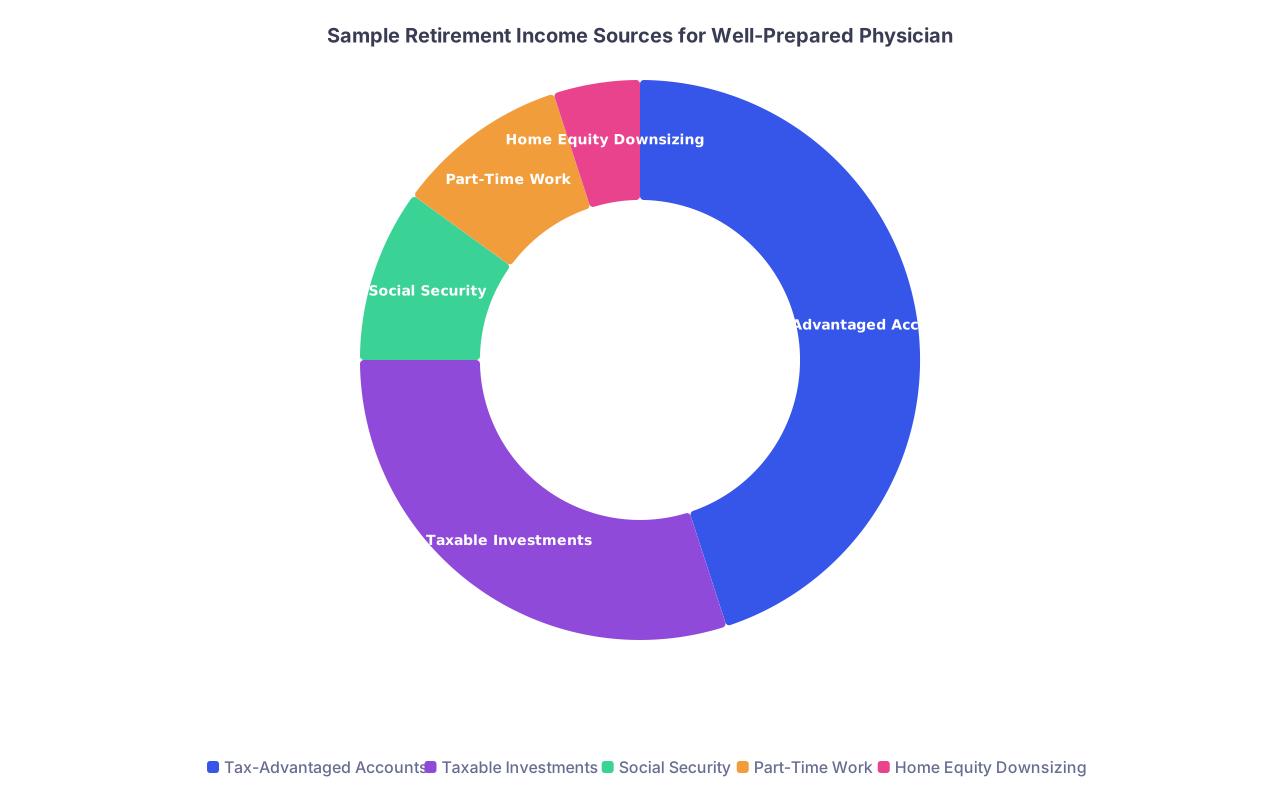
- Aggressive use of tax-advantaged accounts: 401(k)/403(b), 457(b), backdoor Roth IRAs, HSA
- A substantial taxable brokerage portfolio that you steadily fund
- Possibly real rental properties or REITs if you like real estate
- Conservative assumptions for withdrawal: 3–4% of total investable assets per year
| Category | Value |
|---|---|
| Tax-Advantaged Accounts | 45 |
| Taxable Investments | 30 |
| Social Security | 10 |
| Part-Time Work | 10 |
| Home Equity Downsizing | 5 |
Notice where home equity sits: last, and small. A nice-to-have. Not the engine.
The House You Live In vs. Real Estate As An Asset
Here’s the nuance a lot of people gloss over: I’m not anti-real-estate. I’m anti-confusing-consumption-with-investment.
Residential real estate can be a powerful wealth-builder:
- If you own rental units that produce positive cash flow and appreciate over decades
- If you buy into diversified real estate funds (REITs) as part of your portfolio
- If you buy below your means and let a modest mortgage quietly amortize
But your primary residence behaves very differently from a well-analyzed rental.
Rental property: You run numbers like cap rate, cash-on-cash, net operating income. You treat it like a business.
Primary residence: You choose based on school district, kitchen aesthetics, commute time, emotional vibes.
Those are fine criteria for living. They’re terrible criteria for retirement planning.
Liquidity, Sequence Risk, And Why Timing Will Punch You
Retirement risk isn’t just “will my investments grow enough.” There’s also sequence-of-returns risk: the risk of bad markets right when you start drawing down.
If your “plan” is:
- Invest some
- Then at 65, sell the house for a huge sum
- Dump it into the market
- Start withdrawals
You’ve created a massive, one-shot exposure to market timing and housing timing simultaneously. Both are volatile. Both can and do move against you.
I’ve watched people hit 2008 trying to sell, and 20–30% of their expected home value just evaporated at exactly the wrong time. They didn’t lose equity on paper—they lost it when they had to transact.
You can’t smooth that out with dollar-cost averaging. You can’t “wait for the rebound” if you also need to pay for food and healthcare.
Spreading your wealth-building over 20–30 years into liquid, diversified assets is how you avoid that cliff.
The Physician Reality Check: A Simple Litmus Test
If you’re a mid-career or late-career physician, here’s a blunt test:
Ignore your primary residence completely. Does your other portfolio (retirement + taxable + any actual rental properties) support the life you want at a 3–4% withdrawal rate?
If yes: good. Your house is a bonus lever—more safety, more options, maybe earlier retirement if you want to use it.
If no: your house is not a plan; it’s a crutch. And you’re behind.
The solution is not to invent elaborate “someday we’ll sell and move to a cheaper state” stories. The solution is to:
- Get very honest about spending
- Right-size housing if needed while you still have high income
- Dramatically increase contributions to real retirement assets

| Step | Description |
|---|---|
| Step 1 | Current Age 40-55 |
| Step 2 | House is lifestyle choice |
| Step 3 | Consider downsizing while working |
| Step 4 | Increase savings rate elsewhere |
| Step 5 | Boost retirement accounts |
| Step 6 | Non-home assets on track? |
| Step 7 | Housing >2x gross income? |
But What About Paid-Off Houses In Retirement?
A paid-off house at 65 is great. I’m completely in favor of that.
The myth I’m attacking is not “pay off your mortgage.” It’s “my house is my retirement plan.”
A paid-off house does three useful things in retirement:
- Lowers your fixed monthly costs – big win
- Gives psychological security – also real
- Provides an optional backstop (reverse mortgage, sale, or downsizing) if things go badly
That’s all fine. That’s sane. The error is treating that optional backstop as your main engine.
Your retirement engine is the portfolio, pensions, and any income streams. Your house is the safety net. Don’t confuse the two.
What To Actually Do Now
If you’re younger in your career, here’s the uncomfortable but accurate guidance:
- Buy less house than the bank says you can “afford.”
- Channel the difference into retirement accounts automatically.
- Assume your primary residence will roughly keep up with inflation. Anything more is gravy, not a guarantee.
If you’re mid-late career and already stretched:
- Stop telling yourself the house will bail you out.
- Run real numbers on “if we sold tomorrow” vs “if we keep this and supercharge savings for 10 years.”
- Be willing to cut square footage to buy back decades of financial security.
You do not need to live like a resident forever. You just need to stop pretending that crown molding and a three-car garage are a pension plan.
Key points:
- Your primary residence is consumption with side-effects, not an income-producing retirement asset.
- Physician incomes hide under-saving for decades, and “I’ll just use the house” is usually code for “I’m behind and don’t want to change.”
- Real retirement security comes from liquid, diversified, income-generating assets; your home should be backup, not the plan.