74% of physicians who think they “have a financial guy” cannot correctly state their own annual investment fees when asked in surveys.
So let’s kill the sacred cow: “If I’m a doctor and hire a financial advisor, I’ll be fine for retirement.”
Maybe. But the data says that’s far from guaranteed.
The more honest version is: most physicians will retire comfortably if they avoid big mistakes and save enough—advisor or not. The advisor might help with that. Or they might just siphon off six figures in quiet fees while you do the hard part (earning and saving) anyway.
Let me walk through what the numbers actually say, not what the industry brochure says.
What “Retiring Comfortably” Really Takes For Doctors
You cannot answer “Do I need an advisor?” until you define the finish line.
For most US physicians, “comfortable retirement” usually translates to:
- Maintain roughly 60–80% of peak attending income
- No fear of running out of money in a normal lifespan
- Flexibility for travel, grandkids, some luxuries, without working by necessity
If you’re a hospitalist making $280k or an orthopod at $600k, that “number” changes, but the math logic does not.
Let’s simplify with evidence-based planning numbers:
- Safe withdrawal rate: 3–4% of your portfolio per year (more conservative post-2020 interest/inflation environment is often closer to 3.5% than the old 4% rule)
- Want $180k/year from investments?
- At 3.5% withdrawal → you need about $5.1M invested
- Want $120k/year?
- At 3.5% → about $3.4M
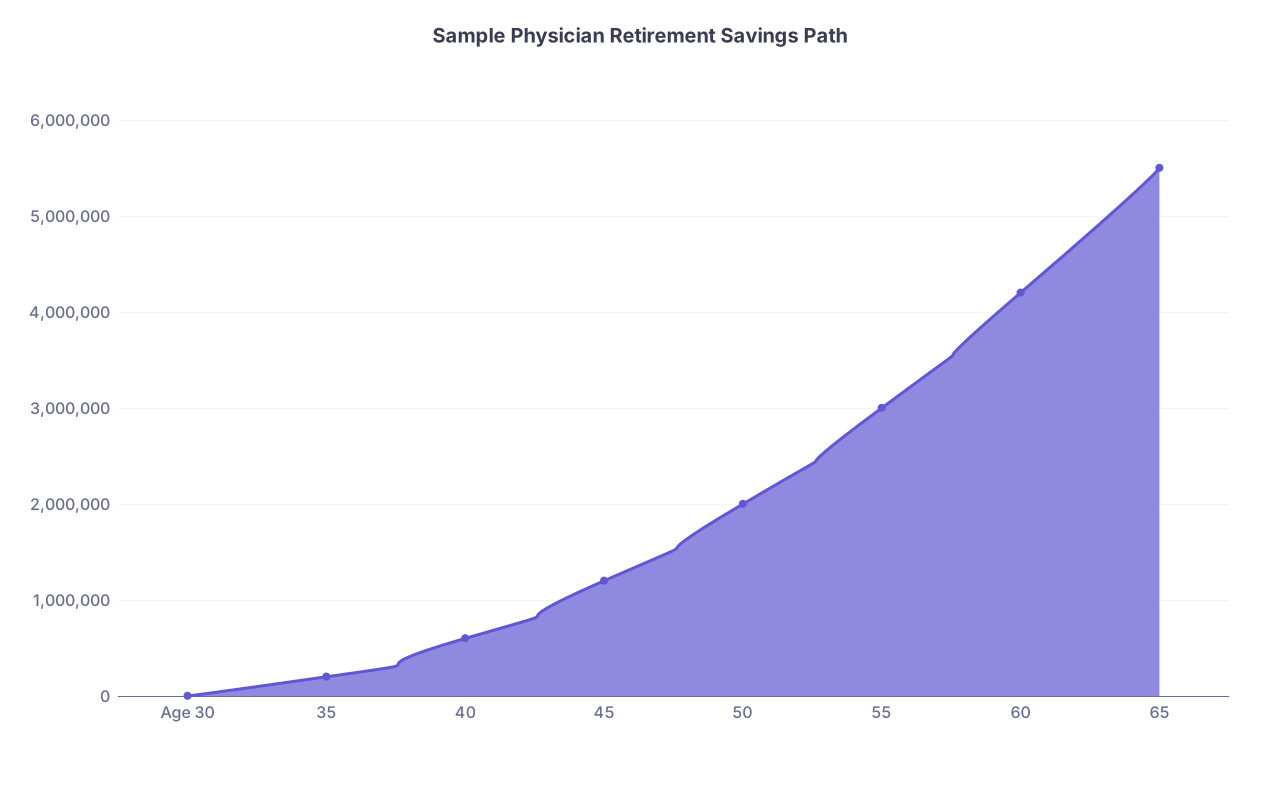
Most dual-physician couples and even many single physicians can absolutely hit those numbers over a 25–30 year career if they:
- Save 20%+ of gross income consistently
- Invest in low-cost diversified index funds
- Avoid lifestyle creep catastrophes (giant houses, endless car payments, private school for every kid when they can’t afford it)
None of that inherently requires a financial advisor.
That’s the first myth: that retirement comfort is primarily a strategy problem. For docs, it’s usually a behavior and savings rate problem.
What The Data Actually Says About Advisors And Outcomes
You’ll hear advisors quote studies that “advised investors earn 3% higher returns per year” or “are better prepared for retirement.” Sounds great. Then you read the fine print.
Most of these studies:
- Are funded by the financial services industry
- Compare advised clients to completely disengaged, do-nothing investors
- Contain survivorship and selection bias (people who bother hiring advisers are often higher earners, more disciplined, and more likely to save anyway)
There are some reasonably solid findings though:
Behavioral coaching has real value.
Vanguard (yes, they sell products, but they’re relatively low-fee) estimated “advisor alpha” at around 3% per year, but most of that is not stock picking. It’s:- Keeping you from panic-selling in crashes
- Forcing some tax efficiency
- Making you stick to a plan
That’s not wizardry. It’s guardrails.
High fees quietly destroy returns.
A 1% annual advisory fee sounds tiny. For a physician? It’s not.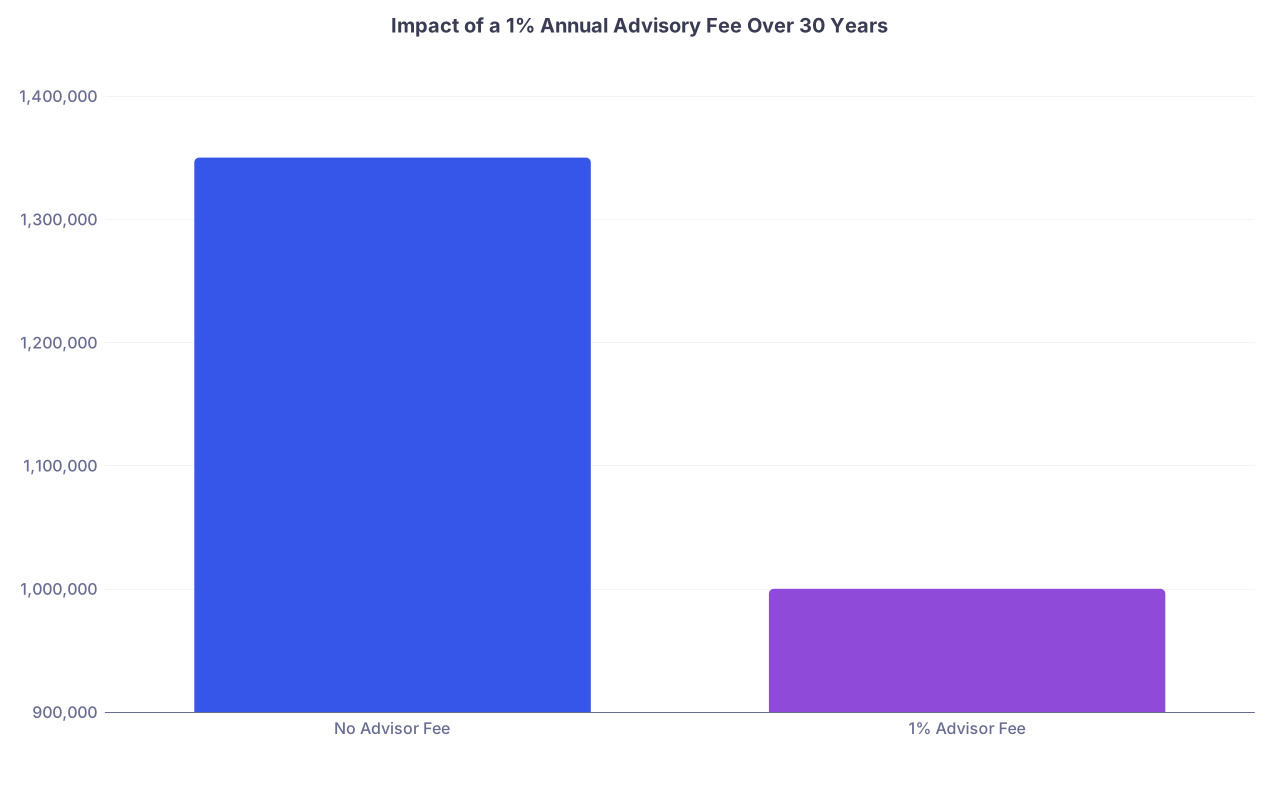
Impact of a 1% Annual Advisory Fee Over 30 Years Category Value No Advisor Fee 1350000 1% Advisor Fee 1000000 Simple ballpark: invest $30k/year for 30 years at 7% vs 6% (7% market return minus 1% fee). You’re looking at roughly:
- ~$1.35M at 7%
- ~$1.0M at 6%
That 1% fee “cost” is hundreds of thousands of dollars over a career. For surgeons depositing $80–100k/year, the difference can easily be over $1M.
Stock-picking and market timing almost never add value.
The SPIVA reports (S&P Indices vs. Active) repeatedly show 80–90% of active funds underperform their benchmarks over 10–15 years. Your advisor is usually picking those funds. That means:- You pay them
- You pay fund fees
- You underperform simple index funds anyway
So the data-backed verdict: advisor value, when it exists, comes from planning, behavior, taxes, and estate—not investment genius. If you’re paying them for “beating the market,” you’re buying a fairy tale.
Where Most Doctors Actually Screw Up (With Or Without Advisors)
I’ve seen the same pattern across attendings in IM, EM, ortho, anesthesia—you name it.
The real wealth killers are:
Late start + giant loans
- Finish fellowship at 32–35 with $300–500k+ in loans
- Spend first 5–7 years “catching up on lifestyle” instead of wealth
By the time they get serious, they’ve blown the most valuable compounding window.
Lifestyle creep outpacing income
This is the big one. New attending buys:- $1.2M house
- Two leased luxury cars
- Private school for two kids
Savings rate drops into the single digits. At that point, it barely matters if your advisor is “good.”
Overpaying for complexity
Advisors love complexity because complexity justifies fees:- 12 different mutual funds
- 3 annuities
- Whole life insurance “for retirement”
- Private real estate funds they “have access” to
Most of this is unnecessary for a high-income physician who could crush it with 3–5 index funds, a solid savings rate, and basic estate docs.
So here’s the uncomfortable truth: many physicians who “have a guy” still retire late or anxious, not because the advisor failed to pick good funds, but because no one forced them to actually save enough or keep their lifestyle under control.
An advisor cannot fix a 5% savings rate and a bloated lifestyle.
Situations Where A Financial Advisor Is Genuinely Valuable
Now the contrarian twist: I’m not anti-advisor. I’m anti-blind-faith and anti-fee-gouging.
There are situations where a good advisor is absolutely worth paying for:
1. You won’t actually do this yourself
Be honest here. Not Instagram honest. If:
- You hate this stuff
- You procrastinate endlessly on actually opening the SEP-IRA or solo 401(k)
- You get analysis paralysis moving from a target-date fund to a 3-fund portfolio
Then a fiduciary, low-fee advisor can be the difference between:
- 0–5% savings in random accounts
- 20%+ savings in a coherent plan
I would rather see you pay 0.3–0.5% of AUM or a flat annual fee and actually save/invest, than insist on DIY perfection while doing nothing.
2. Complex tax and entity situations
For physicians who are:
- Practice owners with multiple entities
- Juggling partnership buy-ins, defined benefit plans, 401(k) profit sharing
- Working locums across states with messy tax exposure
A good planner coordinated with a competent CPA can create tens of thousands per year in tax savings. That’s real alpha.
This is especially true when you’re layering:
- Cash balance pension plans
- Backdoor Roths / mega-backdoor Roths
- Solo 401(k) for side gigs
- Asset location (what goes in Roth vs taxable vs pre-tax)
Most doctors are not going to do this well solo. Fair.
3. Estate, asset protection, and special needs
If you have:
- Kids from prior marriages
- High liability risk (surgeons, OB, EM)
- Loved ones with special needs
- Significant real estate or practice equity
Then coordinated planning (advisor + estate attorney) can mean:
- Heirs don’t get crushed by bad titling or tax treatment
- Assets are protected as much as your state law allows
- You don’t leave a disorganized mess behind
That is worth real money and stress avoided.
What Kind Of Advisor Model Makes Sense For Doctors?
This is where most physicians get fleeced. The model matters more than the marketing.
| Model Type | Typical Cost | Best Use Case |
|---|---|---|
| AUM % (Assets) | 0.5–1.0% per year | High-touch planning, low DIY |
| Flat Annual Fee | $2k–$10k per year | Higher net worth, complex plan |
| Hourly Planning | $200–$500 per hour | Targeted, limited questions |
| Commission-based | Hidden in products | Generally avoid |
The usual “1% of assets under management” is lazy pricing for doctors. Very profitable for them, very questionable for you.
For a $3M portfolio, 1% is $30,000/year. Every year. Even if they barely rebalance.
Better options for most physicians:
- Flat-fee planning: e.g., $3–8k per year depending on complexity
- Hourly consults: one-time or periodic checkups to validate your DIY plan
- Low-AUM-fee advisors: 0.3–0.5% with clear, written fiduciary duty
Anything with commissions on products (whole life, variable annuities, front-loaded mutual funds) should set off alarms.
You want:
- Fee-only (not fee-based)
- Fiduciary, in writing
- No proprietary products
- Simple, understandable portfolio
If they can’t explain your entire investment strategy in one page of English, they probably don’t deserve your trust or your fees.
How Much Of This Can A Doctor Realistically DIY?
Here’s the unsentimental answer: many physicians are absolutely capable of doing 80–90% of this themselves with a few good books and a weekend of focused effort.
The core skills needed:
- Understand your savings rate target (20–25%+ of gross is a solid physician benchmark)
- Learn basic index fund investing (a 3–5 fund portfolio across US stock, international, and bonds)
- Set up automatic investing into:
- 401(k)/403(b)/457(b)
- Roth IRA/backdoor Roth
- Taxable brokerage
- Keep insurance clean:
- Term life, not whole life
- Own-occupation disability policy
- Avoid investment-embedded insurance products
The process from med school debt to retirement comfort is more like this than like some complicated Wall Street movie:

| Step | Description |
|---|---|
| Step 1 | Resident with debt |
| Step 2 | Early attending, pay loans |
| Step 3 | Increase saving rate to 20 percent |
| Step 4 | Max tax advantaged accounts |
| Step 5 | Invest in low cost index funds |
| Step 6 | Pay off mortgage |
| Step 7 | Portfolio 3 to 5 million plus |
You do not need an advisor to follow that arc. What you might need is:
- Accountability
- Occasional course-correction
- Someone to tell you “no, you do not need the 7,000 sq ft house yet”
You can buy that help selectively instead of permanently renting it at 1% of your net worth.
The Biggest Myths About Advisors And Physician Retirement
Let’s knock out a few persistent fantasies I’ve heard in physician lounges and M&M conferences:
“I have a financial advisor, so I’m set.”
I’ve reviewed enough “plans” to tell you: many are just glorified sales pitches with projections assuming:- 8–9% annual returns
- Aggressive withdrawal rates
- Laughable expense estimates
Your advisor cannot override a low savings rate or chronic overspending.
“Advisors have access to better investments.”
Translation: higher-fee, less transparent stuff. Hedge-fund-lite “alts,” private REITs, variable annuities.
Actual high-quality opportunities are limited to ultra-high-net-worth and institutions. Most docs are being sold complexity, not performance.“Doctors are too busy to manage money.”
Doctors are too busy to reinvent tax law, sure. But you’re telling me a person who mastered cardiology cannot understand a 3-fund portfolio and basic tax-advantaged accounts? Come on.
The problem is interest, not intelligence.“It doesn’t matter what they charge if they get me to my goal.”
That’s like saying it doesn’t matter what the hospital charges as long as the patient survives. Costs matter.
Over a 30-year attending career, you can easily pay $300k–$1M+ in advisory and product fees. That’s not pocket change.
Where The Line Really Is: Do You Need An Advisor To Retire Comfortably?
Blunt answer:
- No, you do not inherently need a financial advisor to retire comfortably as a physician.
- Yes, you may benefit from one if:
- You will not implement basic strategies alone
- You have real complexity around taxes, ownership, or estate issues
- You want behavioral guardrails and are willing to pay for them intelligently
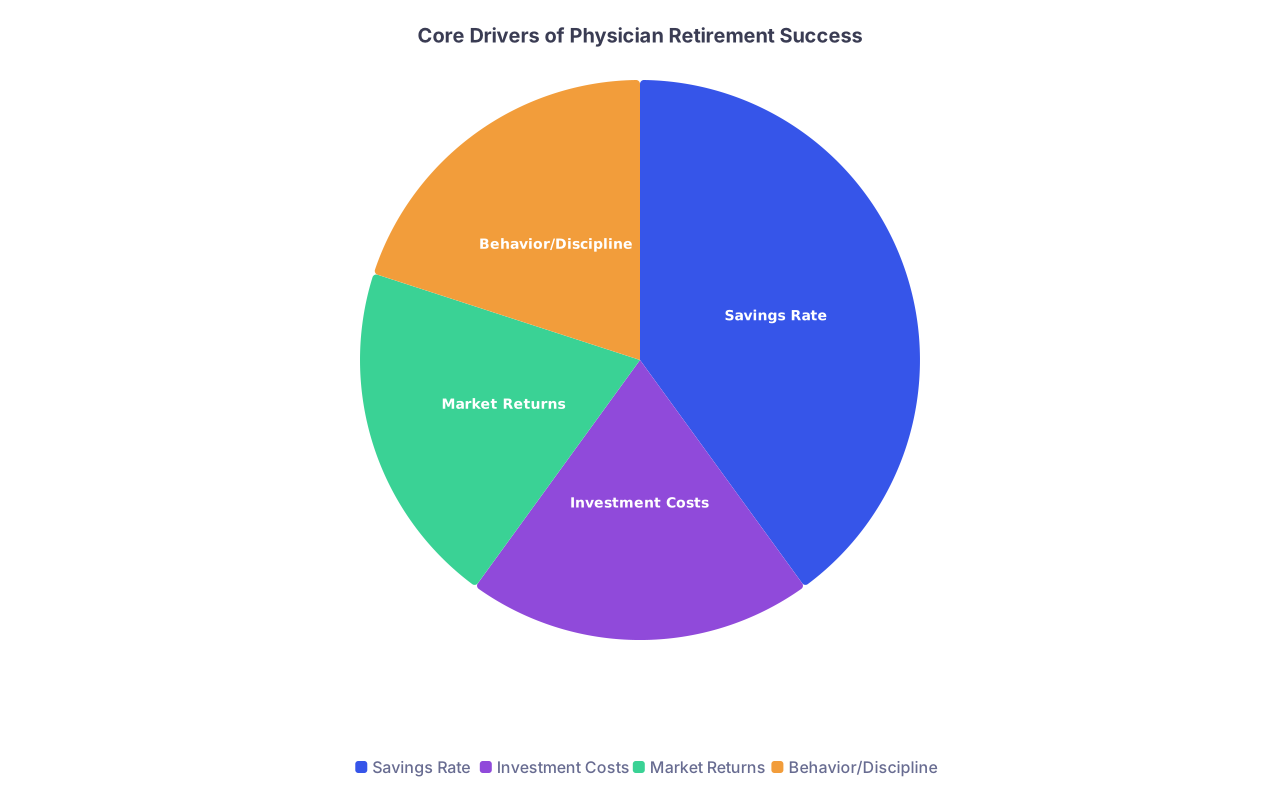
The non-negotiables for a comfortable physician retirement are surprisingly boring:
| Category | Value |
|---|---|
| Savings Rate | 40 |
| Investment Costs | 20 |
| Market Returns | 20 |
| Behavior/Discipline | 20 |
Most of the win comes from:
- Sustained savings rate
- Avoiding dumb products and high fees
- Staying invested through volatility
You can get that with:
- A DIY approach plus an occasional paid second opinion
- A low-fee, truly fiduciary planner
- Or a mix of both over your career
You just do not need to outsource your brain and your wallet to the first “wealth manager for physicians” who drops a glossy brochure in the doctors’ lounge.

| Category | Value |
|---|---|
| Age 30 | 0 |
| 35 | 200000 |
| 40 | 600000 |
| 45 | 1200000 |
| 50 | 2000000 |
| 55 | 3000000 |
| 60 | 4200000 |
| 65 | 5500000 |


| Step | Description |
|---|---|
| Step 1 | Doctor asking if advisor needed |
| Step 2 | DIY plus occasional hourly check |
| Step 3 | Hire flat fee or low AUM fiduciary |
| Step 4 | Basic low fee advisor or DIY |
| Step 5 | Will you implement a simple plan alone |
| Step 6 | Complex taxes or practice ownership |
Key points:
- Most physicians can retire comfortably without a financial advisor if they save enough, invest simply, and avoid high-fee products.
- Advisors are most valuable for behavior coaching, tax/estate complexity, and implementation—not for stock-picking magic.
- If you hire one, make the fees explicit, keep the investments simple, and remember: your savings rate and discipline matter more than their sales pitch.