
Why ‘Doctors Always Retire Late’ Is More Myth Than Inevitable Fate
What if the whole “doctors always work until they drop” story is mostly an excuse people tell themselves for bad planning?
Let me be blunt: late retirement is common in medicine, but it’s not destiny. It’s usually a financial, psychological, or identity problem that started 20–30 years earlier and was never corrected. And a lot of what you’ve heard about physicians needing to work into their late 60s or 70s collapses as soon as you look at real data.
This isn’t about feel‑good reassurance. It’s about dismantling the lazy myths that keep doctors from making rational retirement plans.
What the Data Actually Shows About When Doctors Retire
First, let’s kill the idea that “all doctors” retire late.
Several studies and surveys (from AMA, specialty societies, and Medscape-type physician surveys) show roughly this pattern:
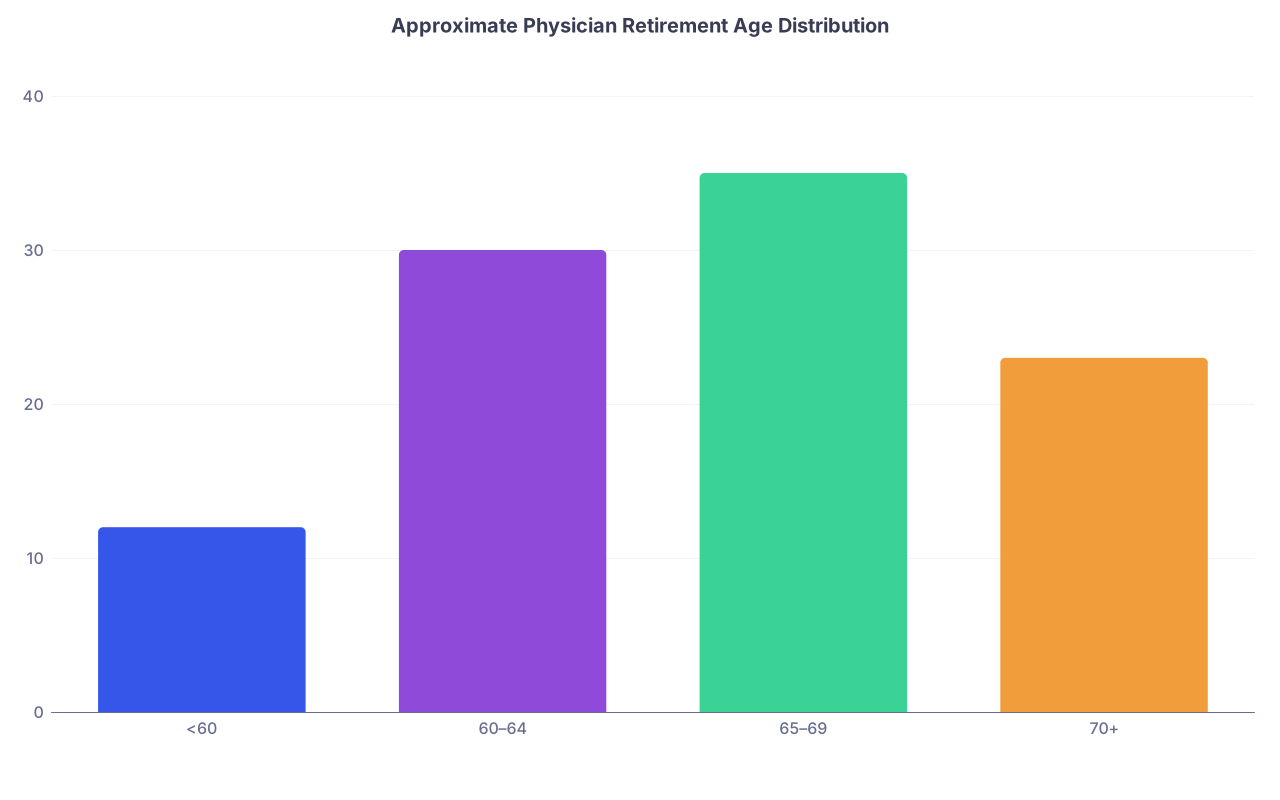
| Category | Value |
|---|---|
| <60 | 12 |
| 60–64 | 30 |
| 65–69 | 35 |
| 70+ | 23 |
No, the exact percentages vary by dataset, but the shape is consistent:
- A minority retire early (before 60).
- A big chunk retire in the “normal” window (60–69).
- A non-trivial minority works into their 70s — often because they want to or because they’re trapped.
The point: it’s not some universal law that physicians retire late. It’s a distribution. And your place on that curve is far more about your choices and planning than your MD/DO degree.
Compare this to the myth sold in hospitals and doctors’ lounges: that you’ll “never be able to retire before 70” because of loans, lifestyle, kids, aging parents, you name it. Convenient narrative. Not remotely universal.
I’ve seen academic attendings walk away at 58 with no drama. I’ve also seen private practice docs in their 70s still grinding full clinic weeks because they literally can’t afford to stop. Same degree. Different behavior over 30 years.
Myth #1: “Student Loans Make Early Retirement Impossible”
This is the go‑to excuse for anyone under 45.
“Yes but my loans are different.”
No, they’re not.
Let’s be clear: six-figure loans are a problem. They delay wealth-building. They create anxiety. But they don’t mathematically require you to retire at 70, unless you compound them with two other choices: inflated lifestyle and no investing.
Here’s what the numbers typically look like in broad strokes.
| Scenario | Lifestyle vs Income | Investing Start | Likely Retirement Window |
|---|---|---|---|
| A | Lives near means | Within 1–2 years of attending | 55–62 |
| B | 20–30% below means | Immediately on attending start | 50–58 |
| C | 20–30% above means | 8–10 years delayed | Late 60s–never |
Three doctors. Same loans. Same income bracket. Totally different outcomes.
Loans are a temporary drag. Lifestyle creep and under‑investing are permanent if you don’t stop them.
What actually keeps doctors chained to late retirement is this stack:
- No clear target number or age.
- Chronic under‑saving in the early 5–10 attending years.
- Belief that “I’ll make up for it later” — right before college costs, aging parents, and burnout show up.
If you’re early or mid‑career and think your loan balance is the main reason you’ll retire late, you’re almost certainly looking at the wrong variable.
Myth #2: “Physicians Need Way More Money Than Everyone Else to Retire”
The “doctor lifestyle” myth is one of the most expensive lies in the profession.
You don’t need a $10M portfolio to retire as a physician. You probably don’t even need $5M. You need an amount that supports your chosen lifestyle in a tax‑efficient way. That’s it.
Let’s put some scale on this. Assume you can safely support ~3–4% withdrawals long-term (not a law, but a working rule). Here’s what that translates to:
| Portfolio Size | 3% Withdrawal | 4% Withdrawal |
|---|---|---|
| $2,000,000 | $60,000 | $80,000 |
| $3,000,000 | $90,000 | $120,000 |
| $4,000,000 | $120,000 | $160,000 |
| $5,000,000 | $150,000 | $200,000 |
| $6,000,000 | $180,000 | $240,000 |
Now pair that with:
- Social Security (for many, $30–$45k/yr combined if married, depending on history and claiming).
- Maybe some practice sale proceeds.
- Maybe part‑time work, consulting, or teaching for a few years.
Suddenly, needing $300–$400k a year after tax to retire in your 50s or early 60s starts to look like what it is: a choice to sustain a very high‑burn lifestyle, not a medical necessity.
I’ve sat in rooms where physicians said, with a straight face, “I couldn’t possibly live on less than $250k a year.” Same person: driving two luxury cars, private school for three kids, giant house in a premium zip code, and zero clue what they actually spend.
So no — being a doctor doesn’t inherently require a massive retirement number. Being a doctor who insists on permanent peak‑status consumption does.
The Real Drivers of “Late Retirement” in Medicine
Let’s stop pretending the main problem is math. Most of the time it isn’t.
1. Identity addiction
A huge number of physicians aren’t just doing a job. They are a doctor. Period. It’s their social currency, their self-worth, their story.
I’ve heard the line dozens of times: “I don’t know who I’d be if I retired.”
That’s not a financial issue; that’s a psychological one. Those physicians keep working because the alternative feels like death of self. Which means they never seriously engage in planning a transition.
If you don’t build an identity beyond “active clinician,” you almost guarantee yourself some version of late retirement — because retiring will feel like annihilation instead of a phase change.
2. No real retirement target, just vague dread
Ask 10 mid-career physicians what their “number” is, and most will give you one of three answers:
- A random big number they heard somewhere (“probably like $5 million?”).
- “No idea, that’s why I have a guy.”
- Some version of “enough to be comfortable,” with zero specifics.
That’s not a plan. That’s hand‑waving.
Contrast that with the physicians who actually retire in their 50s or early 60s. They almost always:
- Know their spend within a reasonable range.
- Have a target or at least a range of portfolios that = “work optional.”
- Model taxes, healthcare, and sequence risk with someone competent.
Once you do that, retirement stops being this mystical event at “age 70+” and starts becoming a solvable equation.
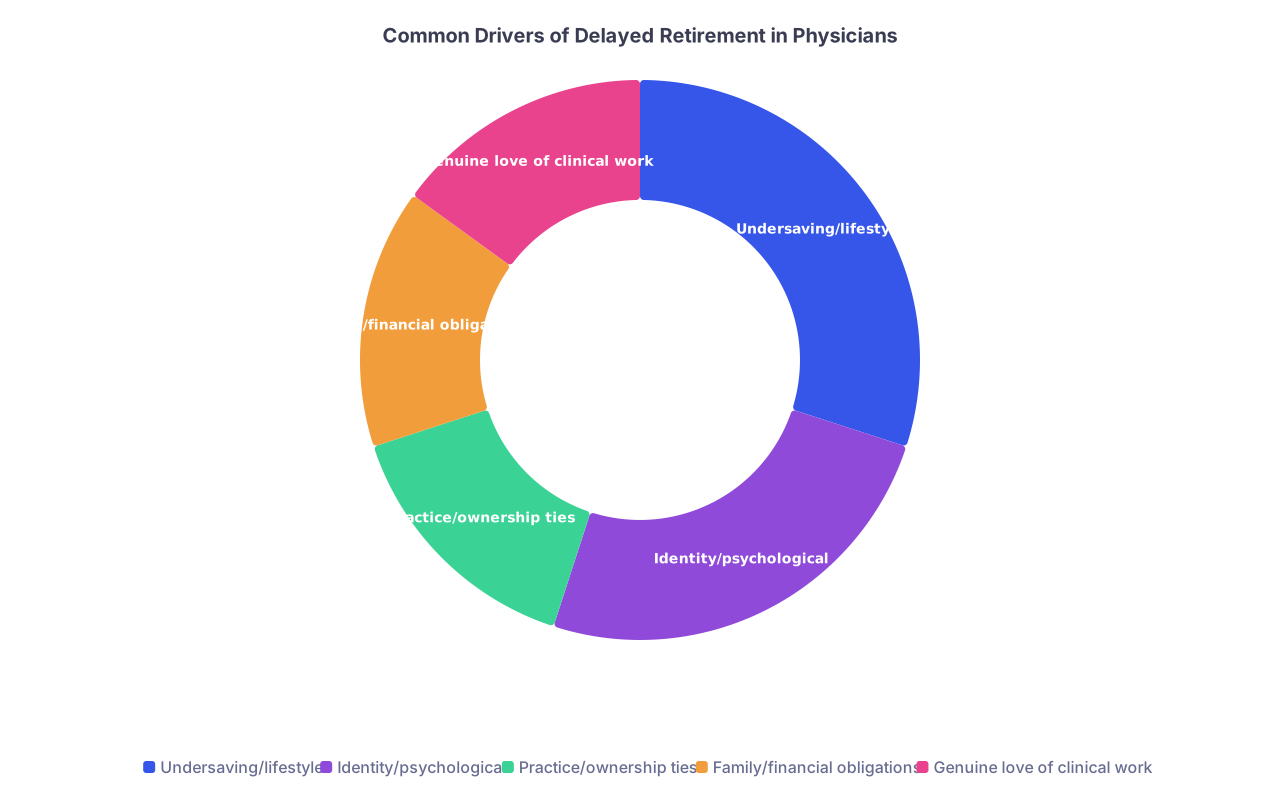
| Category | Value |
|---|---|
| Undersaving/lifestyle | 30 |
| Identity/psychological | 25 |
| Practice/ownership ties | 15 |
| Family/financial obligations | 15 |
| Genuine love of clinical work | 15 |
You’ll notice “genuine love of clinical work” is there — and that’s actually the good reason to retire later. But it’s not the majority.
3. Practice ownership and golden handcuffs
Private practice owners get trapped by a nasty combo: sunk costs, partnership structures, and vague buyout expectations that never get formalized.
I have watched people stay five to ten years longer than they wanted because:
- The buyout formula was opaque or unfair, and they kept thinking “just a few more years and it’ll be worth more.”
- No succession planning, so walking away felt like “abandoning the team” or “leaving money on the table.”
- They never separated “practice income” from “lifetime net worth,” so stopping work felt like turning off the only faucet.
This isn’t inherent to ownership; it’s inherent to poor agreements and procrastination. The doctors who exit cleanly? They negotiate clear practice transition plans and buyout structures by their early 50s, not at 63 in a panic.
4. Poor tax and account structure
Here’s a less sexy, very real factor: a lot of physicians build wealth in extremely tax‑inefficient ways, then discover at 60 that their “$4M” behaves more like $2.7M after taxes and RMDs.
Common mistakes:
- Stuffing everything into pre‑tax accounts with no Roth strategy, then being shocked by required minimum distributions.
- Ignoring taxable brokerage accounts because they “sound complicated,” instead of using them strategically.
- Never doing any partial Roth conversions in their lower‑income years (like early retirement before Social Security + RMDs).
That can delay “work‑optional” by several years — not because the gross portfolio is inadequate, but because the net, spendable cash after tax is worse than it needed to be.
Again, not destiny. Just the bill coming due for ignoring planning.
Healthcare, Legal, and Other “But What About” Issues
This is the section where people usually panic: “What about health insurance? Malpractice tail? Estate planning? Isn’t that why we have to retire late?”
No. Those are obstacles. They’re not immovable.
Healthcare pre‑Medicare
If you retire before 65 in the U.S., you have three main options:
- Spouse’s coverage.
- Buying ACA (exchange) plans.
- Part‑time or locums with benefits (for some roles).
The common mistake physicians make: assuming private or ACA coverage will be impossibly expensive and never actually pricing it out. I’ve watched people claim they “can’t retire” when their projected healthcare costs were a tiny fraction of their portfolio and planned spending.
You can model this. You can budget it. It might push you from 55 to 58. It does not automatically push you to 70.
Legal and malpractice tail
Yes, malpractice tail coverage, partnership contracts, and non‑competes matter. They can be painful to unwind if you ignore them for 25 years.
But again — that’s a planning problem.
- Tail coverage: often negotiable as part of a practice exit or acquisition if you think early enough.
- Non‑competes: matter if you want part‑time local work; irrelevant if you genuinely retire or relocate.
- Ownership contracts: can be renegotiated years in advance; worst cases happen when people “don’t want to rock the boat” until they’re already burnt out.
The physicians who end up cornered in their late 60s by legal or practice issues are almost always the ones who kept saying, “I’ll deal with that later.”
What Physicians Who Don’t Retire Late Actually Do Differently
Strip away the noise, and early/normal‑age retirees in medicine tend to have a few boring but decisive habits.
They define “work‑optional” clearly
They don’t obsess over a magic dollar number. They define something like:
- “We want $150k/year net after tax, in today’s dollars, with the ability to travel a bit and help the kids modestly.”
- “We’re fine with part‑time consulting for 3–5 years as a buffer.”
Then they work backwards. Once the numbers pencil out, they start unwinding even if the culture around them thinks they’re “too young” to retire.
They right‑size lifestyle early, not at 60
They still live well, but they lock in key decisions:
- Reasonable house relative to income.
- Not every “doctor toy” on day one of attending life.
- Savings rate that looks more like 20–30% of gross, not 5–10%.
And they don’t wait until the kids are in college to start.
They actively build a post‑clinical identity
The ones who glide into retirement without imploding their psyche:
- Have hobbies that are real, not theoretical.
- Have relationships and communities that aren’t all tied to work.
- Often build a second act: teaching, volunteering, writing, business, mentoring.
So when it’s time to scale back or leave, they’re stepping toward something, not just away from clinic.
The Bottom Line: Late Retirement Is Usually a Choice, Not a Sentence
If you enjoy practicing into your 70s and you’re good at it, fine. That’s not failure. That’s a valid preference.
But don’t confuse that with inevitability.
For most physicians, “doctors always retire late” is a myth that conveniently justifies vague planning, lifestyle inflation, and avoidance of uncomfortable financial and identity questions.
You can retire at 55. You can retire at 60. You can go part‑time at 52 and call that semi‑retirement. The math works for a lot more doctors than you’d think, once the spending and planning are honest.
The real question isn’t “Can doctors retire earlier?” It’s “Are you willing to make the trade‑offs and do the planning that the early and on‑time retirees actually do?”
Because this isn’t fate. It’s a series of decisions spread over 20–30 years.
FAQ (Exactly 5 Questions)
1. What’s a realistic retirement age target for most physicians?
For many physicians who start saving aggressively within a year or two of finishing training and avoid major lifestyle bloat, late 50s to early 60s is absolutely realistic. Mid‑50s is doable for those with higher savings rates and good investment discipline. If you save minimally and inflate lifestyle heavily, you push yourself into late 60s or beyond.
2. How much should a physician aim to save each year to avoid retiring late?
As a rough rule of thumb, a total savings rate of 20–30% of gross income (including employer matches and pension contributions) is a solid target if you start in your early 30s. If you’re starting late (mid‑40s+), you probably need to be closer to 30–35% to have similar flexibility.
3. Are doctors actually worse at retirement planning than other high‑income professionals?
Often, yes. Many physicians outsource everything to an advisor they barely understand, or they ignore the details because they’re burned out and time‑starved. Combine that with irregular financial education in training and delayed earning, and you get a group that’s highly intelligent but often financially under‑informed relative to their income.
4. Is working part‑time a realistic step before full retirement for physicians?
Very much so. Many doctors move to 0.5–0.7 FTE in their late 50s or early 60s, which drastically reduces burnout while keeping income, benefits, and clinical identity. Financially, it also helps bridge higher‑risk years just before or after leaving full‑time work, making portfolio withdrawals gentler initially.
5. What’s the biggest mistake pushing physicians into unnecessarily late retirement?
Not quantifying anything. No defined retirement spending target, no portfolio goal range, no tax plan, no practice exit strategy, and no timeline. That vagueness leads to chronic “just a few more years,” even when the numbers would have supported stepping back much sooner.
Key points:
- “Doctors always retire late” is a cultural story, not a mathematical law; many retire in their 50s or 60s by choice.
- The main drivers of delayed retirement are lifestyle inflation, undersaving, identity issues, and poor planning — not student loans or professional destiny.
- With clear targets, disciplined saving, and an intentional exit strategy, most physicians can make retirement age a decision, not a default.