
What if the medical practice you’ve been pouring your life into for 20 years ends up being worth less than your last three years of W‑2 income?
That’s not a hypothetical. I’ve watched it play out for physicians, dentists, and other professionals who were absolutely sure that “owning the practice” was the golden ticket to a cushy retirement. Then the buyout number lands on the table and it’s… underwhelming. Sometimes insultingly low.
Let’s take a machete to the myth: owning a practice does not automatically mean a better retirement. It can help. It can also hurt. And in plenty of real-world cases, the employee doc retiring with a fat 401(k), smart investments, and no drama ends up in a better position than the “entrepreneur” with the fancy logo and the crumbling building.
You want the truth, not the brochure version. So let’s look at what the data and patterns actually show.
The Core Myth: “Equity = Great Retirement”
There’s this story that gets told at conferences and in physician Facebook groups:
- Be an associate.
- Buy in or start your own practice.
- Grow it.
- Sell it for a big multiple.
- Retire on the proceeds.
Reality: most practice exits do not look like a tech startup IPO. They look like a small, negotiated asset sale with tax friction, legal friction, and timing risk. Sometimes it’s a glorified severance package stretched over a few years.
Here’s the part most people don’t want to hear: for many clinicians, the bulk of their retirement security comes from boring stuff—consistent saving in tax-advantaged accounts, broad-market investing, paying off debt—not from extracting top dollar for a practice at age 65.
Let me show you how uneven the outcomes actually are.
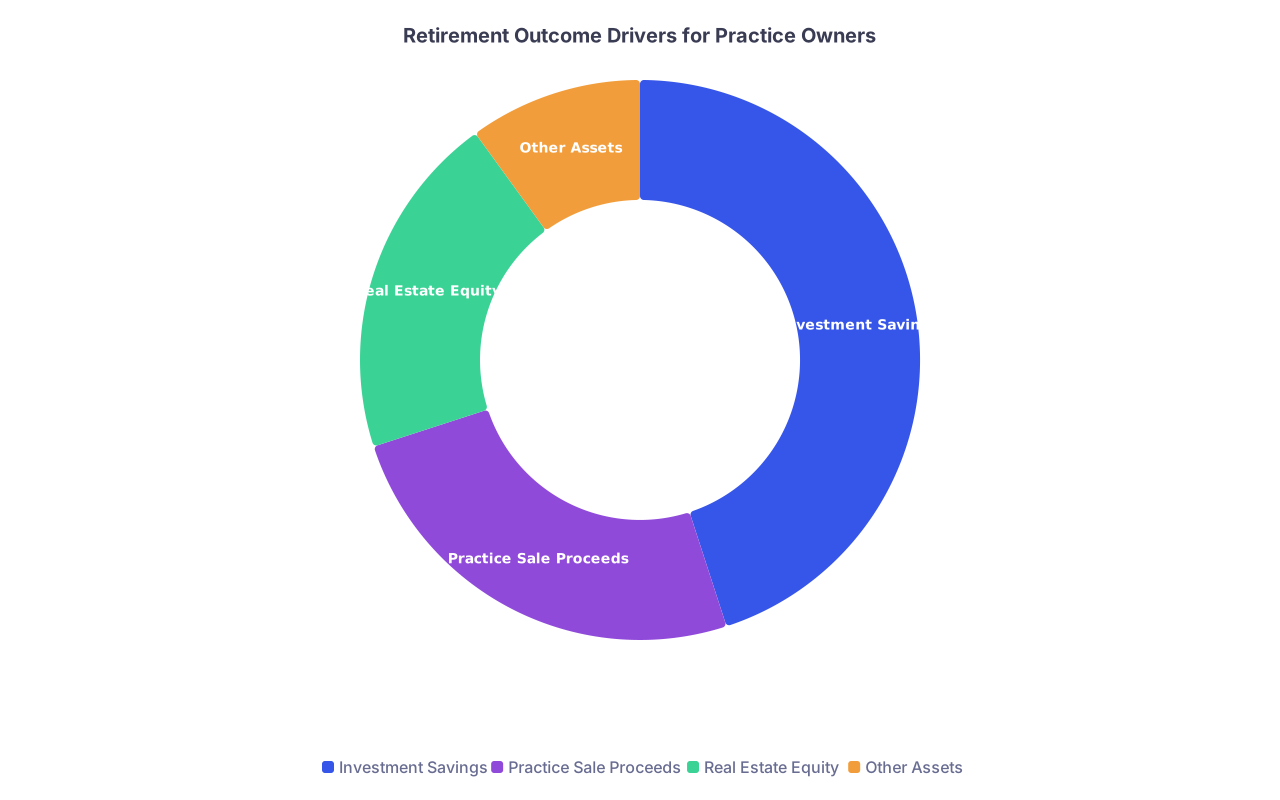
| Category | Value |
|---|---|
| Investment Savings | 45 |
| Practice Sale Proceeds | 25 |
| Real Estate Equity | 20 |
| Other Assets | 10 |
That rough breakdown is what shows up again and again in the data and in real financial plans I’ve seen: the practice sale is helpful, but rarely the main engine unless it’s a large, well-run group.
Where Practice Ownership Really Helps (When It Actually Does)
Let me be fair: I’m not anti-ownership. I’m anti-fantasy.
Owning a practice can absolutely improve your retirement odds if certain boxes are checked.
First, you often have more control over compensation and benefits. That means you can:
- Push your own retirement plan limits: 401(k), profit sharing, maybe a cash balance plan.
- Set up defined benefit structures that allow six-figure annual contributions.
- Deduct more legitimate business expenses, freeing personal cash flow.
A high-earning specialist with a well-structured S-corp, a 401(k) + profit sharing + cash balance plan, and aggressive but sane savings habits can hit multi‑million retirement numbers by their late 50s without even counting practice sale value.
Second, practice owners sometimes have access to more tax-efficient equity:
- You might own the building (through a separate entity) and collect rent.
- You might gradually bring in partners who buy in at real valuations.
- You might be in a specialty that PE or hospital systems actually compete for.
Those scenarios can create meaningful, additional value.
But here’s the catch: those advantages are design choices, not automatic perks of ownership. I’ve seen plenty of owners with:
- No retirement plan beyond a sad SIMPLE IRA.
- No practice real estate.
- No buy-in/buy-out structure.
- No realistic succession path.
In that case, you’ve basically just worked as a self-employed person with more headaches and almost no extra retirement leverage.
Where the Retirement Story Falls Apart for Owners
Now we get to the uncomfortable stuff.
There are several repeat-offender reasons why practice ownership fails to deliver the “better retirement” people expect.
1. The Practice Isn’t What You Think It’s Worth
You think: “I’ve worked 25 years. This should be a big number.”
Buyers think: “What’s the cash flow after paying a replacement doc fair market salary?”
Those are not the same thing. Valuations are driven by normalized earnings and risk, not your emotional attachment or sunk effort.
| Practice Type | Common Multiple of Adjusted Earnings | Reality Check |
|---|---|---|
| Solo primary care | 0.5x – 1.5x | Sometimes just an asset sale |
| Small specialty (2–5 docs) | 1x – 3x | Dependent on contracts & payor mix |
| Dental practice | 60% – 80% of collections | Varies heavily by location |
| PE-backed roll-up target | 4x – 8x | Only for scalable, larger groups |
For a lot of solo and small practices, once you adjust for:
- Market-rate comp for a replacement physician
- Overhead
- Aging equipment
- Payer mix risk
…the “enterprise value” is unimpressive. In some cases, the buyer is functionally paying for your charts and goodwill, and you’re thrilled just to not have to close the doors yourself.
2. Buyer Power Has Shifted
Twenty years ago, a young doc might feel lucky to get a partnership offer. Today, many feel lucky to avoid it.
Why? Because now they can often get:
- Solid salary with productivity bonus.
- No personal guarantee on office leases.
- Employer-funded retirement match.
- Less admin hell.
That means fewer natural buyers for your practice. Hospital systems and PE groups are picky. They want scale, predictable revenue, and leverageable infrastructure. Not your charming but chaotic three-employee clinic with a paper chart graveyard.
I’ve literally sat in a room where the “exit strategy” for a small practice came down to this: either sell at a discount to a younger associate (who didn’t want the risk) or wind down and auction the furniture.
3. Owners Under-Save Because They Believe the Practice Is the Plan
This one is brutal and common.
Because owners are “building equity,” they tell themselves they can afford to:
- Delay retirement savings.
- Take more cash out for lifestyle.
- Plow extra money into the business instead of into a diversified portfolio.
Then in their mid‑50s they discover that:
- The practice is hard to sell.
- The realistic valuation is maybe 1–2 years of their current income.
- Their investment accounts look like they belonged to a mid-career employee, not a near-retiree owner.
Translate that: they traded 20+ years of extra stress and liability for very little incremental retirement benefit.
4. The Overhead Monster
I’ve seen owners who gross $1.5 million, but after rent, staff, malpractice, supplies, and debt, their actual take-home isn’t much higher than their employed peers. Sometimes lower.
If your margin is constantly squeezed by:
- Rising staff costs
- Poor payer contracts
- New compliance requirements
- EHR and tech upgrades
…then you may be running in place. A big-looking business, with a small economic engine. That doesn’t magically transform into a great retirement outcome.
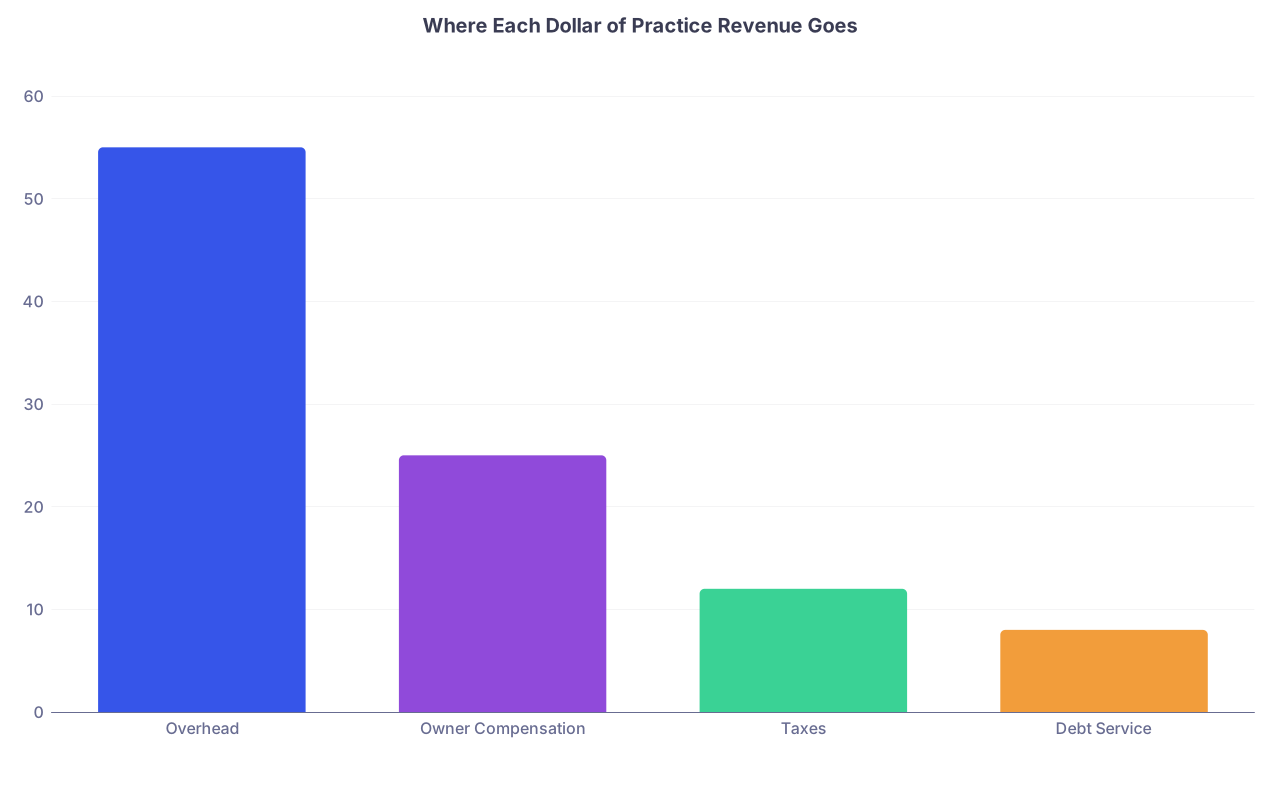
| Category | Value |
|---|---|
| Overhead | 55 |
| Owner Compensation | 25 |
| Taxes | 12 |
| Debt Service | 8 |
Those percentages are typical for many small to mid-sized practices. The sliver you keep as the owner has to cover both your current lifestyle and your future retirement. There is not as much leftover as people assume.
Ownership vs Employment: Who Actually Retires Better?
Let’s compare two very simplified paths. Yes, I know reality is messier. That’s the point.
- Dr. A – Employed hospitalist earning $300k, saves 20% into retirement accounts and a taxable portfolio, works 30 years.
- Dr. B – Practice owner earning variable income averaging $400k, saves 10% because “the practice is my equity,” works 30 years, sells practice at 1.5x normalized earnings (call it $600k net after tax at retirement).
Basic math (assuming reasonable long-term returns, not fantasy):
- Dr. A investing 20% of $300k = $60k/year for 30 years at 6–7% real returns ends up with several million in today’s dollars.
- Dr. B investing 10% of $400k = $40k/year for 30 years, plus a one-time $600k at the end, usually ends up behind Dr. A.
Not because Dr. B earned less. Because Dr. B used the idea of equity as an excuse to save less.
Meanwhile, the employed doc had:
- Less business risk.
- No staff headaches.
- Often better disability and health benefits.
I’ve watched this exact dynamic play out in real financial plans. The myth flips: the “boring” W‑2 doc in a solid system retires more comfortably than the owner who was “sure” their practice would make up the difference.
When Practice Ownership Does Lead to a Better Retirement
I’m not telling you to avoid ownership. I’m telling you to stop treating it like a guaranteed lottery ticket.
Ownership tends to pay off for retirement when:
You treat the practice as an income engine, not a retirement plan.
You still max your retirement accounts. You still build a diversified portfolio. The practice sale is a bonus, not the foundation.You build transferrable value.
Systems, brand, contracts, team, multi-physician structure. Buyers are paying for cash flow that does not fall apart when you leave.You have a real succession or exit strategy early.
That means bringing in partners, grooming a younger doc, or positioning the practice as an acquisition target well before you’re ready to quit.You separate and optimize real estate.
Owning the building in a separate entity, with market rent, can be a significant retirement asset even if the practice itself sells modestly.You don’t inflate lifestyle just because “it’s a business expense.”
I’ve watched owners torch retirement potential through “practice-paid” cars, travel, and unnecessary upgrades that were really just lifestyle creep dressed up as strategy.

| Step | Description |
|---|---|
| Step 1 | Practice Owner |
| Step 2 | Risk of weak retirement |
| Step 3 | Ownership boosts retirement |
| Step 4 | Mostly self employed income |
| Step 5 | Strong savings rate? |
| Step 6 | Transferrable practice value? |
That’s the actual decision tree buried underneath all the ego and romance about “being your own boss.”
The Legal and Structural Stuff People Ignore Until It Hurts
Since you asked under “financial and legal aspects,” let’s talk about the boring documents that make or break real exits.
If you’re in a group practice:
- Your partnership or shareholder agreement often matters more than your revenue. I’ve seen formulas that practically guarantee a terrible buyout for older partners (e.g., book value only, or arbitrary caps).
- Non-compete clauses, call obligations, and post-retirement consulting requirements can turn a “sale” into a slow, irritating glide path rather than a clean exit.
If you’re solo:
- Without clear agreements with associates, they can (and do) walk away and set up shop down the street, taking a chunk of your patient base with them.
- If you die or become disabled without a buy-sell agreement funded by insurance, your spouse and family are often stuck fire-selling the practice or just closing it.
You want better retirement odds from ownership? Fine. Start with a competent healthcare attorney and a CPA who actually understand practice valuation, not just tax prep. The structure and agreements you sign in your 40s can determine whether your 60s involve options or regret.
What to Do If You Already Own a Practice
If you’re reading this as a current owner and feeling slightly nauseous, good. That means you’re paying attention.
No, you don’t have to sell tomorrow. But you should:
- Get an independent valuation now, not the fantasy number in your head.
- Audit your personal savings rate. If you’re under 15–20% of gross income for retirement and you’re over 45, that’s a problem.
- Review all your legal documents: partnership agreements, leases, buy-sell provisions, employment contracts with associates.
- Map a 5–10 year exit timeline instead of waiting until you’re burned out and desperate.
And then, critically, stop saying, “My practice is my retirement plan.” That sentence has wrecked more physician retirements than any student loan balance ever did.
FAQ: Five Questions You’re Probably Asking
1. If I’m early in my career, should I avoid buying or starting a practice because of all this?
No. Ownership can absolutely be worth it—financially and psychologically—if you go in with clear eyes. But you should buy or build a practice with the primary goal of creating strong current income and professional autonomy, not as your main retirement vehicle. Build retirement on diversified savings; treat the eventual sale as upside.
2. How do I know if my practice is likely to be attractive to buyers?
Look at it the way a buyer will: Are revenues stable or growing? Is there more than just you producing? Are operations systematized or does everything rely on your personal heroics? Do you have good payer contracts and clean financials? If the answer to most of these is “no,” your practice is probably more of a job-in-a-box than a marketable business.
3. Is it ever rational to plan on the practice sale as a big retirement piece?
Yes, but only for certain situations: larger multi-physician groups, strong specialty demand, or practices clearly in the crosshairs of PE or health system roll-ups. Even then, smart owners still save aggressively outside the practice. Planning on a major liquidity event is fine. Depending on it is where people get wrecked.
4. I’m in my late 50s and behind on savings. Should I double down on practice growth or focus on investments?
Usually you do a mix, but if you’re behind, I’d prioritize locking in a higher, consistent personal savings rate immediately. Incremental growth in practice value is nice, but it’s speculative and slow. Redirecting more of your current income into retirement accounts and a taxable portfolio is faster, more reliable, and doesn’t depend on finding the perfect buyer at the perfect moment.
5. What’s one concrete step I can take this year to improve my retirement odds as an owner?
Increase your automatic retirement contributions by a meaningful amount—5–10% of income if you can—and get a fresh, independent practice valuation. That combo forces you out of fantasy land. You’ll know what the practice is actually worth and you’ll be building retirement security that doesn’t evaporate if a buyer backs out.
Key points:
Practice ownership can help your retirement, but only if you treat the practice as an income engine, not your sole retirement plan. Most real-world retirements are built on consistent, diversified saving—not on squeezing a big check out of a small practice at the finish line.