
The idea that residents “can’t” start retirement investing is false. Not exaggerated. Not context‑dependent. Just wrong.
They don’t. But they absolutely can.
I’ve heard every version of the excuse from interns at 11 p.m. sign‑out:
“I’ll start when I’m an attending.”
“Retirement accounts don’t matter until you’re maxing them.”
“It’s pointless with this salary and my loans.”
The data says otherwise. The math says otherwise. And the residents who quietly start with $50–$200 a month during training end up decades ahead of their co‑residents who waited for “later.”
Let’s tear this apart properly.
The Core Myth: “My Resident Salary Is Too Low for Retirement Investing”
No, it’s not. The problem is not ability; it’s priority.
Median PGY‑1 salary in the U.S. is roughly $60,000–$65,000; by PGY‑3 or 4, often $65,000–$75,000+ depending on region and specialty. After taxes, yes, that doesn’t feel like much, especially with loans and maybe a high‑cost city.
But “I can’t save anything” is usually code for “I’m living like a future attending, not a current trainee.”
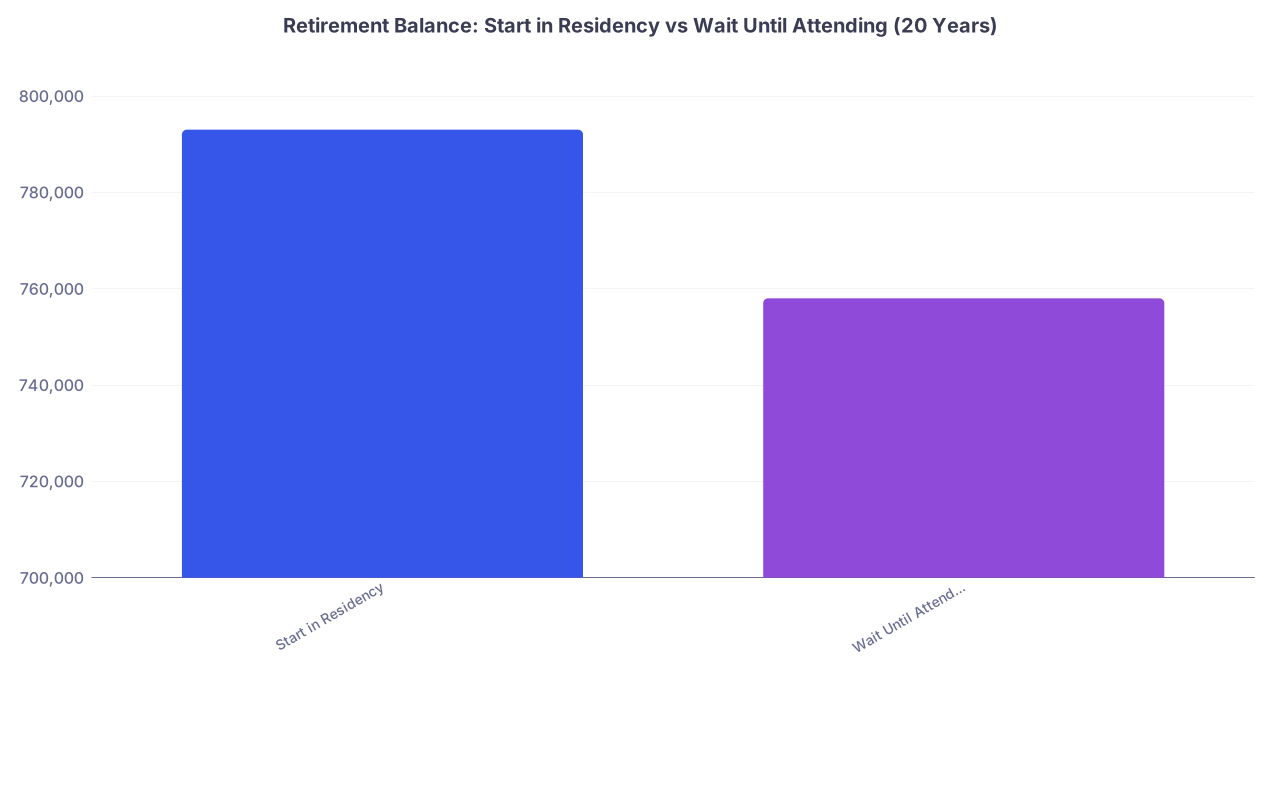
Here’s what the math actually looks like if you start small in residency versus “waiting until I’m an attending.”
Assume:
- 4 years of residency
- 7% average annual return
- $150/month during residency
- Then $1,500/month as an attending starting year 5
Case A: You start during residency.
Case B: You wait until attending life to start.
| Category | Value |
|---|---|
| Start in Residency | 793000 |
| Wait Until Attending | 758000 |
After 20 years of investing as an attending, the resident who started with just $150/month during training has roughly $35,000 more than the one who waited, even though both were investing the exact same amount as attendings.
Why? Because the first four years got an extra 20 years of compounding.
If you bump that resident contribution to $300/month, the gap gets bigger. If training is 5–7 years (surgery, neurosurgery, cards), it gets much bigger. The early years are turbocharged.
The myth that “it’s pointless until you can max accounts” is one of the most expensive lies residents believe.
The Psychological Trap: “I’ll Start When…”
The most dangerous word in personal finance is “later.”
I’ve watched this play out in real time:
- PGY‑1: “I’ll start when I’m not on nights.”
- PGY‑2: “I’ll start when I’m out of this brutal rotation.”
- PGY‑3: “I’ll start when fellowship ends and my income is stable.”
- New attending year 1: “I’ll start once my loans/refinance/new house are settled.”
- Attending year 3: “We just had a kid and daycare is insane. Next year for sure.”
Ten years go by. No real retirement investing. Lifestyle has quietly expanded to fill (and exceed) the attending paycheck.
That pattern is not hypothetical. I’ve seen it with people who now have $400k+ income and almost no net worth.
Here’s the truth: if you don’t build the muscle of “pay myself first” on $65k, it rarely appears magically at $350k. Your brain keeps the same script. Your lifestyle just has nicer flooring.
Starting in residency isn’t about the dollar amount. It’s about identity and habit:
“I am someone who invests for my future every month, no matter what.”
Even if it’s $25. Even if it’s $50. Once that’s baked in, scaling up as an attending is a mechanical adjustment, not an existential crisis.
Loans vs Retirement: The False Either/Or
Another popular myth:
“With my loans, it’s financially dumb to invest for retirement during residency.”
Again: too simplistic, usually wrong.
Most residents I talk to have federal loans with rates around 5–7%. Some are on PAYE/REPAYE/SAVE, some planning PSLF, some planning to refinance later.
You do not need to choose 100% loan focus or 100% investing. The data usually supports a hybrid:
- Make sure you’re on the right repayment plan (especially if PSLF is on the table).
- Get any employer 401(k)/403(b) match if available. That’s free money.
- Then split extra dollars between higher‑interest loans and basic retirement investing.
If you’re PSLF‑bound, aggressively overpaying loans as a resident is often lighting money on fire. Those payments could have been your first retirement dollars instead of reducing a balance that might be forgiven later.
Let’s be specific.
You have $200/month you can squeeze out of your budget.
Option 1: Extra loan payment at 6%.
Option 2: Roth IRA contribution, expected 7% long‑term market return.
Over 4 years of residency, assuming you stop investing and let it ride for 30 years:
- Extra loan payments: save a few thousand in interest, sure. Once the loan is gone, the benefit stops.
- Roth contributions: grow for decades, tax‑free, and are protected from your later behavior.
I am not saying “never pay loans early.” I’m saying pretending this is a pure math problem is naive. Behavior and structure matter. Money you invest in a Roth at 27 is very hard to sabotage later. Money that just makes your loan go away tends to be absorbed by lifestyle the moment it’s gone.
If you’re PSLF‑eligible, the case for investing something during residency is even stronger.
What Residents Actually Have Access To (That They Ignore)
The myth usually hides behind ignorance: “I’ll figure this out later, it’s too complicated now.”
It’s not. Here’s the stripped‑down menu residents almost always have:
1. Employer 403(b) or 401(k)
Most academic hospitals offer a 403(b). Some community programs have a 401(k).
Typical features:
- Pre‑tax contributions lower your taxable income.
- Some have a match (even 3–5% of salary is huge). Many residents have no idea this exists.
- Investment options are usually a mix of target date funds, index funds, and some garbage high‑fee stuff.
If your hospital offers a match, the myth about “I can’t invest” gets annihilated. You’re literally walking away from guaranteed money by not contributing at least enough to get the full match.
I have personally seen residents discover two years into training that their employer has been offering a 4% match all along. That’s thousands of dollars they never captured.
2. Roth IRA
Residents are in a rare sweet spot:
- Low enough income to qualify for direct Roth contributions.
- High enough income to have some capacity to fund it.
Roth IRA basics:
- 2024 limit: $7,000/year (under 50).
- Funded with after‑tax dollars. Grows tax‑free. Withdrawn tax‑free in retirement.
- Contributions (not earnings) can be withdrawn at any time without tax/penalty.
That last point kills another myth: “I’m locking this money up for 40 years.” No. You can always get back what you put in if the universe collapses, you’re jobless, and your car dies.
A resident putting even $2,000/year in a Roth for 4 years ends up with a tax‑free compounding machine that will probably outgrow anything you do with that money later.
3. HSA (Health Savings Account), if you have a high‑deductible plan
This is the stealth retirement account almost no resident uses as such.
If you’re on a qualifying high‑deductible health plan and your hospital offers an HSA:
- Contributions are pre‑tax.
- Growth is tax‑free.
- Withdrawals for medical expenses are tax‑free.
- After 65, non‑medical withdrawals are taxed like a traditional IRA.
Translation: it’s a “triple tax‑advantaged” account. If you can cash‑flow your current medical expenses and leave the HSA invested, it can become another retirement bucket.
Most residents just swipe the HSA debit card for every minor thing. That’s fine if you truly can’t cover it. But understand what you’re giving up: a powerful long‑term asset.
How Much Is “Enough” As a Resident?
Here’s where people get stuck in perfectionism.
“If I can’t max the Roth, what’s the point?”
“If I can only do $50/month, I’ll wait.”
The point is habit plus compounding. Not perfection.
To make this less abstract, let’s compare three residents.
| Resident Type | Monthly Invested | 4-Year Total Contributions | Value After 4 Years (7% return) |
|---|---|---|---|
| None | $0 | $0 | $0 |
| Minimalist | $100 | $4,800 | ≈$5,200 |
| Committed | $300 | $14,400 | ≈$15,600 |
Now let that “Committed” portfolio sit untouched for 30 years at 7%:
- That ~$15,600 becomes roughly $119,000 by itself.
That’s six figures of future money from what felt like scraps during training. And that’s before you invest a single attending‑level dollar.
This is why the “I’ll just start later” mentality is broken. Later never gives you back those 30 extra compounding years.
Legal & Structural Realities Residents Forget
You’re not just playing with calculators. There are real legal and structural advantages to starting early.
Asset protection
In many states, money in retirement accounts (401(k), 403(b), IRA) is shielded from creditors and lawsuits. Exact details vary, but the gist is: retirement dollars are often better protected than money in a checking account.
You’re entering a high‑liability profession. Even if you’re insured, building protected assets early is not crazy.
Tax diversification
Future you has no idea what tax law will look like. That’s why having both pre‑tax and Roth buckets is powerful.
Residents are typically in lower tax brackets than future attendings. That leans the scale toward Roth:
- You pay a relatively low tax rate now.
- Your investments grow and come out tax‑free when you’re in a higher bracket later.
Wait until you’re an attending, and Roth contributions often mean giving up a 35–37% deduction now. Many attendings still do Roth, but for residents it’s almost a no‑brainer.
Employer vesting rules
Some programs have vesting schedules for employer contributions. For example, you only keep the match if you stay 3 years.
If you ignore the retirement plan for the first 2 years and find out about it as a senior, you may never collect that full match. Starting early isn’t just about contributions; it’s about unlocking employer money you’d otherwise never see.
The Real Barriers (They’re Not Mathematical)
If this were purely about numbers, most residents would invest something for retirement. The barriers I see are different:
Ignorance of options
No one in orientation mentioned the 403(b). Or they did, but you were half‑asleep post‑night shift.Analysis paralysis
“Target date vs index fund vs Roth vs pre‑tax vs brokerage… forget it, I’ll do it later.”Lifestyle denial
Uber Eats twice a day and a $1,900 studio feels “essential”. It’s not. It’s just what everyone around you is doing.Cultural myths in medicine
The older attending who brags, “I didn’t save a dime until after fellowship and I turned out fine,” conveniently leaves out the inheritance, the spouse’s income, or the 1990s housing market.
The fix is not complicated sophistication. It’s basic, boring actions:
Pick one account.
Pick one broad stock index fund or target‑date fund.
Set an automatic monthly contribution.
Forget about it.
If everything else feels overwhelming, that gets you 80% of the benefit.
A Simple “Resident Starter Pack” Blueprint
You wanted something concrete. Here’s a no‑nonsense approach I’ve seen work repeatedly.
Step 1: Find out what your program offers
Ask HR or log into your benefits portal:
- Do I have a 403(b) or 401(k)? Is there a match? What’s the vesting schedule?
- Do I have an HSA option?
- What are the investment options? (Look for low‑cost index or target‑date funds.)
Step 2: Decide your first priority
- If there’s a match: contribute enough to get the full match. Non‑negotiable.
- If there’s no match but you qualify for Roth IRA: strongly consider starting there.
Step 3: Set a modest, automatic number
Start with something that does not hurt but is not meaningless:
- $50–$100/month bare minimum.
- $150–$300/month if you have any flexibility.
You can always increase it later. The key is that it happens automatically.
Step 4: Don’t chase cleverness
Invest in:
- A target‑date retirement fund that roughly matches your age, or
- A broad total stock market index fund / S&P 500 index fund.
That’s it. You are not a hedge fund. You are a sleep‑deprived resident.
The Contrarian Reality: Residents Are Uniquely Positioned to Win
This is the part no one tells you while you’re complaining about night float.
As a resident, you have three massive advantages that most 30‑year‑olds do not:
- Guaranteed huge future income (statistically speaking). You have one of the highest lifetime earning trajectories of any profession.
- Decades of compounding ahead of you. Your early dollars have more time to work than the dollars of your 45‑year‑old co‑worker finally waking up.
- Built‑in delayed gratification skills. You survived organic chemistry, Step exams, and call. You can handle not leasing the luxury building across from the hospital.
The only people who squander those advantages are the ones who believe the myth that “it doesn’t matter yet.”
It matters.
Not because you’ll retire at 45 on your intern Roth. But because starting during residency changes your trajectory, your habits, and your relationship to money.
Residents absolutely can start retirement investing. The data says starting early – even with tiny amounts – creates a clear long‑term advantage. The structures (403(b), Roth IRA, HSA) are already sitting there waiting for you. The only real question is whether you want to keep pretending you “can’t,” or whether you’re willing to be the outlier who quietly lets compounding work for you instead of against you.
Key points to walk away with:
- The math is unambiguous: even small resident‑level investing creates a meaningful compounding edge over “I’ll start as an attending.”
- You almost certainly do have access to retirement accounts (403(b)/401(k), Roth IRA, maybe HSA); the barrier is behavior, not availability.
- You don’t need perfection. You need one simple, automatic contribution now, and the discipline not to talk yourself out of it for “later.”