
Last year I watched a PGY-3 chief resident argue with payroll about a $200 meal stipend error while her department chair quietly left early for a “board meeting” downtown. She had no idea that single afternoon would pay him more, long-term, than her entire month of call shifts. No one had ever explained how the game is actually played in academic medicine.
Let me pull back the curtain on how academic chairs quietly build wealth while you are grinding on nights. And more importantly—how you can stop being the last one to figure this out.
The First Secret: Your Chair Is Not Living on a W‑2 Salary
Residents think in W‑2s. “The chair makes $450k, maybe $550k, must be nice.” That’s the surface number you see in public salary databases. That’s not the real story.
Here’s what you do not see:
- Incentive comp that is structured to be variable for you but predictable for them
- Multiple “side” roles that pay like small jobs but feel like quick meetings
- Assets being accumulated quietly through university and hospital channels
While you are complaining about a $62k PGY-2 salary, your chair may have five or six income streams, all flowing into tax-advantaged accounts or investments.
Let me be blunt: the attendings you admire for their “dedication to academics” often got very rich because of academics, not in spite of it. But they never walk into morning report and say:
“By the way, that extra committee I joined just funded another year of maxing my backdoor Roth IRA.”
They just show up in a nicer car each contract cycle.
Where the Money Actually Comes From
Forget the base salary. The real game is all the other channels of income around the periphery of their title.
1. Administrative Stipends and “Protected Time”
When you see “0.4 FTE protected time for administration,” you think: fewer clinics, more meetings. You missed the second part of the sentence that’s never written: and higher pay per hour actually worked.
That chair might officially be “60% clinical, 40% admin” but the admin pay is structured differently. Often higher hourly equivalent, sometimes tied to a different funding bucket (hospital funds, dean’s office, service line budget).
I’ve seen chairs effectively get:
- Base academic salary
- Plus: separate stipend for chair role
- Plus: a different pot for “medical director” of something
- Plus: quality incentive money routed through those roles
All for time that often overlaps. One meeting might satisfy three job descriptions. You are paged 14 times in an hour while they’re in a 60-minute “strategic planning” session that generates admin RVUs and leadership brownie points.
They are not doing more hours than you. They’re getting better-paid hours.
2. Committee Work That Magically Pays
Residents join committees for “leadership experience” and a line on their CV. Chairs and senior faculty join committees that come with checks.
You’ve probably seen it and not recognized it:
- Hospital Quality and Safety board
- Pharmacy & Therapeutics
- Credentials or Peer Review
- Strategic planning councils
Those aren’t just meetings. Many of them pay honoraria, stipends, or route FTE support back to the department, which frees up more clinical money for them personally. The hospital CFO wants a named chair on that board; they’re willing to pay for the prestige and alignment.
You: sit on an education committee for free pizza.
Your chair: sits on system-wide committees that pay $10–40k/year quietly in the background.
3. Sponsored Talks, Advisory Boards, and “Expert Panels”
Here’s the part you almost never see because it happens off campus, out of your line of sight, sometimes on Fridays when you think your chair is “working from home.”
Academic chairs, especially in specialties like cardiology, oncology, rheumatology, GI, and anesthesiology, have a second life as:
- Advisory board members for pharma and device companies
- Paid speakers at closed-door industry events
- Consultants for biotech startups and venture groups
- Guideline writers and “steering committee” members
This is not the shady envelope-in-the-hallway stuff you’re imagining. It’s nicely documented, often disclosed in a slide that gets flashed past in 2 seconds at a national talk, and absolutely, unequivocally part of how they build wealth.
I’ve seen chairs make more in a single advisory board weekend than a PGY-1 makes in a month. All routed through LLCs, taxed more favorably, and then funneled into investments.
4. Equity and Early Access You Don’t Even Know Exists
Here’s where things get quiet. Because equity is where the real money hides.
A chair of orthopedics or cardiology does not need to work 80 more clinical hours per month to double their net worth. They need:
- Early access to a startup founding team
- A small advisor equity slice in a medical device company
- Founding stake in a data analytics spinout from the health system
- To be the clinical champion on a commercialization project
You see “Dr. Smith is the PI for this new device trial.” What you don’t see is the side letter giving Dr. Smith equity or options in the startup that spun out of the trial’s technology. Or the founder shares allocated when the “innovation center” translates research IP into a company.
When these companies exit—IPO or acquisition—those small stakes become life-changing money. I’m talking single events that equal 10–20 years of an attending salary.
You will never see that in a Medscape compensation survey.
5. Retirement Accounts You’re Not Even Aware Exist
You worry about your 403(b) match starting as an attending. Your chair has been playing with a completely different toolkit.
Let me show you typical architecture for a senior academic physician in a large system:
| Account Type | Annual Limit (Approx) | Who Uses It Well |
|---|---|---|
| 403(b) | $23,000+ | Most faculty |
| 457(b) (government) | $23,000+ | Hospital-employed |
| Backdoor Roth IRA | $6,500+ | Savvy attendings |
| Cash Balance Plan | $50k–$250k+ | Senior leadership |
| HSA | $4,000–$8,000 | Anyone eligible |
That’s the quiet wealth machine. It’s not sexy, but it’s relentless.
Where you’re putting $200/month into a Roth (if that), they’re shoving $100–300k/year into tax-advantaged or tax-deferred vehicles, year after year.
And your hospital or university has internal people who walk them through it. Retirement specialists. Financial vendors. Invite-only sessions. You’re never in those meetings because you’re on call.
How They Use the Systems You Ignore
Now let me show you exactly where you’re leaving money and advantages on the table while they methodically collect them.
Playing the Institutional Retirement Game
Most residents barely open their benefits packet. Smart chairs memorize theirs.
At a lot of academic centers, the best wealth-building tools are literally in the HR portal:
- 403(b) with automatic match: Chairs max it out from day one as attendings. Residents often don’t contribute at all.
- 457(b) (if available): This is the stealth weapon. Parallel contribution limit, often with institutional options. Senior people defer huge amounts of income pre-tax here to control their taxes and build retirement capital.
- Defined benefit or cash balance plans: At many universities, senior faculty past a certain rank can participate in plans you have never even heard mentioned. Why? Because they are capacity-limited, politically sensitive, and heavily tilted toward higher earners.
You know the line you always hear in faculty meetings: “We’ll send out more information by email.” Translation: the people who know what to look for will act; everyone else will delete it.
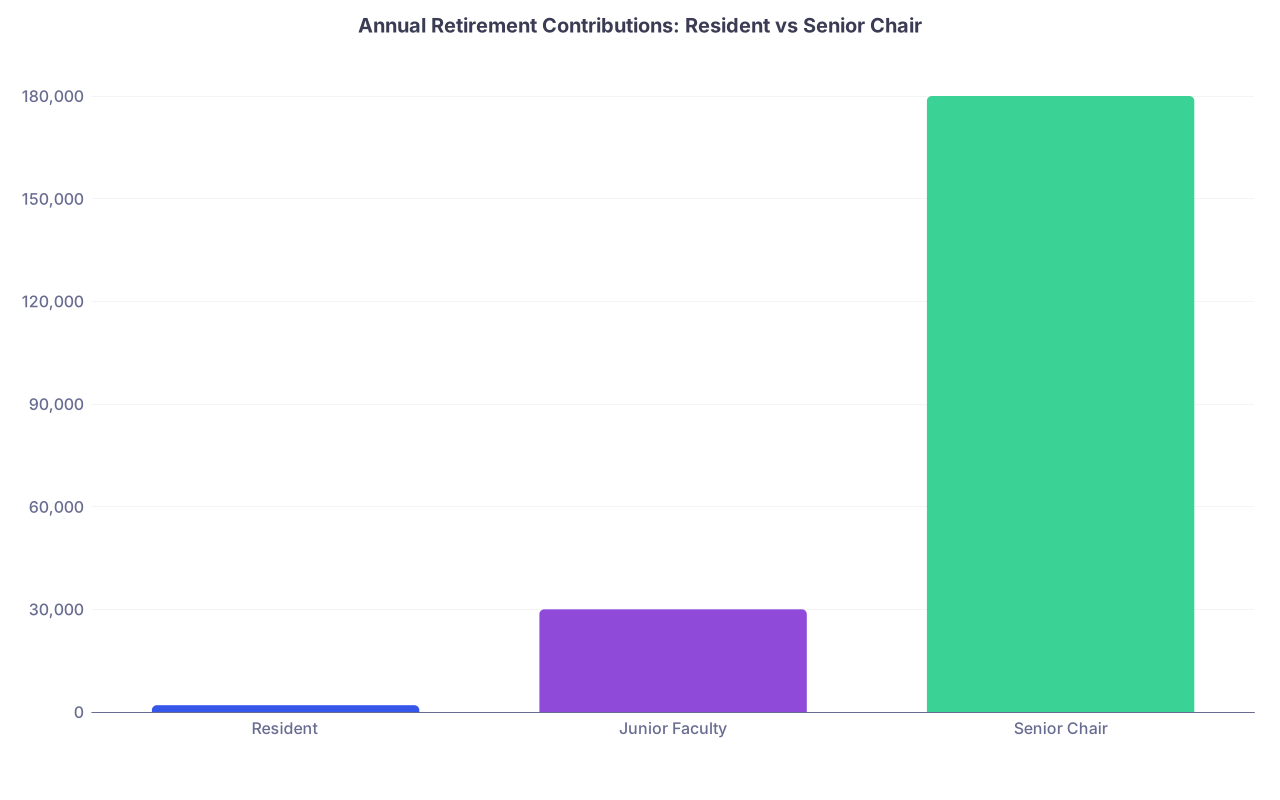
| Category | Value |
|---|---|
| Resident | 2000 |
| Junior Faculty | 30000 |
| Senior Chair | 180000 |
That’s how you end up with a 65-year-old chair with a $6–8 million retirement portfolio telling you they’re “just lucky” with money. No. They were aggressive and intentional, using tools you never bothered to learn because no one pushed them in your face.
Tax Strategy: Why Their Money Grows Faster Than Yours
Another quiet advantage: how income is classified and taxed.
Residents live almost entirely on W‑2 income. Highest tax rate, least flexibility. You start moonlighting and think you’re becoming sophisticated. You’re still playing checkers.
Chairs:
- Route speaking and consulting income through an LLC or S-corp
- Deduct legitimate business expenses (travel, CME, home office portion, professional services)
- Use retirement plans linked to that entity (solo 401(k) or SEP-IRA) on top of their institutional accounts
- Time income and deductions deliberately across tax years, with professional advice
That $25k advisory board side gig? They might keep $18–20k of it net, then invest it. Your $25k moonlighting year during fellowship? You might take home $14–16k because everything’s W‑2 or 1099 with poor planning, then you burn it on rent and DoorDash.
They’re not smarter than you. They’re just playing a more advanced game, with accountants who specialize in high-income professionals.
The Power Moves You Never See: Governance and Real Estate
The really wealthy chairs all do two things most trainees never connect to money: governance and real estate.
Governance: Where Influence Turns Into Opportunity
You think the hospital board is some abstract entity. Chairs know that sitting in those rooms is where opportunity originates.
Here’s what happens in those spaces:
- New service lines are discussed before they exist
- Capital allocation decisions (buildings, tech, clinics) are planned years in advance
- Innovation initiatives and partnerships with industry or tech firms are launched
Being in that room means early information and first access.
So the chair of surgery hears the health system is planning an ambulatory surgery center joint venture. Guess who gets invited to be a physician partner. Guess who gets founder equity, sweetheart buy-in terms, or profit-sharing.
You, as a resident, will read about the new center in an email after the deal is signed.
Real Estate: They Don’t Just Work in Hospitals; They Own Around Them
Let me be very direct: a shocking number of older academic physicians built significant wealth by buying things near hospitals before they became hot.
- Small medical office buildings
- Condos near campus rented to fellows or junior faculty
- Parcels of land later used for hospital expansion
- Partnerships in surgery centers, imaging centers, or dialysis facilities
Here’s how it often works:
A hospital announces a new cancer center. Before the public announcement, there were 2–3 years of internal meetings. Senior leadership and chairs knew the probable site. Quietly, some of them bought buildings or land nearby.
Ten years later, those properties are worth multiples of what they paid—plus a decade of rental income.
You see a “savvy” faculty member with “lucky” real estate moves. No. They had information and the courage to act on it while you were locked in the hospital 80 hours a week.
What You Can Start Doing Now—Even as a Resident
You’re not a chair. You do not have their access, leverage, or time. But you’re not powerless.
You can quietly start building the habits and structures they’re using—on a smaller scale now, then scaled up the moment your attending paycheck hits.
1. Stop Pretending Money Is “Later’s Problem”
Residents who say, “I’ll start caring about retirement as an attending” are already 5–10 years behind. I’ve seen PGY-3s with $10k invested look at a 60-year-old chair with millions and think it’s all salary. It’s mostly time and compounding.
You can do a few simple, adult things:
- Contribute something to a Roth IRA each year you’re eligible. Even $100/month. I’ve watched those small numbers, started early, become huge later with attending-level contributions layered on top.
- Learn the basics of your hospital’s retirement options now. Even if you can barely use them, you’ll be ready at full throttle when your income jumps.
- Build a written debt payoff and investment plan before you graduate. Chairs don’t wing it. Neither should you.
2. Treat “Side Work” Like the Beginning of a Business
Your future wealth is probably not going to come from your base salary either. But you need to build the scaffolding now.
When you do any 1099 work (moonlighting, telemedicine, random consulting):
- Create a simple LLC in your state once it makes sense.
- Open a separate business bank account.
- Track expenses that legitimately support your professional work.
- Read enough about taxes to know what questions to ask a CPA.
You’re rehearsing for the day when advisory board invites, paid talks, or niche consulting opportunities start coming your way. Chairs who look “lucky” spent a decade slowly building that platform.
3. Watch How Wealthy Academics Actually Spend Time
If you want the same outcome, observe the inputs.
You already know which attendings are burned out and broke. You also know which senior people seem oddly relaxed about money, travel, and retirement. Pay attention:
- Who sits on which committees that matter?
- Who’s always “out for a meeting” with the dean, the system, or some vendor?
- Who mentions participating in industry panels, guidelines, advisory boards?
- Who talks about real estate casually, like it’s just part of life?
That’s your model. Not the chronic complainer three years out who just finished fellowship and still behaves like a resident with a bigger paycheck.
4. Make Friends With the Boring People: HR, Benefits, Compliance
Your chair has had multiple one-on-one sessions with:
- The institutional retirement counselor
- The benefits specialist
- Sometimes even the hospital’s tax and legal team
You ignore those emails. You shouldn’t.
Those people will:
- Walk you through every retirement and insurance option you have
- Show you obscure plan features nobody explains in orientation
- Give you internal documents that are better than any blog you are reading at 2 a.m.
I’ve seen a single benefits meeting change a junior attending’s trajectory because they finally understood the 457(b) and stopped leaving $30–40k/year of tax-advantaged space unused.
5. Guard Your Future Optionality Like a Hawk
The chairs who got wealthy in academics all did one subtle thing: they preserved flexibility.
They:
- Kept their reputations clean enough that industry and leadership wanted to work with them
- Developed an area of expertise deep enough that their name meant something
- Avoided burning bridges with the people who invite others into deals, committees, and ventures
You can be outspoken. You can have boundaries. But do not be the resident who becomes “radioactive” politically. You need doors open later—for leadership roles, external work, and the kind of invitations that turn into wealth.
Retirement Planning Reality Check: Your Chair’s Ending vs Your Current Path
Let’s be concrete.
Picture two trajectories starting the year after residency:
- You, unplanned: Start at $260k. Delay investing for “a few years” while you “get settled.” Put 5% into 403(b), ignore 457(b), no Roth, no taxable investing. Ten years later you’ve paid some debt, saved some cash, but net worth growth is sluggish.
- Chair-style, from day one: Same $260k start. From year one: max 403(b), use 457(b) if available, backdoor Roth annually, invest taxable surplus. Maybe modest outside income flows into an LLC with its own solo 401(k) in a few years.
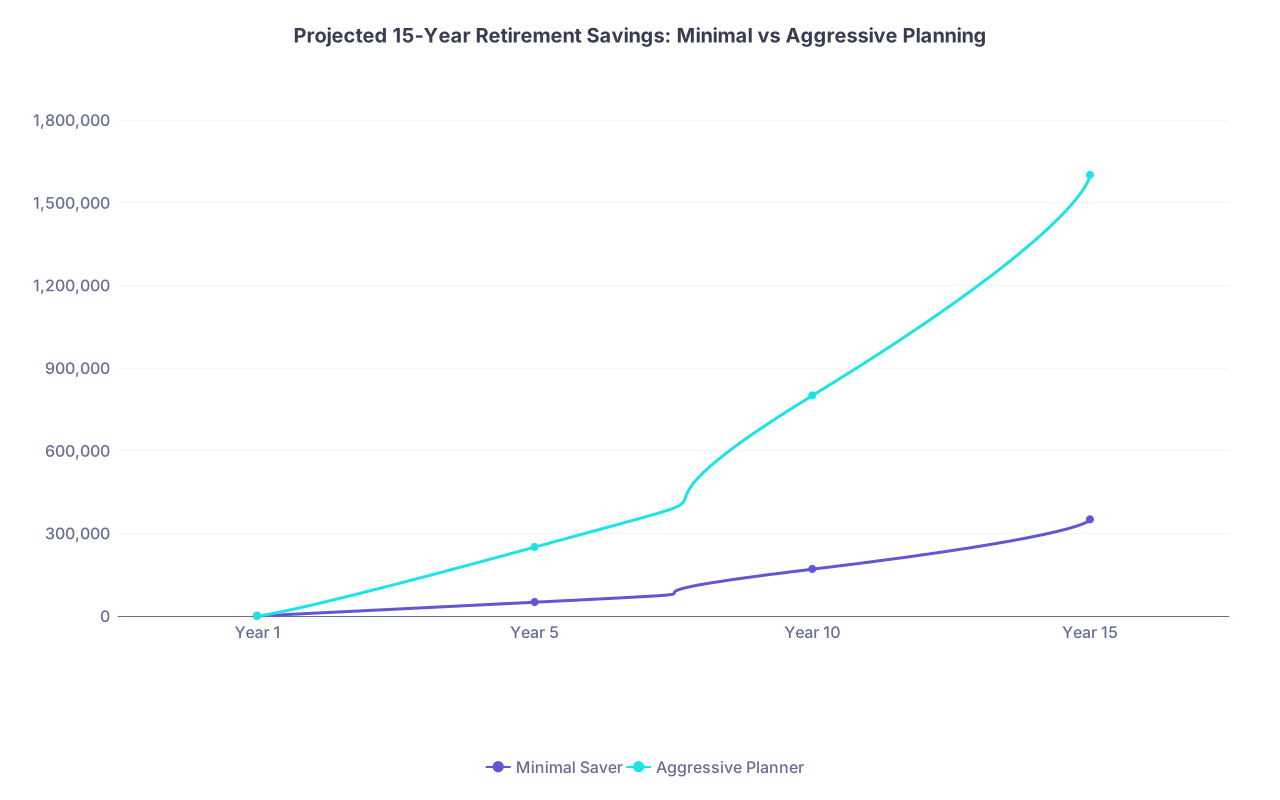
| Category | Minimal Saver | Aggressive Planner |
|---|---|---|
| Year 1 | 0 | 0 |
| Year 5 | 50000 | 250000 |
| Year 10 | 170000 | 800000 |
| Year 15 | 350000 | 1600000 |
That “aggressive planner” path? That’s the junior version of what your chair has been doing for 20–30 years, with bigger numbers and more channels.
You will not catch up later by “working hard.” You will only catch up by changing your framework now.
The Part No One Says Out Loud
Here’s the harsh truth: academic medicine is structurally designed so that:
- Trainees work the hardest, with the least upside
- Mid-career attendings carry the clinical volume
- Senior leadership and chairs extract the most leverage from the system
You’re not going to change that during residency. Complaining about fairness doesn’t move the needle on your retirement accounts.
What you can do is steal their playbook:
- Use every tax-advantaged account available to you
- Build side income in a structured, intentional way
- Position yourself for the kind of roles and opportunities that actually scale wealth
- Stop thinking your paycheck is the only lever that matters
No one is going to sit you down in morning report and explain any of this. The system runs better when you’re tired, grateful to have a job, and too busy to ask about equity, governance, or 457(b) plans.
You’re here now. You know better.
Start acting like someone who plans to retire on your terms, not on the hospital’s schedule.
FAQs
1. I’m a PGY-2 barely paying rent. Is retirement planning even realistic right now?
Yes—but scaled to your reality. You are not maxing accounts; you’re building habits. That might mean $50–100/month into a Roth IRA, reading one good personal finance book, and actually understanding your loan repayment options. Do not confuse “I can’t save $20k/year” with “nothing I do matters.” The first dollars and the knowledge you build now change how fast you accelerate once you’re an attending.
2. Should I try to be an academic chair just for the money?
No. That’s a miserable strategy. Chairs who thrive usually care about power, influence, or building programs, and they tolerate constant politics. If you hate meetings, conflict, and bureaucracy, chasing a chair role will chew you up. You can absolutely get rich as a non-chair academic by being strategically involved, building side income, and using the same financial tools without the title.
3. Aren’t some of these industry ties unethical or risky?
Some are. Some are perfectly appropriate when disclosed and managed correctly. The point here isn’t “do everything your chair does.” It’s understanding that there’s an entire economic layer to academic medicine you never see. You still have to decide what aligns with your ethics and your specialty’s culture. But blindly staying poor out of vague moral discomfort, while others get compensated fairly for expertise, is not noble. It’s naïve.
4. I’m going into private practice, not academics. Does any of this still apply?
Absolutely. Private practice simply shifts the levers: practice ownership, ancillaries (imaging, ASC, labs), real estate, and partnerships become your “chairs’ toolkit.” The retirement accounts, tax strategy, side-entity structure, and real estate angle are nearly identical. If anything, you have more upside outside academics—as long as you stop thinking like a resident and start thinking like an owner.