
What happens to that “huge” resident paycheck when the IRS quietly takes an extra five figures over your first decade because you misunderstood your retirement accounts?
Let me be blunt: young doctors are walking tax mistakes with stethoscopes.
You go from making $0 to $60k as a resident, then to $250k+ as an attending, and you are doing this inside one of the most complex tax systems on earth. The timing of when and how you use retirement accounts as a trainee and early attending can easily mean a difference of hundreds of thousands of dollars over your career.
And most of the damage happens in the first 5–10 years.
This is not about being perfect. It is about avoiding the big, stupid, expensive errors that are very hard to undo later.
1. Ignoring Roth While You Are “Poor” (by Physician Standards)
During residency and early fellowship, you are in the lowest tax bracket you will likely see for the rest of your working life. That is not an insult. That is an opportunity.
The mistake:
Not maxing Roth options (Roth IRA, Roth 401(k)/403(b)) while your taxable income is low, then regretting it later when you are paying 32–37% tax on every extra dollar.
Here is the ugly pattern I have watched over and over:
- PGY-1–3: “I’ll start retirement later, I can barely afford rent.”
- PGY-4–6: “I’ll just do the match, loans are killing me.”
- First attending year: “Now that I make $300k, I’m going to do a backdoor Roth!”
- Ten years later: Massive pre-tax balances, almost no Roth, no tax flexibility.
You do not want that.
During residency/fellowship, you typically fall into a 12–22% federal bracket, maybe 24% at the top end with moonlighting. Later, as an attending, you may live in the 32–37% bracket for decades.
Paying 22% tax now to never pay tax on that Roth money again is often a bargain.
What you should not screw up here
- Skipping Roth IRA entirely during training.
- Putting all your contributions into pre-tax 403(b)/401(k) in residency instead of Roth, when your bracket is low.
- Waiting until attending life to “finally care” about Roth when the tax cost is much higher.
A common disaster: resident with $70k salary chooses pre-tax 403(b) to “get a deduction,” saving maybe 22% in taxes. Then as an attending, withdraws that money in retirement at 32%+. That is backwards. You locked in a worse tax trade.
Better default for most residents:
- Max Roth IRA if you can.
- If your employer plan has a Roth option, strongly favor Roth contributions during training.
Are there exceptions? Sure. Huge spouse income, big side business, etc. But the default mistake is underusing Roth when you are relatively low income.
2. Not Understanding the Roth IRA vs Backdoor Roth Timeline
There is a very specific tax trap young doctors fall into:
They do not realize that once their attending income hits certain levels, they are no longer allowed to contribute directly to a Roth IRA. So they wait. And then they try to “backdoor Roth” while still holding pre-tax money in other IRAs. That’s when the IRS steps in with the pro-rata rule and wrecks their plan.
The mistake:
Failing to contribute directly to Roth IRA during residency and early attending years before your income exceeds the limit, then doing sloppy backdoor Roths with existing pre-tax IRA balances later.
Let me spell out the pattern that blows up:
During residency:
“I’ll deal with Roth later, I just want to survive.”First attending job, income now $280k:
“Time for those Roth IRA contributions everyone talks about!”
Except now, your modified AGI is too high for direct Roth.You hear about backdoor Roth:
Put $6,500 (or whatever the annual limit is) into a traditional IRA, convert it to Roth. Simple… except you have $40k in an old rollover IRA from a prior employer plan.Result: IRS pro-rata rule. Your conversion is not 100% tax-free. The IRS treats all your IRAs as one big pot of pre-tax and after-tax money.
This is where people get totally blindsided.
| Career Stage | Income Level | Best Roth Move |
|---|---|---|
| MS4 / PGY-1 | Very low | Direct Roth IRA if any earned income |
| PGY-2–Fellow | Low–moderate | Max direct Roth IRA, Roth 401k/403b |
| New attending | High | Switch to backdoor Roth if over limits |
| Later attending | Very high | Backdoor Roth + consider Roth in plan |
If you do not take advantage of direct Roth eligibility while you have it, you will kick yourself later.
Two big ways to avoid this mistake:
- While eligible, do direct Roth IRA every year you can.
- Before doing a backdoor Roth, clear out pre-tax IRAs:
- Roll them into your employer 401(k)/403(b) if allowed, or
- Convert strategically to Roth in lower-income years (e.g., between training and first job, or during a sabbatical).
The tax code will not care that “no one explained this to you.” It will just tax the conversion.
3. Ignoring Employer Match or Leaving Free Money on the Table
This one is almost too stupid to write, but I still see it with residents and even first-year attendings:
They do not contribute enough to the employer retirement plan to receive the full match. In some programs, that is literally a 50–100% risk-free return on your contribution.
Example:
Hospital offers 100% match on the first 4% of your salary. You make $65k as a resident.
- You contribute 2% = $1,300. Employer matches $1,300.
- You just walked away from another $1,300 of free money.
Multiply that over several years and compound it over decades. You just torched tens of thousands of dollars to maybe pay off a loan six months earlier.
And yes, I know you feel broke in residency. But if you are not capturing the match, you are stepping over dollars to pick up nickels.
The mistake here is not complex. It is just negligence.
Minimum standard for any physician in training or early practice:
Contribute at least enough to your 401(k)/403(b)/TSP to get the full employer match. Always. Unless you literally cannot feed yourself. And no, “I like my nicer car” does not qualify as starvation.
4. Treating All “Retirement Accounts” as the Same
You will hear a lot of jargon thrown around:
- 401(k)
- 403(b)
- 457(b)
- Roth IRA
- Traditional IRA
- HSA
- Defined benefit / cash balance plan
The mistake:
Thinking “retirement account” is one category, and not paying attention to very specific tax rules, penalties, and sequencing order for contributions.
That is how high-income doctors end up choosing the wrong accounts, in the wrong order, for their situation.
Here is what trips people the most:
- 403(b) vs 457(b) at academic hospitals. Residents and fellows sometimes have access to both and have no idea how powerful that is.
- Governmental 457(b): Very flexible; can often be rolled over and not subject to employer bankruptcy risk.
- Non-governmental 457(b): Deferred compensation, technically still the hospital’s money. Subject to employer creditors. Big risk if you are at a shaky institution. Many physicians dump money in without understanding that they are unsecured creditors.
You also have the HSA problem. HSAs (if you are on a high-deductible plan) are “triple tax-advantaged”:
- Deduction when you contribute
- Tax-free growth
- Tax-free withdrawals for qualified medical expenses
And yet many young docs ignore HSAs or, worse, pay current medical bills from the HSA instead of paying out-of-pocket and letting the HSA grow.
Let me show you how different the tax angles can be:

| Category | Value |
|---|---|
| Roth IRA | 3 |
| Traditional 401k | 2 |
| HSA | 3 |
| Taxable | 0 |
(Think of 3 as “max tax advantages,” 0 as “none.”)
The number of times I have heard a PGY-3 say, “I think I have some 457 thing? Not sure,” is… discouraging.
You do not need to be a tax attorney. But you do need to know:
- Which accounts are pre-tax (tax later) versus Roth (tax now).
- Which are truly yours (IRA, 401(k), 403(b), Roth) versus still technically your employer’s (non-gov 457(b)).
- How and when you can access each without penalties.
Failing to distinguish these can cost you both in taxes and in plain old risk of loss if your hospital implodes.
5. Forgetting About Taxes When You Change Jobs or Move States
Young doctors move constantly: med school → residency → fellowship → first job → second job. Each transition is a minefield for retirement accounts.
The mistake:
Cashing out, rolling incorrectly, or ignoring tax consequences when leaving an employer.
I have seen residents do all three of these:
Cash out an old 401(k)/403(b) with a few thousand dollars “to help with moving.”
- That triggers ordinary income tax plus a 10% early withdrawal penalty if under 59½.
- You just paid maybe 22–32% in tax + 10% penalty. That is a brutal haircut.
Roll a 403(b) into a traditional IRA right before they become high-income attendings, then discover years later that their pre-tax IRA makes backdoor Roths messy thanks to the pro-rata rule.
Ignore state tax differences when moving, doing Roth conversions in a high-tax state instead of waiting until they move to a lower- or no-income-tax state.
A smarter play for many is:
- When leaving a residency/fellowship job, strongly consider rolling old 403(b)/401(k) money into your new employer plan instead of a traditional IRA. That keeps your IRA “clean” for backdoor Roth strategy later.
- If you know you’re moving from, say, California to Texas or Florida, think carefully about when to do big Roth conversions or take large taxable withdrawals.
Your early-career mobility can be a tax opportunity if handled correctly. Or it can be a donation to the IRS if handled carelessly.
6. Over-Funding Pre-Tax Accounts Without a Tax Plan for Retirement
This one is more subtle, and almost no one worries about it early on. Which is exactly why it becomes a problem later.
The mistake:
Being so obsessed with lowering this year’s taxes that you stuff everything into pre-tax accounts for decades, ending up with a huge required minimum distribution (RMD) problem and very little tax flexibility in retirement.
Here is the rough scenario:
- Age 30–45: You max pre-tax 401(k)/403(b)/457(b), no Roth, no taxable brokerage, minimal HSA investing. “I love these deductions!”
- Age 60+: You have several million in pre-tax accounts.
- Age 73+ (under current rules): RMDs force large taxable withdrawals every year, possibly pushing you into higher brackets in retirement than you ever expected.
You traded a small tax benefit early for a bigger tax headache later.
A better long-term strategy usually mixes:
- Some pre-tax (401(k)/403(b)).
- Some Roth (IRA, Roth in plan).
- Some taxable brokerage (for flexibility and capital gains treatment).
- HSA growth if available.
The key idea: tax diversification. Just like investment diversification, but with taxes. You want the ability in retirement to choose where to pull money from depending on tax brackets, healthcare costs, Social Security timing, etc.
Let me visualize what happens when you only think short term:
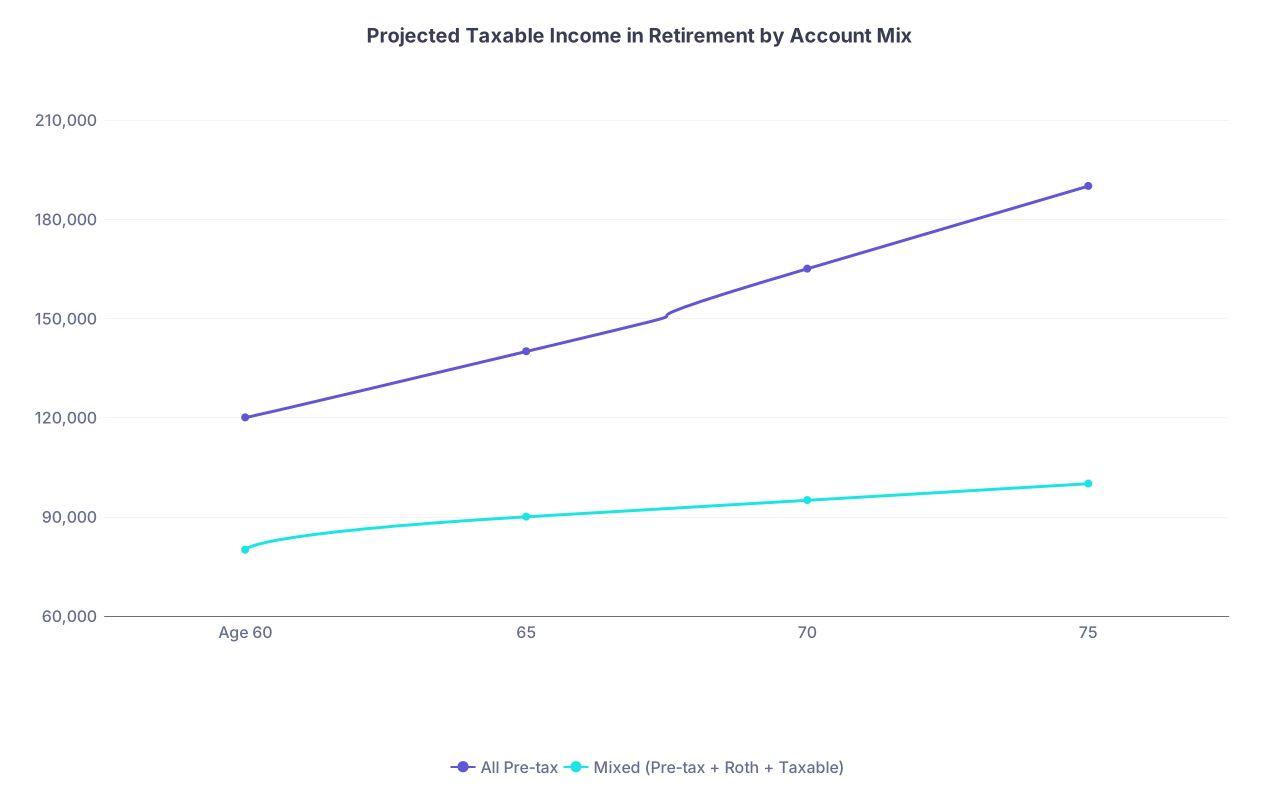
| Category | All Pre-tax | Mixed (Pre-tax + Roth + Taxable) |
|---|---|---|
| Age 60 | 120000 | 80000 |
| 65 | 140000 | 90000 |
| 70 | 165000 | 95000 |
| 75 | 190000 | 100000 |
The all-pre-tax doctor is forced into higher taxable income later, while the mixed-account doctor can keep taxable income more controlled.
If you are a PGY-2, this seems impossibly far away. But the decisions you make now about Roth versus pre-tax are literally shaping that future tax problem.
7. Letting “My CPA Will Handle It” Be Your Retirement Strategy
I have nothing against good CPAs. I do have a problem with doctors outsourcing their entire tax and retirement brain to someone who is focused mostly on last year’s return.
The mistake:
Assuming that handing your W-2 to a tax preparer equals “having a tax strategy.”
Most CPAs:
- File your return.
- Maybe point out easy deductions.
- Rarely map out a 30-year Roth vs pre-tax plan, or explain the nuances of 457(b) risks, or time Roth conversions with your career transitions.
That is not an insult. That is just not what many are paid or trained to do in depth.
If you do not understand the basics yourself, you will not even know what questions to ask. I have listened to attendings say, “My CPA said backdoor Roth is fine,” while they sit on $150k in traditional IRA balances and are setting up a tax mess.
Your job is not to become a tax expert. Your job is to:
- Understand the major account types you use.
- Recognize common traps (pro-rata rule, early withdrawal penalties, RMDs, non-gov 457 risk).
- Ask your CPA/financial planner specific questions, not “Am I good?”
“Am I good?” is not a plan. It is a wish.
FAQs
1. I am a PGY-2 with loans and no savings. What is the single biggest retirement mistake to avoid right now?
The biggest mistake is skipping Roth entirely during your low-income years. Even if you can only put in a small amount, open and fund a Roth IRA if you have any earned income. If you have an employer plan with a match, at least contribute enough to get the full match, then push Roth IRA as your next step. Do not wait until you are an attending to think about Roth. By then, the tax price is higher and the simple “direct Roth” door may be closed.
2. Should I choose Roth or pre-tax in my residency 403(b)/401(k)?
In most cases, Roth contributions make more sense during residency and fellowship. Your tax bracket is relatively low, and odds are high that future you will be in a higher bracket as an attending and possibly in retirement. Paying tax now at 12–22% to never pay tax on that money again is usually a strong trade. The main exceptions: if your spouse already has high income, or you have significant side income pushing you into higher brackets during training. Otherwise, default to Roth in training.
3. I have an old traditional IRA from a previous job. Does this mess up backdoor Roth contributions?
Yes, potentially. The IRS pro-rata rule looks at the total of all your traditional, SEP, and SIMPLE IRAs when calculating how much of your Roth conversion is taxable. If you have significant pre-tax money in those IRAs, your backdoor Roth will not be fully tax-free. To avoid this, many physicians roll old 401(k)/403(b) money into a new employer plan instead of into an IRA, or they convert IRAs to Roth in a low-income year before starting regular backdoor Roths.
4. Is my 457(b) plan safe, or should I avoid it?
It depends on whether it is a governmental or non-governmental 457(b). Governmental 457(b) plans are generally safer and can often be rolled over like other retirement plans. Non-governmental 457(b) plans are deferred compensation and remain assets of the employer. That means if the hospital goes bankrupt or faces major litigation, your 457(b) could be at risk as an unsecured creditor. Using them can still be worthwhile, but you should understand the employer’s financial health and not blindly assume it is the same as a 403(b).
5. How do I balance student loan payments with retirement contributions as a young doctor?
The mistake is going all-or-nothing. Many residents either ignore retirement completely to attack loans or ignore loan strategy to feel better about saving. A more rational approach usually looks like this: get your loan plan correct first (IDR vs refinance, PSLF or not), then at least capture any employer match in your retirement plan, and fund a Roth IRA during low-income years if possible. You do not have to max everything, but completely skipping tax-advantaged retirement savings in training is a long-term error that you cannot fully fix later.
Key points to walk away with:
- Use your low-income years (residency/fellowship) to aggressively build Roth and capture employer matches; those opportunities do not last.
- Understand the basic rules of the accounts you use—especially Roth vs pre-tax and IRA pro-rata—so you do not stumble into avoidable tax traps.
- Stop letting the tax tail wag the dog. You are not trying to win a single year; you are trying to win a 40-year career and a 30-year retirement.