
The smartest attendings are quietly using deferred compensation plans to move six-figure sums off the IRS’s radar—legally—while the rest of the group just nods in meetings and pretends to understand.
Let me tell you what really happens.
Most physicians hear “deferred comp” and think it’s some fancy 401(k) clone. It isn’t. It’s a completely different animal with different rules, risks, and power. The partners who understand it use it to shift income out of their highest tax years, protect assets from certain creditors, and build a side “shadow retirement” that never shows up on their W-2 in the way you expect.
The ones who don’t understand it? They’re the ones who get locked into golden handcuffs, lose money when a hospital system changes ownership, or discover at 60 that their “promised” pot of money was never really theirs.
You want to be in the first group.
What Deferred Compensation Really Is (Not the Sales-Pitch Version)
Start with the core truth: Nonqualified deferred compensation (NQDC) for attendings is a contract, not a benefit. That’s the part administrators downplay.
You agree to earn money now and take payment later. In return, you get:
- No tax on that deferred income this year
- Potential tax arbitrage if your future tax rate is lower
- Possible asset protection benefits, depending on your state and employer structure
But you also get:
- Creditor risk (it’s a company IOU, not your asset)
- Job risk (you often must stay to get the money)
- Rule risk (Section 409A is unforgiving if you screw up timing)
At big health systems—think Mayo, Cleveland Clinic, Kaiser, large academic centers—these plans are designed primarily for senior, high-earning physicians and execs. HR will call them “Nonqualified 457(f), 409A plans, SERPs, or Supplemental Retirement Plans.” Same basic idea: Phantom bucket of money, controlled by a contract.
The phrase I’ve heard in closed-door comp meetings: “We need something to keep the high producers from walking to the guy across town.”
That “something” is often deferred comp.
The Two Main Flavors Attendings Actually See
There are a thousand technical structures, but for practicing physicians, you’ll usually run into two dominant types.

1. Elective Deferred Compensation (You Choose How Much to Defer)
This is where you say, “I’ll take $100k of my $600k comp this year and defer it.” It never hits your W-2 as current income.
Key points behind the scenes:
- Elections are usually done before the calendar year (or before you earn the bonus). No mid-year “oops, my tax bill is high, let’s defer more.”
- Payout timing must be chosen at election: “lump sum at 65” or “10 annual payments starting 5 years after separation,” etc.
- You can’t just change your mind later without huge restrictions. 409A requires you push payments at least 5 years farther out, and you must do it well in advance.
The savvy attendings use this when they’re:
- In their 40s/50s, peak earnings, in the 37%+ marginal bracket
- Confident they’ll retire from that institution or at least stay long enough
- Willing to take some employer-creditor risk for big tax deferral
2. Employer-Funded “Golden Handcuff” Plans (They Give You the Money… Kind Of)
These are the “we’re contributing $50k a year to a supplemental retirement account for you” deals. Sounds free. It isn’t.
The hospital credits that amount to a phantom account, often with hypothetical investment returns (e.g., mirroring mutual funds). But legally, that money still belongs to the organization until a vesting or payout trigger.
What’s happening in the back room is simple:
HR and legal design a plan where:
- You must stay 5, 7, or 10 years to vest
- Vesting might be “cliff” (all or nothing)
- Payout is often timed around retirement or separation from service
I’ve sat in meetings where leadership literally said, “Let’s move from 3-year to 7-year vesting to improve retention.” That’s not about generosity. It’s about handcuffs.
Sometimes it’s a 457(f) style arrangement where vesting itself is the taxable event—the year it vests, you get hit with tax even if they don’t actually pay you the cash until later.
That catches a lot of physicians off guard.
Why Savvy Attendings Actually Use These Plans
Let’s strip the marketing and talk about why the smartest docs say yes.
1. Tax Arbitrage in Your Peak Earning Years
Top attendings at large systems sit in punishing brackets. You know the feeling when your bonus hits and 40–50% evaporates between federal, state, and payroll taxes.
Here’s what they’re really doing, quietly:
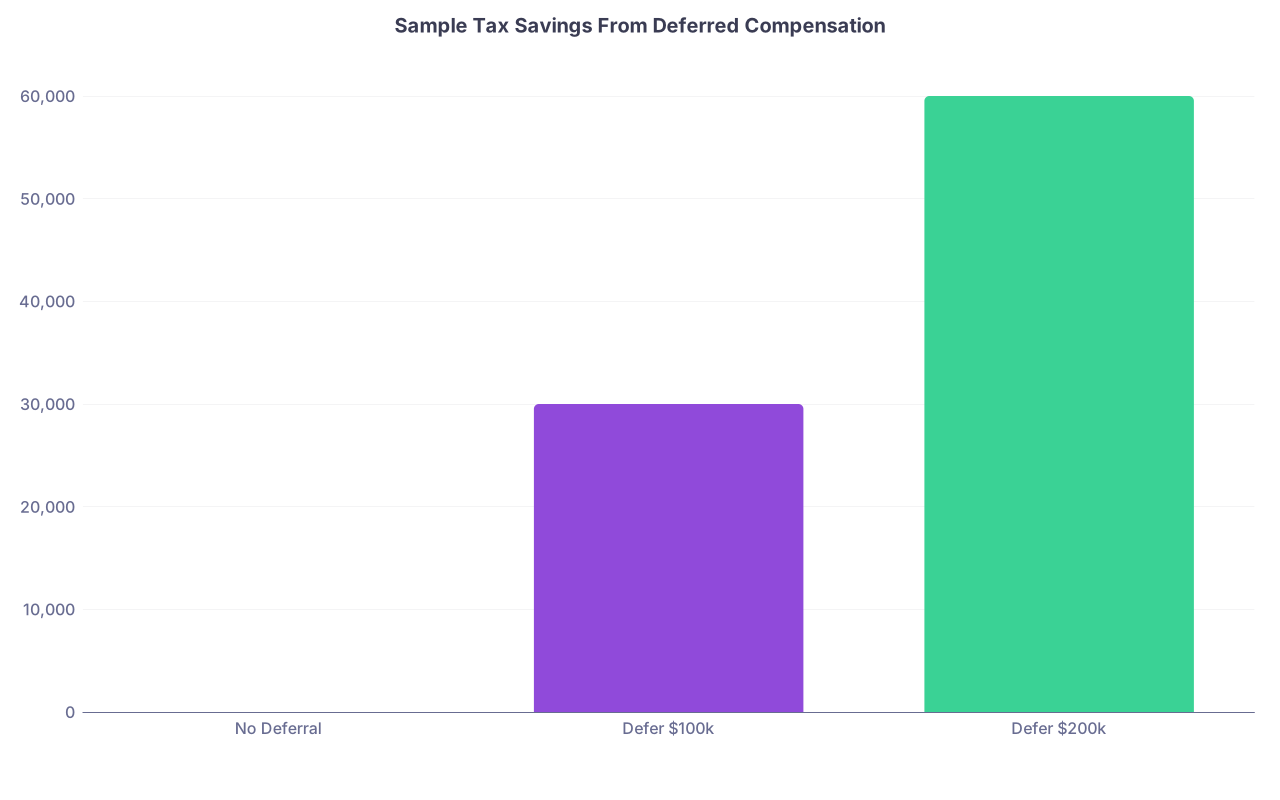
| Category | Value |
|---|---|
| No Deferral | 0 |
| Defer $100k | 30000 |
| Defer $200k | 60000 |
On a rough level (illustrative only):
- Current marginal rate: ~37% federal + state
- Future effective retirement rate: maybe 24–32%
If they defer $200k a year for 8 years, they’ve shifted $1.6M out of their highest taxed years into their lower-income retirement years. That’s six-figure tax savings across a career—even after accounting for risk.
The ones who get burned are the ones deferring small amounts “just because HR said it was good” without thinking about their long-term tax picture.
2. Using It as a Second, Hidden Retirement Bucket
Public-facing retirement: 401(k)/403(b), backdoor Roth, taxable brokerage.
Back room reality: The aggressive attendings treat NQDC as a separate stack, timed to bridge the gap between retirement and Social Security/Required Minimum Distributions.
For example, a typical savvy setup I’ve seen:
- 401(k)/403(b): Maxed every year, invested aggressively while in 40s/50s
- NQDC: Deferrals set to pay 10 annual installments from age 60–70
- Roths/taxable: Used for flexibility, early retirement, or big one-time purchases
Their thinking: “I retire at 60, my NQDC pays me $200k/year for 10 years while I let my 401(k) grow and delay Social Security.”
It’s coordinated, not random. Most attendings never think this way. The sophisticated few do because they paired a good planner with a good CPA and read the actual plan documents instead of the HR brochure.
The Dark Side: What Nobody Tells You at the HR Lunch
Now we get into the stuff you only hear whispered over coffee with the senior partner who “learned the hard way.”

1. You’re a General Creditor, Not an Owner
This is the part most physicians miss.
Your deferred balance is not “your account” the way a 401(k) is. It’s an unsecured promise. If the hospital system goes bankrupt, merges, or gets hammered by liability, you stand in line with other creditors.
I watched one regional system implode financially. The neurosurgeons had mid-six-figures in deferred comp each. On paper. In reality? Pennies on the dollar in bankruptcy court.
Did the docs max their 401(k)s first? The smart ones had. The others deferred too aggressively and found out what “unsecured promise” really means.
2. Golden Handcuffs Are Real, Not a Metaphor
I’ve seen brilliant physicians stay in toxic environments because they had $400k vesting “in two more years.” Miserable, burnt out, but trapped.
A 457(f)-style plan with cliff vesting at 10 years might look like this:
| Year of Service | Vested Amount |
|---|---|
| 1–4 | $0 |
| 5 | 20% |
| 7 | 60% |
| 10 | 100% |
Now add a clause: “Forfeited if you leave before vesting, except in death or disability.”
You’re not just deferring income. You’re selling your career flexibility.
Savvy attendings go in eyes wide open. They ask: “If this place gets unbearable, is this dollar amount worth staying three more years?”
Sometimes the answer is yes. Often it’s no.
3. The 409A Trap: You Don’t Get to Freestyle Timing
Section 409A is the IRS sledgehammer behind these plans. If you mess up the timing, you don’t just owe regular tax. You can trigger:
- Immediate taxation of the entire deferred balance
- A 20% additional federal penalty
- Possible interest charges
I’ve seen mid-career attendings ask HR if they can “pull some of that deferred money early to help with a house.” If HR had said yes outside a narrow set of exceptions, that could trigger a disaster.
A good plan is rigid by design. You choose at the front end. Then you live with it.
How the Savvy Ones Actually Decide How Much to Defer
This is where the real behind-the-scenes calculus happens.

| Step | Description |
|---|---|
| Step 1 | Eligible for Deferred Comp |
| Step 2 | Max 401k/403b, HSA, Backdoor Roth |
| Step 3 | Use Taxable Brokerage Instead |
| Step 4 | Small or No Deferral |
| Step 5 | Moderate to Aggressive Deferral |
| Step 6 | Max Qualified Plans? |
| Step 7 | Employer Stability High? |
| Step 8 | Current Tax Rate Very High? |
The behind-closed-doors checklist I see the sharpest attendings use looks like this (even if they don’t write it down):
Am I already maxing my 401(k)/403(b), HSA, and any available 457(b)?
If not, they fix that first. Those are generally safer and more portable.How stable is this employer, really?
- Academic flagship with billion-dollar endowment? More comfortable deferring.
- Regional community system with shaky finances and constant leadership churn? Much less.
What’s my marginal tax rate now vs. expected in retirement?
- If they’re in the top brackets and plan a step-down career or move to a low/no-tax state, deferral makes a ton of sense.
- If they’re actually going to have huge pensions, large RMDs, and high retirement income, the benefit shrinks.
What’s my exit plan from this job?
If they’re pretty sure they’ll leave in 3–5 years for family, opportunity, or sanity reasons, they keep deferrals small or skip the riskier golden handcuff designs.How much liquidity do I really need in the next 5–10 years?
I’ve seen people over-defer, then scramble to pay for kids’ college or a home because too much of their cash flow got locked into deferred comp.
The attendings who understand this don’t ask, “Is deferred comp good?” They ask, “How much risk can I comfortably take here, in this job, at this time in my career, for this tax benefit?”
The Tax and Legal Angles You Don’t Hear in the Town Hall
This is the part that happens in quiet conversations with the hospital’s outside ERISA counsel and the senior partners who’ve been through a few cycles.
State Creditor Laws and Malpractice Risk
In some states, your 401(k) is practically bulletproof against creditors. NQDC? Not so much. Because it’s technically still employer property, it can sometimes be better shielded from your personal creditors but exposed to theirs.
That flips the usual story physicians hear about “asset protection.”
- If you’re worried about getting sued personally beyond policy limits: max qualified plans first.
- If your employer is financially rock solid and you’ve got ample umbrella and malpractice: NQDC risk is more palatable.
This is why you see old-school partners with big deferred balances in very stable academic systems and far less enthusiasm in smaller, private-equity-backed hospitals.
Tricky Payout Structures
I’ve seen several “sophisticated” plans that blow up because of poor design:
- Lump sum at age 60 for a physician who plans to keep working full-time until 65. Result: massive tax spike, terrible timing.
- 5-year payout triggered at separation from service for someone who wants a phased retirement with part-time work at another institution. Result: high combined income during those years.
The sharp attendings (or their planners) align their payouts with reality:
- If they plan to fully retire at 60: schedule payouts 61–70
- If they plan to downshift to part-time at 55: aim for payouts during lower-income years
- If they have big future income (spouse with high income, business income, rental empire): maybe lighter on deferral or longer, smaller payouts
The legal documents usually allow for much more nuance than HR explains in a 45-minute PowerPoint. But nobody reads them except the attendings who treat this like the six- or seven-figure contracts they are.
A Realistic Playbook for a Mid-Career Attending
Let me walk you through a pattern I’ve seen work very well for physicians in their 40s and 50s at large systems.
You’re 45, making $600k at a stable academic center, married, high-tax state, two kids. You’ve already:
- Maxed 403(b) + 457(b)
- Doing backdoor Roths
- Have a decent taxable brokerage account
Your hospital offers:
- An elective NQDC plan (deferrals of base and bonus)
- A supplemental employer-funded 457(f)-style plan with 7-year cliff vesting
Here’s how the savvy version of you might actually use it:
- Start deferring $100k/year into NQDC, invested equivalently to your 60/40 or 70/30 allocation.
- Elect payout as a 10-year installment starting at 61 (when you plan to retire or go extremely part-time).
- Accept the employer-funded 457(f), but you decide mentally that you are not staying past 7 years purely for the vesting. If it’s still a good job, great—you vest. If it isn’t, you walk and treat anything forfeited as a sunk cost, not a cage.
Run that for 10–15 years. If the system stays healthy, you walk into your 60s with:
- A large qualified-retirement stack
- A separate $1–2M+ NQDC stream paying out in lower-tax years
- Flexibility to delay 401(k) withdrawals and Social Security
And you did it all while understanding the tradeoffs, not just going along with what HR packaged as “extra retirement.”
That’s how the insiders do it.
FAQs
1. Should I ever use deferred compensation before maxing my 401(k)/403(b) and HSA?
No. That’s backwards. Max the qualified, protected, portable stuff first. Then look at NQDC. I’ve only seen attendings violate this rule when they don’t understand the difference between qualified and nonqualified plans—or when someone sold them hard on the tax angle without explaining the risk side.
2. How much of my income is “too much” to defer into these plans?
Once you’re deferring so much that your day-to-day cash flow feels tight or you’re skipping obvious needs—college savings, sufficient emergency fund, paying down high-interest debt—you’ve gone too far. A common upper bound I see among cautious but aggressive physicians is 20–30% of gross income into NQDC, after everything else is well funded. But that’s highly context-dependent and should be modeled with a good CPA or planner.
3. What if I’m not sure I’ll stay with my current employer long term?
Then you either keep deferrals small or structure them for earlier payouts you can live with. The worst move is heavy deferral plus long vesting in a job you already suspect is temporary. When in doubt, prioritize portable vehicles—Roths, 401(k)/403(b), even taxable accounts—over tying money to a shaky or short-term employer relationship.
4. How do I actually evaluate my employer’s financial stability for this?
Look at bond ratings, recent financial statements, margin trends, and capital projects. Talk to older attendings who’ve been through a few budget cycles. If leadership turns over constantly, service lines keep getting cut, and the CFO keeps pushing “cost-containment measures,” that’s a yellow flag. On the other hand, long-term profitability, stable leadership, strong academic or system backing, and ongoing investment in infrastructure are all signs the creditor risk is more acceptable.
Key points: Deferred compensation is a contract and an IOU, not a free retirement account. The smartest attendings use it after maxing safer options, to shift income out of brutal tax years and create a second retirement income stream. And they never forget the trade: every dollar you defer buys tax benefits—but also ties you tighter to your employer’s health and your own willingness to stay put.