
The fastest way to blow up a solid retirement plan is to ignore disability insurance.
Why Disability Insurance Is The Risk You Keep Underestimating
You are probably protecting the wrong things.
Most people:
- Insure the car.
- Insure the house.
- Maybe obsess over investment choices.
And then casually skip or underfund the one policy that protects the asset that actually builds retirement: your income.
Your 401(k) balance is not your biggest financial asset in your 30s, 40s, or even early 50s. Your future earnings are. Lose those, and every carefully modeled retirement projection becomes fiction.
Here is the brutal sequence I see again and again:
- High earner with a “strong” retirement plan.
- No (or weak) long‑term disability coverage.
- Illness or injury → income drops by 40–80%.
- Retirement contributions stop.
- Savings get raided to pay bills.
- Retirement age gets pushed back a decade. If they get there at all.
Not dramatic. Just what the math forces.
The Math You Are Pretending Not To See
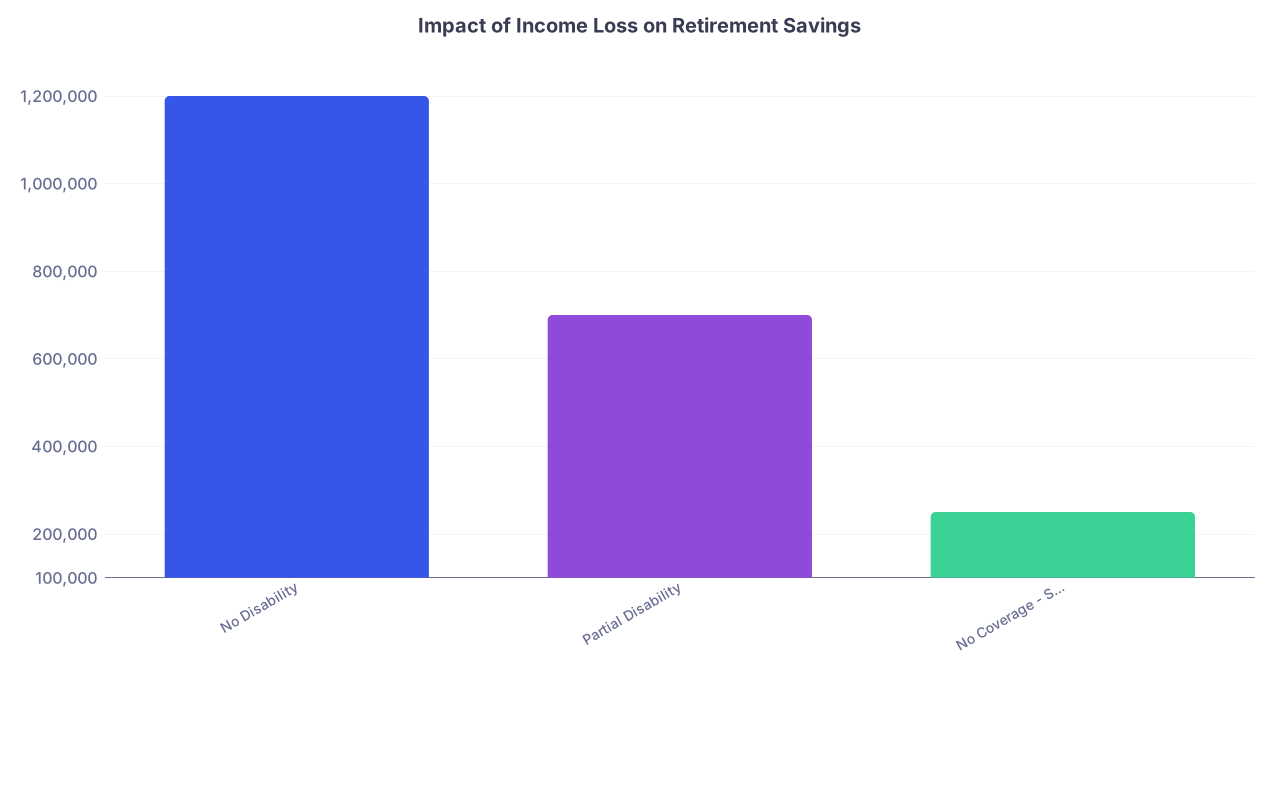
| Category | Value |
|---|---|
| No Disability | 1200000 |
| Partial Disability | 700000 |
| No Coverage - Stopped Saving | 250000 |
Take a simple scenario.
- Age: 35
- Income: $120,000
- Retirement savings: $150,000
- Annual retirement contribution: 15% ($18,000)
- Planned retirement age: 65
- Assume 6% annual return, contributions increasing with 2% raises
If everything goes fine, you might end up with around $1.2–1.4 million in retirement assets from this plan alone (ignoring Social Security and spouse).
Now the part no one models in their pretty retirement calculator:
At 42, you develop a chronic condition:
- You cannot work full‑time in your current role.
- Income drops to $50,000 (or less).
- You stop retirement contributions for 10 years.
- You withdraw $20,000 per year from savings for 5 years to cover costs.
Result:
- Retirement balance at 65? Often cut by half or worse.
- Retirement age? Quietly shifts to 70 or 72, if health even allows.
And if you are thinking, “But I will just cut my expenses,” remember:
Your expenses usually go up when you are disabled. Medical costs, adaptive equipment, maybe home modifications, maybe part‑time help.
Ignoring disability insurance is not just risky. It is numerically reckless.
The Most Common, Expensive Misconceptions
These are the stories people tell themselves right before their retirement plan collapses.
“My Emergency Fund Will Cover It”
No, it will not.
An emergency fund is for:
- 3–12 months of expenses.
- Short‑term job loss or surprise bills.
A disability is:
- Often measured in years. Sometimes decades.
- Frequently involves ongoing medical and care costs.
If you are 40 and become unable to work permanently, you are not bridging a 6‑month gap. You are trying to cover 25–30 years of lost earnings. That is not an “emergency fund” problem. That is an “income replacement” problem.
“I Have Group Disability Through My Employer, So I’m Fine”
This might be the single most dangerous half‑truth in personal finance.
Typical employer long‑term disability (LTD) plan:
- Replaces about 60% of base salary.
- Often:
- Taxable if employer paid the premium.
- Excludes bonuses, commissions, overtime.
- Has weak definitions of disability.
- Caps benefits (for example, max $5,000–$8,000 per month).
Run the numbers.
If you:
- Earn $150,000 salary + $50,000 bonus.
- Employer LTD pays 60% of salary only = 0.6 × 150k = $90,000.
- Benefits are taxable → maybe ~$65,000 net.
You just dropped from:
- ~ $120,000+ net income (including bonus)
- To ~ $65,000.
That is nearly a 50% pay cut.
And that is assuming they pay at all, and keep paying.
Also: Many group policies allow the insurer to change or cancel terms. You have very little control.
“Social Security Disability Will Take Care of Me”
This is fantasy-level optimism.
Reality of Social Security Disability Insurance (SSDI):
- Hard to qualify.
- Slow to approve (months to years).
- Benefits are modest.
| Source | Typical % of Income | Taxable? | Reliability |
|---|---|---|---|
| Employer LTD | 40–60% | Often Yes | Medium |
| SSDI | 20–30% (or less) | Maybe | Uncertain |
| Own Policy | 50–70% (or more) | Usually No | High |
Relying on SSDI as your primary backstop is like planning your retirement around winning a lawsuit you have not filed yet. Possible? Maybe. Prudent? No.
“I’m Healthy, The Odds Are Low”
No. You are mixing up “death” and “disability” probabilities.
People gladly buy life insurance in their 30s and 40s but balk at disability coverage because “I probably won’t need it.”
The numbers are ugly:
- The risk of a long‑term disability before retirement is often higher than the risk of premature death.
- Back injuries, mental health conditions, autoimmune diseases, cancer treatment side effects, car accidents—they rarely check your calendar first.
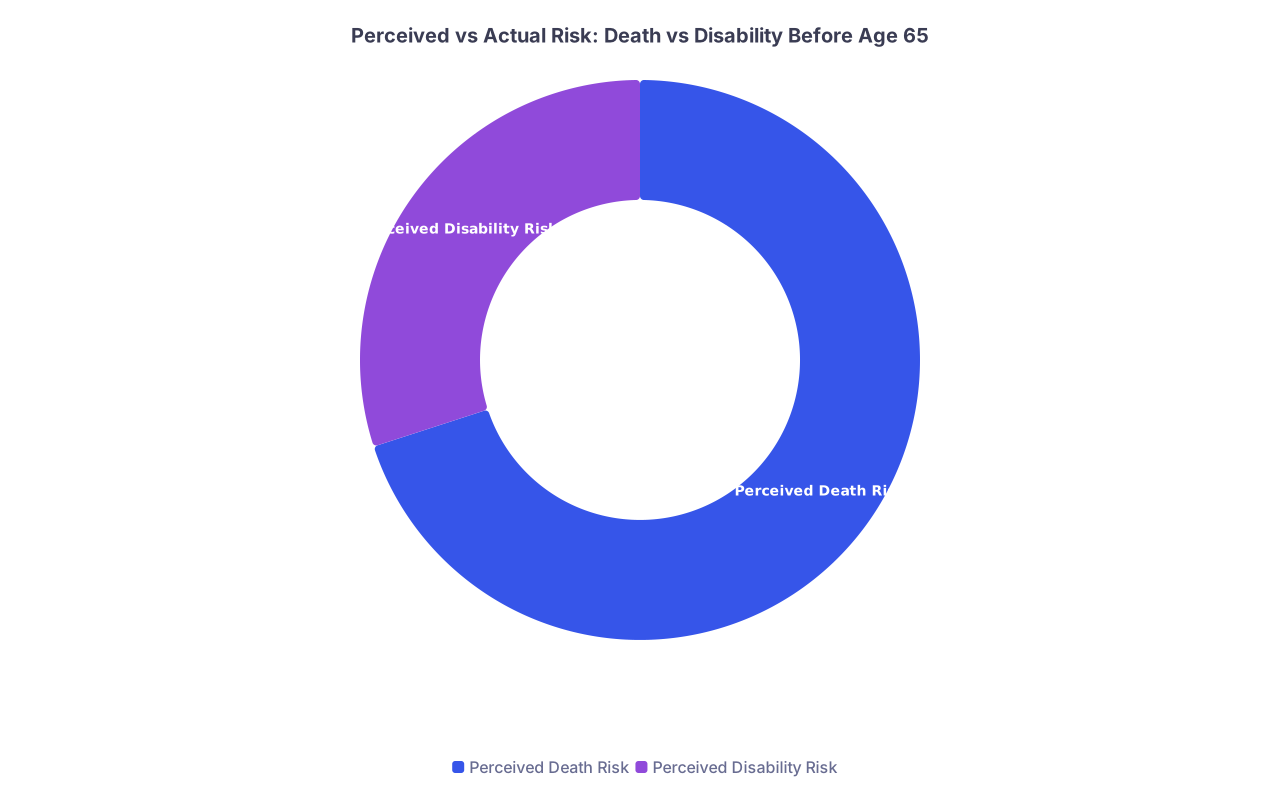
| Category | Value |
|---|---|
| Perceived Death Risk | 70 |
| Perceived Disability Risk | 30 |
People fear the wrong pie slice. Disability risk is not small. You just do not see it talked about as much.
“My Spouse Can Just Work More”
This is the most emotionally blind excuse.
When one partner becomes disabled:
- The other often has to work less, not more, to help with:
- Appointments.
- Caregiving.
- Household tasks the disabled partner can no longer manage.
- Stress skyrockets.
- Burnout is real.
Betting your retirement on your partner carrying everything—financially and practically—is a recipe for resentment and hardship, not security.
How Disability Insurance Actually Protects Your Retirement
Disability insurance is not about “extra protection.” It is about preserving the engine of your retirement plan.
It Keeps Contributions Going When Life Does Not
Best‑case scenario:
- You have a strong “own‑occupation” disability policy that:
- Pays if you cannot perform the material duties of your specific job.
- Replaces 60–70% of your pre‑disability income.
- Is paid with after‑tax dollars (so benefits are tax‑free in many jurisdictions; confirm with a tax professional).
Now run the earlier scenario again:
- Age 42, disability hits.
- Policy pays $6,000–$8,000 per month, tax‑free.
- You:
- Continue living without liquidating investments.
- May still contribute to retirement, even at a reduced level.
- Avoid tapping Roth IRAs, 401(k)s, or home equity just to survive.
Even if you cut contributions in half, the difference over 20+ years is hundreds of thousands of dollars in retirement assets preserved.
It Stops the “Retirement Savings Death Spiral”
Without disability coverage, the sequence looks like this:

| Step | Description |
|---|---|
| Step 1 | Disability Event |
| Step 2 | Income Drops Sharply |
| Step 3 | Stop Retirement Contributions |
| Step 4 | Withdraw From Savings |
| Step 5 | Pay Penalties and Taxes |
| Step 6 | Sell Investments at Bad Times |
| Step 7 | Retirement Age Pushed Back |
With a solid policy in place, that entire chain can be interrupted at the first step. Income is replaced → you do not have to dismantle your future to afford your present.
It Protects Against Sequence‑of‑Returns Catastrophe
If you are disabled close to retirement and must start pulling from investments early:
- You may be forced to sell in a down market.
- Early withdrawals magnify the damage of poor returns.
- Recovery becomes very difficult.
A disability policy lets you:
- Leave retirement assets invested.
- Bridge the income gap.
- Choose when you tap your nest egg instead of being forced to.
The Policy Mistakes That Quietly Sabotage You
Even people who buy disability insurance make errors that gut its usefulness.
Mistake 1: Accepting Weak Definitions of “Disability”
This is the silent killer in many policies.
Two big definitions:
Own‑occupation
- You are disabled if you cannot perform the substantial duties of your current occupation.
- Best for professionals whose skills are specific (physicians, dentists, attorneys, high‑skill tech, executives).
Any‑occupation
- You are disabled only if you cannot perform any job for which you are reasonably suited by education, training, or experience.
- Translation: If you can flip burgers or answer phones, they might say you are not disabled.
If your retirement plan depends on your high income in a specialized field, do not accept an “any‑occupation” definition. You worked too hard to train for a career only to be financially treated like an entry‑level worker after an injury.
Mistake 2: Ignoring Benefit Length and Waiting Period
Two key levers:
- Elimination period (waiting period): how long after disability before benefits begin. Often 90 days.
- Benefit period: how long benefits last. Options often include:
- 2 years
- 5 years
- To age 65 or 67
If your policy only pays for 2 or 5 years and you are 45 when you become disabled, what is the plan for the next 15–20 years? Retirement does not wait politely offstage.
Choosing a shorter benefit period to save a small premium is a common false economy that blows up long‑term planning.
Mistake 3: Not Accounting For Taxes and Inflation
Two more traps:
Taxation
- Employer‑paid premiums → benefits are usually taxable.
- Individually paid, after‑tax premiums → benefits often tax‑free.
Underestimating taxes on benefits leads to surprise income gaps.
Inflation
- A flat $5,000/month benefit at age 35 will feel very different at age 55.
- Without a cost‑of‑living adjustment (COLA) rider, your “protection” erodes every year.
Buyers fixate on benefit amount today and ignore what that same number becomes in 15 or 20 years. That is a mistake.
Mistake 4: Underinsuring High Earners
If you are a high earner and:
- Have big retirement contributions.
- Plan on maintaining a certain lifestyle.
- Carry obligations (kids, tuition, mortgage).
Then a standard group policy cap (for example, $8,000/month) may leave you catastrophically underinsured.
| Item | Amount |
|---|---|
| Pre‑disability Net Income | $13,000/mo |
| Employer LTD Benefit (net) | $5,000/mo |
| Monthly Shortfall | $8,000/mo |
| Annual Shortfall | $96,000/yr |
Multiply that gap over 10–20 years and your retirement plan is gone. You need supplemental individual coverage, not wishful thinking.
How To Actually Align Disability Insurance With Your Retirement Goal
This is where you avoid the big mistakes.
Step 1: Calculate the Income You Truly Need Protected
Do not start with “What can I get?” Start with “What must I preserve?”
Ask:
- What is my current net monthly income?
- How much of that:
- Covers fixed essential costs?
- Goes to retirement and long‑term goals?
- What is the minimum I need to:
- Avoid raiding savings?
- Keep some level of retirement investing going?
You are trying to protect not just survival, but future stability.
Step 2: Audit What You Already Have
Pull the actual documents. Not the HR brochure. The policy.
Look for:
- Definition of disability (own‑occupation vs any‑occupation).
- Percentage of income covered and what income counts.
- Caps on monthly benefits.
- Whether premiums are employer or employee paid.
- Elimination period.
- Benefit period.
Then compare it to your actual income and needs. If you are guessing, you are already behind.
Step 3: Decide If You Need an Individual Policy
If your audit shows:
- Weak definition.
- Low cap relative to your income.
- Short benefit period.
- No coverage at all (self‑employed, contractor, small firm).
Then you likely need an individual long‑term disability policy.
It will usually:
- Cost more than you want to pay.
- Still be cheaper than working 10 extra years because your retirement savings evaporated.
Focus on:
- Strong own‑occupation definition.
- Benefit period to at least your target retirement age.
- Ability to increase coverage as income rises.
Step 4: Add Riders Carefully, Not Blindly
Common riders that actually matter for long‑term retirement protection:
- Residual/partial disability: pays if you can work but with reduced income. Many disabilities fall into this category.
- COLA (cost of living adjustment): increases benefits periodically to fight inflation.
- Future increase option: lets you raise coverage later without new medical underwriting.
The mistake is either buying every shiny rider or stripping them all to save a few dollars. You want the ones that directly protect your long‑term income trajectory.
Step 5: Coordinate With Your Overall Retirement Plan
Disability insurance is not separate from retirement planning. It is the firewall.
Integrate it by:
- Adjusting your required savings rate if premiums reduce disposable income. Slightly lower contributions + real protection is better than high contributions that vanish overnight when disaster hits.
- Updating retirement projections to include:
- The possibility of disability.
- The role of benefits in maintaining contributions.
- Reviewing coverage at major life events:
- Marriage or divorce.
- Birth of a child.
- Major income jump.
- Taking on large debt (house, business).
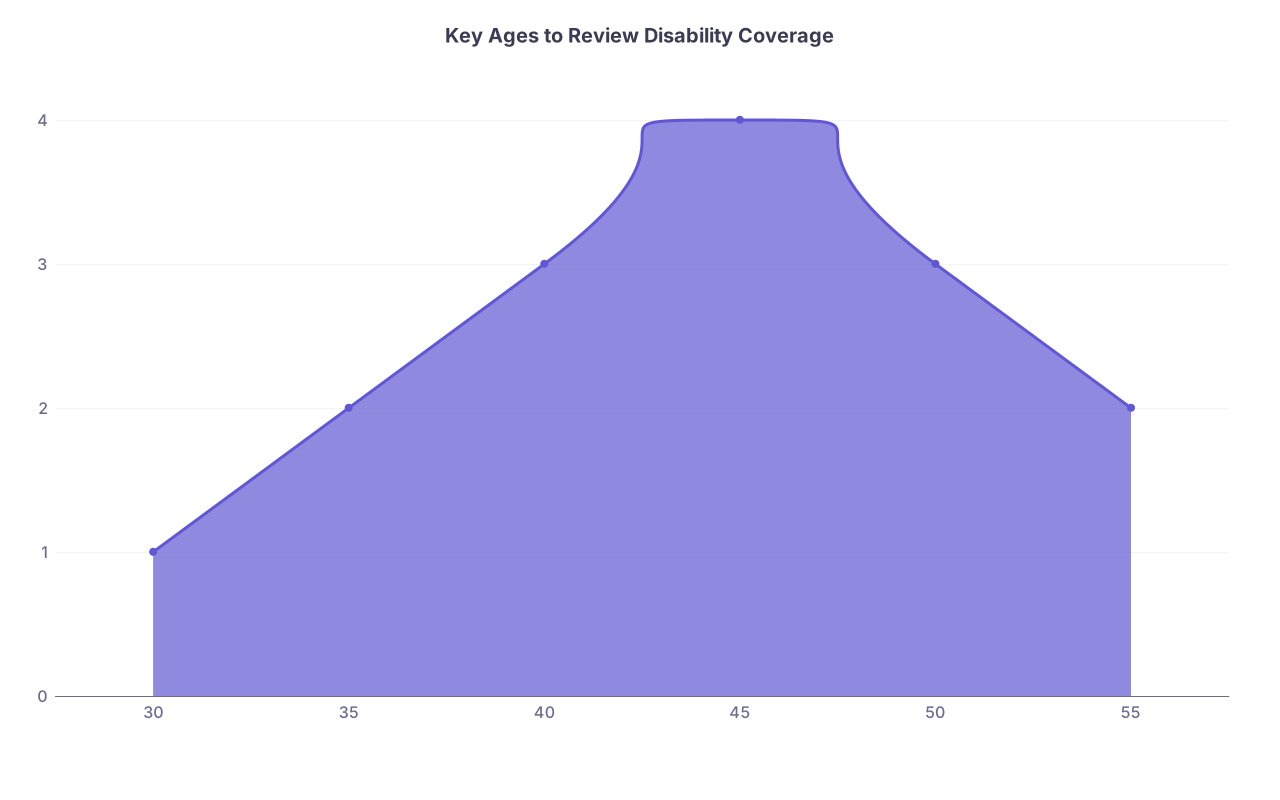
| Category | Value |
|---|---|
| 30 | 1 |
| 35 | 2 |
| 40 | 3 |
| 45 | 4 |
| 50 | 3 |
| 55 | 2 |
Reviews should spike when responsibility spikes. Most people do the opposite.
The Quiet Psychological Trap: Optimism
The final mistake is purely mental: refusing to plan for unpleasant outcomes.
You do not want to picture yourself:
- Sick.
- Injured.
- Unable to work.
- Watching your retirement accounts shrink.
So you do nothing. Which is, unfortunately, a decision.
The reality:
Planning for disability is not pessimism. It is respect for the fact that your body and brain are not guaranteed to cooperate with your spreadsheet.
Your retirement goal is fragile without income protection. You can have the best investments, the smartest tax strategy, and a perfect asset allocation—and one serious health event can erase decades of discipline.
Do not confuse being “positive” with being prepared. They are not the same thing.
Today’s action step:
Pull every disability‑related document you have—employer benefits booklet, any individual policy, Social Security statement. Sit down and answer one blunt question on paper: If I could not work for the next 10 years, how would my retirement plan actually look? If you do not like that answer, it is time to fix the coverage, not the fantasy.