The most valuable part of many physician employment contracts is buried in a few bland lines you barely read: the retirement perks. That’s where a lot of doctors quietly become rich—or quietly get screwed.
Let me walk you through what actually happens behind closed doors when administrators, CMOs, and HR “comp and benefits” people talk about your retirement. Because they aren’t thinking about your future. They’re thinking about budgets, turnover, and control.
The Dirty Secret: Retirement Is How They Underpay You
Hospitals and large groups love to brag about “total compensation.” That slide on interview day with salary, bonus, CME, health, retirement, all rolled into a big number that looks generous.
Here’s the part no one says out loud: retirement benefits are the cheapest, least painful way for employers to make an offer look competitive while paying you less in actual cash. And they know 80% of physicians will not understand the fine print.
The real leverage is hidden in details like:
- How much they match—and when you’re actually vested
- Whether there’s a “hidden” supplemental plan only partners or senior docs get
- What happens to employer contributions if you leave at year 2 vs year 7
- Whether they cap your ability to use your own money in the best tax shelters
I’ve sat in meetings where an administrator literally said, “We can shave 15k off base and just bump the 401(k) match language. They’ll like the number.” And he was right. The candidate never pushed back.
You are not going to be that person.
The Core Retirement Structures: What You’re Really Looking At
Let’s strip the marketing language off and talk like adults.
Most employed physicians will see some mix of the following:
- 401(k) or 403(b)
- 457(b) (often “nonqualified,” which matters a lot)
- Possible defined benefit or cash balance plan
- Employer match or “profit sharing”
- Supplemental executive retirement plans (SERPs) or phantom “top hat” plans for leadership or partners
How generous these are—and how restrictive—varies wildly.
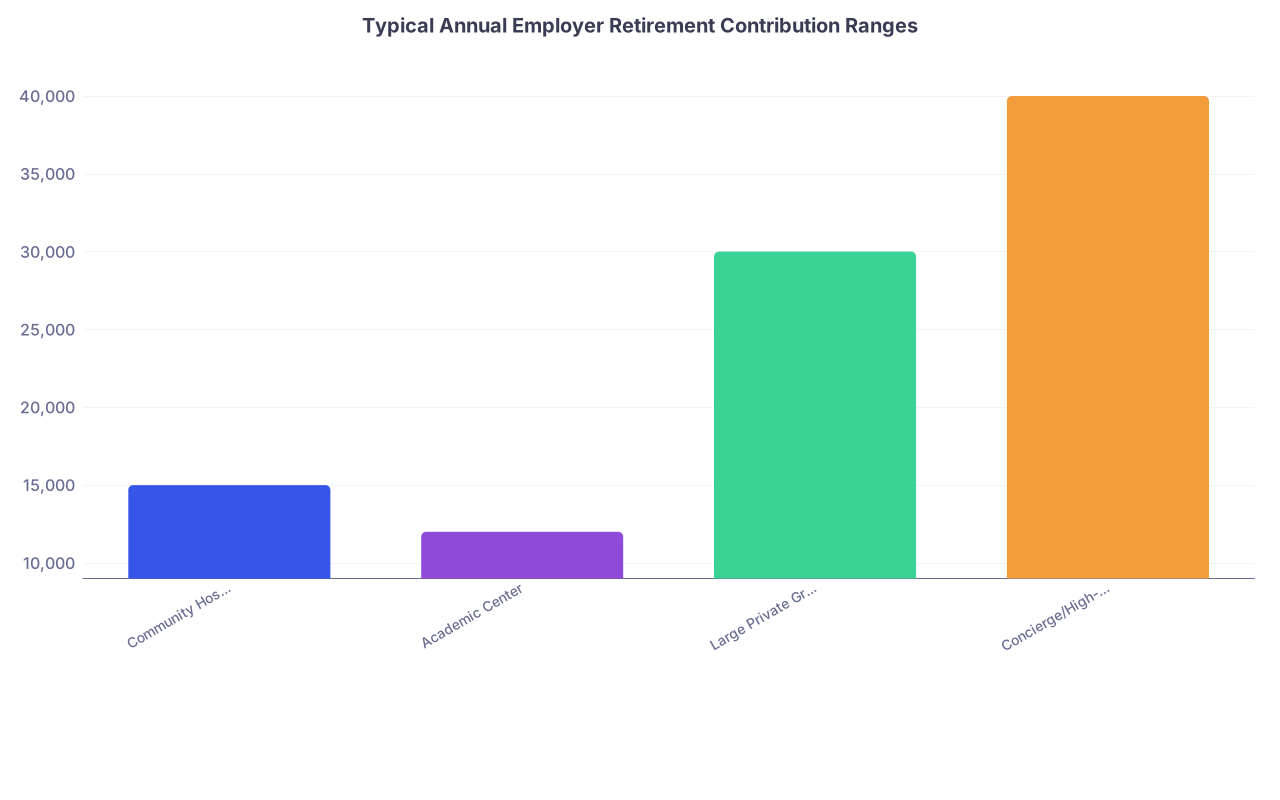
| Category | Value |
|---|---|
| Community Hospital | 15000 |
| Academic Center | 12000 |
| Large Private Group | 30000 |
| Concierge/High-End Group | 40000 |
Those are real ballparks I’ve seen repeatedly. Same specialty, similar RVU expectations, radically different long-term retirement trajectories because of plan design.
Let’s dissect the unspoken pieces that actually change your life.
The 401(k) / 403(b) Trapdoors
Everyone skims this section. Big mistake.
In most contracts it’ll say something like, “Eligible for 401(k) after 6 months; employer match up to 4% of salary.” That sounds fine. Safe. Standard.
Here’s what they don’t explain.
1. Match games and vesting schedules
There are two big levers they quietly use on you:
- When you start getting a match
- When those employer dollars actually become yours
I’ve seen:
- 1-year wait before any employer match
- 3-year cliff vesting (0% vested until day 1 of year 3)
- 6-year graded vesting (20%, 40%, 60%, 80%, 100%… you leave at year 4, you lose 40% of employer money)
If you’re in a specialty with a lot of early-career job hopping—EM, hospitalist, some surgical subs—this is not an accident. They expect you to churn and leave employer contributions behind. That forfeited money goes back into the plan or reduces their future funding.
| Vesting Type | Typical Schedule | Who It Favors |
|---|---|---|
| Immediate | 100% day 1 | Physician |
| 3-Year Cliff | 0% until year 3 | Employer |
| 6-Year Graded | 0–100% over 6 years | Employer (early leavers) |
| 2-Year Cliff | 0% until year 2 | Employer |
Behind the scenes: I’ve heard CFOs explicitly say, “That three-year cliff saves us a fortune on the hospitalists and nocturnists.” They know many won’t make it to year 3.
What you should do:
Read the vesting schedule in the plan document, not just the contract. Ask:
- “What is the vesting schedule on employer contributions?”
- “How much money does the average new hire actually vest over the first 3–5 years?”
Yes, you can ask that. And you should.
2. Salary definitions that quietly cap your benefits
Another quiet trick: defining “eligible compensation” in a way that reduces the match.
You might think your match applies to total comp (base + RVU bonus + call pay). Sometimes it does. Often it doesn’t.
I’ve seen contracts where:
- Match only applied to base salary, not RVU bonuses
- Match didn’t apply to certain “stipends” (medical directorships, leadership pay)
- Comp above a certain threshold wasn’t matched
Over a decade, that’s a six-figure difference.
Ask bluntly:
“Is the employer match based on base only or total cash comp including bonuses, call, and stipends?”
If they start dancing around the answer, you have your answer.
3. Academic centers: the 403(b) + 401(a) combo
Academic institutions love complex structures: usually a 403(b) (your deferrals) and a 401(a) (mandatory or employer contributions).
The quiet win at some elite places (think big-name academic centers):
- Mandatory 5% employee contribution
- Automatic 10%+ employer contribution, no match required
- Often immediate or fast vesting
These can be retirement gold. But there’s a catch: leave early, and you may be walking away from years of compounding at a place that quietly had one of the best retirement deals in the country.
On the flip side, I’ve seen mid-tier universities talk a big game with “10% contributions” but bury a 3-year cliff and base-salary-only definitions.
Again: plan document > brochure.
The 457(b): The Most Misunderstood “Benefit” You’ll Be Offered
If you’re at a nonprofit hospital system, they’ll often throw a 457(b) into your package and call it a perk. “Additional tax-advantaged savings!” they say.
Let me be very clear: a nongovernmental 457(b) is not like your 401(k).
You are not just “saving more pre-tax.” You are becoming an unsecured creditor of your employer. If the system crashes financially, your 457(b) can vanish in bankruptcy. You stand in line with other creditors.
Most docs have no idea.
How admins think about the 457(b)
I’ve heard variations of this: “If we offer a 457(b), our senior docs will feel taken care of and tied to the institution. And it doesn’t really cost us anything.”
That second part is the key. There’s usually no employer contribution. It’s your money, in their name, subject to their solvency and distribution rules.
The “perk” is tax deferral, with risk.
When a 457(b) is actually useful
It can still be worth using if:
- You’re at a stable, large, financially strong system
- You’re in a very high tax bracket and already maxing 401(k)/403(b) and backdoor Roth
- You understand the distribution rules (often forced distributions upon separation, which can spike your tax bill)
But if you’re in a shaky community hospital, new system, or small nonprofit with thin margins and a lot of debt? Stuffing six figures into a 457(b) is not intelligent.
Ask:
- “Is this a governmental or nongovernmental 457(b)?”
- “Is this plan subject to the claims of the hospital’s general creditors?”
- “What happens to my balance if the hospital is acquired or goes through restructuring?”
If they look uncomfortable, that tells you what you need.
The Hidden Gem: Cash Balance and Defined Benefit Plans
This is where a lot of older partners and senior docs quietly win the game without ever talking about it at the interview dinner.
Smaller private groups, especially high-earning surgical or specialty groups, sometimes have a cash balance plan or defined benefit structure layered on top of a 401(k)/profit-sharing plan.
This is what that really means: they’re creating a second, massive tax-advantaged bucket, often allowing six-figure annual contributions per doc, mostly paid by the practice.
You’ll see language like “employer-funded cash balance plan” or “defined benefit plan” in the benefits section—or not at all, because they hand you a separate packet after you sign.
I’ve seen groups where:
- Partners over 50 get 100k–200k/year going into a cash balance plan
- New hires get very little benefit for the first few years
- The plan is designed primarily to enrich older partners who own the practice
That’s not evil. It’s just the truth. The plan was built to help them shelter income. You’re a side effect.
If you’re joining one of these setups, you must understand:
- Who pays what into the plan
- When you become eligible for full participation
- Vesting if you leave after 3–5 years
- What percentage of total contributions goes to the physicians vs staff
This is where your accountant or a fee-only planner earns their money. And yes, you should have one before signing a contract that mentions “defined benefit.”
Supplemental Plans: The Stuff They Don’t Put in the Brochure
There’s a whole class of “extra” retirement or quasi-retirement perks that are selectively offered:
- SERPs (Supplemental Executive Retirement Plans)
- Top-hat plans
- Phantom equity or long-term incentive units
You’ll almost never see these openly described in the standard physician offer letter. Instead, they’re rolled out later to “key physicians,” leaders, or partners.
Insider truth: the most powerful retirement perks—guaranteed income streams, extra tax-deferred buckets, or golden-handcuff style plans—are used to anchor high-value docs and leaders. If you never ask whether such structures exist, you may never be invited into them.
I’ve watched this play out: the early-career cardiologist who becomes the unofficial workhorse, hitting insane RVUs, building service lines, doing all the things. No one ever tells him the senior cardiologist chairing three committees has a separate deferred comp plan paying him an extra 40–60k/year in “retirement accruals.”
If you’re clearly being targeted as leadership material, you need to ask, late in negotiations, calmly:
“Are there any supplemental retirement or deferred compensation programs for physicians in leadership or partnership tracks? If so, what’s the usual pathway to eligibility?”
You’re not being greedy. You’re signaling that you’re not naive.
Profit Sharing: The Most Abused Term in Physician Contracts
“Profit sharing” sounds sexy. It often isn’t.
Sometimes, yes, this means the employer throws extra money into your retirement accounts each year—often a discretionary amount pegged to profits. But more often it’s a black box:
- No formula
- No guarantee
- Varies year to year with no transparency
Behind the scenes, admin discussions usually sound like: “Let’s keep the profit-sharing language vague. We’ll plug in a number depending on how we do and who we want to keep happy.”
If profit sharing is a major selling point in your offer, you should push for clarity:
- “What has the profit-sharing percentage been for the last 3 years?”
- “Is there a minimum or typical target contribution?”
- “Is it allocated evenly or tied to compensation/RVUs?”
If they refuse to give a track record, assume it’s smoke.
Non-Obvious Perks That Function Like Retirement Benefits
Not everything labeled “retirement” is in the retirement section. Some quiet perks create massive long-term value but get one sentence in the contract.
Watch for these:
1. Employer-paid disability with own-occupation coverage
A robust, own-occ disability policy paid by the employer can be more valuable than an extra 5k of 401(k) match. It protects the entire future earning stream that funds all your retirement.
But there’s a catch: many employer policies are weak. Narrow definitions, caps that don’t match your income, taxable benefits. Or they prohibit you from getting a decent individual supplement.
Ask:
- “Is this true own-occupation coverage?”
- “What is the monthly benefit cap?”
- “Can I add my own individual policy on top?”
If your contract quietly blocks you from doing that, that’s a hidden negative.
2. Subsidized or guaranteed access to group long-term care or umbrella coverage
Occasionally, larger employers will offer access to group long-term care policies or umbrella liability without medical underwriting. If you’re older or have some medical baggage, that’s a quiet gem.
Not common, but when it’s there, pay attention.
3. Paid sabbaticals and phased retirement
Academic centers and some large groups are experimenting with phased retirement: reduced clinical FTE with partially maintained benefits, or formal sabbaticals that allow you to stretch your career.
These don’t show up in the “retirement” section, but they directly affect:
- How long you can tolerate clinical work
- How much longer you can accumulate retirement savings
- Your quality of life in your 50s and 60s
If you’re mid-career, ask honestly: “What does a typical retirement path look like here?” Then shut up and see what stories they tell.
You’ll learn more from that answer than from any glossy HR slide deck.
How Age, Specialty, and Turnover Shape What You’re Offered
Here’s a pattern I’ve seen repeatedly:
- High-turnover roles (ED, hospitalist, urgent care) → worse vesting, lower match, more 457(b) instead of real employer dollars
- Stable, hard-to-recruit specialties (radiology in rural areas, anesthesia in certain markets) → surprisingly strong retirement packages to keep you rooted
- Academic powerhouse departments → lower salary but extremely strong 403(b)/401(a) contributions with fast vesting
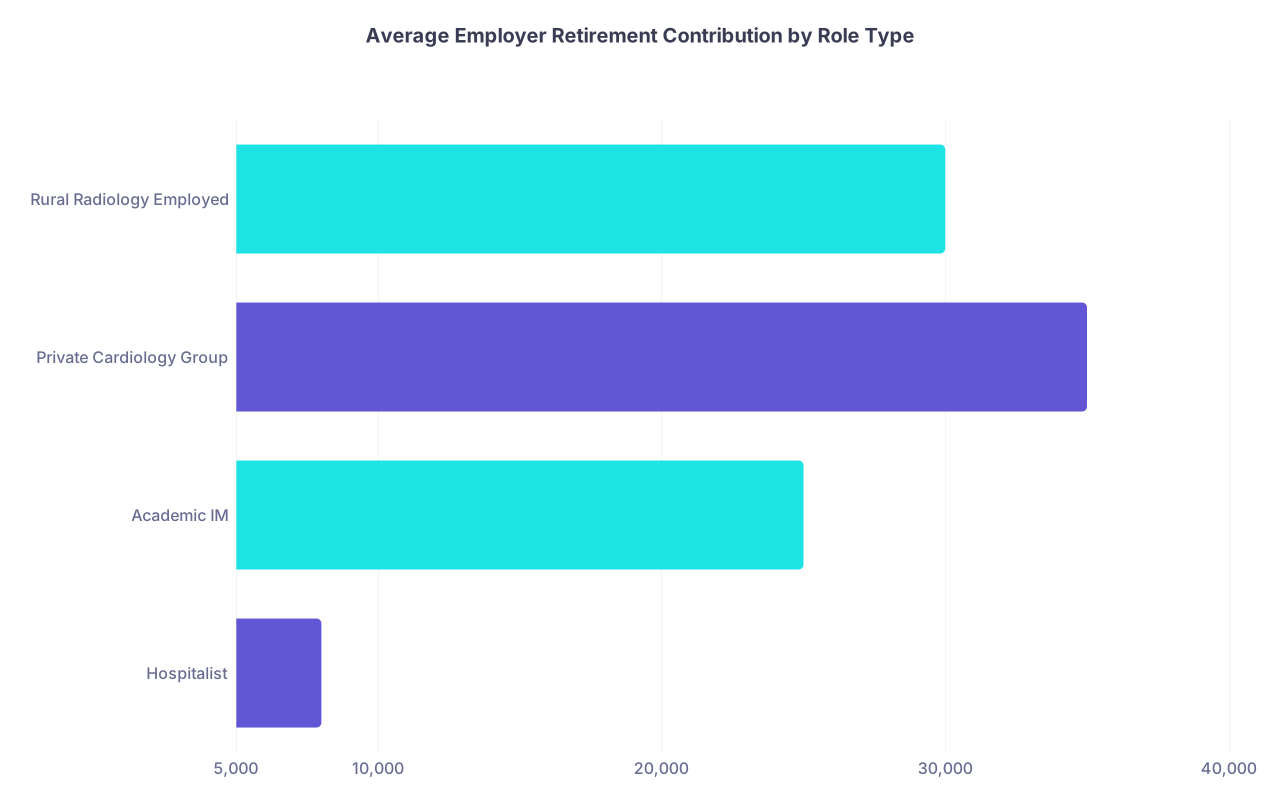
| Category | Value |
|---|---|
| Hospitalist | 8000 |
| Academic IM | 25000 |
| Private Cardiology Group | 35000 |
| Rural Radiology Employed | 30000 |
They are not designing these benefits around fairness. They design them around behavior: who they want to keep, how long, and at what cost.
If you’re entering a role where the average tenure is 2–3 years and the vesting is 3-year cliff, you’re donating your employer “match” back to the system unless you’re sure you’ll stay.
How to Actually Analyze the Retirement Side of an Offer
You don’t need to become a pension actuary. But you do need to do more than glance at the bullet points.
Here’s the lean version of what a serious physician does:
- Get the actual plan documents for 401(k)/403(b), 457(b), and any defined benefit or cash balance plans. Not the glossy summaries. The real thing.
- Confirm:
- Vesting schedule
- Definition of compensation for employer contributions
- Historical employer contributions (last 3 years)
- Eligibility timelines (when you can enter, when employer starts paying)
- Ask your advisor or a fee-only planner: “If I make 350k here and 325k at another job, which is better over 10–15 years after retirement benefits and taxes?”
I have watched docs walk away from “higher salary” jobs once this math was done. And they were right to do it.
Because 20k/year of extra employer retirement money, compounding for 25 years, destroys a 10–15k difference in salary today.
FAQs
1. How much should retirement benefits matter compared to salary when I compare offers?
If you’re planning to stay at least 5–7 years, retirement benefits can easily be a six-figure swing over your career. I’d put them in the same league as base plus bonus. For short-term positions (1–2 years), vesting and portability matter more than headline match percentages. Do the math: estimate employer contributions over your expected stay, adjust for vesting, then compare across offers.
2. Is a nongovernmental 457(b) too risky to use?
Not automatically. But you should treat it as a higher-risk tax deferral tool, not a no-brainer retirement account. If you’re at a huge, stable nonprofit system with strong financials and you’re already maxing better options (401(k)/403(b), HSA, backdoor Roth), using a 457(b) can make sense. At a shaky or heavily indebted hospital, I’d either minimize contributions or skip it and invest in a taxable brokerage instead.
3. Who should review my contract from a retirement perspective—lawyer or financial planner?
A contract lawyer will catch legal landmines and noncompetes; a good one might flag vesting or vague profit-sharing language. But most aren’t optimizing your long-term retirement math. For that, a fee-only financial planner or CPA who regularly works with physicians is better. Ideal setup: lawyer for legal risk, planner/CPA to quantify the retirement and tax impact. One without the other leaves blind spots.
The unspoken truth is simple: retirement perks are how employers quietly tilt the table in their favor—or, occasionally, hand you a golden deal you never realized you had.
If you remember nothing else, remember this: read past the salary line, get the real plan documents, and force the numbers into the open. The physician who understands the retirement section of the contract almost always ends up wealthier than the one who only chases base pay.