
The worst retirement mistake PGY-1s make is waiting “until things calm down.” They never do. You build wealth in residency or you chase it for the next 30 years.
You are not going to have a perfect financial plan this year. You are going to have a functional one, built on a clear timeline. Month by month. Paycheck by paycheck.
Below is exactly when and how to start retirement contributions in PGY‑1, with concrete checkpoints from Match Day through the end of intern year.
Big Picture: Your PGY‑1 Retirement Roadmap
At this point, you need an overview before we drill into weeks and paychecks.
Here is the sequence that actually works:
Pre-residency (Match → Orientation)
- Collect your numbers: salary, loan status, expected move costs.
- Decide your minimum retirement savings goal for PGY‑1.
- Learn what accounts your program offers (403(b), 401(k), 457(b)).
First 1–2 paychecks
- Lock in basic cash flow (rent, food, transportation).
- Start some retirement contribution, even if tiny (1–3%).
- Turn on loan grace period / IDR applications, not aggressive payoff yet.
Months 3–6
- Increase contributions as your budget stabilizes.
- Capture any employer match (non-negotiable).
- Open a Roth IRA if appropriate and you can swing it.
Months 7–12
- Automate everything.
- Adjust for taxes, overtime, moonlighting, and cost-of-living reality.
- Finish PGY‑1 with at least one full year of consistent contributions.
That is the spine. Now we put dates and actions on it.
Phase 0: Match to Residency Start (March–June)
At this point, you are still a fourth-year with more time than money. Use the time.
March–April: Right After Match
Goal: Get your financial starting line in writing and choose a PGY‑1 savings target.
List the key numbers
- Expected PGY‑1 gross salary (e.g., $60–70k; check your GME website).
- Location and ballpark rent range.
- Student loan total and interest rates.
- Cash on hand: checking + savings.
Set a realistic PGY‑1 retirement goal
For most interns, a sane starter target is:
- Minimum: 3–5% of PGY‑1 salary into retirement accounts
- Ideal stretch: 10–15% combined (match + your contributions + Roth IRA)
Do not overthink this. Pick a percentage now so you are not negotiating with yourself when you are post-call and exhausted.
- Decide your debt vs retirement philosophy early
You need a default rule, or you will panic-spend on loans and skip investing.
- If you expect PSLF or IDR forgiveness:
- Plan: Minimum payments on loans, aggressive retirement savings within your budget.
- If you plan rapid payoff after training:
- Plan: Put at least enough in retirement to get any match, then consider extra to loans.
Write your rule on paper. You will forget it on night float.
May–June: Pre-Move and Onboarding
Goal: Understand your benefits and build the first draft of your PGY‑1 budget.
Read the benefits packet (yes, actually) You are looking for four things:
- Retirement plans offered: 403(b), 401(k), 457(b).
- Employer match: percentage, vesting, eligibility start date.
- Whether contributions are pre-tax or Roth options are available.
- When you can enroll and how (online portal, HR forms, etc.).
Estimate net pay
Take your annual salary and convert it to monthly take-home. Rough and dirty:
- Subtract ~25–30% for federal, state, Social Security/Medicare.
- Then subtract:
- Health insurance premiums
- Disability insurance (if through employer)
- Required fees/dues
What remains is your net paycheck. You need this number for everything else.
- Draft a PGY‑1 baseline budget
Keep it simple. Your fixed numbers:
- Rent + utilities
- Transportation (car payment, gas, insurance / public transit)
- Groceries
- Phone, internet
- Minimum loan payment estimate (IDR or standard)
Now ask: If I removed 3–5% of my gross pay into retirement, does this budget collapse?
If not, that is your starting contribution.
- Choose your future contribution split
Default that works for most interns:
- First priority: Employer retirement plan up to the full match (if any).
- Second: Roth IRA up to what you can afford.
- Third: Extra voluntary contributions to 403(b)/401(k)/457(b).
We will plug actual numbers in after you see your first paycheck.
Phase 1: Orientation Month (July) – Get Money Flowing
At this point, you are starting residency and getting your first real paycheck. This is where most people blow it with lifestyle creep.
Week 1–2 of Residency
Goal: Enroll in the retirement plan and commit to a starting percentage.
- As soon as HR gives you portal access
Log in. Go to the retirement/benefits section. Do not wait.
- If there is an employer match, set your contribution to at least the full match threshold. Example:
- “We match 100% of the first 3% you contribute” → you contribute 3% minimum.
- If no match:
- Start with 3–5% if your pre-budget looked reasonable.
You can adjust later. The mistake is starting at 0%.
- Choose between pre-tax and Roth in the employer plan
PGY‑1 income is relatively low for a physician career. That usually argues for Roth contributions if your plan offers them. Rough rules:
- If you are not drowning in cash flow problems:
- Choose Roth 403(b)/401(k).
- If you are in a high-tax state or totally stretched:
- Pre-tax can create more take-home now, which may be necessary.
You can split between them too, but do not paralyze yourself with micro-optimization.
- Pick a fund option and move on
Do not try to become a portfolio manager on week one. If available:
- Choose the Target Date Retirement Fund closest to age 65, or
- A simple broad index fund (e.g., “Total US Stock Index”).
That is good enough for PGY‑1. You can refine later.
First paycheck (late June or July)
Goal: Reality-check your budget, then lock in the first 3 months of savings.
Compare expected vs actual net pay
- Look at your pay stub.
- Confirm:
- Health insurance deduction
- Any automatic retirement deduction (some hospitals do this)
- Tax withholdings
Test your 3–5% contribution
If that amount feels invisible to your spending, good. Leave it.
If it hurts:
- Drop by 1–2% but do not turn it off.
- Cut discretionary categories first (eating out, random Amazon, not your future).
At this point, 1–3% is infinitely better than 0%.
- Automate from day one
Make sure contributions come directly out of your paycheck. If you are planning a Roth IRA later, set a calendar reminder for Month 3 (we will get there).
Phase 2: Stabilization (Months 2–3)
At this point, your rent, commute, and cafeteria habits are clear. Now you tune contributions.
Month 2: Adjust and Plan the Next Step
Goal: Decide on a realistic end-of-year contribution target.
- Review one month of spending
You are looking for:
- How much is left over right before payday?
- Any categories clearly bloated (DoorDash, rideshares, impulse buys)?
From that, decide:
- By Month 6, what total retirement % could you reach without living in misery?
- Common step-ups: from 3% → 6%, or 5% → 10%.
- Plan step increases
Do not jump from 0 to 15% overnight. Instead, schedule:
- Increase #1 at Month 3
- Increase #2 at Month 6
- Optional Increase #3 at Month 9 (if raises or moonlighting kick in)
Literally put calendar events on your phone tied to pay periods.
Month 3: First Scheduled Increase + Roth IRA Decision
Goal: Increase contributions and decide if a Roth IRA is on the table this year.
- Increase employer plan contribution
Example path:
- Started at 3% in July.
- At Month 3, bump to 5–6%.
- Recheck your next two paychecks for impact.
- Decide: Roth IRA this year or not?
PGY‑1 salary usually fits well within Roth IRA income limits. Quick guide:
Open / fund a Roth IRA in PGY‑1 if:
- You can still cover essentials with:
- 3–6% into the employer plan and
- $100–200/month into a Roth IRA.
Delay Roth IRA if:
- You are barely breaking even month to month.
- You are cash-poor after a move, deposits, or family obligations.
Roth IRA is great. Staying solvent is better.
- If “yes” to Roth IRA:
- Open at a low-cost brokerage (Vanguard, Fidelity, Schwab, etc.).
- Set up automatic monthly transfer on payday.
- Start small: $100/month. Adjust later.
Same fund philosophy: target date fund or broad index fund. Do not get fancy.
Phase 3: Mid-Year Power-Up (Months 4–6)
At this point, you are functioning as an intern. You know whether your budget is fantasy or real. Time to solidify.
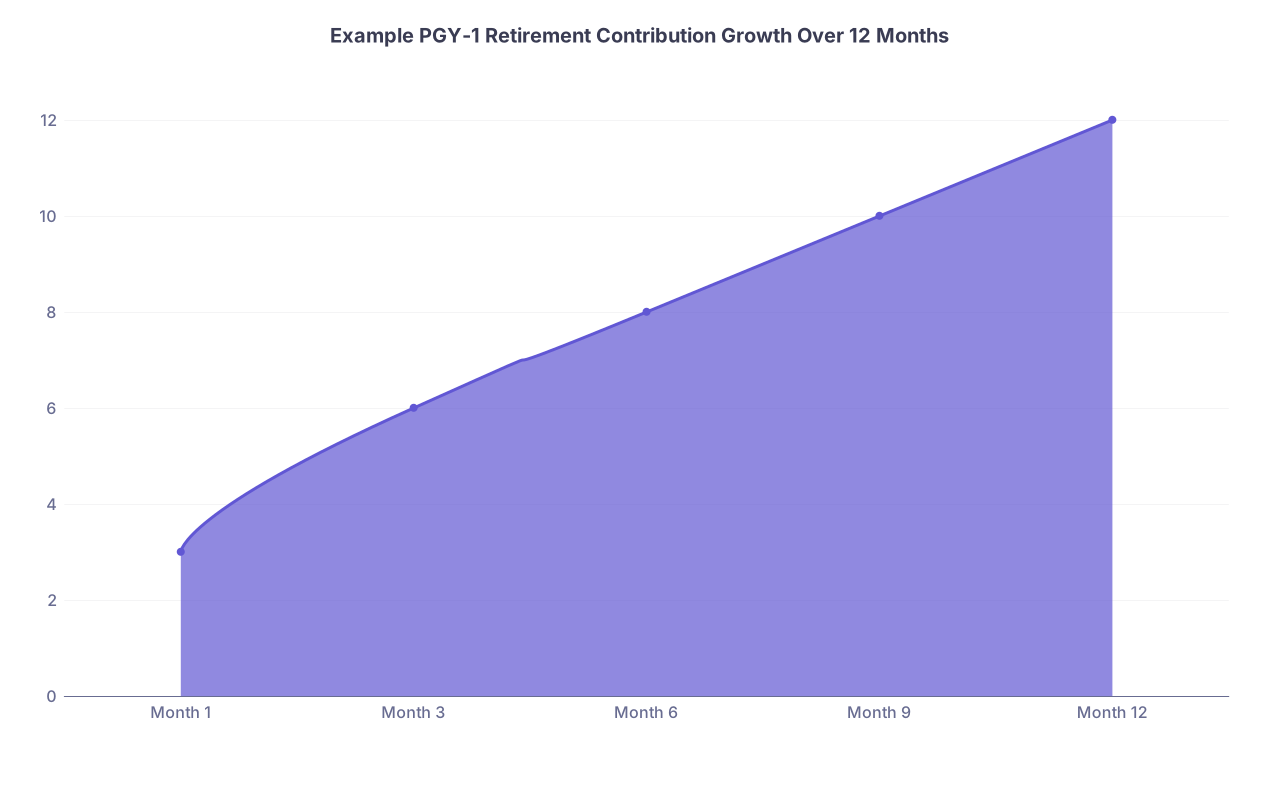
| Category | Value |
|---|---|
| Month 1 | 3 |
| Month 3 | 6 |
| Month 6 | 8 |
| Month 9 | 10 |
| Month 12 | 12 |
Months 4–5: Clean Up and Optimize
Goal: Align your retirement plan with actual life, not the dream version.
- Handle tax filing status and withholding
If you started in July, your first tax year as a resident will be a partial year. Check:
- That your W‑4 withholding is sane (not “exempt” or bizarre).
- That you are not massively under-withheld, or you will get smashed next April.
This matters because under-withholding will tempt you to cut savings later.
- If you have a match, verify you are getting it
Look at your pay stub + retirement statement:
- Contribution % matches what you elected.
- Employer match is actually showing up.
I have seen residents assume for years that they were getting a match they never triggered.
- If you are using IDR for loans
- Confirm your Income-Driven Repayment is actually in place.
- Check that the payment is stable and affordable.
- If you are PSLF-bound, ensure all payments are qualifying (right plan, employer certified).
This prevents loan chaos from derailing your savings in Month 10.
Month 6: Mid-Year Reset and Second Increase
Goal: Reach a sustainable, meaningful contribution level.
- Increase contributions again
Reasonable mid-year targets:
- Total 8–10% of income going to retirement, combining:
- Employer retirement plan (pre-tax or Roth)
- Roth IRA (if using)
- Employer match
You do not need perfection. You need progress.
- Decide on account priority for the rest of PGY‑1
If you can do more and you have these options:
If you have a 457(b) in addition to 403(b)/401(k):
- As a resident, do not rush to fill both. Having one solid account + Roth IRA is more than enough. 457(b)s can be great, but they add complexity.
If no Roth IRA yet but cash flow has improved (roommate added, rent dropped, etc.):
- This is a logical moment to open/fund it and set small monthly contributions for the rest of the year.
Phase 4: Second Half of PGY‑1 (Months 7–12)
At this point, the foundation is set. Now the focus is consistency and minor tuning.

Months 7–9: Automate and Ignore (Mostly)
Goal: Make retirement savings “background noise” in your finances.
- Put every recurring money decision on autopilot
You should have:
- Employer retirement contributions coming straight out of pay.
- Roth IRA, if using, on automatic monthly transfers.
- Minimum student loan payments auto-drafted.
If you have to manually remember to invest, you will forget during ICU month.
- Handle raises and moonlighting correctly
If your program gives a PGY‑2 raise that hits late in PGY‑1 or you pick up moonlighting:
- Do not immediately expand lifestyle to fill it.
- Instead, bump your retirement percentage by 1–2% when that first higher check hits.
This is painless money. Capture it.
- Check your investment allocation once
Look at your statements:
- If you used a target date fund: perfect, leave it.
- If you manually chose funds and somehow ended up holding 7 different overlapping funds, consider simplifying.
But do not use this as a procrastination project. You are not a hedge fund.
Months 10–12: Year-End Check and PGY‑2 Setup
Goal: Finish PGY‑1 with a clear record and a higher baseline.
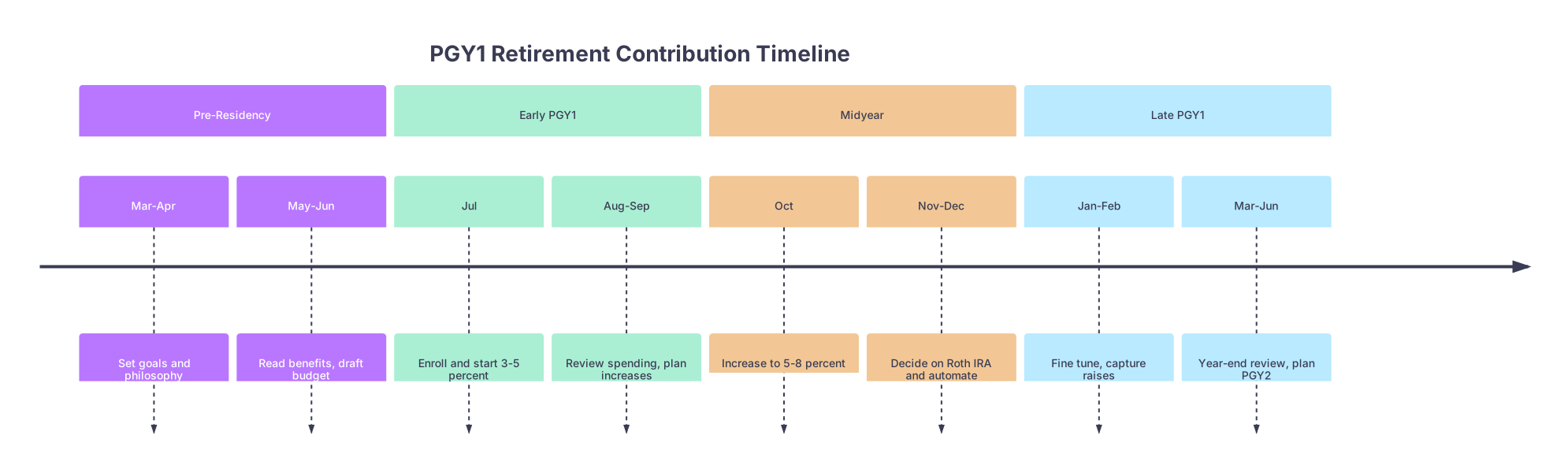
| Period | Event |
|---|---|
| Pre-Residency - Mar-Apr | Set goals and philosophy |
| Pre-Residency - May-Jun | Read benefits, draft budget |
| Early PGY1 - Jul | Enroll and start 3-5 percent |
| Early PGY1 - Aug-Sep | Review spending, plan increases |
| Midyear - Oct | Increase to 5-8 percent |
| Midyear - Nov-Dec | Decide on Roth IRA and automate |
| Late PGY1 - Jan-Feb | Fine tune, capture raises |
| Late PGY1 - Mar-Jun | Year-end review, plan PGY2 |
- Do a simple year-end review
By now you should be able to answer:
- How much did I contribute to:
- Employer plan(s)?
- Roth IRA (if applicable)?
- Did I receive the full employer match every month I was eligible?
If not, fix it now, not “next year.”
- Adjust for next-year salary
PGY‑2 usually comes with a salary bump. Before it arrives:
- Decide what fraction of that raise goes to:
- Increased retirement contributions
- Lifestyle upgrades
- Extra loan payments (if that is your strategy)
I like 50/50: half to future you, half to present you.
- Refine your asset location
As balances grow:
- Favor Roth accounts during lower-earning years (residency/fellowship).
- Use pre-tax accounts more heavily during attending years, when your tax bracket explodes.
For now, note the plan. You will implement it gradually.
Quick Reference: What To Do When
| Phase & Timing | Key Retirement Actions |
|---|---|
| Match–June | Set % goal, read benefits, rough budget |
| Orientation (July) | Enroll in plan, start 3–5%, pick simple fund |
| Months 2–3 | Review spending, bump to ~5–6%, decide on Roth IRA |
| Months 4–6 | Verify match, stabilize IDR/PSLF, aim for 8–10% |
| Months 7–9 | Automate everything, capture raises with % increase |
| Months 10–12 | Year review, confirm match, plan PGY‑2 contributions |
How Much Is “Enough” in PGY‑1?
You want numbers, not slogans. So here is a rough, directionally correct framework for PGY‑1 only.
Assume:
- PGY‑1 salary: $65,000
- You manage an average total retirement savings rate of 8–12% for the year (including match).
That means:
- 8% → $5,200 invested
- 12% → $7,800 invested
Does that make you rich? No. But:
- These dollars have the longest runway to compound.
- You build the habit and infrastructure now, not when you are an overwhelmed new attending making 3–5× as much and still feeling broke.
Waiting until after fellowship easily costs you six figures at retirement. Just from lost time.
Final Takeaways
- Start something with your very first paycheck. Even 1–3% beats the “I’ll start as an attending” fantasy.
- Tie every increase to a specific month or raise. Month 3, Month 6, PGY‑2 raise. Put dates on it.
- Keep the structure boring: employer plan up to match, plus Roth IRA if cash flow allows, automated, parked in a simple target date or index fund.
You will never again have as much compounding time ahead of you as you do in PGY‑1. Act like it.