
The worst retirement mistake physicians make is simple: they start 10 years too late and think they can “catch up.” You can’t. Not without pain.
So here’s the bare minimum you should be doing at every step—pre‑med to PGY‑1—so you do not become the 55‑year‑old attending muttering, “I wish someone had told me this sooner.”
This is a timeline playbook. At each stage: what accounts to open, what forms to sign, what numbers to hit. No fluff.
Pre‑Med Years (High School + College): Just Build the Muscles
At this stage, you are not “building a retirement portfolio.” You are building habits and basic infrastructure. The money will be small. The impact will not.
High School (or gap year before college)
At this point you should:
- Open:
- A basic checking account (no fees).
- A high-yield savings account (online bank, FDIC insured).
- Set up:
- Direct deposit if you have any job.
- Automatic transfer: even $25–$50 per month into savings.
If you have earned income (W‑2 or 1099), the minimum retirement move is:
- Open a Roth IRA in your own name (at a low-cost brokerage: Vanguard, Fidelity, Schwab).
- Contribute anything. Even $100–$500 for the year.
Mechanics:
- Invest it in a single low-cost index fund (for example, a total US stock market index fund).
- Turn on automatic reinvestment of dividends.
This isn’t about the amount. It’s about wiring your brain: “When I earn, I invest a piece.”
College Pre‑Med: 4-Year Checklist
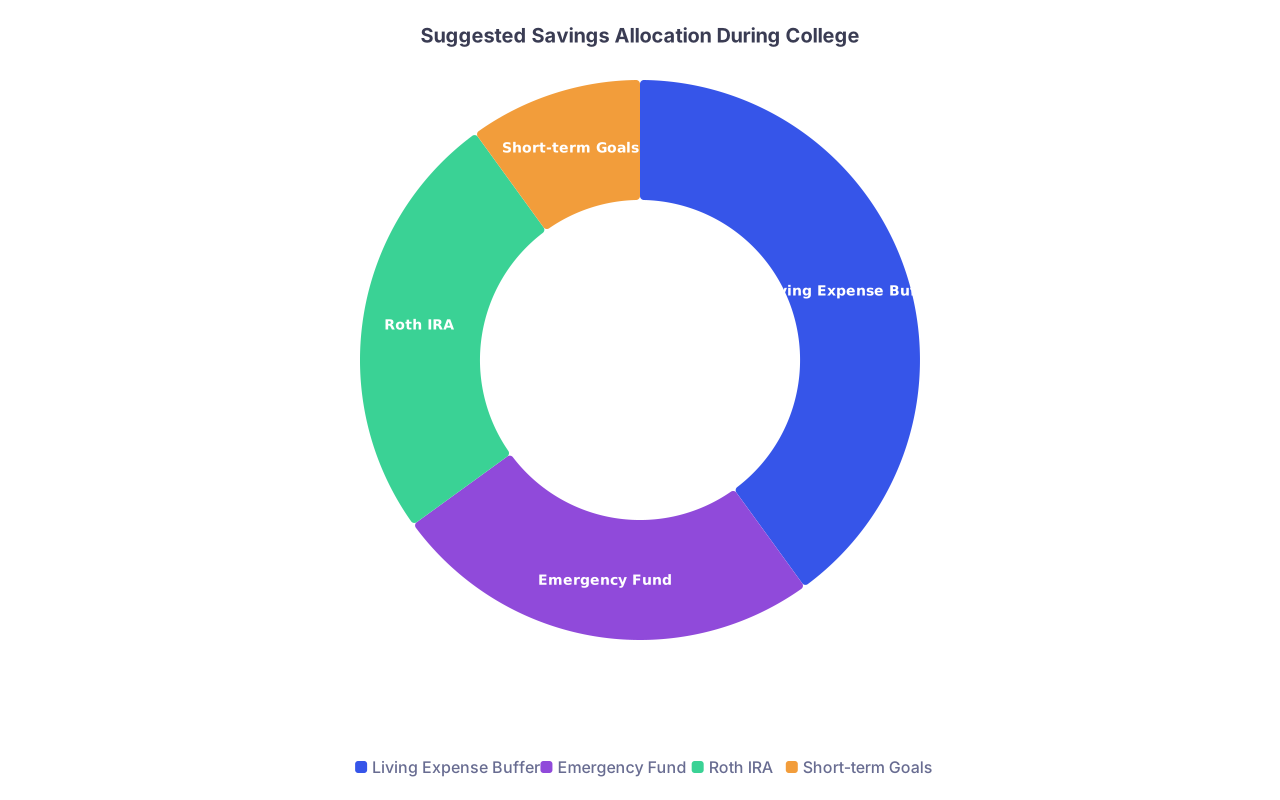
| Category | Value |
|---|---|
| Living Expense Buffer | 40 |
| Emergency Fund | 25 |
| Roth IRA | 25 |
| Short-term Goals | 10 |
From freshman to senior year, at each point you should:
Freshman Year
- Track every dollar for at least 3 months:
- Use any simple app or spreadsheet.
- Avoid:
- Credit card debt. One emergency swipe can haunt you for years.
- If working:
- Roth IRA contribution goal: $500 for the year.
Sophomore Year
- Keep the Roth IRA alive:
- New contribution goal: $1,000 for the year if you’re working.
- Build a mini emergency buffer:
- Target: $500–$1,000 in savings.
- Learn the basics:
- Difference between Roth IRA vs 401(k)/403(b).
- What an index fund is.
Junior Year
- You might be staring at MCAT, shadowing, research.
- Minimum retirement steps:
- Stay out of new debt beyond necessary federal student loans.
- Keep the Roth alive with any contribution, even $100.
- Set up:
- One recurring monthly transfer into savings or Roth. Tiny is fine. But automatic.
Senior Year / Application Year At this point you should:
- Know:
- Projected med school debt range (talk to financial aid offices, older students).
- Decide:
- You will avoid high-interest credit card and personal loans during med school.
- Retirement move:
- Keep your Roth open.
- Stay invested in 1–2 simple index funds. Do not day-trade.
If parents gift money? Push for Roth IRA funding instead of random luxuries. Most never think to ask.
Medical School M1–M4: Protect the Future You, Even When You’re Broke
Med school is where most people give themselves a pass: “I’ll start when I’m an attending.” That’s how you lose a decade.
Your income is tiny (or zero). That’s fine. The key here: infrastructure and discipline, not big dollars.
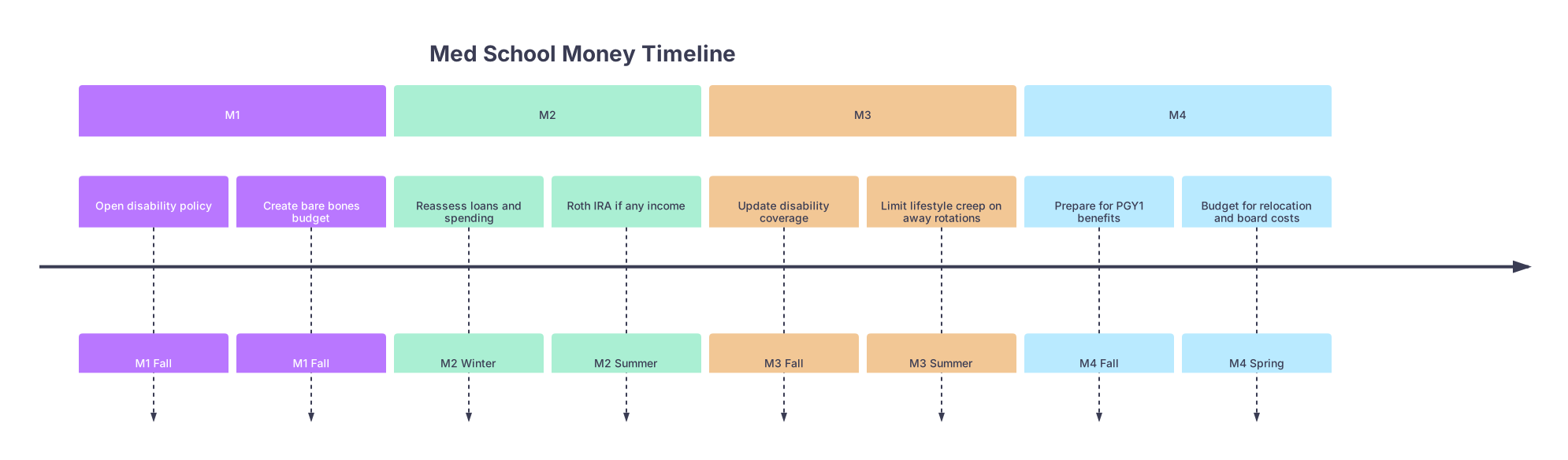
| Period | Event |
|---|---|
| M1 - Open disability policy | M1 Fall |
| M1 - Create bare bones budget | M1 Fall |
| M2 - Reassess loans and spending | M2 Winter |
| M2 - Roth IRA if any income | M2 Summer |
| M3 - Update disability coverage | M3 Fall |
| M3 - Limit lifestyle creep on away rotations | M3 Summer |
| M4 - Prepare for PGY1 benefits | M4 Fall |
| M4 - Budget for relocation and board costs | M4 Spring |
M1: Set the Guardrails
At this point you should:
Know your debt terms
- Federal vs private.
- Interest rates.
- Whether interest is subsidized or not (hint: mostly not anymore).
Create a med school budget
- Monthly:
- Rent
- Food
- Transportation
- Board fees / resources
- Target:
- No more than COA (Cost of Attendance) borrowing if possible. I’ve watched people borrow max COA, then live like a resident and end up with “mystery money” getting burned on DoorDash and travel.
- Monthly:
Disability insurance (student-level)
- If offered a free or low-cost disability policy through school, sign up.
- This is not retirement savings, but it protects your future earnings. Non-negotiable.
Minimum retirement step in M1:
- Keep your existing Roth IRA invested.
- Don’t liquidate it to “reduce loans.” Not worth it at this stage.
M2: Don’t Let the Step Prep Year Blow Up Your Finances
At this point you should:
- Review:
- Total loans so far.
- Projected total at graduation.
- Tighten:
- If lifestyle drifted up, cut back. You’re about to hit the boards and clinicals; you won’t care about the fancy subscription boxes then.
If you have any earned income (summer research, part-time work, tutoring):
- Fund Roth IRA up to:
- Lesser of earned income or annual Roth limit (check current IRS limit, often around $6,500).
- Minimum target as a med student:
- $500–$1,000 per year into Roth if possible.
If no income? Fine. Then your “retirement task” is just maintaining your system:
- Track expenses 1–2 months a year.
- Don’t add dumb debt (cars, credit cards, “0% interest” furniture).
M3: Clinicals, Chaos, and Hidden Lifestyle Creep
You’re busy. You’re tired. DoorDash and Uber start to look like “needs.” This is where a lot of people quietly add $10–20k to their loan totals unnecessarily.
At this point you should:
- Re‑check:
- Loan totals again.
- Interest accrual.
- Cap your lifestyle:
- Pick a monthly fun number (e.g., $150–$250 total for eating out, random purchases).
- Think ahead:
- Away rotations = extra housing and travel. Plan these costs now, don’t slap them on a card later.
Retirement move:
- If you somehow find yourself doing paid moonlighting or side work (rare, but some M3s/M4s tutor or do consulting):
- Push as much of that income into your Roth IRA as you reasonably can.
M4: The Transition Year — Most Underutilized Financial Window
M4 is weird: lots of time off, travel for interviews, rotations. Not much structure.
At this point you should:
- Estimate:
- Residency starting salary and pay schedule (usually ~$60–75k, paid biweekly).
- Build:
- A PGY-1 starter budget now, before the chaos hits.
- Save:
- Target at least $1,000–$2,000 by graduation specifically for:
- Moving
- Licensing
- Boards
- Deposits
- Target at least $1,000–$2,000 by graduation specifically for:
Retirement step:
- If you earn anything M4 (substantial side work or prior-year income):
- Top off your Roth IRA if at all possible.
- Decide:
- You will sign up for your residency retirement plan in your first month. Non-negotiable.
The Last 6 Months of M4: PGY‑1 Prep Mode
Here’s the bridge. Legal and financial prep now makes your intern year survivable.
At this point (roughly January–June before starting residency) you should:
Get your documents in order
- Track:
- All loan servicers.
- Total balances.
- Logins and passwords in a secure manager.
- Track:
Decide on repayment plan
- If you will pursue PSLF:
- Learn basics of IDR (SAVE, PAYE, etc.).
- If not:
- Rough plan for aggressive payoff as attending, but for PGY-1 you probably still use an IDR-type plan.
- If you will pursue PSLF:
Open the right accounts before moving
- High-yield savings account (if you haven’t already).
- Keep your:
- Roth IRA at a low-cost brokerage.
- Confirm:
- Your mailing address / email is updated everywhere before you move.
Basic legal setup
- At minimum:
- Beneficiaries listed on:
- Roth IRA
- Any investment accounts
- Bank accounts (payable-on-death if possible)
- Beneficiaries listed on:
- This is “minimum estate planning” for a broke intern. Still matters.
- At minimum:
PGY‑1 (Intern Year): The Year That Actually Sets Your Retirement Trajectory
This is where people screw it up or get it right. You finally have a real paycheck—and a real opportunity. Your minimum moves in the first 12 months matter more than you think.
| Timeframe | Key Retirement Action |
|---|---|
| Month 1 | Enroll in 401(k)/403(b), pick target-date or index fund |
| Month 2-3 | Choose IDR plan, submit PSLF employer form if applicable |
| Month 4-6 | Build $1,000–$2,000 emergency fund |
| Month 7-9 | Increase retirement contribution by 1–2% of income |
| Month 10-12 | Review accounts, rebalance, adjust contributions |
Month 1 of PGY‑1: Do Not Skip This
You’re onboarding, overwhelmed, drowning in Epic and passwords. This is where HR sends you a link to “Enroll in Benefits” and you’re tempted to ignore it.
Do. Not. Ignore. It.
At this point you should:
Enroll in your retirement plan (401(k)/403(b)/457(b))
- If there is:
- Employer match: your absolute minimum is to contribute enough to get the full match. Always. That’s free money.
- If no match:
- Still contribute something, even 3–5% of your gross pay.
- If there is:
Pick a sane investment option
- Easiest default:
- A target-date retirement fund close to your expected retirement year (e.g., 2060 for a young intern).
- Or:
- A simple US total stock market fund (if you can tolerate volatility and have decades ahead).
- Easiest default:
Set your contributions as percentage, not flat dollar
- So future raises automatically bump your contributions.
Confirm Roth vs Traditional
- As a PGY‑1 on a relatively low income, Roth contributions usually make sense:
- You lock in today’s lower tax rate.
- If the plan offers Roth 401(k)/403(b):
- Strongly consider using Roth for at least part of your contributions.
- As a PGY‑1 on a relatively low income, Roth contributions usually make sense:
Month 2–3: Tackle Loans and PSLF Structure
At this point you should:
- Consolidate federal loans if advised (especially if multiple servicers).
- Choose:
- An income-driven repayment (IDR) plan that qualifies for PSLF, if that’s your path.
- Submit:
- Your PSLF Employer Certification Form as soon as you’re eligible with your teaching hospital.
This isn’t directly “retirement savings,” but:
- Getting PSLF right freezes a chunk of your future cash flow for investing as an attending.
- Screwing it up can cost you six figures.
Month 4–6: Build a Real (But Small) Cushion
You’re a few months in. You’ve felt the biweekly paycheck, the rent, the taxes, the cafeteria temptation.
At this point you should:
- Build:
- Emergency fund of $1,000–$2,000 minimum in a high-yield savings account.
- Maintain:
- Retirement contributions at your starting percentage (do not reduce unless you truly cannot cover rent/food/loans).
If you get a tax refund:
- That’s your jumpstart:
- First: finish the mini emergency fund.
- Then: consider boosting Roth IRA up to the annual limit if cash allows.
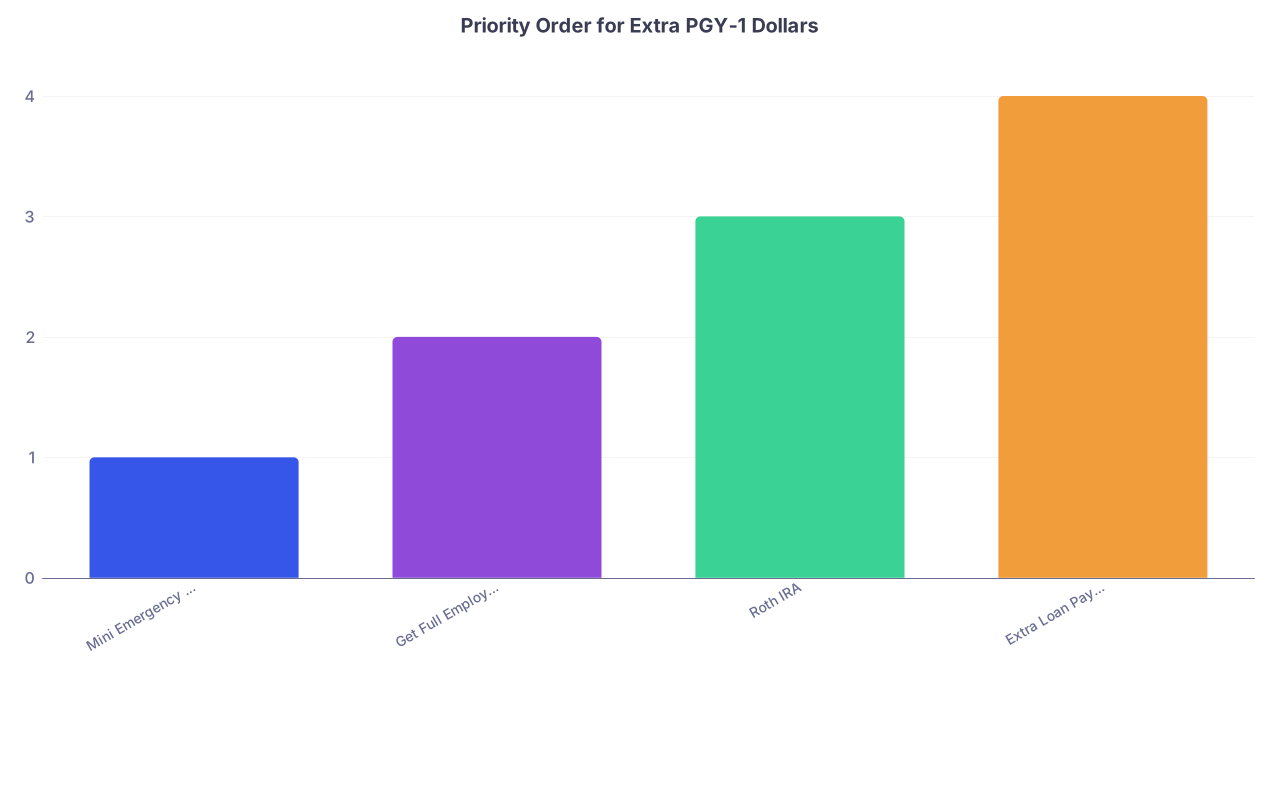
| Category | Value |
|---|---|
| Mini Emergency Fund | 1 |
| Get Full Employer Match | 2 |
| Roth IRA | 3 |
| Extra Loan Payments | 4 |
Month 7–9: Quietly Ratchet Up
Around this time, you somewhat adapt. You know roughly what you spend.
At this point you should:
- Increase:
- Retirement plan contribution by 1–2 percentage points of your salary.
- Example:
- If you started at 4%, bump to 5–6%.
- Keep lifestyle:
- Same apartment, same car. Do not reward yourself with a car payment just because your co-resident did.
If you have not yet:
- Open/maintain a personal Roth IRA on top of your work plan if you can afford it.
- Ideal: contribute up to the annual limit.
- Minimum: anything you can do consistently.
Month 10–12: Year-End Check and Clean Up
End of PGY‑1, you’re not “rich,” but you’re not clueless anymore either. This is the time to lock in habits before PGY‑2–PGY‑3 add more responsibility.
At this point you should:
Review your retirement accounts
- Check:
- Contributions for the year.
- Investment choices.
- Fees (expense ratios under 0.20% are reasonable; lower is better).
- Check:
Rebalance if needed
- If you chose a target-date fund, it rebalances itself. Done.
- If you chose your own mix:
- Make sure you’re still mostly in broad index funds, not random high-fee active funds.
Set PGY‑2 targets
- Decide:
- Contribution rate goal for next year (many residents aim for 10–15% by the end of residency, but bare minimum is gradual yearly increases).
- Decide:

| Step | Description |
|---|---|
| Step 1 | PGY1 Paycheck |
| Step 2 | Taxes and Benefits |
| Step 3 | Loan Payment IDR |
| Step 4 | Essential Expenses |
| Step 5 | Retirement 401k 403b |
| Step 6 | Roth IRA |
| Step 7 | Discretionary Spending |
| Step 8 | Emergency Fund Top Up |
Quick Snapshot: Minimum Targets by Stage
| Stage | Minimum Retirement Action |
|---|---|
| High School | Open Roth IRA if any earned income, contribute anything |
| College | Keep Roth alive, avoid high-interest debt |
| M1–M2 | Learn loans, basic budgeting, protect Roth IRA |
| M3–M4 | Control lifestyle creep, prep for PGY-1 benefits |
| PGY-1 Month 1 | Enroll in 401(k)/403(b), get full employer match |
| PGY-1 Year | Build $1–2k emergency fund, slowly increase contributions |
](https://cdn.residencyadvisor.com/images/articles_svg/chart-example-retirement-savings-growth-starting-pgy-1-1301.svg "Example Retirement Savings Growth Starting PGY-1")
| Category | Value |
|---|---|
| Start PGY1 | 0 |
| End PGY1 | 5000 |
| End PGY3 | 25000 |
| End PGY5 | 60000 |
| [Age 40](https://residencyadvisor.com/resources/retirement-planning-for-doctors/age-30-40-50-60-physician-milestones-for-retirement-readiness) | 250000 |
Final Reality Check
You do not need to be a finance nerd to retire comfortably as a physician. But you can’t ignore this stuff until you are an attending and expect math to save you.
Key points:
- Each stage has a minimum move. Pre‑med: open and fund a Roth with anything. Med school: protect your future earnings and avoid stupid debt. PGY‑1: enroll in the retirement plan on day one and build a small cushion.
- Automation beats willpower. Automatic transfers, automatic 401(k)/403(b) contributions, and simple index funds will do more for you than heroic “catch-up” plans later.
- The first real paycheck year (PGY‑1) sets your long-term trajectory. Get the match, start investing, and keep lifestyle reasonable. Do that, and future you has options instead of regrets.