
The worst retirement mistake attendings make happens in year one: they “wait until things calm down.” They never do.
You have one shot at building the right financial plumbing as you start. Miss the first 12 months, and you spend the next decade fighting upstream against lifestyle creep, bad contract terms, and sloppy tax decisions.
Here is how your first year as an attending should look, month by month, with a ruthless focus on retirement and long‑term wealth.
Big Picture: Your 12‑Month Retirement Setup Roadmap
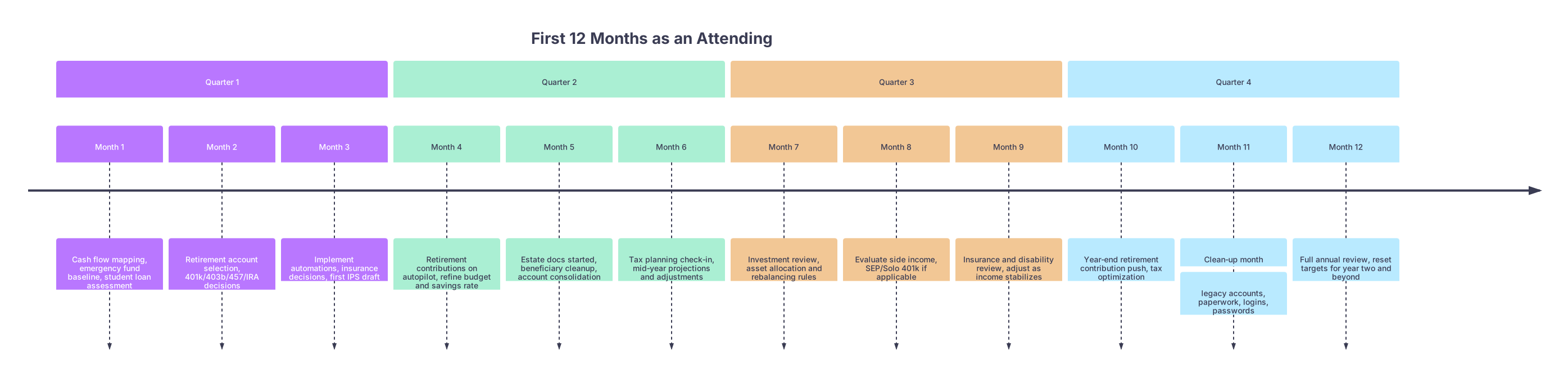
| Period | Event |
|---|---|
| Quarter 1 - Month 1 | Cash flow mapping, emergency fund baseline, student loan assessment |
| Quarter 1 - Month 2 | Retirement account selection, 401k/403b/457/IRA decisions |
| Quarter 1 - Month 3 | Implement automations, insurance decisions, first IPS draft |
| Quarter 2 - Month 4 | Retirement contributions on autopilot, refine budget and savings rate |
| Quarter 2 - Month 5 | Estate docs started, beneficiary cleanup, account consolidation |
| Quarter 2 - Month 6 | Tax planning check‑in, mid‑year projections and adjustments |
| Quarter 3 - Month 7 | Investment review, asset allocation and rebalancing rules |
| Quarter 3 - Month 8 | Evaluate side income, SEP/Solo 401k if applicable |
| Quarter 3 - Month 9 | Insurance and disability review, adjust as income stabilizes |
| Quarter 4 - Month 10 | Year‑end retirement contribution push, tax optimization |
| Quarter 4 - Month 11 | Clean‑up month |
| Quarter 4 - Month 12 | Full annual review, reset targets for year two and beyond |
You are building a system, not chasing a number. At each point, you will either:
- Turn on a lever (a new account, automation, contribution)
- Tighten a lever (increase savings, improve allocation, reduce fees)
- Or remove a leak (bad debt, poor insurance, tax sloppiness)
Month 1: Stabilize Income, Cash, and Debt
At this point you should stop thinking “I’m finally getting paid” and start thinking “I am a high‑income business with overhead.”
Week 1–2: Baseline and Triage
Get your real take‑home number.
- Look at your first paystub.
- Note: gross salary, pre‑tax benefits, tax withholdings, retirement options.
- Write down actual net pay per month. That is your real number, not the contract.
Set a target savings rate from day one.
- Minimum I recommend for new attendings:
- 20% of gross toward retirement/long‑term investing
- 25–30% if you can stomach it before lifestyle inflates
- You will not “work up to it later.” Lock it early.
- Minimum I recommend for new attendings:
Inventory your financial chaos.
- Student loans: servicer, balances, interest, current plan, PSLF status.
- Credit cards / personal loans.
- Existing retirement accounts from med school / residency (403(b), 401(k), 457, Roth/Traditional IRAs).
- Employer benefits: 401(k)/403(b)/457, HSA, ESPP, pension.
Week 3–4: Cash and Emergency Fund
Your first retirement move is not picking funds. It is avoiding getting wrecked by an early emergency.
- Set a target emergency fund:
- 3 months of expenses if you have a stable W‑2 hospital job and no dependents.
- 6 months if you are married / have kids / variable income.
- Decide how to build it:
- If you have <1 month saved: pause aggressive investing until you hit 1–2 months.
- Use a high‑yield savings account, separate from checking.
- Cap lifestyle:
- Sketch a “ceiling lifestyle” that still allows your 20–30% savings rate.
- Everything else is noise.
At the end of Month 1, you should have:
- Net pay known
- Target savings rate written down
- Emergency fund target and current level
- List of all loans and all existing retirement accounts
Month 2: Choose Accounts and Retirement Vehicles
At this point you should decide exactly which buckets you will use for long‑term retirement funding. No more “I’ll see what HR offers later.”
Week 1: Map Your Retirement Account Stack
| Priority | Account Type | Why It Matters |
|---|---|---|
| 1 | 401k/403b match | 100%+ ROI from employer match |
| 2 | HSA (if eligible) | Triple tax advantage, stealth IRA |
| 3 | Backdoor Roth IRA | Tax‑free growth, high‑income friendly |
| 4 | Max 401k/403b | Big pre‑tax or Roth bucket |
| 5 | 457(b) (if good) | Extra tax‑advantaged space |
| 6 | Taxable brokerage | Flexible, good for early retirement |
Pull your HR packet and identify:
- Is your 401(k) / 403(b) traditional, Roth, or both?
- Do you have a governmental 457(b)? (Usually good.) A non‑governmental 457(b)? (Often riskier, creditor exposure.)
- Any pension components?
Week 2–3: Roth vs Pre‑Tax Call
This is where people overcomplicate things. You are a new attending, likely in a high marginal tax bracket now, and you expect retirement to be somewhat lower.
As a blunt rule of thumb (United States):
- If you are in 32%+ federal bracket:
- Favor pre‑tax 401(k)/403(b) contributions.
- Do backdoor Roth IRA for additional Roth space.
- If you are unusually sure your income will be much higher later (future partner, high‑pay specialty, big side business), tilt a bit more toward Roth employer contributions, but still keep pre‑tax in the mix.
Week 4: Set Concrete Contribution Targets
By end of Month 2 you should:
- Elect at least enough to get full employer match on 401(k)/403(b).
- Decide:
- Will you pursue max 401(k)/403(b) this calendar year?
- Will you fund a backdoor Roth (for you and spouse if eligible)?
- Will you use HSA as a long‑term retirement asset, not just a spending account?
Turn this into dollar amounts per paycheck, not vague intentions.
Month 3: Automate and Protect the System
At this point you should turn your plan into a machine that runs without your constant attention.
Week 1–2: Automate Savings and Investments
- Set paycheck contributions for:
- 401(k)/403(b)/457(b)
- HSA (if available)
- Set automatic monthly transfers from checking to:
- High‑yield savings (emergency fund) until target reached
- Brokerage account for long‑term taxable investing
- Cash to fund annual backdoor Roth (if doing lump sum later)
Do not rely on “doing it manually when I remember.” You will not remember.
Week 3: Choose an Asset Allocation
You are not a hedge fund. Keep it boring and broad.
Example allocations (for a 30‑something attending planning on 25–30+ years to retirement):
- 80–90% stocks / 10–20% bonds
- Of stocks: 60–70% US total market, 30–40% international total market
- Bonds: one broad US bond index fund
Use the same basic allocation across all accounts (401(k), Roth, IRA, taxable), adjusted for tax efficiency later.
Week 4: Basic Protection
Month 3 is also when you stop pretending you are invincible.
- Disability insurance:
- Own‑occupation, enough to replace 60–70% of your attending income.
- Outside your employer if possible.
- Term life insurance if:
- Anyone depends on your income (spouse, kids, aging parents).
- 20–30 year level term, 10–15x your annual income as a starting ballpark.
Retirement planning dies instantly if you are disabled without coverage.
By the end of Month 3 you should have:
- Automated contributions turned on
- Asset allocation chosen and implemented
- Disability and term life applications in process or already in force
Month 4–6: Lock in Structure, Legal, and Tax
These three months are about structure, not shiny things. No crypto. No “friend’s startup.” Just foundations.
Month 4: Refine Budget and Savings Rate
At this point you should match your real lifestyle to your retirement targets.
- Look at 3 months of spending.
- Confirm: Are you actually hitting that 20–30% savings / investing rate?
- If not:
- Reduce fixed upgrades (housing, cars) before they happen.
- Cut automatic lifestyle inflation: subscriptions, random recurring charges.
- Increase retirement contributions before upgrading lifestyle:
- Bump 401(k)/403(b) percent if you are below annual max.
- Increase auto‑transfer to taxable if retirement buckets are already on track.
Month 5: Estate and Beneficiaries
Not fun. Necessary.
Checklist:
Beneficiaries:
- Verify and update for:
- 401(k)/403(b)/457(b)
- IRAs / Roth IRAs
- Life insurance policies
- Use primary + contingent beneficiaries.
- Verify and update for:
Core estate documents (yes, in year one):
- Will
- Medical power of attorney / health care proxy
- Durable financial power of attorney
- Basic guardianship plan if you have kids or plan to soon
You want your retirement assets to transfer cleanly if something goes wrong. Do this before “I’ll get to it” turns into five years.
Month 6: Tax Planning and Mid‑Year Calibration
At this point you should know where you stand for the current tax year.
- Pull a mid‑year estimate with a CPA or solid tax software:
- Project taxable income
- Project current and planned retirement contributions
- Check if you are on track with withholdings (avoid massive April surprise)
Decisions to consider:
- If your marginal rate is punishing and you have room:
- Increase pre‑tax 401(k)/403(b) contributions.
- If you have a good governmental 457(b), consider contributing there as well.
- If you are behind on retirement savings:
- Plan a “catch‑up quarter” in Q4 with more aggressive contributions or a bonus allocation.
By end of Month 6:
- You have a solid sense of your tax picture
- Your overall savings rate is measured, not guessed
- Estate basics are in motion or done
Month 7–9: Optimize Investments and Income Streams
Second half of the year is for tightening the system and layering optional extras.
Month 7: Investment Tune‑Up and Rules
At this point you should stop winging your investments and start following rules.
- Review your portfolio:
- Are you still at your target allocation?
- Are you holding redundant or expensive funds (0.50%+ expense ratios)? Replace them with low‑cost index funds (0.02–0.15%).
- Set rebalancing rules:
- Once or twice per year, or
- When any major asset class drifts more than ~5 percentage points from target.
- Write a simple Investment Policy Statement (IPS):
- Target allocation (e.g., 80/20)
- Which accounts you use for what
- When you rebalance
- How much you invest annually
Put it in a one‑page document. This is your “do not panic when markets drop 25%” guide.
Month 8: Side Income and Extra Retirement Space
If you have or plan any side work (locums, telemedicine, consulting):
- Decide if that side work is:
- Just “extra spending money,” or
- A retirement accelerator.
If the latter, set rules:
- Use side income to:
- Fund a Solo 401(k) or SEP‑IRA (prefer Solo 401(k) if you want to keep backdoor Roth clean).
- Boost taxable investments, not lifestyle.
- Track:
- Business expenses
- Quarterly estimated taxes if needed
This is how some attendings quietly reach financial independence ten years earlier than their peers.
Month 9: Insurance and Risk Review
At this point you should verify that nothing in your risk profile has changed without your financial plan catching up.
- Did you:
- Buy a house?
- Have a child?
- Increase your income with a promotion or RVU bump?
- If yes, adjust:
- Term life coverage (more dependents = more coverage).
- Disability coverage (higher income may justify more benefit).
- Umbrella liability policy (1–3M) over home/auto for lawsuit protection.
Again, this protects the retirement plan more than it “optimizes” returns. But one lawsuit or disability wipes out a decade of perfect investing.
Month 10–12: Year‑End Push and Full Review
The last quarter of your first attending year is about closing all loops and setting the stage for a cleaner year two.
Month 10: Year‑End Retirement Push
At this point you should decide what you want the year to look like on paper for the IRS and for your net worth.
- Check where you stand on:
- 401(k)/403(b) contributions (are you at or near the annual limit?).
- Backdoor Roth contributions (have you done it yet this year?).
- HSA max.
- 457(b) if applicable and if you decided it is safe enough.
If you are behind:
- Use:
- Year‑end bonuses
- Extra shifts
- Deferred lifestyle upgrades
- To top off:
- 401(k)/403(b)
- HSA
- Roth IRA (via backdoor route if necessary)
This is where disciplined people separate from everyone else.
Month 11: Administrative Clean‑Up
Month 11 is boring and essential. This is where clutter dies.
Clean‑up checklist:
- Consolidate old accounts:
- Roll prior employer 401(k)/403(b) into:
- Current plan (if low cost and good options), or
- A single rollover IRA (but be careful if you rely on backdoor Roths; pre‑tax IRA money complicates that).
- Roll prior employer 401(k)/403(b) into:
- Password manager:
- Store logins for all financial institutions.
- Document where major accounts are.
- Beneficiary recheck after life changes this year.
- Rename accounts clearly (“Retirement – His 401k,” “Emergency Fund,” etc.) to avoid confusion.
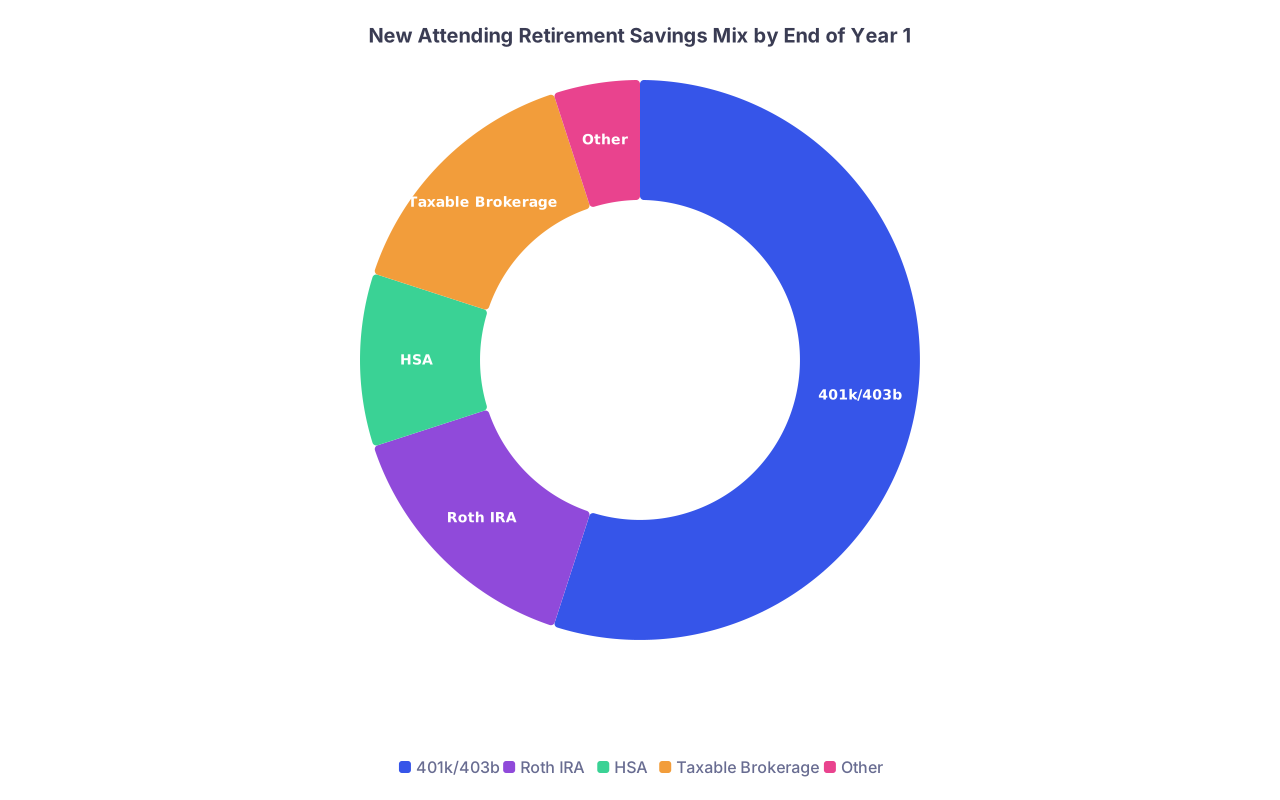
| Category | Value |
|---|---|
| 401k/403b | 55 |
| Roth IRA | 15 |
| HSA | 10 |
| Taxable Brokerage | 15 |
| Other | 5 |
You want to enter year two with simple, visible structures, not 12 random accounts scattered across five custodians.
Month 12: Full Annual Review and Year Two Plan
At this point you should look at your first year as an attending like a business reviews its first fiscal year.
Run a simple annual review:
Net worth snapshot
- Assets: cash, investments, retirement accounts, real estate equity.
- Liabilities: student loans, mortgage, other debts.
- Compare to where you started in Month 1.
Savings rate check
- What percentage of gross income actually went to retirement and long‑term investing?
- If below your target:
- Identify specific leaks (housing, car, random lifestyle).
- Decide one concrete change for year two.
Retirement plan trajectory
- Rough projection:
- If you keep saving X% and earning a reasonable long‑term return, where will you be in 10, 20, 30 years?
- This is not about precision. It is about confirming direction.
- Rough projection:
Decide changes for next year
- Will you:
- Increase savings rate by 2–5%?
- Adjust asset allocation slightly as life changes?
- Change how you use side income?
- Push harder on student loan payoff vs retirement contributions?
- Will you:
Write a short one‑page “Year Two Financial Plan” based on what you learned.
Visual Summary of Your First‑Year Focus
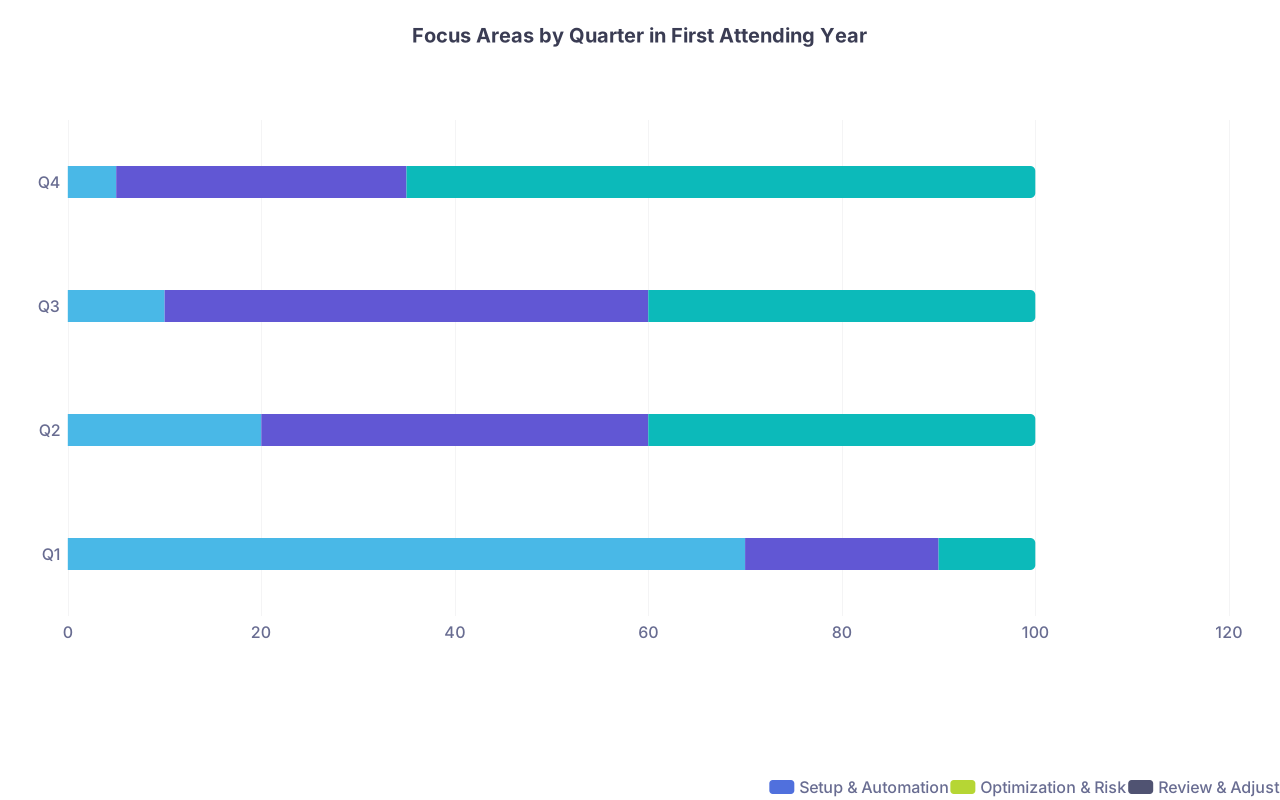
| Category | Setup & Automation | Optimization & Risk | Review & Adjust |
|---|---|---|---|
| Q1 | 70 | 20 | 10 |
| Q2 | 20 | 40 | 40 |
| Q3 | 10 | 50 | 40 |
| Q4 | 5 | 30 | 65 |
Three Things You Must Walk Away With
Aggressive early structure beats perfect later tweaks. The big win in year one is turning on the right accounts, automating contributions, and protecting your income. Not finding the perfect fund.
Your savings rate is the main driver of retirement success. Lock in 20–30% of gross income going to retirement and long‑term investing in year one, and you are already ahead of most attendings ten years out.
Treat this like running a business, not “seeing what happens.” Annual reviews, written rules for investing, and deliberate tax decisions in year one will compound for the rest of your career.