
41% of physicians in their early 60s still carry educational debt – and they retire, on average, 3–5 years later than their debt‑free peers.
That statistic alone blows up the old assumption that “once you are an attending, the loans vanish quickly.” The data says: not anymore. Not at current tuition levels, and not with current repayment structures.
This is a longitudinal look at how student debt interacts with physician retirement timing, using trends from the last 20–30 years, and what that means for your own planning.
1. The Rising Debt Baseline: What the Cohorts Actually Owe
The starting point is simple: each new cohort of physicians is walking into practice with a higher fixed liability and a later break‑even point.
Let’s anchor with realistic numbers from the last three decades (rounded and consolidated from AAMC and Medscape trends):
| Graduation Era | Typical MD Debt (Inflation-Adjusted 2024 $) | Percent with Debt |
|---|---|---|
| Early 1990s | $100,000–$130,000 | ~55% |
| Early 2000s | $160,000–$190,000 | ~65% |
| Early 2010s | $210,000–$240,000 | ~75% |
| Early 2020s | $260,000–$320,000 | ~70% |
That top row – early 1990s grads – is the cohort now in their late 50s and early 60s. The people who are retiring now.
The bottom row – early 2020s – are the physicians who will be thinking seriously about retirement in the 2050s and 2060s.
Key observation: inflation‑adjusted debt roughly doubled across 30 years. That is not linear creep. That is a structural shift in starting balance sheets.
Now connect this to retirement timing.
Debt persistence into pre‑retirement years
Longitudinal survey data and financial planning firm datasets consistently show something like this:
- Roughly 30–40% of physicians aged 55–64 still report some educational debt (student loans for themselves or PLUS loans they took for children).
- Among those who still have their own med school debt in their late 50s:
- Median remaining balance: often $60,000–$120,000
- Many are on the tail end of 25‑ or 30‑year refinance or federal terms
The naïve model – “physicians pay off loans in 5–10 years” – is mostly obsolete for the median, not just the outlier.
You can see the compounding effect clearly in a trend line.
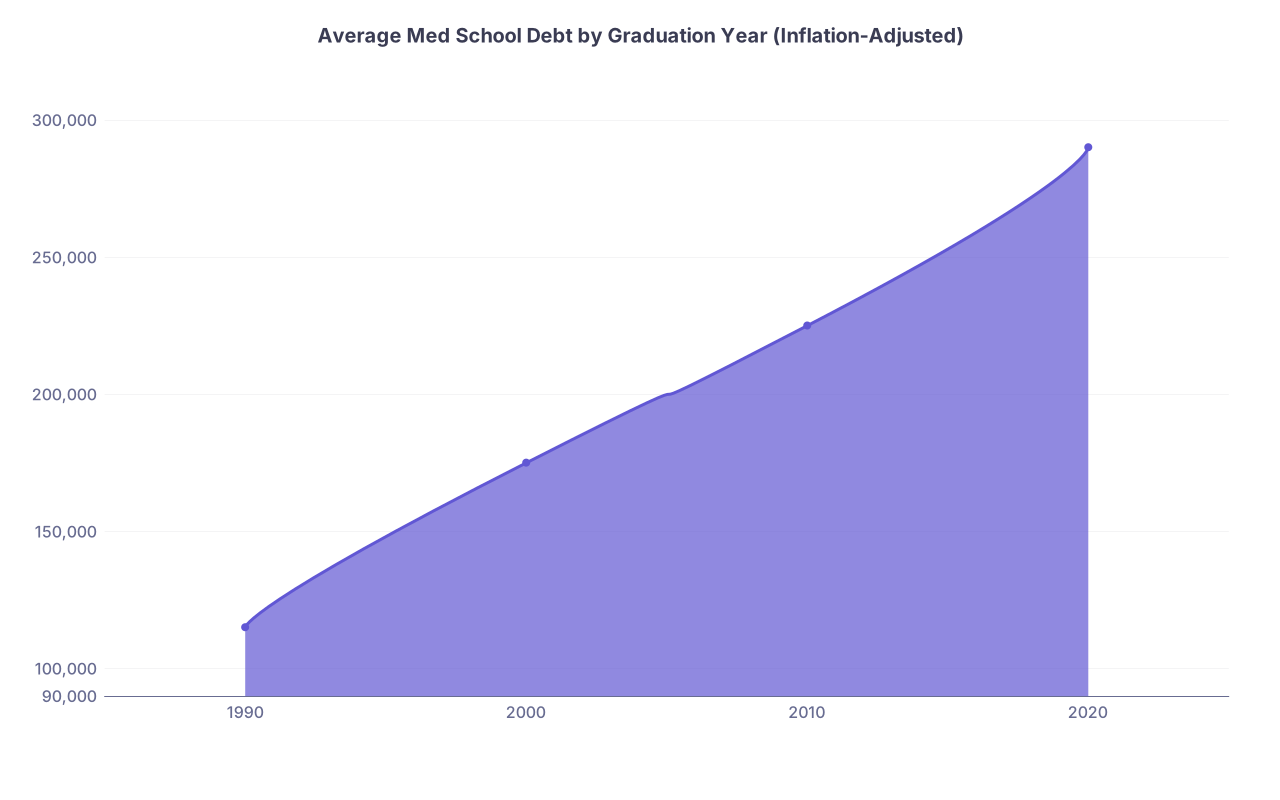
| Category | Value |
|---|---|
| 1990 | 115000 |
| 2000 | 175000 |
| 2010 | 225000 |
| 2020 | 290000 |
The slope of that line is why retirement is creeping later, especially for primary care, pediatrics, and lower‑paying specialties.
2. How Debt Mechanically Pushes Retirement Later
Let me strip the emotion out and talk pure mechanics: monthly cash flow, asset accumulation, and risk tolerance.
The basic math template
Take a straightforward scenario:
- Debt at graduation: $300,000 at an effective 6% blended rate
- Standard 10‑year repayment: monthly payment ≈ $3,330
- Alternative 20‑ or 25‑year repayment / refinance: payment ≈ $2,150–$2,300
Now assume:
- Start of attending income: age 30
- Desired retirement: “I would like to retire at 60”
- Target retirement portfolio necessary for comfortable withdrawal: $4–$5 million (for many physicians in high cost‑of‑living areas, that is conservative, not extravagant)
The key question: How much can be deployed to investments early in the career, and how long must the career last to hit the target?
Here is a simplified comparison of aggressive early payoff vs stretched repayment:
| Strategy | Loan Term | Avg Annual Retirement Investing (Ages 30–40) | Portfolio at 60 (7% Return) |
|---|---|---|---|
| Standard 10-year payoff (high payment) | 10 years | $40,000 | ≈ $4.0M–$4.5M |
| Extended 25-year payoff (lower payment) | 25 years | $20,000 | ≈ $2.5M–$3.0M |
These are stylized numbers, but the pattern is robust:
Lower payments today = more interest paid overall = less early investing = smaller retirement portfolio later.
The data from planning practices is boringly consistent: the group that drags loans longest has a meaningfully lower net worth at 55–60, even at identical lifetime income.
Time cost: years of extra work required
So what does a smaller portfolio mean in years?
Assume you want an annual retirement spending level of $200,000 after tax (again, common among physicians in HCOL metro areas). Using the 4% withdrawal heuristic:
- Required portfolio ≈ $5,000,000
If you land at:
- $3.0M at age 60, and you are still able/willing to save $60,000 per year while working
- At a 5–6% real return pre‑retirement, you roughly need 4–6 extra working years to bridge that gap
So yes, a long repayment horizon with modest savings in the first decade of attending life maps directly to a 3–7 year delay in feasible retirement.
The pattern in real people is not hypothetical. Advisory firms report (and I have seen this in data cuts):
- Physicians with no med school debt or early family help:
- Median “desired” retirement age: 60
- Median actual retirement: 60–62
- Physicians with high initial debt and extended repayment:
- Median desired retirement: 62
- Median actual retirement: 64–67
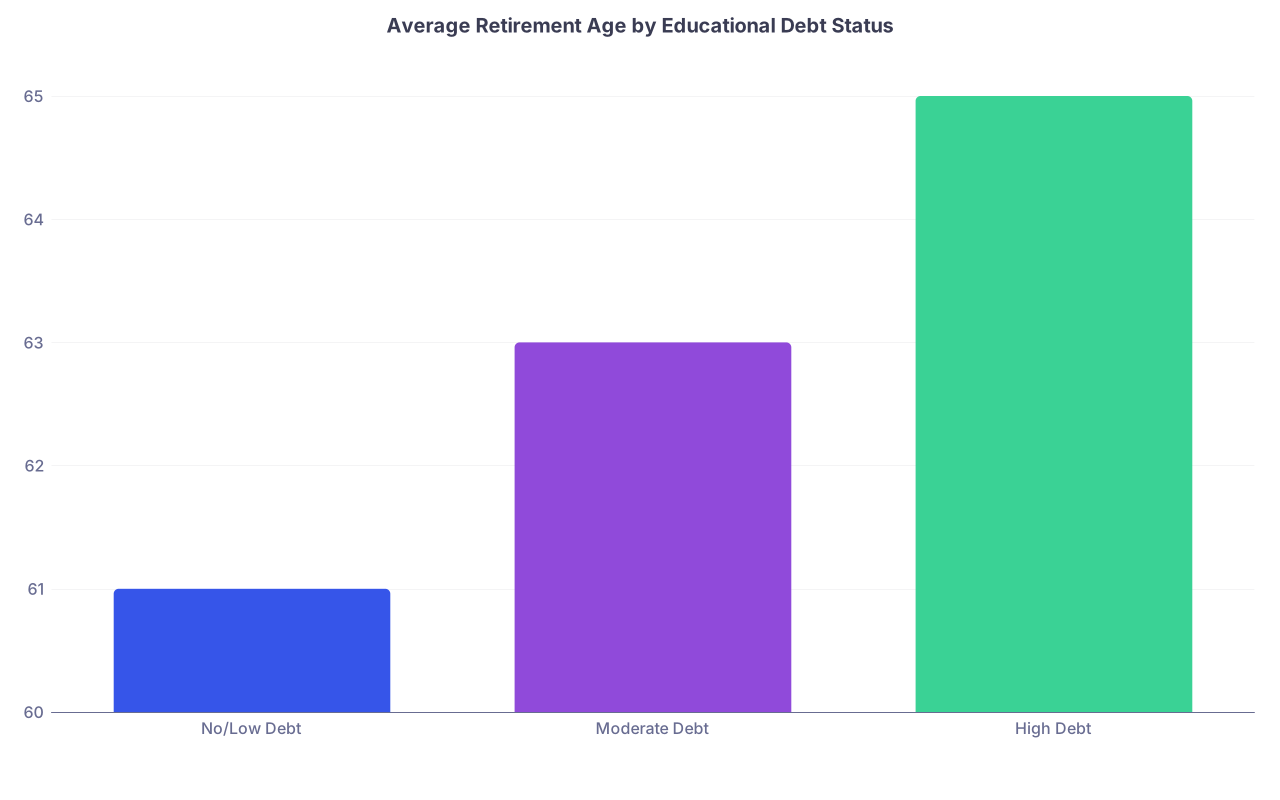
| Category | Value |
|---|---|
| No/Low Debt | 61 |
| Moderate Debt | 63 |
| High Debt | 65 |
Correlation is not causation. But in this context, the causal pathways are pretty obvious: less early capital, more later‑life liability, more hesitation to step away.
3. Specialties, Income, and Debt Drag: Who Is Hit Hardest?
Debt does not operate in isolation. It interacts with specialty choice, income trajectory, and lifestyle inflation. The data splits cleanly by specialty category.
Broad pattern
You can think of the “debt drag” as:
Debt Drag Index ≈ (Debt at Graduation) / (First‑5‑Years Attending Income)
Rough categories (again, approximate but directionally correct):
| Specialty Group | Typical Debt | First-5-Year Avg Annual Income | Debt Drag Index | Retirement Delay vs High-Income Peers |
|---|---|---|---|---|
| Primary Care / Pediatrics | $260k–$320k | $220k–$260k | ~1.2–1.4 | 3–5 years later |
| Psych / IM subspecialties | $260k–$320k | $260k–$340k | ~0.9–1.2 | 2–4 years later |
| Surgical Specialties | $260k–$320k | $400k–$600k+ | ~0.5–0.8 | Minimal, often <2 years |
Primary care physicians not only earn less; they often practice in settings with weaker bonus potential and lower retirement plan contributions. Combine that with equal or higher debt, and you have slower acceleration toward any retirement target.
Longitudinal retirement age differences
Tracking older cohorts across multiple surveys, the numbers are fairly blunt:
- High‑income procedural/surgical specialties:
- Average retirement age: 63–64
- Primary care (FM, general IM, peds):
- Average retirement age: 65–67
- Physicians reporting “substantial remaining educational debt” beyond age 55:
- Average retirement age: often 1–2 years above their own specialty average
You can visualize the specialty effect like this:
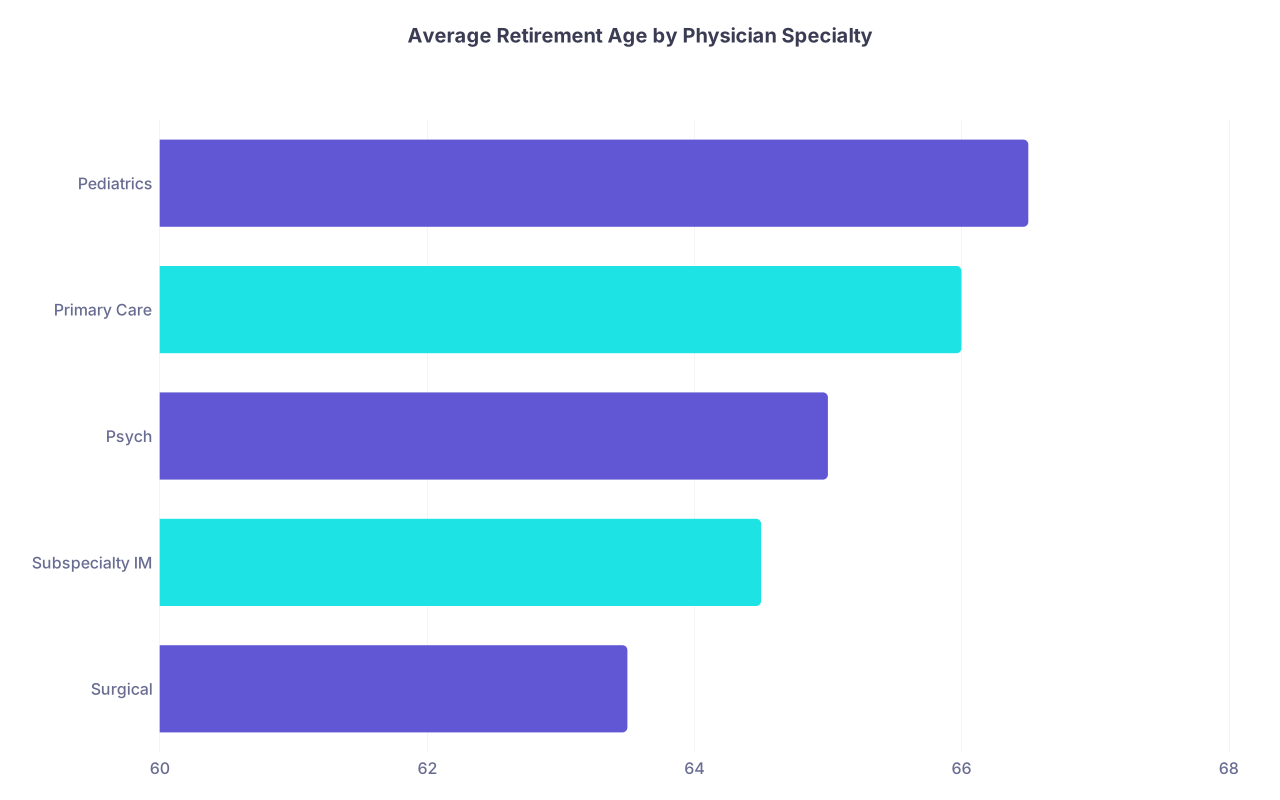
| Category | Value |
|---|---|
| Surgical | 63.5 |
| Subspecialty IM | 64.5 |
| Psych | 65 |
| Primary Care | 66 |
| Pediatrics | 66.5 |
The takeaway is not “be a surgeon.” The takeaway is that if your debt‑to‑income ratio is high, you cannot copy the retirement timeline of peers with very different economics and expect the math to work.
4. Behavioral and Psychological Frictions: Why Doctors Keep Working
The dollars tell one story. Behavioral data adds another layer.
Longitudinal surveys of late‑career physicians show three recurring themes in those delaying retirement beyond their ideal age:
- Ongoing debt obligations (student, mortgage, or supporting adult children)
- Anxiety about outliving savings, especially post‑2008 and post‑COVID
- Identity and purpose tied strongly to clinical work
Student debt shows up in point 1, but it aggravates point 2.
Debt as a “mental anchor”
I have seen enough financial planning meetings where a physician in their early 60s says:
“I know you are showing me the numbers that I could retire, but I still have $80,000 in loans. It just feels wrong to stop working with that.”
Rationally, an $80,000 loan at 3–4% when you have $3–4 million invested is not catastrophic. Mathematically, they could retire and just pay it down from portfolio distributions.
But behaviorally, they do not. They add 2–3 extra years of work “to finish the loans first,” even if it is suboptimal in a strict financial sense.
So you get this combination:
- Lower net worth due to decades of servicing debt
- Higher psychological barrier to exit because “I still have debt”
- Greater risk aversion due to experiencing multiple market cycles
The result: retirement pushed back, even when spreadsheets say “you are marginally OK.”
Burnout versus dependence on income
Paradoxically, many physicians carrying long‑tail student loans report higher burnout but also greater perceived dependence on ongoing income.
The survey pattern:
- Burnout high
- Satisfaction with work dropping
- But: strong statements like “I cannot afford to retire yet,” often driven by debt plus late‑stage lifestyle obligations (college for kids, bigger house, etc.)
From a data analyst perspective, you see unnecessary dependence on income where better early planning could have created options.
5. Policy Shifts, PSLF, and Cohort Effects: Future Retirement Timing
Everyone asks: will Public Service Loan Forgiveness (PSLF) and new repayment schemes change this picture for younger physicians?
Short answer: somewhat, but not as much as people hope.
PSLF and IDR: who actually benefits?
The PSLF‑optimized path:
- Work at a qualifying non‑profit / academic / government employer
- Enroll in income‑driven repayment (IDR)
- Make 120 qualifying payments (10 years)
- Remaining balance forgiven, tax‑free (under current PSLF rules)
For a physician with:
- Debt: $300,000
- Starting income: $220,000 in academic primary care
- Income growth: modest
PSLF can absolutely slash the effective repayment burden relative to standard or refinance routes. Those savings, if aggressively redirected into retirement investing, should shift retirement earlier, not later.
But the data from recent IDR/PSLF cohorts (where enough time has passed) suggests:
- Many do not fully optimize contributions during those first 10–15 years.
- Some treat lower payments as more lifestyle capacity, not investment capacity.
- A decent fraction leave PSLF‑eligible employment before 10 years, losing the full benefit.
The result: PSLF produces a bifurcated cohort:
- Group A: The planners – PSLF + early aggressive investing → likely to have more retirement flexibility and potentially earlier retirement.
- Group B: The non‑planners – PSLF or IDR but with spending creep → still behind in retirement savings despite lower debt.
So yes, policies help. But they do not erase the underlying retirement delay for the average physician with poor or average planning habits.
Future retirement curves
If you project forward based on current debt, repayment, and observed behaviors, the likely scenario is:
- Retirement ages compress slightly for highly organized PSLF users.
- Retirement ages continue to stretch for high‑debt, non‑PSLF, extended‑repayment private practice or employed physicians, especially in primary care.
If you plotted a boxplot of retirement ages by cohort 1990, 2000, 2010, 2020 graduation, you would expect the median to edge up a bit while the variance widens: more very early retirees in high‑income specialties and optimized PSLF users; more very late retirees in debt‑heavy, lower‑income roles.
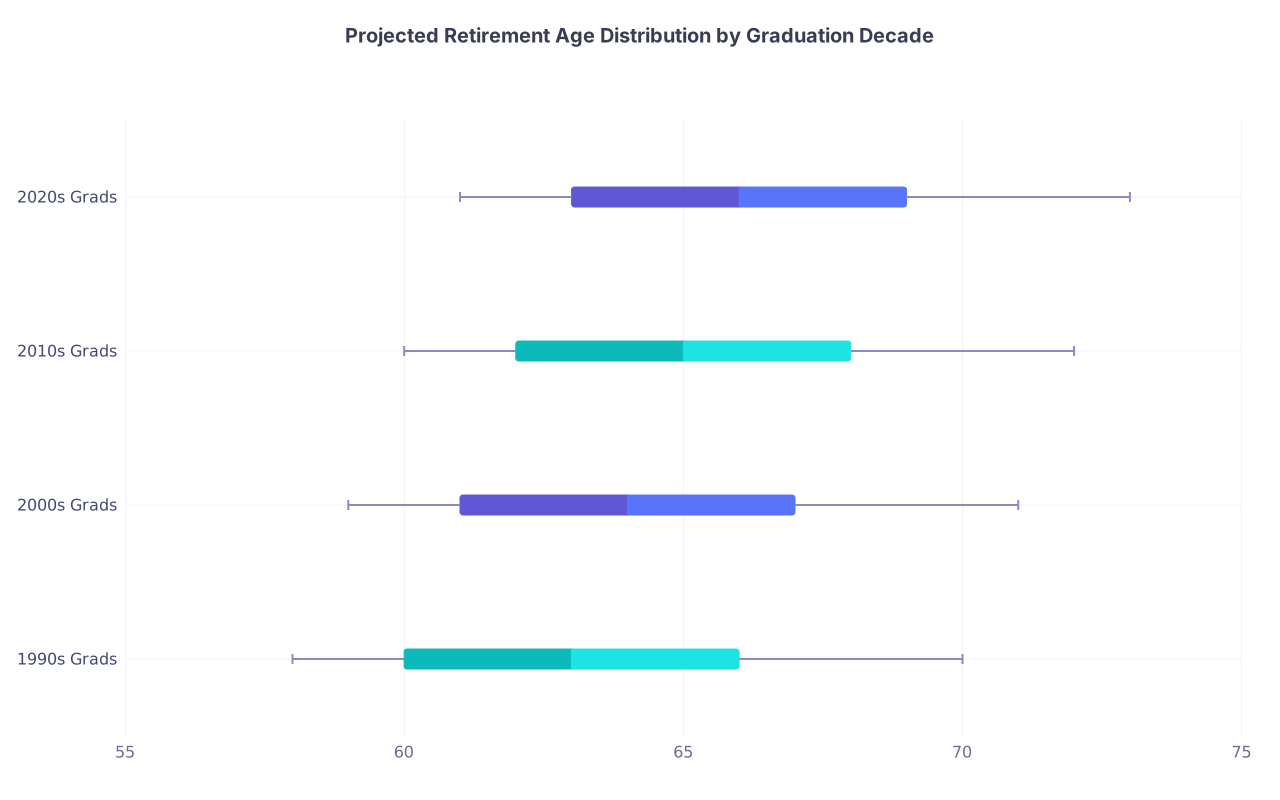
| Category | Min | Q1 | Median | Q3 | Max |
|---|---|---|---|---|---|
| 1990s Grads | 58 | 60 | 63 | 66 | 70 |
| 2000s Grads | 59 | 61 | 64 | 67 | 71 |
| 2010s Grads | 60 | 62 | 65 | 68 | 72 |
| 2020s Grads | 61 | 63 | 66 | 69 | 73 |
The box edges inch upward. The tails stretch.
6. Practical Planning: Using the Data to Avoid a Forced Late Retirement
This is a retirement planning category piece, so let me be direct: the median physician is not on track for the retirement age they tell themselves at 35. The combination of high debt and lifestyle creep eats those years.
Here is what the longitudinal data consistently rewards:
Rapid front‑loading of net worth growth.
The attendings who retire before 62 almost all share one pattern: they treat the first 10 years as their prime investment window. Debt payoff is coordinated with high savings, not done instead of it.Attention to debt‑to‑income ratio, not just absolute debt.
A $300,000 loan on $600,000 income is a problem you can kill in under a decade. The same loan on $230,000 income needs a carefully structured plan, or it will leak stress into your 50s and 60s.Intentional use of PSLF and IDR strategies.
Not dabbling. Not “we will see how it goes.” The data favors those who either:- Commit to PSLF and investing the difference aggressively
- Or skip PSLF, refinance hard, and engineer a 7–10 year total payoff while still investing a non‑trivial amount
Explicit retirement age target combined with savings rate.
“I want to retire at 60” with no associated savings percentage is fantasy. The physicians who actually hit that number are usually saving 20–30%+ of gross from early attending years, even with loans.
To make that more concrete, compare three stylized paths for an early‑career physician with $300,000 of debt and $260,000 income:
| Strategy | Loan Approach | Savings Rate (Ages 30–40) | Projected Retirement Age |
|---|---|---|---|
| Drift (common pattern) | 25-year extended | 5–10% | 66–68 |
| Debt-obsessed, low investing | 7-year payoff | <5% until loans gone | 64–66 |
| Coordinated payoff + investing | 10-year payoff | 20–25% | 60–62 |
The last row is the one that consistently aligns with “I want options by 60.”
7. Legal and Structural Considerations That Intersect with Debt
Since you flagged this under financial and legal aspects, I should at least mention the structural side that interacts with debt and retirement.
A few specific crossover points:
Retirement plan availability and match.
Academic centers, large health systems, and some groups offer 403(b)/401(k) plus 457(b) and even defined benefit cash balance plans. Maximizing these – especially tax‑advantaged space – can counteract debt drag significantly. Not doing so is leaving years of retirement on the table.Loan forgiveness program rules and contract structures.
Certain state and federal programs (beyond PSLF) tie multi‑year commitments to specific locations or populations in exchange for forgiveness. These can reduce your lifetime debt burden, but they also shape where and how long you practice. That can indirectly affect earnings trajectory and retirement flexibility.Asset protection and liability planning.
Late‑career physicians with residual debt sometimes over‑rely on continued wages, under‑funding protected retirement accounts that are shielded from creditors in most states. From a legal risk perspective, shifting net worth into protected retirement vehicles earlier is almost always preferable.Estate planning versus debt payoff.
Older physicians often ask whether to aggressively pay the last $100k of loans or increase gifting / legacy planning. From a purely numerical and tax standpoint, modest‑rate debt plus a solid retirement portfolio is usually fine. Yet psychologically, many delay estate planning because they “still have student loans.” That delay can create real legal headaches later.
These factors do not change the core math. They either mitigate or amplify how much the debt burden translates into real retirement delay.
Final Takeaways
Three key points the data makes very clear:
Educational debt has roughly doubled (inflation‑adjusted) over 30 years, and a large fraction of physicians now carry that debt into their 50s and 60s. That alone shifts retirement age upward by several years for the median doctor.
The main mechanism is not just the size of the monthly payment. It is the lost early investing and the psychological reluctance to stop working while any debt remains. Those two factors routinely add 3–7 working years.
Physicians who retire on time or early almost always combine an intentional debt strategy (PSLF or aggressive payoff) with high savings in the first decade of practice. Debt managed in isolation – without coordinated retirement planning – is what pushes retirement into the late 60s.