
The common belief that “academic physicians sacrifice money but win on retirement security” is only half true. The data show a more nuanced, and in many cases opposite, reality.
If you are choosing between academic medicine and private practice, you are not choosing between “secure but modest” and “risky but lucrative.” You are choosing between two very different retirement engines: one built on guaranteed benefits and institutional scaffolding, the other on higher cash flow and tax-advantaged compounding if you have the discipline to use it.
Let us quantify it.
1. Baseline Economics: Lifetime Earnings and Savings Capacity
Start with cash. Retirement outcomes are driven first by how much pretax and after-tax money you can push into investment vehicles over 25–35 years.
Compensation gaps: what the numbers say
Across multiple salary surveys (MGMA, AAMC, Medscape), the pattern is consistent:
- Academic physicians earn roughly 25–40 percent less than private practice peers in the same specialty.
- The gap is smaller in primary care, larger in procedure-heavy subspecialties.
A simplified but realistic cross-sectional look:
| Specialty | Academic Median ($) | Private Practice Median ($) | PP Premium (%) |
|---|---|---|---|
| Internal Med | 230,000 | 280,000 | 22% |
| General Surgery | 350,000 | 475,000 | 36% |
| Cardiology | 450,000 | 650,000 | 44% |
| Orthopedics | 550,000 | 800,000 | 45% |
| Anesthesiology | 380,000 | 520,000 | 37% |
Assume a 30-year attending career. Even with conservative growth assumptions, the cumulative earnings delta is massive.
Take anesthesiology:
- Academic: 380k × 30 years = 11.4 million (nominal, pre-tax).
- Private: 520k × 30 years = 15.6 million.
That is a 4.2 million lifetime earnings gap before taxes and before any investment return. You will not “make that up” with a slightly better university 403(b) match unless your private practice savings discipline is nonexistent.
Savings rate is the real lever
Retirement outcomes are not driven by income level alone but by the savings rate. Two basic scenarios for the same person:
Academic physician:
- Income: 380k
- Savings rate: 18 percent total toward retirement (employee + employer)
- Annual retirement contributions: ~68k
Private practice physician:
- Income: 520k
- Conservative savings rate: 20 percent
- Annual retirement contributions: ~104k
Assume 30 years, 5 percent real (after-inflation) return. Future value of an annual series:
- Academic: 68k/year @ 5 percent for 30 years ≈ 4.5 million (real).
- Private: 104k/year @ 5 percent for 30 years ≈ 6.9 million (real).
Same person. Same age. Same investment skill. The private practice path yields roughly 2.4 million more in inflation-adjusted retirement assets solely from higher savings capacity, not even counting bigger lump sums from practice sales (which academics typically do not get).
The myth that “academics retire safer” ignores this basic arithmetic.
2. Retirement Plan Design: Who Actually Has Better Vehicles?
The structure of retirement plans is where academics historically looked safer. But the gap has narrowed, and in some areas reversed.
Defined benefit vs defined contribution
Classic academic advantage: defined benefit pensions.
Twenty years ago, a large fraction of university-employed physicians had some form of:
- Final-average-salary pension.
- Or cash-balance plan with institutional funding.
The trend line is clear: these are shrinking or closed to new entrants, or significantly less generous than older cohorts enjoyed.
In contrast, many private groups and especially hospital-employed physicians now have:
- 401(k) with decent match.
- Possible cash balance/defined benefit plans used as tax shelters for partners.
- Flexibility to layer solo 401(k), defined benefit, or other qualified plans post-exit.
So the neat stereotype—“academics get pensions, private practice gets 401(k)”—is outdated.
Typical academic retirement package
A fairly standard university-employed physician might see:
- 403(b) or 401(a)/403(b) combination:
- Employee contribution: up to 22,500–23,000 (current limits vary by year).
- “15-year rule” catch-up for some 403(b) plans (often underused).
- Employer contribution:
- 8–12 percent of salary common; sometimes fixed regardless of employee contribution.
- Optional 457(b) nonqualified plan:
- Additional 22,500–23,000 deferral.
- Subject to employer solvency risk (unsecured promise).
Total potential tax-advantaged space can easily hit 50–70k per year for a mid-senior academic.
Typical private practice retirement stack
Here the spread is wide. The floor and the ceiling are both higher.
A bare-bones employed private practice doc might only see:
- 401(k) with 3–5 percent match.
- No 457(b) option.
- No defined benefit / cash balance.
But an owner or partner in a well-structured group can reach far more aggressive numbers.
A realistic, not cherry-picked structure:
- 401(k) with profit share:
- 22,500 employee + up to ~43,500 employer = ~66,000 total (age < 50 figures).
- Cash balance plan:
- Additional 50,000–100,000+ per year, depending on age and actuarial design.
With that design, a 50-year-old partner can legitimately move 150,000–200,000 per year into tax-advantaged space. Academic employment rarely gets close.
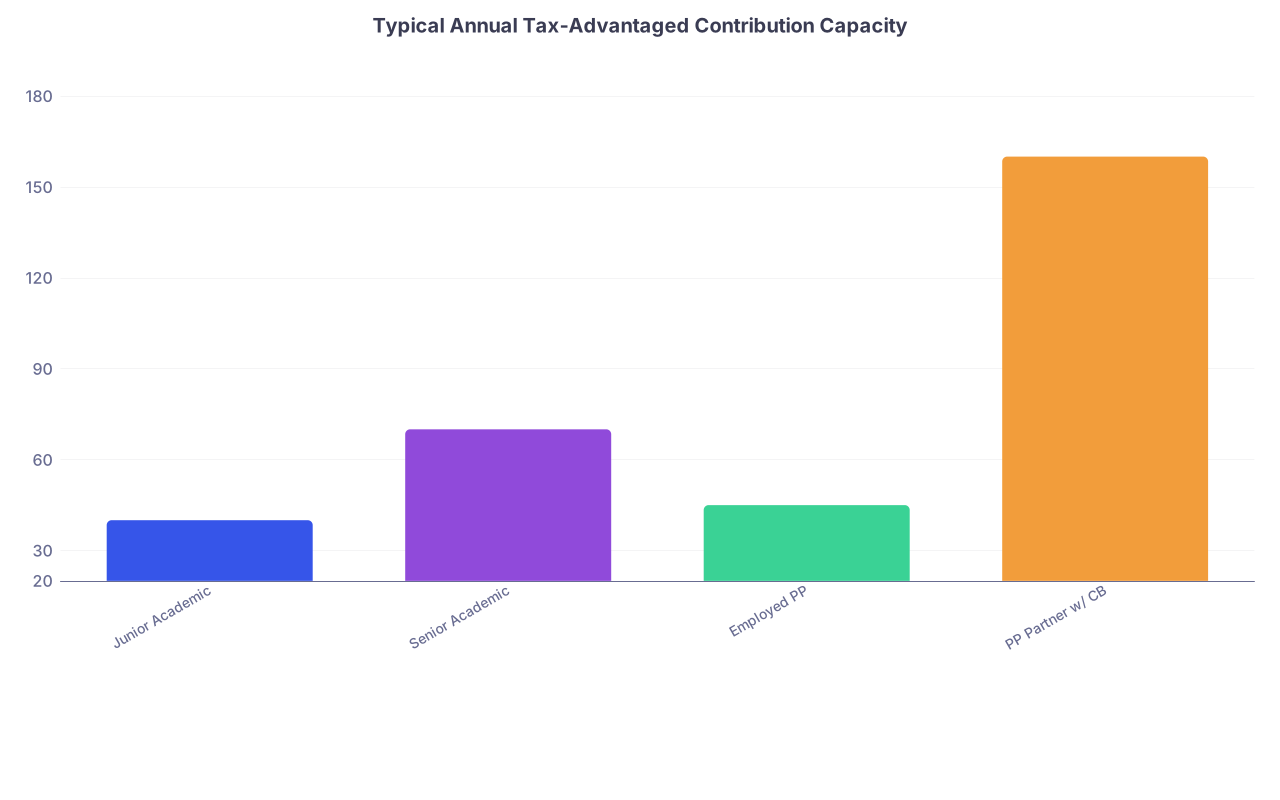
| Category | Value |
|---|---|
| Junior Academic | 40 |
| Senior Academic | 70 |
| Employed PP | 45 |
| PP Partner w/ CB | 160 |
The raw capacity for tax deferral and compounding tends to favor private practice ownership, not academic employment. Again, the constraint is behavior, not plan design: many high-income private physicians simply do not use the available structures.
3. Risk, Volatility, and Job Security: Where Is “Safety” Actually Coming From?
Retirement security is not just about how much you save, but how predictable the path is.
Employment risk
Academics like to say: “The university job is safer.” Sometimes. Not always.
Empirically:
- Academic layoffs and contract non-renewals have increased as health systems buy up faculty practices and pressure RVU productivity.
- Tenure protection for clinical faculty is thin or irrelevant in many medical schools.
- Program closures, department mergers, and funding cuts are not rare.
Private practice risk profile:
- Revenue tied directly to patient volume, payer mix, and contract negotiations.
- But owners have more levers: alter staffing, renegotiate coverage, sell to hospital, build ancillaries, diversify payers.
Income volatility is generally higher in private practice, but long-term unemployment risk is not clearly higher. Physicians in both tracks are extremely employable if willing to change markets or employers.
From a retirement perspective, the more relevant risk is sequence-of-returns combined with job shocks:
- 55-year-old academic let go, forced to take lower-paying job.
- 55-year-old private practice owner forced to sell practice at a discount.
In both cases, earlier aggressive savings and conservative leverage matter more than the employment label.
Plan risk: 457(b) vs personal accounts
Academics often use 457(b) plans heavily to juice their tax-deferred savings. The data point everyone glosses over:
Those plans are technically assets of the employer.
If the university or hospital faces financial distress, your 457(b) is an unsecured liability. There are real examples of health systems going through bankruptcy restructurings where 457(b) balances were at risk or impaired.
Private practice physicians relying more on:
- 401(k)/profit sharing.
- IRAs/backdoor Roths.
- Taxable brokerage accounts.
These vehicles sit in your name, not on a university’s balance sheet.
So on a pure legal-ownership axis, private practice often carries lower retirement-plan counterparty risk.
4. Taxes, Equity, and Practice Sale: The “Hidden” Retirement Engine
This is where private practice usually wins by knockout if structured even moderately well.
The practice sale effect
Academic physicians rarely exit with a monetizable asset. Maybe a small book advance or speaking circuit income. But the main job vanishes, income drops sharply at retirement, and there is no practice equity sale.
Private practice physicians, especially in specialties attractive to consolidation (orthopedics, cardiology, GI, ophthalmology), have several distinct equity events:
- Initial buy-in to partnership (negative cash flow early, but building equity).
- Possible sale to a hospital or private equity group.
- Ongoing distributions or earn-outs post-transaction.
- Final retirement buy-out based on formula (collections, wRVUs, accounts receivable, etc.).
A very conservative numeric example:
- Partner in a medium-sized cardiology group.
- Buy-in at year 5 of practice.
- Practice later sells to a hospital system at 7.0× EBITDA.
- Each partner nets 800,000 before tax from the transaction.
- At retirement, final accounts receivable and buy-out nets another 300,000.
That is 1.1 million pre-tax “bonus” that most academic physicians will never see.
Even if you haircut these figures by 50 percent across the board, that is still 550,000 of additional capital that, if invested at 5 percent real for 15 years pre-retirement, grows to roughly 1.1 million real. One practice deal equals an entire extra mid-to-upper seven-figure retirement leg.
Ancillary income and ownership
Beyond the core practice:
- Surgery centers
- Imaging centers
- Office real estate
- Lab services
- Infusion suites
Academic physicians may have fractional participation in some ancillaries but usually do not own them outright. Compliance and conflict-of-interest policies often block that.
Private physicians can (and often should) structure partial or full ownership. These create:
- Passive rental income in retirement (e.g., clinic building leased to a buyer).
- Asset sale events taxed at capital gains rather than ordinary income.
Tax character matters. A physician with 700,000 in capital gains at 15–20 percent rates retains far more post-tax than the same dollars earned as W-2 salary at 37 percent plus payroll taxes.
From a retirement-income standpoint, private practice does not just add more zeros. It changes the type of income in your later years.
5. Modeling Retirement Outcomes: Concrete Scenarios
Strip away rhetoric and run the math.
We will compare two fictional but realistic physicians, same specialty, same city, starting at age 35 after training. Both want to retire at 65. Assume 5 percent real returns, 2 percent real growth in earnings, and real contribution growth aligned with income.
Scenario A: Dr. Academic
- Starting salary: 260,000 at age 35.
- 2 percent real raise annually.
- Employer retirement contribution: 10 percent of salary into 403(b).
- Employee contribution: 15 percent of salary into 403(b)/457(b) total.
- Total savings rate: 25 percent of gross income.
- No practice sale; no ancillaries.
By age 65:
- Real income at 65: ~470,000 (inflation-adjusted).
- Average annual retirement contributions over career: ~90,000 (real, ramping with salary).
- Portfolio at 65 (real): roughly 5.5–6.0 million.
Safe withdrawal (4 percent rule, debatable but serviceable benchmark):
- 4 percent of 5.75 million ≈ 230,000 per year (real) for life.
- Combined with partial Social Security, retirement income might equal 60–70 percent of late-career earnings.
Scenario B: Dr. Private Practice Owner
- Starting salary: 350,000 at age 35 as employed associate.
- Becomes partner at 40; income jumps to 500,000.
- 2 percent real growth annually from 40–60, then flat.
- Employer retirement plan (partner level): 401(k) + cash balance for total of 120,000 annual tax-advantaged contributions starting at 40.
- Before partnership (35–40), saves 20 percent of 350,000 ≈ 70,000/year.
- Practice sale event at 55: net after tax of 800,000; invests it.
By age 65:
- Average annual contributions 35–40: 70,000 (real).
- Average 40–65: 120,000 (real).
- Core portfolio at 65:
- 5 years at 70k + 25 years at 120k @ 5 percent real ≈ 7.5–8.0 million.
- Practice-sale lump sum:
- 800k at 55, 10 years @ 5 percent real ≈ 1.3 million.
- Total retirement portfolio: ≈ 8.8–9.3 million (real).
Safe withdrawal at 4 percent:
- 4 percent of 9.0 million ≈ 360,000 per year (real).
- Again plus Social Security, and possibly residual rental income from real estate.
So under these assumptions, the private practice path yields roughly 55–60 percent more sustainable retirement income than the academic path. This is not a marginal difference.
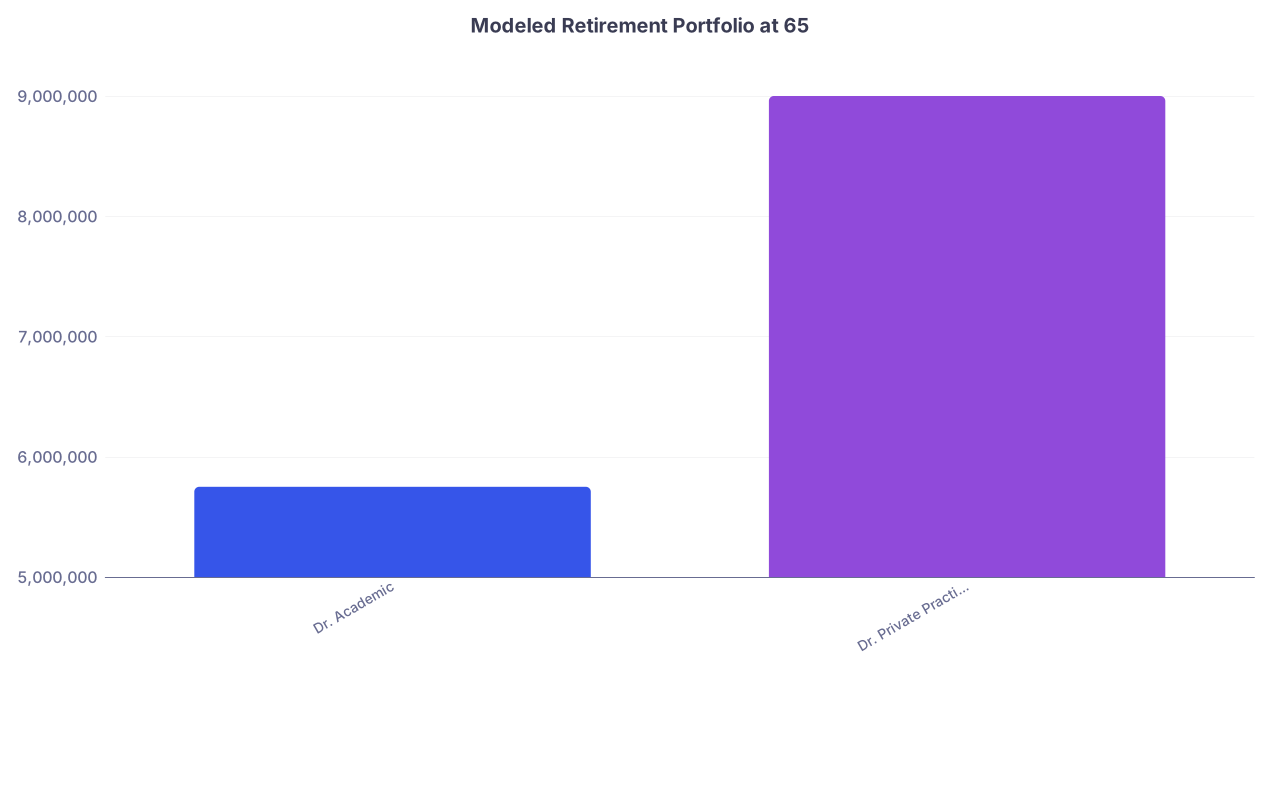
| Category | Value |
|---|---|
| Dr. Academic | 5750000 |
| Dr. Private Practice | 9000000 |
You can dispute any single input. Maybe the academic saves 30 percent instead of 25 percent. Maybe the practice sale is smaller. But you have to twist the numbers very hard before the academic path overtakes a disciplined, well-structured private-practice path in pure financial outcomes.
6. Non-Financial Variables That Still Affect Retirement
Money is not the only dimension. But it still shows up indirectly in retirement.
Burnout and career length
High-burnout environments lead to:
- Early retirement (or career change) at 55 instead of 65.
- Reduced productivity and income in late career.
- Lower willingness to keep working part-time.
Academic physicians sometimes stay in the workforce longer because:
- They shift to more teaching/administration.
- They negotiate phased retirement, 0.5–0.7 FTE roles.
- The identity tie to the institution is strong.
Private physicians more often either work full-throttle or sell and leave. A few move into locums or concierge practices, but the common pattern is a hard stop after a sale.
From a retirement-funding angle:
- 10 extra years of part-time academic work at 200,000–250,000 compensation with 20 percent savings and minimal drawdowns can dramatically stabilize your portfolio.
- Conversely, an owner who sells at 55 and then spends aggressively for 10 years can easily undermine an otherwise strong balance sheet.
The lifestyle variable and spending behavior matter as much as early-career plan choice.
Geographic and cost-of-living effects
Academics are often clustered in higher-cost urban areas:
- Boston, San Francisco, NYC, Chicago.
- Higher housing costs, tax rates, and everyday expenses.
- Less free cash flow early in career, when compounding is most powerful.
Private practice opportunities are more evenly distributed, including lower-cost regions:
- Suburban or semi-rural settings with much cheaper housing.
- Lower state income taxes or none.
- Easier to bank 25–30 percent of income while living very comfortably.
A 400,000 salary in Dallas or Nashville can produce more actual savings than 500,000 in New York once you account for housing, taxes, and tuition. That bleeds directly into eventual retirement assets.
7. So Which Path Wins on Retirement Outcomes?
If the only metric is maximum achievable financial outcome, private practice—especially with ownership, ancillaries, and disciplined saving—wins decisively in most realistic models.
If the metric is minimum acceptable floor with minimal ongoing effort, a well-structured academic employment with generous employer contributions and a modest but steady savings habit can feel safer. The machine runs for you:
- Automatic contributions.
- Less need to design complex plan structures.
- Built-in guardrails by HR and benefits committees.
But let me be blunt: in 2026, academic medicine is not the pension utopia many senior faculty still remember. Newer cohorts:
- Rarely get rich defined-benefit pensions.
- Face RVU pressure and clinical loads that look a lot like hospital-employed private practice.
- Are still fully responsible for their own savings behavior.
The main things the data show:
Earnings and plan capacity: Over a 25–30 year horizon, the higher income and more flexible retirement structures of private practice create a much larger potential retirement nest egg, often 40–60 percent higher or more if used well.
Risk structure: Academic 457(b) plans carry real employer-credit risk; private practice equity carries market and business risk. One is not magically “safer”; the risk just shows up in different places.
Behavior dominates label: An academic physician saving 30 percent of income and retiring at 70 can absolutely out-compound a wasteful private practice peer spending everything. The letters on your badge matter less than your savings rate, asset allocation, tax strategy, and spending.
If you want the best retirement outcome, stop asking “academic or private practice?” like it is a personality quiz. Start asking:
- What savings rate will I commit to, regardless of job?
- How will I use the specific tax and equity tools available in my setting?
- How long am I realistically willing to work, and at what intensity?
Those answers, not your employer type, drive the numbers that will actually matter when you are 68, looking at your withdrawal plan and deciding how many clinics—or tee times—you want next month.