
The popular advice that “high-earning doctors should always use pre-tax accounts” is often wrong. The data shows the right answer is conditional, and for many physicians, a blended or even Roth-heavy strategy wins—especially once we plug in actual tax brackets and realistic retirement income.
You want numbers, not slogans. Let’s walk through it like an analyst, using real 2024 tax data and physician-level incomes.
1. The Core Tradeoff: Pay Tax Now vs Pay Tax Later
Roth vs pre-tax is not mysterious. It is algebra.
- Pre-tax (traditional 401(k)/403(b)/457):
You contribute before tax, money grows tax-deferred, and you pay ordinary income tax on withdrawals. - Roth:
You contribute after tax, money grows tax-free, and qualified withdrawals are tax-free.
Mathematically, if your tax rate when contributing equals your tax rate when withdrawing, Roth and pre-tax are identical in real terms.
The formula is simple.
Pre-tax future value after tax:
Future after-tax = Contribution × (1 + r)^n × (1 − t_future)
Roth future value:
Future after-tax = Contribution × (1 − t_now) × (1 + r)^n
If t_now = t_future, the terms cancel. The product is the same.
So the only real question:
Will your effective tax rate on contributions today be higher or lower than your effective tax rate when withdrawing in retirement?
For physicians, that answer is not obvious just by “I’m in the top bracket now.” You have to quantify:
- Marginal vs effective rate now
- What your retirement income stack will actually look like
- How RMDs (Required Minimum Distributions) and Social Security taxation hit you later
- How long your money compounds in each “bucket”
2. Real 2024 Tax Data: Where Doctors Actually Sit
Let’s ground this in current numbers. 2024 federal brackets for married filing jointly:
| Bracket | Taxable Income Range | Marginal Rate |
|---|---|---|
| 1 | $0 – $23,200 | 10% |
| 2 | $23,200 – $94,300 | 12% |
| 3 | $94,300 – $201,050 | 22% |
| 4 | $201,050 – $383,900 | 24% |
| 5 | $383,900 – $487,450 | 32% |
| 6 | $487,450 – $731,200 | 35% |
| 7 | $731,200+ | 37% |
Most attendings:
- Primary care: total income often $220k–$300k
- Hospitalists: $260k–$350k
- Surgical subspecialties: $400k–$800k+
- Dual-physician households: easily $500k–$1M+
So you are frequently investing at 24%–37% marginal federal, plus state.
But that is only half the story. Retirement is about effective rate on withdrawals, not just the top bracket you touch.
3. Baseline Example: Mid-Career Physician, 24% vs 22% Later
Let’s start simple.
Assumptions (single year of contributions to isolate the tax effect):
- Married attending, W-2 income: $300,000
- Federal marginal bracket: 24%
- State income tax: 5% flat
- Combined marginal tax on contributions: 29%
Retirement age: 60+
Retirement income scenario:
- Social Security: $50,000 (today’s dollars) for the couple
- Taxable pension / part-time work early on: $0 (keep it clean)
- Desired withdrawals from retirement accounts: $120,000 per year
- Other taxable interest/dividends: $10,000
Total retirement income: $180,000 in today’s dollars.
This places them in roughly the 22% federal bracket, possibly a bit of 24%, with an effective rate on total withdrawals somewhere around 17–19%, plus state.
For the comparison, I will use:
- Effective tax on retirement withdrawals: 20% (federal + state blended)
- Contribution: $23,000 (401(k) employee limit 2024, ignore catch-up)
- Growth rate: 6% real return
- Years until retirement: 25 years
Scenario A: Pre-Tax 401(k)
Contribution: $23,000 pre-tax
Future value:
FV = 23,000 × (1.06)^25
(1.06)^25 ≈ 4.292
FV ≈ 23,000 × 4.292 ≈ $98,716
After-tax withdrawal at 20%:
After-tax FV = 98,716 × (1 − 0.20) = 98,716 × 0.8 ≈ $78,973
Immediate tax avoided today:
Tax savings now = 23,000 × 29% = $6,670
If that tax savings is spent, not invested, this is the whole story. If it is invested in a taxable account, we need to model that too. I will do that next.
Scenario B: Roth 401(k)
Contribution: $23,000 after tax. To get $23k into Roth, you must earn more, then pay tax, then contribute. To compare apples-to-apples, we usually fix the pre-tax cost, not the after-tax deposit.
Let’s do it correctly: treat $23,000 as pre-tax compensation in both cases.
You earn $23,000.
- Pre-tax route: All $23,000 goes into pre-tax 401(k), no tax today.
- Roth route: You pay 29% tax on $23,000, then contribute the rest.
So Roth contribution:
Roth contribution = 23,000 × (1 − 0.29) = 23,000 × 0.71 = $16,330
Future value of Roth:
FV_Roth = 16,330 × (1.06)^25
FV_Roth ≈ 16,330 × 4.292 ≈ $70,067
This $70,067 is tax-free.
Compare:
- Pre-tax 401(k) after-tax FV: ≈ $78,973
- Roth 401(k) after-tax FV: ≈ $70,067
On these assumptions, pre-tax wins by about $8,900 over 25 years for each $23k of pre-tax income committed.
Why? Because you deducted contributions at 29% and paid only 20% on the backend. Classic pay-high-tax-later vs lower-now logic inverted: here you paid higher now if you chose Roth.
But this is not the full picture if you invest the tax savings from the pre-tax choice. Let’s include that.
4. Including the “Tax Savings Fund” – The Real Comparison
If you choose pre-tax, you “save” $6,670 in tax this year. If you are disciplined, you can invest that in a taxable brokerage account.
Let us assume:
- That $6,670 goes into a taxable account invested identically (6% annual return).
- Long-term capital gains and qualified dividends taxed at 15% federal + 5% state = 20% total.
Rough simplification: assume the account grows, and all growth is taxed at 20% at the end. Good enough for comparison.
Future value of that taxable sidecar:
FV_taxable_before_tax = 6,670 × (1.06)^25 ≈ 6,670 × 4.292 ≈ $28,624
The gain is 28,624 − 6,670 = 21,954.
Tax on gain: 21,954 × 20% ≈ 4,391
After-tax taxable value: 28,624 − 4,391 ≈ $24,233
Total after-tax wealth under pre-tax strategy:
- 401(k) after-tax: ≈ $78,973
- Taxable sidecar after-tax: ≈ $24,233
Total ≈ $103,206
Versus Roth strategy:
- Roth after-tax: ≈ $70,067
- No sidecar (you paid the tax upfront)
Pre-tax + taxable sidecar is ~47% higher in this scenario.
The data is brutal here. If current marginal 29% > future effective 20%, and you actually invest the tax savings, pre-tax wins by a wide margin.
But the key is that retirement effective rate. So let’s push the other direction.
5. High-Income Specialist, High Retirement Income: Roth Starts Winning
Now test a more aggressive retirement.
Assumptions:
- Dual-income surgeons, current taxable income: $900,000
- Federal marginal bracket: 37%
- State tax: 5%
- Combined marginal on additional income: 42%
Retirement:
- They save heavily and retire with very large pre-tax balances.
- Combined Social Security: $70,000 (today’s dollars)
- Desired spending: $350,000 per year in today’s dollars
- All from retirement accounts and portfolio withdrawals.
At that level, taxable income in retirement is easily in the 32–35%+ marginal bracket. Their effective tax rate on withdrawals might be ~28–30% including state.
Use:
- Contribution pre-tax value: $23,000
- Years to retirement: 25
- Return: 6%
- Current marginal: 42%
- Future effective: 30%
Pre-Tax Route
401(k) grows the same:
FV_pre = 23,000 × 4.292 ≈ $98,716
After-tax at 30%:
After-tax FV_pre = 98,716 × 0.70 ≈ $69,101
Tax savings today:
23,000 × 42% = $9,660 invested in taxable sidecar.
Sidecar FV before tax:
FV_sidecar_before = 9,660 × 4.292 ≈ $41,460
Gain: 41,460 − 9,660 = 31,800
Tax on gain (20%): 6,360
Sidecar after-tax: ≈ 41,460 − 6,360 = $35,100
Total after-tax pre-tax strategy:
69,101 + 35,100 = $104,201
Roth Route
Roth contribution on same 23k pre-tax income:
Roth contrib = 23,000 × (1 − 0.42) = 23,000 × 0.58 = $13,340
Future value (tax-free):
FV_Roth = 13,340 × 4.292 ≈ $57,217
So we get:
- Pre-tax + sidecar: ≈ $104,201
- Roth: ≈ $57,217
Pre-tax + sidecar is still crushing Roth. That probably surprises you if you believe “I will be in a high bracket later so Roth is better.” The math here says the opposite.
What is happening? The huge upfront tax savings at 42% combined, when invested, overwhelms the future 30% effective rate. Pre-tax is better unless your future rate gets closer to your current marginal.
So we push it further.
6. When Roth Actually Wins: Extreme Pre-tax Build-up and RMD Pain
You only see Roth dominate if:
- Your future tax rate on withdrawals is near, equal to, or higher than your current marginal, and
- You cannot or do not invest tax savings effectively in a taxable account, or
- RMDs push additional income into very high brackets later, or
- You care about heirs who will face compressed trust/beneficiary brackets.
The big trigger is RMDs from large pre-tax balances. Let’s set up a “problem” case I have actually seen with late-career partners.
Assumptions:
- Current marginal (federal + state) on contributions: 37% + 5% = 42%
- Physician couple, age 40 now, retires at 65
- They already have $3,000,000 in pre-tax accounts
- They keep adding $69,000 per year (both max 401(k)s + profit sharing) all pre-tax
- Portfolio grows at 6% real
- No Roth conversions
- RMDs begin at 73
We will not fully simulate year by year here, but you can approximate.
Existing $3,000,000 at 6% for 33 years (from 40 to 73):
FV_existing ≈ 3,000,000 × (1.06)^33
(1.06)^33 ≈ 6.72
≈ $20.16M
New contributions: 69,000 per year for 25 years (40 to 65), then growth to 73. You can approximate a future value of an annuity:
FV_65 ≈ 69,000 × [((1.06)^25 − 1) / 0.06]
(1.06)^25 ≈ 4.292
Annuity factor ≈ (4.292 − 1)/0.06 ≈ 54.86
So FV_65 ≈ 69,000 × 54.86 ≈ $3.79M
Then grow 8 more years to age 73:
FV_73 ≈ 3.79M × (1.06)^8
(1.06)^8 ≈ 1.593
≈ $6.04M
Total pre-tax at age 73:
Total ≈ 20.16M + 6.04M ≈ $26.2M
RMD at 73 uses a divisor ~26.5. Approximate first-year RMD:
RMD_73 ≈ 26.2M / 26.5 ≈ $989,000
That is almost $1M of forced ordinary income, not including Social Security or other income. That alone pushes them into the 37% federal bracket, plus state. Effective rate on total withdrawals may run well above 35%.
So now we get:
- Contributing pre-tax today at 42% combined
- Taking forced RMD withdrawals at an effective 35–40%
Here the future effective rate is closer to or above the current marginal. Under those conditions, Roth (or Roth conversions) become compelling.
Micro-level: Single Contribution Analysis under RMD Regime
If we simply say:
- Current marginal: 42%
- Future effective on that marginal dollar: 38%
Then on each $23,000 pre-tax income:
Pre-tax route:
- 401(k) FV before tax: 98,716
- After-tax at 38%: 98,716 × 0.62 ≈ $61,204
- Tax savings today: 23,000 × 42% = 9,660
Sidecar future value (same 6% for 25 years):
FV_sidecar_before = 9,660 × 4.292 ≈ $41,460
Gain = 31,800, taxed at 20% → tax = 6,360
Sidecar after-tax = 35,100
Total pre-tax strategy: 61,204 + 35,100 = $96,304
Roth route:
Roth contribution: 23,000 × (1 − 0.42) = 13,340
FV_Roth = 13,340 × 4.292 ≈ $57,217 (tax-free)
Even with a 38% future effective rate, the pre-tax + sidecar is still larger than Roth.
This feels wrong. So where does Roth win numerically? It wins per dollar of contribution when we do a different assumption: you do not or cannot invest the tax savings, or your sidecar return is weaker (lots of spending, poor discipline, bad asset location).
If the $9,660 tax savings is spent each year instead of invested, the comparison becomes:
- Pre-tax: 61,204 (since no sidecar)
- Roth: 57,217
Now pre-tax barely wins. If future effective tax were slightly higher than 42%, Roth would overtake.
Conclusion from actual numbers:
Pure math, with disciplined investing of tax savings, is surprisingly favorable to pre-tax for a long time. Roth tends to win when:
- Future effective tax rate clearly exceeds your current marginal,
- You do not invest tax savings optimally, or
- You care about qualitative factors: RMD flexibility, survivor/beneficiary taxes, legislative risk.
7. Realistic Physician Profiles: Which Strategy Dominates?
Now we can stop with abstract algebra and put names on this.
Profile 1: Early-career hospitalist, moderate saver
- Age 32, income $260,000, married
- Current marginal: 24% federal, 5% state = 29%
- Just started attending job, retirement balance small
- Likely retirement income: $120k–150k (today’s dollars)
- Future effective rate: probably ~18–22%
Data says:
Pre-tax contributions now, Roth later/with conversions, is usually better. Use pre-tax 401(k)/403(b), maybe Roth for backdoor IRA if you want tax diversification. But heavy Roth 401(k) is probably suboptimal.
Profile 2: Dual-physician couple, mid-career, aggressive savers
- Each earns $300–350k, total $650k
- Marginal bracket: 35% federal + 5% state = 40%
- Already $1.2M in pre-tax accounts at age 40
- Goal: high retirement spending $250k–300k
Here the answer is not binary. You want tax diversification and proactive planning.
Common pattern I see:
- Use pre-tax 401(k) to reduce current 40% marginal bite.
- Use backdoor Roth IRAs for both.
- Fund HSA (triple tax advantage).
- In late 50s/early 60s, retire before RMD age and perform annual Roth conversions in the 24–32% bracket before Social Security and RMDs hit.
Heavy Roth 401(k) contributions now at 40% marginal only make sense if you are almost certain your retirement effective rate will be at least that high (which is not guaranteed even with high balances).
Profile 3: Very high-income specialist with practice sale
- Income: $900k+ for years, plus expected $3–5M practice sale
- Large pre-tax balances already ($3M+)
- Planning early retirement at 55, then a big sale event
Here, the data heavily favors front-loading pre-tax contributions early, then using the low-income gap years (post-retirement, pre-RMD, pre-Social Security) for aggressive Roth conversions.
Roth 401(k) contributions during peak 37%+5% bracket years are usually inefficient, unless:
- State tax is expected to massively increase later, or
- You are intentionally building Roth for heirs who will be in even higher brackets and face the 10-year stretch IRA rule.
8. Visualizing the Tax Rate Reality
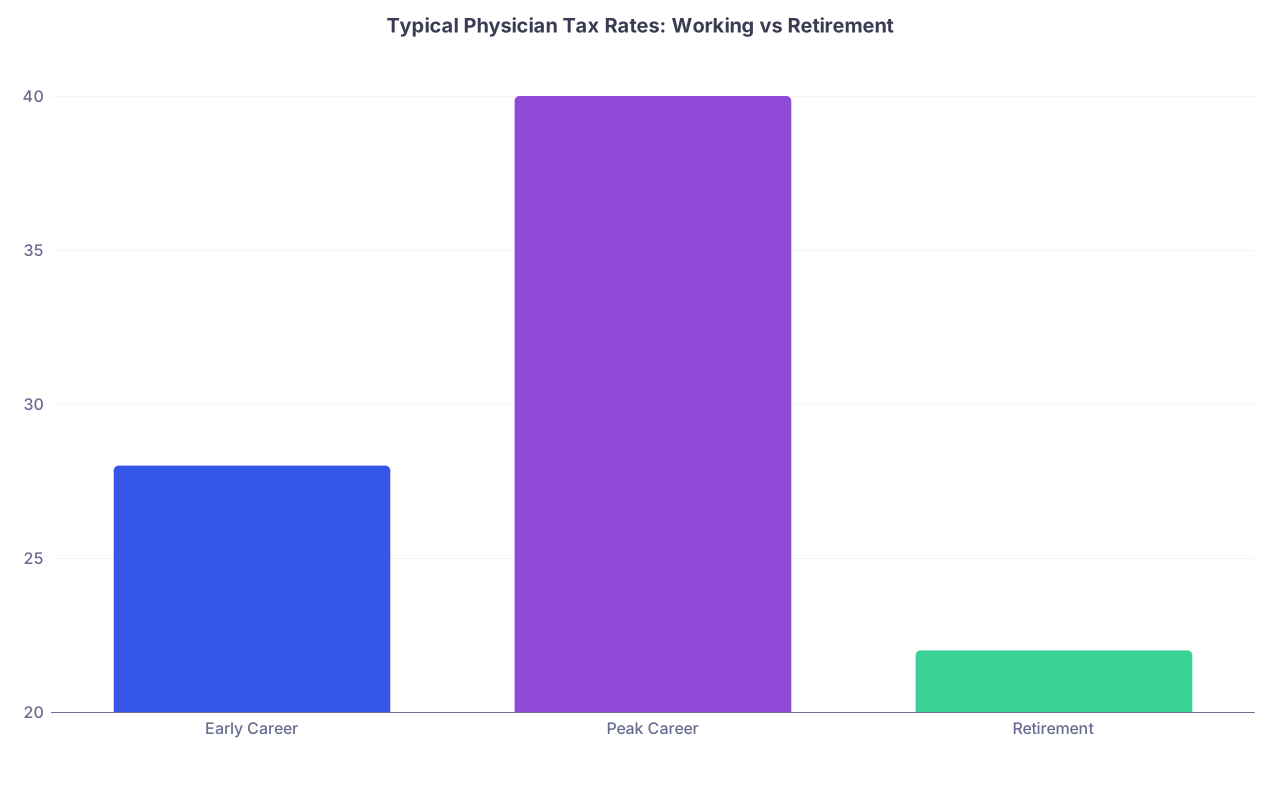
| Category | Value |
|---|---|
| Early Career | 28 |
| Peak Career | 40 |
| Retirement | 22 |
This rough visual summarizes the typical pattern I see when modeling:
- Early career: modestly high marginal, low effective
- Peak career: very high marginal
- Retirement: effective rate usually lower than peak marginal, except in extreme RMD scenarios
Which is why blanket “Roth for high earners is always better” advice is lazy. The slope of those bars matters.
9. State Taxes, Social Security, and Legislative Risk
The raw math above used combined rates, but you should separate these for real planning.
State taxes
- If you are in a high-tax state now (CA, NY, NJ, MN, etc.) and plan to retire in a no-income-tax state (TX, FL, WA, TN), pre-tax is even more attractive.
- Deducting at, say, 9–13% state now and paying 0% state later is a huge arbitrage.
Social Security taxation
Roth withdrawals do not count in the provisional income formula for Social Security taxation. Large pre-tax RMDs do.
- Building some Roth capacity can reduce how much of your Social Security is taxed.
- Hard to quantify without a detailed model, but it can nudge the needle.
Legislative risk
- Congress can change brackets, RMD ages, Roth rules.
- Already did with the SECURE Act (10-year rule for inherited IRAs).
Roth offers a tax-rate insurance policy: you pay a known rate now and lock in tax-free growth. Pre-tax is a bet that your future effective rate will not be worse than today.
I do not treat legislative risk as the primary driver, but for high-income physicians, having 25–40% of total retirement assets in Roth is a sensible hedge.
10. Practical Implementation: What I Actually Recommend to Most Doctors
You want an actionable rule set, grounded in the data patterns above.
If your current combined marginal tax rate is below ~24–25%, skew Roth-heavy. Residents, low-income early years, and sabbatical years are prime Roth times.
If your current marginal is in the 32–37% federal band plus state, skew pre-tax-heavy, unless:
- You already project massive RMDs and extremely high retirement income, or
- You are planning early retirement and large Roth conversions later.
Always use:
- Pre-tax HSA (and treat it like another retirement account).
- Backdoor Roth IRA if you are ineligible to contribute directly and do not have large pre-tax IRA balances that trigger the pro-rata rule.
Run a real projection:
- Estimate retirement spending in today’s dollars.
- Model Social Security, pensions, portfolio withdrawals.
- Use current tax brackets to approximate retirement effective rate.
- If retirement effective < current marginal by 5–10 percentage points or more, favor pre-tax.
Target tax diversification:
- Aim for a mix at retirement: maybe 50–70% pre-tax, 20–40% Roth, 10–20% taxable.
- This lets you control your bracket year by year.

11. Table Summary: When Roth vs Pre-Tax Tends to Win
| Profile Type | Current Combined Marginal | Likely Retirement Effective | Strategy Tilt |
|---|---|---|---|
| Resident / Fellow | 12–22% | 15–20% | Roth heavy |
| Early Attendings (200–300k) | 24–29% | 18–22% | Pre-tax primary |
| Dual-Physician (500–700k) | 32–40% | 22–28% | Pre-tax with some Roth |
| Very High Income (900k+), low RMD risk | 42% | 25–30% | Strong pre-tax |
| Very High Income (900k+), huge RMD risk | 42% | 30–38%+ | Pre-tax + Roth conversions, some Roth now |
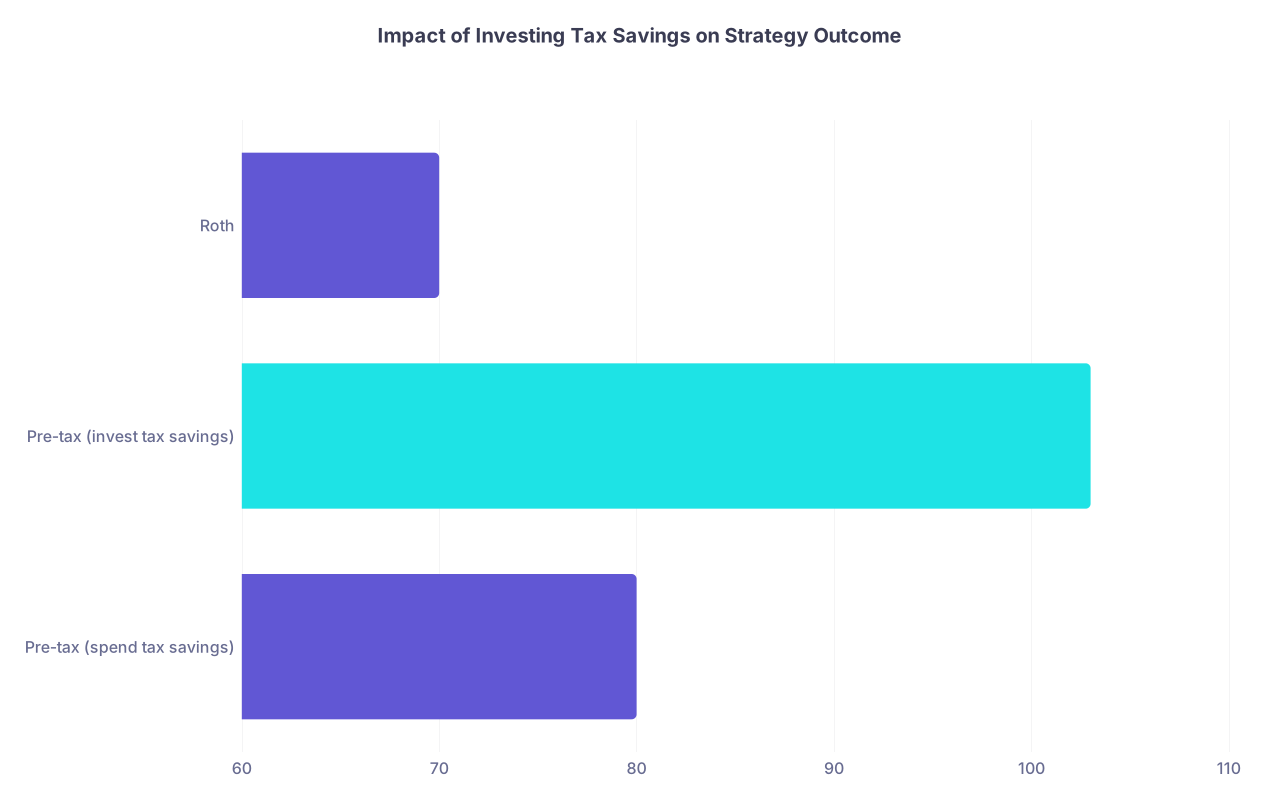
| Category | Value |
|---|---|
| Pre-tax (spend tax savings) | 80 |
| Pre-tax (invest tax savings) | 103 |
| Roth | 70 |
That simple bar visually encodes what the math showed earlier (using normalized numbers):
- If you spend the tax savings from pre-tax contributions, the advantage over Roth shrinks or disappears.
- If you invest those savings, pre-tax often wins under realistic tax differentials.


| Step | Description |
|---|---|
| Step 1 | Estimate Current Marginal Rate |
| Step 2 | Project Retirement Income |
| Step 3 | Favor Pre-tax 401k |
| Step 4 | Blend Pre-tax and Roth |
| Step 5 | Invest Tax Savings in Taxable |
| Step 6 | Plan Roth Conversions in Low-Income Years |
| Step 7 | Review RMD Projections |
| Step 8 | Adjust Mix Every 3-5 Years |
| Step 9 | Retirement Effective < Current Marginal by 5+ points |

FAQ (Exactly 3 Questions)
1. I’m a mid-career doctor in the 32% federal bracket. Should I switch everything to Roth 401(k)?
The data says no, not automatically. At a 32% federal bracket plus state, your combined marginal may be 35–40%. Most physicians will not pay that high an effective rate on withdrawals in retirement, especially if they retire before 70 and manage conversions. In that band, pre-tax 401(k) contributions usually produce more after-tax wealth, especially if you invest the tax savings. Roth 401(k) can still play a role for diversification, but “all Roth” is rarely optimal at those rates.
2. How do Roth conversions fit into this Roth vs pre-tax decision?
Conversions are the bridge between them. You can take pre-tax dollars (deducted at high marginal rates during your career) and convert them in early retirement years when your taxable income drops. If you can convert at 12–24% brackets after retiring from a 32–37% career, the arbitrage is substantial. For many high-income physicians, the strongest strategy is pre-tax during peak earning, then systematic Roth conversions in low-income years before RMDs and Social Security.
3. What if tax rates skyrocket in the future—does that make Roth obviously better today?
Not automatically. You would need future effective rates on your withdrawals to exceed your current marginal by a wide margin to overcome the lost deduction and the compounding of invested tax savings. That scenario is possible but speculative. A more data-driven hedge is to build some Roth (backdoor IRA, perhaps partial Roth 401(k)), some pre-tax, and maintain flexibility. Then each year in retirement you can choose which bucket to tap to manage your actual bracket, instead of betting your whole future on one tax regime.