
The hard truth is this: a disturbing number of attendings are not working past 65 because they “love medicine.” They’re working because they cannot afford to stop.
I’ve sat in those closed-door meetings with department chairs, practice owners, hospital CFOs. I’ve heard the way they talk about “senior partners” and “late-career physicians.” And I’ve seen the spreadsheets—the ones that tell you exactly who is financially stuck and who could walk away tomorrow.
You’re being sold a myth: that if you become an attending, live a “normal” doctor life, and throw some money into a 401(k), you’ll coast into a comfortable retirement at 60 or 65. That’s not what’s happening behind the scenes.
Let me walk you through the traps that keep attendings in the hospital well into their late 60s and 70s, even when they’re exhausted, burnt out, or quietly terrified of a market downturn.
The Illusion of Being “Set” as an Attending
The first mistake starts early: people assume the attending salary solves everything. It doesn’t.
Here’s how it actually plays out.
New attendings come out at 32–35 with:
- Multiple six figures of debt
- No real investing experience
- No clear retirement target
- A social circle that normalizes $80k SUVs and $2M homes
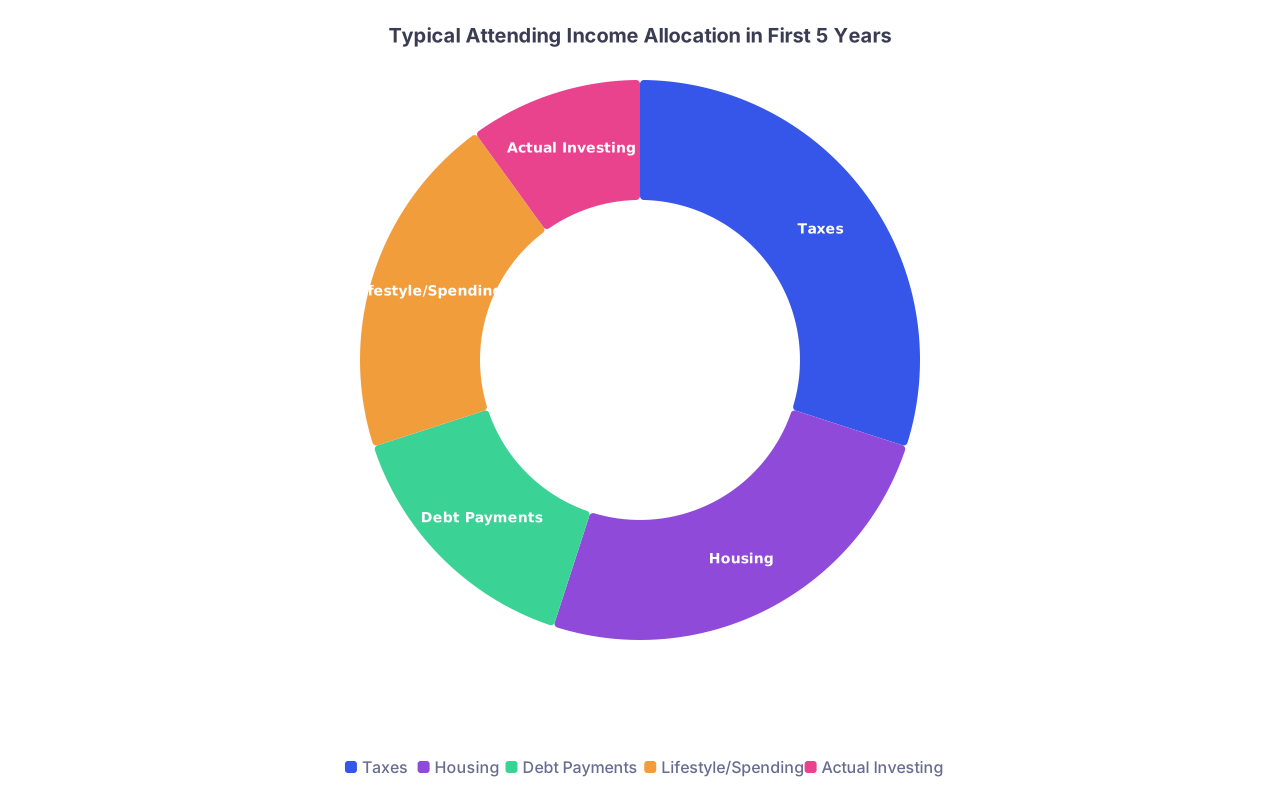
Within 3–5 years, most have inflated their fixed lifestyle to the point that “retirement” becomes this vague, distant idea, always postponed by one more big purchase.
| Category | Value |
|---|---|
| Taxes | 30 |
| Housing | 25 |
| Debt Payments | 15 |
| Lifestyle/Spending | 20 |
| Actual Investing | 10 |
I’ve seen actual budget reviews that look like that. Ten percent going to real investing. Maybe.
What nobody says out loud: if you don’t hit it hard in your first 10–15 years as an attending, you’re almost certainly working past 65. Full stop.
Because the math is brutal and it does not care about your credentials.
Trap #1: The Late Start + Lifestyle Creep Combo
Most attendings are trying to win a 40-year game in 20 years. That’s the structural problem.
- Start working “real” money at 32–35
- Want to be financially independent by 60–65
- Lose the first 5–10 years to lifestyle inflation and delayed saving
Then they wake up at 50 with a net worth that looks respectable on paper—nice house, some retirement accounts—but not anywhere near what’s needed to sustain a high fixed-cost lifestyle for 30+ years of retirement.
I’ve watched partners in their early 60s sit with a financial planner the group brought in and get blindsided. They’re thinking, “I’ve been making $400–600k for 20+ years, I must be fine.” Then the analysis hits:
- $1.5–2M in retirement accounts
- Primary residence with $300–600k equity
- Maybe a taxable account with $200–400k
- Still supporting adult kids in some way
Looks “rich,” feels precarious.
Because if your burn rate is $250k+ per year post-tax, that portfolio is not letting you retire at 60 with any margin of safety. And they know it.
Trap #2: The “Doctor House” That Quietly Owns You
Housing is one of the most vicious, quiet traps. I’ve seen more attendings held hostage by their house than by their student loans.
The story is always the same:
They finally become attendings. Spouse is burnt out from training years. Kids are coming or already here. They tell themselves:
“We sacrificed for so long. We deserve a nice place.”
Then the “nice place” is a 5,000+ sq ft home in an upscale suburb with a mortgage that makes early retirement mathematically insane.

Here’s the part no one tells you: hospital admins know this. Group partners know this. They know once you’ve bought into that level of fixed cost, you’re not going anywhere. You’re too expensive to quit.
I’ve literally heard a practice leader say, half joking, half not:
“Don’t worry, after they buy the big house and put their kids in private school, they’ll never leave. They can’t.”
And that wasn’t a joke. That was the retention strategy.
The house itself isn’t the problem. It’s the knock-on effects:
- Property taxes that behave like a second mortgage
- Maintenance that scales with square footage
- Upgrades that accrete like plaque—kitchen, landscaping, decor
- Neighborhood expectations (cars, vacations, parties, schools)
Now project that forward. At 65, that house is still eating a massive portion of your cash flow. Downsizing sounds good in theory, but people rarely do it at the scale needed. Or they procrastinate until it’s too late.
So they keep working. “Just a few more years” to feel comfortable selling, remodeling, paying off the last mortgage, helping the kids… The years stack.
Trap #3: Underestimating What Retirement Actually Costs
Most attendings dramatically underestimate what it costs to retire at their current lifestyle.
Behind closed doors, the financial advisors hired by groups or hospitals quietly show a version of this, adjusted for income level:
| Age | Target Invested Assets (Multiple of Annual Spending) |
|---|---|
| 40 | 3–4x |
| 50 | 6–8x |
| 60 | 10–12x |
| 65 | 12–15x |
Key phrase: annual spending, not income.
If your family spends $220k a year (post-tax), to be reasonably secure at 65 you’re looking at $2.5–3.3M in actual invested assets, minimum. Many dual-physician or high-income households are closer to $300–400k a year in spending once you add tuition, travel, second home, etc. Now your “comfortable” number is $3.6–6M+.
I’ve watched 67-year-old attendings who still need to work three days a week, because:
- They don’t hit those multiples
- Their withdrawal rate would be dangerously high
- They’re terrified of a 30–40% market drawdown early in retirement
So they cling to the job. They tell juniors they “still love it.” Some do. Many don’t. But they’re trapped by math.
Trap #4: The Tax Blind Spot That Erodes Decades
Physicians get hammered by taxes, and a lot of them never really adjust their strategy.
The real insider problem isn’t just high marginal rates. It’s tax-inefficient behavior over decades:
- Massive W-2 income with no shield strategies
- Minimal use of backdoor Roths, HSAs, defined benefit plans when available
- Overloaded into taxable bond funds in high brackets
- Selling investments at bad times for big capital gains to fund lifestyle
I’ve seen attendings 20 years in whose portfolios are unnecessarily smaller by seven figures purely due to tax drag and bad location of assets.
The irony? The practice often brings in a “financial professional” who pushes high-fee products, not tax strategy. Why? Because the hospital/large group doesn’t really care about your net worth. They care about your productivity and your “engagement.”
There are attendings still working at 68 who could have been done at 58 if someone had actually optimized their tax planning early and set a real target.
Trap #5: The Illusion of the Practice Buy-In / Buy-Out
In private practice, the big fantasy is: “The buyout will take care of me.”
Reality behind closed doors:
- Older partners quietly manipulating valuation formulas
- Buyout structures heavily favoring the existing senior group
- Younger docs overpaying on the way in and underpaid on the way out if they’re not at the top of the seniority stack
I’ve seen this movie:
A 63-year-old partner in a specialty group is counting on a $1M+ buyout. Then reimbursement cuts hit. Hospital acquisition talks start. The “goodwill” valuation used to justify older partners’ buyout numbers gets slashed. Younger docs balk at funding huge payouts. The entire buyout formula is re-negotiated downward.
Result: that physician’s “retirement anchor” just lost $500–700k on paper. Overnight. Now their “I’ll retire at 65” quietly becomes “I’ll probably stay to 70. Just to be safe.”
No one advertises this publicly. But those negotiations are often brutal, and they absolutely reshape late-career timelines.
Trap #6: The Kid Trap (College, Launching, and Rescue Missions)
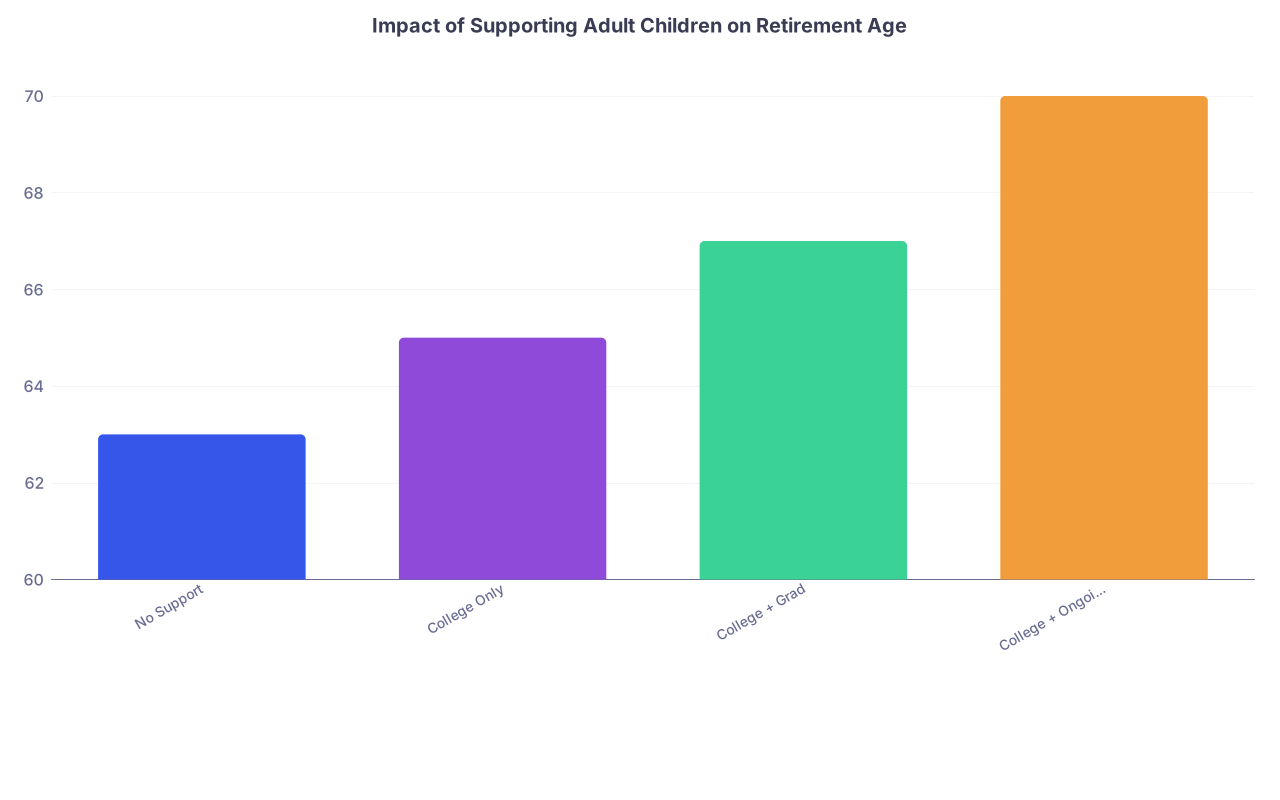
Another major reason you see 65–75-year-old attendings still grinding: their kids.
Not in the abstract. In the checkbook.
I’ve watched this play out again and again:
- $60–80k/year private colleges for multiple kids
- Helping with med school or grad school for them
- Down payments or “temporary” support for adult children who are underemployed or in expensive cities
- Bailing out kids from bad business decisions
None of this is insane or immoral. It’s generous. It’s also how people lock themselves into another 5–10 years of work without fully registering what they’ve done.
| Category | Value |
|---|---|
| No Support | 63 |
| College Only | 65 |
| College + Grad | 67 |
| College + Ongoing Support | 70 |
Those are the conversations you don’t see:
- The 66-year-old oncologist still doing call because he’s covering grandkids’ private school
- The 70-year-old internist whose adult child moved back in “for a year” that turned into five
Administrators look at those attendings as reliable workhorses. They know they won’t walk away from their income easily. They also know they can freeze them out of leadership roles and still get their RVUs.
Trap #7: Under-Saving in the “Prime” Decade (45–55)
The 45–55 decade is where the game is won or lost. Most attendings waste it.
That’s the stretch where:
- Kids are old enough that childcare costs are lower
- Income is at or near peak
- Partnership tracks, seniority, and administrative stipends kick in
It’s also the stretch where:
- Second homes appear
- Luxury cars become routine
- Expensive travel becomes normalized
- “We can always work longer” starts as a joke and ends as a plan
Behind the curtain, I’ve seen partners in their mid-50s utterly shocked when the group’s third-party financial consultant shows them the projection: keep spending how you’re spending, and you’re working to 70 at least.
Sometimes they fix it—hard pivot, downsize, crank up savings. More often? They adjust the retirement date in their head and keep going.
Because making hard changes at 52 is emotionally harder than just promising yourself you’ll retire at 70 “while cutting back.”
Except cutting back is not always under your control.
Trap #8: The Health and Competence Denial
This one’s ugly, but you want the truth.
I’ve sat in meetings where program directors, department chairs, and medical staff leadership discussed late-career physicians whose skills were clearly slipping. People whisper about the near-misses. The “old doc who shouldn’t be on call anymore.” But they tread lightly.
Why? Because they know that if you pressure that doctor to step back, you’re not just attacking their identity. You’re threatening their entire financial scaffolding.
Many of these attendings:
- Still have mortgages
- Still have financially dependent family members
- Don’t have the portfolio to walk away
- Are terrified of losing income and health insurance at the same time
So they resist. They fight. They insist they’re fine. They agree to token changes, but they don’t actually step down.
And the system often blinks first. Because credentialing committees do not want a fight, especially with someone “who has given so much to this hospital.” So the physician keeps working—long past when they want to, and sometimes past when they should.
If you don’t want to be that person, you need a financial plan that lets you walk away before everyone else thinks you should.
Trap #9: The Health Insurance Handcuffs
For U.S. physicians, the healthcare system handcuffs even its own.
Many attendings keep working well past 65 not because they need income, but because they’re terrified of losing:
- Employer-subsidized health insurance for themselves
- Coverage for a spouse who’s younger or has major ongoing medical needs
- Access to care networks they know and trust
Some of the smartest, most respected attendings I know have quietly said variations of this:
“I don’t actually need the salary anymore. I need the benefits. If my spouse’s meds and specialists weren’t covered through my employer plan, we’d be in trouble.”
So they stay on:
- Per diem roles with benefits
- Reduced FTE but enough to keep coverage
- Administrative or teaching-heavy roles attached to benefit-eligible lines
No one warns you about this when you’re 30. But at 62, if your partner has expensive chronic conditions, “just retire” isn’t a plan.
Trap #10: No Clear Number, No Clear Date
The biggest behind-the-scenes common denominator?
Most attendings do not have:
- A defined “enough” number
- A specific target retirement or “optional work” date
- A written, coherent financial strategy past “max out accounts and invest”
So they drift.
I’ve sat in faculty meetings where a 68-year-old attending says, half to themselves, “I guess I’ll keep going as long as I can.” Not because they love the job that much. Because they never drew a line.
If you never set:
- “When my portfolio hits X, and my paid-off fixed costs are Y, I will cut to 0.5 FTE”
- “At 65, regardless of admin role, I’m stepping away from clinical”
…then inertia wins. The hospital will not retire you for your own good. They will happily extract another 5–10 years of productive labor from you. Especially if they sense you don’t have a plan.

| Step | Description |
|---|---|
| Step 1 | Start Attending |
| Step 2 | First 5 Years |
| Step 3 | Mid Career Options |
| Step 4 | Lifestyle Locked In |
| Step 5 | Target FI by 55-60 |
| Step 6 | Work Longer Needed |
| Step 7 | Planned Exit or Cutback |
| Step 8 | Drift to 70+ |
| Step 9 | Save Aggressively? |
| Step 10 | Set Retirement Date? |
What the Attendings Who Could Walk Away Do Differently
You want the real contrast? Here’s what I see in the 55-year-old cardiologist who could retire tomorrow but still chooses to work:
They:
- Crushed debt and started saving hard in their first 5–10 attending years
- Never let housing float beyond ~2x their gross income
- Set an explicit “FI number” (e.g., $3M invested, no mortgage)
- Kept lifestyle inflation well behind income growth
- Used every tax-advantaged account available, aggressively and consistently
- Didn’t treat kids’ every want as mandatory
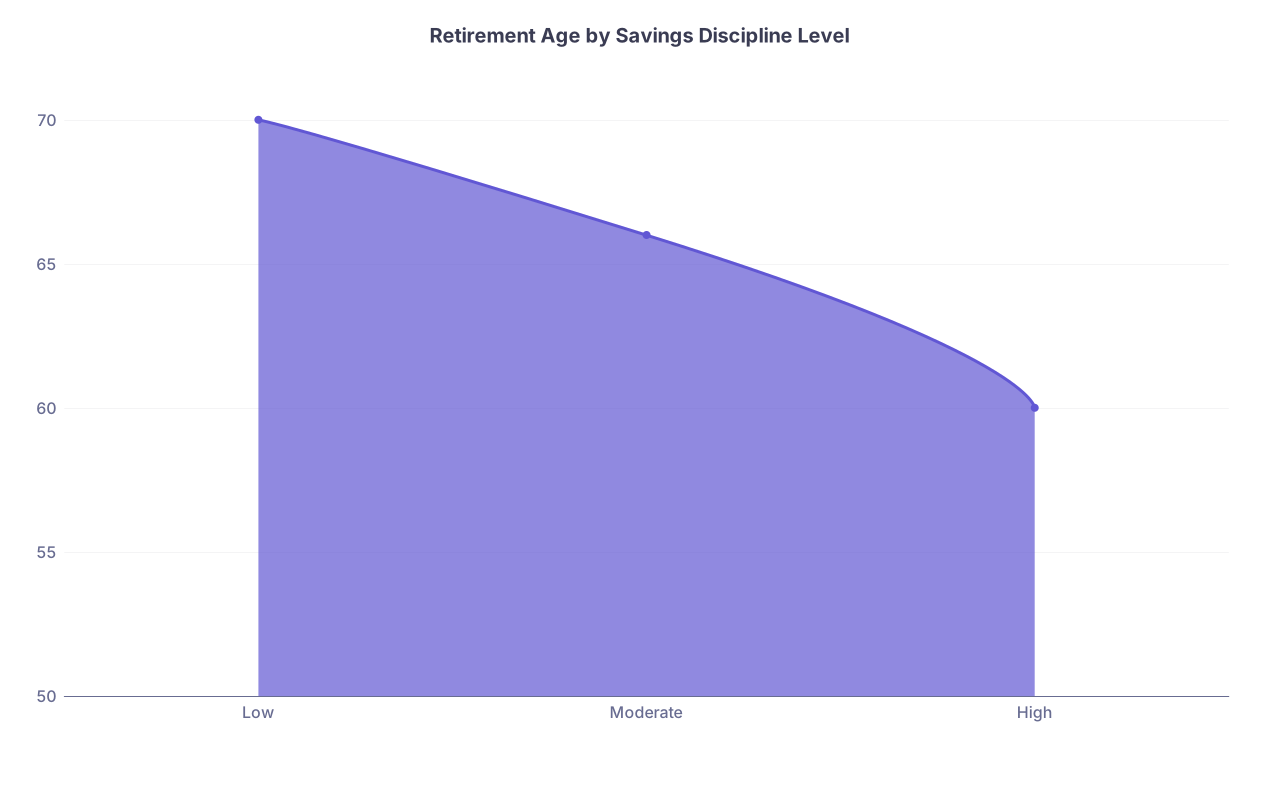
And here’s the punchline: they often look “less rich” on the outside. Smaller or paid-off house. Older cars. Fewer Instagram vacations. But they’re the ones who could send the “I’m done” email tomorrow and mean it.
I’ve watched those people quietly step back at 58 or 60, while the flashier, higher-spending colleagues keep grinding at 68 and beyond. Not because the latter love medicine more. Because they boxed themselves in.
| Category | Value |
|---|---|
| Low | 70 |
| Moderate | 66 |
| High | 60 |
How to Avoid Becoming the 70-Year-Old Who “Can’t Afford to Quit”
I’m not going to feed you generic platitudes. You already know you should “save and invest.” Let’s be blunt about the levers that matter most:
Decide your “enough” number early.
Not some fantasy. A real, calculated, inflation-adjusted number tied to your actual spending. You can change it later, but you need a target to aim at, or lifestyle will expand to fill the void.Cap fixed lifestyle ruthlessly in the first 10 years.
That means house, cars, schools. Set a hard ceiling that leaves room for a 20–30% savings rate (or more) after taxes and debt payoff. If you blow this decade, you’re volunteering for late-60s work.Treat retirement planning like a professional problem, not a side hobby.
You’d never manage a complex cancer case based on social media posts and hearsay. Yet physicians routinely wing their financial plan with less rigor than their gym membership. Get real planning, understand tax strategy, demand clarity on your trajectory.Protect your ability to exit, even if you never use it.
This is the big mental shift. The goal isn’t necessarily to retire at 55 or 60. It’s to be able to. On your terms. So if the job turns toxic, your health shifts, or you simply lose the fire, you don’t find yourself staring down 10 more years because your mortgage and lifestyle said so.

Hospitals won’t do this for you. Senior partners won’t do this for you. Residency won’t teach you any of it.
The system is perfectly happy if you are still generating RVUs at 72, clinging to your salary for security, while they quietly groom your replacement.
You can step off that path. But you have to see the traps the older generation fell into—and avoid them deliberately.