
The way most private practice partners talk about retirement buyouts is a fairy tale. The way they actually structure them is much messier, more political, and far more negotiable than anyone tells you as an associate.
You are not buying into a tidy formula. You are joining a living organism run by humans with conflicting incentives. And when it comes to retirement money, those incentives collide hard.
Let me walk you through how this really works behind closed doors. What partners actually say in those “partner-only” meetings. And how the retirement checks for the senior docs really get decided.
The Dirty Little Secret: Most Groups Are Making It Up As They Go
Here’s the uncomfortable truth I’ve seen play out over and over:
Even “sophisticated” private practices with 20+ partners often do not have a clear, enforceable, and realistic retirement buyout formula until someone is already on the runway to retire.
On paper, you’ll see:
- A partnership agreement with some vague “redemption of equity” language
- A “value per share” or “capital account” provision
- Maybe a 3–7 year payout description
But in practice, when Dr. Smith (age 66, founding partner) announces his real retirement date, the partners suddenly realize:
- The formula is too generous and will gut the remaining partners’ income, or
- The formula is too stingy and will cause a war with the senior docs, or
- The formula never really accounted for modern realities (EMR, ASC ownership, hospital contracts, APPs, etc.)
So they “revisit” it. Usually in a slightly panicked, last‑minute way.
That’s your starting point: whatever is written is only half the story. The other half is the current politics and cash flow.
The Two Pillars: Hard Assets vs. “Goodwill” (And Who Gets Paid For What)
Behind almost every retirement buyout structure there are two components:
- Tangible / hard assets
- Intangible / goodwill value
Let’s be precise.
1. Hard assets: the easy part everyone pretends is the whole story
Hard assets are the things you can actually point to:
- Exam tables, scopes, ultrasound machines, lasers
- Furniture, computers, EMR hardware
- Accounts receivable (A/R) – sometimes
- Real estate, if the practice owns the building (though that’s often in a separate entity/LLC)
These can be valued in a relatively straightforward way. Cost minus depreciation. Fair market value. An appraisal for the building.
Most groups will structure the outgoing partner’s buyout so they’re cashed out of:
- Their capital account (whatever they put in originally, sometimes adjusted)
- Their share of hard assets (often at book value or some percent of FMV)
- Their share in real estate LLC, if any (separate deal, usually financed by rent flows)
This part is rarely controversial. It’s math. Maybe unflattering math, but math.
Where the knives come out is goodwill.
2. Goodwill: where the money and the fighting live
Goodwill is everything that makes the practice worth more than the furniture:
- Established referral base
- Reputation in the community
- Existing patient list
- Hospital contracts, ASC volume, call coverage deals
- Payor contracts, better-than-average rates
- Ancillary businesses (imaging, PT, lab, ASC, optical, etc.)
Senior partners love goodwill. They built the thing. They think they should get paid for it on the way out.
Younger partners hate paying big goodwill numbers. They feel like they’re paying twice: once via lower comp while ramping up, and again via a big check to people who are no longer working.
So what happens? Groups quietly shift over time from “heavy goodwill buyouts” to “minimal goodwill,” but nobody ever sends you a memo explaining this evolution. You just see different structures in different vintages of partners.
This is why the 70‑year‑old founding partner often has a much richer retirement deal than the 58‑year‑old who joined ten years later. Same group. Different era. Different leverage.
The Most Common Retirement Buyout Structures (And What’s Really Going On)
Let’s cut through the theory. These are the actual models I see used, with their real implications.
| Model | What It Really Means For You |
|---|---|
| Pure hard-asset only | Minimal buyout, low risk for juniors, seniors underpaid on exit |
| Modest goodwill multiple | Seniors get a decent tail; juniors accept lower income for some years |
| Revenue/collections-based tail | Outgoing doc paid as a % of future revenue they “generated” |
| Phantom equity / units | No true ownership transfer; payout mimics equity but is 100% internal |
| Defined fixed payout | Flat amount or banded by years in partnership; politics baked into the number |
1. Hard-assets-only buyout
This is becoming more common in competitive markets and hospital-shadow practices. Structure looks like:
- You get your capital account back
- You get your share of depreciated assets
- You keep or sell your interest in the building LLC separately
- No explicit goodwill payment
For the outgoing partner, this stings. They feel like they’ve “sold” their life’s work for the cost of some exam tables and computers.
For the remaining partners, it’s safer. The practice isn’t handicapped by legacy obligations.
The hidden truth:
In hard-asset-only groups, the “retirement benefit” usually happened while the senior partner was working, through:
- Higher effective comp ratios for senior partners
- Favorable call schedules
- Cherry-picking cases or OR time
- Larger share of ancillaries
In other words, the senior docs already took their retirement in advance via better economics for years.
You, as the junior, may not see that spelled out anywhere. But it’s coded into the compensation history.
2. Modest goodwill multiple (the “compromise” model)
The classic old-school model was something like:
- Practice valued at X times EBITDA or X times average compensation
- Goodwill allocated by ownership units or years of partnership
- Buyout paid over 3–7 years post-retirement
These days, where it still exists, groups usually soften it:
- Goodwill value capped (e.g., 0.5–1x average annual comp instead of 2–3x)
- Payout stretched over longer (7–10 years) to avoid crushing cash flow
- Multiple partners retiring can trigger a cap – “If more than 2 retire in 3 years, goodwill payments are proportionally reduced”
The hidden tension:
Mid-career partners will often push to quietly revise these numbers downward once they see the math. Especially when they realize they’ll be paying these tails while trying to recruit new blood in a competitive market.
Senior partners understand this and often resist any change “for legacy reasons.” When they invoke “legacy,” they mean “my retirement.”
3. Revenue/collections-based tail
This is popular in specialties where patient loyalty or referral habits strongly stick to the practice rather than the individual: cardiology, ortho, GI, some surgical subspecialties.
Structure looks like:
- Outgoing partner gets X% of collections (or profit) from:
- Their patient panel for Y years, or
- Their attributed hospital/ASC volume, or
- Their referrer list’s downstream revenue
- Usually declines over time (e.g., 7% year 1, 5% year 2, 3% year 3)
On paper, it “aligns incentives.” In reality:
- It’s a nightmare to track cleanly unless your EMR and billing are excellent
- Senior partner has a vested interest in claiming every possible patient and referrer as “theirs” before retiring
- Remaining partners may quietly resent sending checks every month to someone who is on a beach in Scottsdale
The real reason groups use this:
It feels more “fair” than arbitrary goodwill, and it can be sold as “you get paid only if the practice continues to benefit from your past work.”
But do not kid yourself. It’s still a goodwill payment dressed up as collections-based math.
The Splash Zone: How Payouts Are Actually Funded
Here’s the thing almost nobody tells the younger partners directly:
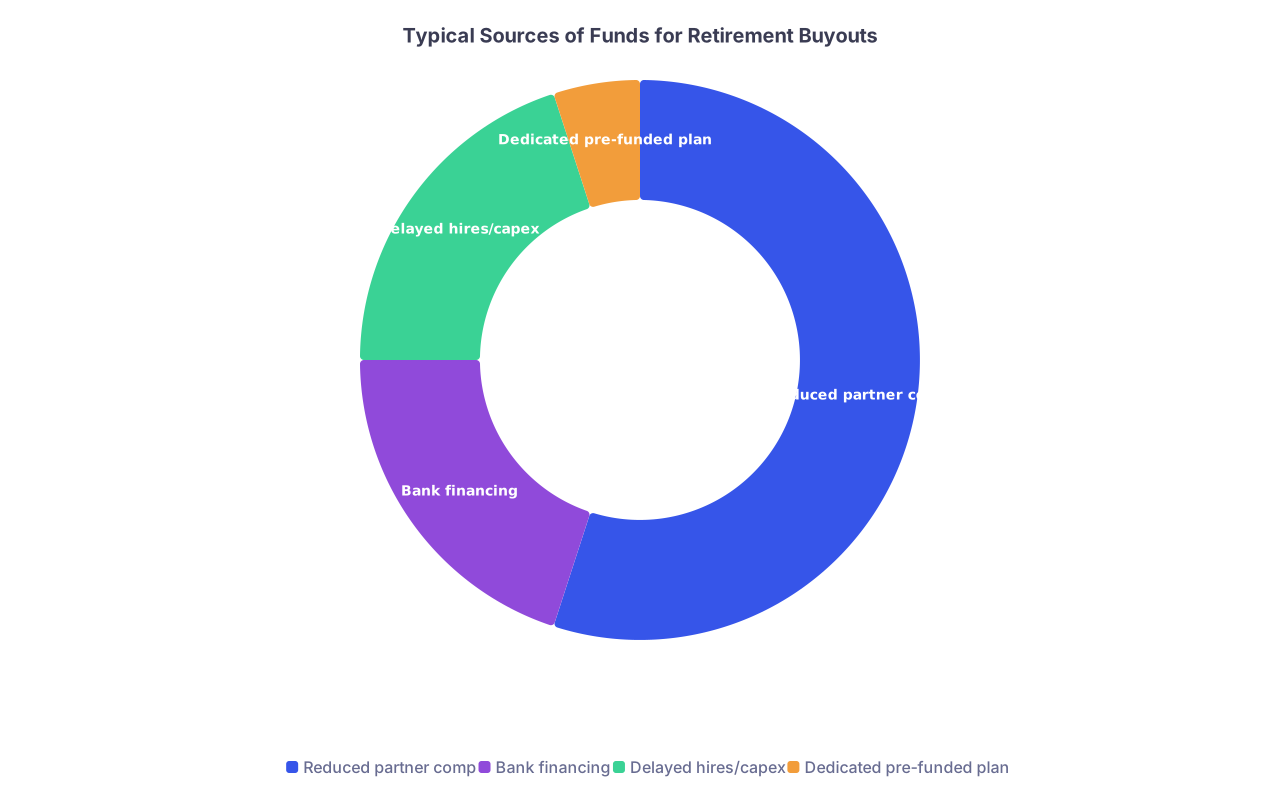
Retirement buyouts are very rarely funded by some distant, magical pool of money. They are funded by:
- Reduced income for the remaining partners
- Occasionally, bank debt serviced by reduced partner income
- Sometimes, slowed hiring or capital projects
| Category | Value |
|---|---|
| Reduced partner comp | 55 |
| Bank financing | 20 |
| Delayed hires/capex | 20 |
| Dedicated pre-funded plan | 5 |
That little “dedicated pre‑funded plan” slice? That’s the unicorn. Most groups talk about setting one up. Very few actually fund it consistently. I’ve sat in too many partner meetings where someone says, “We should really start a reserve for buyouts,” and the response is, “Let’s revisit that next year; collections are tight.”
So what actually happens when Dr. Senior retires?
- The senior partner stops taking call and stops producing revenue
- Their collections disappear or are partially absorbed by others
- The group must now:
- Cover their salary-equivalent cost (if replacing them)
- Cover their retirement tail payments
- There’s a tug-of-war between recruiting a replacement vs. preserving income for current partners vs. honoring the buyout
You need to understand this dynamic because it determines how stable your future buyout really is. Generous promises are cheap when printed. They are expensive when checks go out.
The Fine Print Traps: Age, Notice, Disability, and “Semi-Retirement”
The real games are not always in the headline formula. They’re in the conditions.
Age and vesting games
Most serious partnership agreements will have:
- A minimum number of years as partner to qualify for full buyout
- Partial vesting for shorter tenures
- Critical ages: 60, 62, 65, sometimes 70
Common structure:
- Under 60 and leaving? You get hard assets only, no goodwill
- 60–65 and retiring? You get X% of the full buyout
- Over 65 and still working? Maybe a declining goodwill entitlement to push you out
This is how mid-career partners quietly protect themselves from paying large buyouts to people they don’t believe “earned” a full retirement package with the group.
Notice periods and timing
Another trick buried in the agreement:
- Require 1–3 years written notice to receive the full buyout
- Shorter notice = reduced buyout or slower payout
- Leaving suddenly for any reason other than verified disability = partial forfeiture
This gives the group time to plan for your departure and softens the hit. It also gives them leverage if there’s conflict. I’ve seen notice provisions used as a weapon in ugly internal politics: “Technically he didn’t give sufficient notice, so we can reduce his tail by 30%.”
Disability and death
These sections are usually painful to read and easy to gloss over. Big mistake.
Reality:
- Long-term disability often leads to a different payout structure than normal retirement
- It might be reduced, accelerated, or limited to hard assets only
- Death benefits may pay a portion of buyout to the estate, but often less than a full retirement tail
Why? Because the group is trying to avoid being on the hook for full goodwill in every possible scenario. They’ll prioritize survival of the practice over maximizing payouts to disabled or deceased partners’ families.
Cold? Yes. But you should understand the rules you’re living under.
How Corporate Buyers and Hospital Deals Changed Retirement Buyouts
Here’s the other big force reshaping retirement structures: private equity, corporate roll-ups, and hospital acquisitions.
Senior partners now see an external market value for their practice. They see friends cashing out to PE for 6–10x EBITDA. They start thinking: “Why should I settle for a modest internal buyout when I can sell the whole thing?”
This leads to two common moves:
The “last big deal” mentality
Senior partners push for a sale or recap and treat the external transaction as their retirement plan. The internal buyout becomes a small afterthought.The pre-emptive haircut
More forward-looking groups will intentionally reduce internal retirement obligations so the practice is a more attractive acquisition target. Lower legacy liabilities look better to buyers.
What happens in a PE or hospital sale?
- Senior partners often negotiate a larger upfront distribution (for historical goodwill)
- Younger partners get lower upfront but more future equity or earn-out potential
- Existing internal retirement formulas get renegotiated or extinguished altogether
I’ve watched groups where the founding docs walked away with seven-figure checks and effectively gave up most of their internal retirement rights in the process. For them, it was a win. For the junior partners, the whole game changed overnight.
What A Realistic, Sustainable Retirement Structure Looks Like
Let me tell you what actually works over 20–30 years without blowing up the group or screwing either generation.
A sustainable structure usually has these characteristics:
- Limited or no pure goodwill – or goodwill that’s clearly capped and known by everyone
- Long runway and transparency – everyone knows the formula and can project their own buyout
- Some form of internal pre‑funding – even modest reserves reduce the political pain later
- Age bands and vesting that match reality – not fantasy numbers pulled from someone’s memory of “how things used to be”
- Separate real estate – building wealth is handled via the property LLC, not overstuffed practice goodwill
In practice, a workable model might look like:
- Hard assets and capital account paid out over 1–3 years
- Modest goodwill based on a percentage of recent average compensation, capped at something sane like 0.5x–1x, paid over 5–7 years
- If more than two partners retire within 3 years, goodwill payouts are proportionally reduced but the schedule remains
- Notice required: 2 years
- Disability: accelerated hard-asset payout, reduced goodwill tail or fixed amount
- Death: defined benefit to estate equal to some fraction of full retirement buyout
Is it perfect? No. But it tends to keep the doors open, protect the mid-career docs, and still give seniors something meaningful.
The Conversation You Actually Need To Have (Before You Buy In)
Here’s what partners and administrators will not proactively show you as an incoming partner-track doc. You’ll need to ask, and ask specifically.
At minimum, you want to see:
- The exact sections on retirement, disability, and death in the partnership agreement
- The buyout formula, including caps, years of payout, and any adjustment clauses
- A historical list: who has retired in the last 10–15 years and what they actually received vs. what the agreement said
- A projection: how many partners will likely retire in the next 5–10 years and what that implies for group cash flow
This is where the real gap appears: the difference between the contract and the culture.
If, when you ask about past retirements, the partners get vague or uncomfortable, that’s a red flag. If they cannot tell you in a sentence how your buyout will be calculated at age 65, they either do not know or do not want to say.
Both are bad.
You should be able to do a simple projection: “If I join at 35, become partner at 38, and retire at 65, and my average comp in my last 3 years is $X, what would my buyout be?” If they cannot walk through that math with you, that tells you everything.

| Step | Description |
|---|---|
| Step 1 | Founding docs create rich buyout |
| Step 2 | First retirements paid as agreed |
| Step 3 | Younger partners feel cash flow pain |
| Step 4 | Policy quietly revised downward |
| Step 5 | Mid career docs accept compromise |
| Step 6 | New generation sees leaner terms |
| Step 7 | External sale or further revisions |
That diagram? I’ve watched this cycle play out almost exactly in multiple groups across different specialties. The names and dollar amounts change. The arc doesn’t.
FAQ: What Physicians Really Ask About Retirement Buyouts
1. How big should I realistically expect my retirement buyout to be?
In most modern private practices, if you’re expecting a multi-million-dollar check purely from internal goodwill, you’re living in the 1990s. A realistic total package (excluding real estate) usually falls somewhere between 0.5x and 1.5x your final annual compensation, spread over several years. Anything above that tends to strain the practice and trigger policy changes, especially if multiple partners retire close together.
2. Is it safer to have no goodwill in the agreement at all?
Safer for the practice? Yes. Safer for you depends on your career stage. If you’re joining a mature group with several partners in their late 50s and 60s, a no-goodwill setup often means you won’t be bled dry paying for their exit. If you’re 45 and the group is relatively young, a modest, capped goodwill component can be reasonable – as long as you can see that future partners will share the burden when it’s your turn.
3. Can groups actually change the retirement formula after I’ve already bought in?
Yes. And they do. The partnership agreement almost always has amendment procedures—some supermajority vote threshold, not unanimity. That means a coalition of mid-career and younger partners can (and will) revise buyouts if they become unsustainable. You can push for grandfathering clauses, but those are political battles, not automatic rights. If you’re counting on the current formula holding for 30 years untouched, you’re delusional.
4. What’s the smartest thing I can do now to protect my retirement, regardless of the buyout?
Assume the internal buyout will be modest and possibly shrink over time. Build your real retirement through tax-advantaged accounts (401(k), cash balance plans, defined-benefit overlays), a rational taxable portfolio, and, if it fits you, real estate or other assets not tied to the practice. View the practice buyout as a bonus tail, not your primary plan. The docs who get crushed are the ones whose entire mental model is “the practice will take care of me.”
5. How do I know if a group’s retirement structure is a deal-breaker?
It’s a deal-breaker if:
- They cannot clearly explain the formula and show real examples.
- The projected obligations for upcoming retirements would materially slash your expected income for years.
- There’s obvious disparity between what older and newer partners get, with no pathway for adjustment.
- Or the partners get defensive when you ask direct questions.
If the economics of the practice are great, the culture is strong, and the retirement deal is merely “lean but clear,” that’s usually fine. If the economics are average and the retirement promises are rich and fuzzy, walk. You’re being set up to pay for someone else’s golden parachute.
Years from now, you won’t remember the exact buyout multiple or the phase‑out schedule. You’ll remember one thing: whether you understood the game you were playing, or whether you let someone else write the rules for your exit while you were too busy grinding RVUs.