

You’re sitting on your couch, it’s 11:47 p.m., and you’ve just done the math you’ve been avoiding for years.
You added up your federal loans, maybe some private ones, peeked at your 401(k) balance, calculated your monthly payments under an income-driven plan… and the numbers feel completely upside down. Like: “Wait, I went to school for a decade to end up with negative net worth and a maybe-retirement?”
And the question that’s now chewing a hole in your brain is basically:
What if my student loans eat my entire retirement plan?
Not in the “I’ll have a little less” way. In the “I will be 68 years old with a Walmart vest and a name tag” way.
Let’s walk through this without sugarcoating, but also without the doom spiral lying to you.
First: Are Your Loans Actually Big Enough To Crush Retirement?
Let me be blunt: big student loans feel like they automatically nuke retirement. They don’t. Not automatically.
Here’s the real gut punch: people don’t lose retirement because of the size of the loans. They lose it because of one of these:
- They delay investing for too long (like a decade+).
- They never increase contributions when income rises.
- They pick the wrong payoff strategy for their situation.
- They ignore taxes and interest mechanics and just… pay minimums blindly.
The loan balance is the monster in the closet. The timeline is the real killer.
Say you’re 32, making $140k, with $250k in loans at ~6–7% interest. That sounds catastrophic. But if you:
- Get on a smart repayment path (IDR or aggressive payoff—not random)
- Put even 10% into retirement starting now
- Actually increase that as income grows
You can still end up with a seven-figure retirement portfolio. I’ve seen it in real numbers, not just optimistic blog posts.
Where things go off the rails is:
- No retirement contributions “until the loans are gone”
- Or, the opposite: tiny payments, no plan for tax bomb, lifestyle creep, and pretending forgiveness takes care of everything like magic.
So, before we catastrophize “entire retirement eaten,” the question is:
Are you making any consistent, automated, long-term investment moves right now?
If the answer is no, that’s actually the bigger immediate problem than the loan balance.
The Ugly Math: How Loans Compete With Your Future Self
Let’s put some numbers on the anxiety.
Imagine two people, same income, same loans:
- Age: 30
- Income: $120k
- Loans: $200k at 6.5%
- Retirement account: $0
Person A panics about loans and maxes payoff:
- Extra $1,500/month to loans
- $0 to retirement for 10 years
- Then starts retirement at 40 with $2,500/month
Person B splits focus:
- $500/month to retirement from now
- $1,000/month “extra” to loans
- Starts smaller but never stops investing
Assume 7% average market return and they both keep contributing until 65.
Person A (starts at 40):
- $2,500/month from age 40–65 at 7% ≈ ~$1.9M
Person B (starts at 30):
- $500/month age 30–65 at 7% ≈ ~$800k
- Then maybe bumps later, but even at just that? Still big.
Now imagine B also increases contributions as raises kick in. You’re probably looking at >$1.5M. Even though they “prioritized” loans less.
The painful part: time beats amount. Waiting 10 years is brutal. That’s what makes it feel like loans are eating your retirement—they’re actually eating your timeline if you don’t start anything until “later.”
So the truly terrifying scenario is not “I have big loans.” It’s:
“I’m 38, I’ve been paying loans for 10 years, my retirement balance is basically nothing, and I still don’t have a plan.”
If that’s you, it’s fixable. But it’s not going to fix itself by hoping PSLF or some forgiveness fairy saves you.
Income-Driven Repayment: Lifeline or Trap?
This is where most of the mental chaos comes from. You’re probably asking:
“If I stay on an income-driven repayment (IDR) plan forever, isn’t interest just going to balloon and then the tax bomb at the end will murder my savings?”
Let’s talk about that without sugarcoat or hysteria.
What IDR actually does (simplified)
- Your payment = a percentage of discretionary income, not based on total debt.
- You pay that for 20–25 years.
- Whatever’s left at the end is forgiven.
- PSLF forgives after 10 years of qualifying payments (public/nonprofit work) and no tax on forgiveness.
- Non-PSLF forgiveness under current IDR rules is taxable as income (unless laws change).
So with IDR, your nightmare isn’t “I’ll pay this forever.” It’s more:
“I’ll pay a moderate amount for decades and then get slammed with a massive tax bill.”
Good news: when you model it out, the “tax bomb” is rarely as apocalyptic as your brain makes it.
Say:
- Loan grows to $300k after 20–25 years
- You get $300k forgiven
- If your effective tax rate that year is ~25%, that’s a ~$75k tax bill
Horrible as a surprise? Yes. But if you start saving, say, $200–300/month into a separate “tax bomb” investment account now, over 20+ years that can easily cover most or all of that bill.
The people truly wrecked by forgiveness tax are the ones who:
- Never planned for it
- Never looked up what their projected forgiveness might be
- Never set aside a dime
Not the ones who were “behind” but started a small, consistent side fund.
The “Loans Ate My Retirement” Scenarios That Actually Happen
Let me lay out some real-world patterns I’ve seen. These are the people who end up at 60 going, “Oh crap.”

Scenario 1: The Max-Payer Who Never Invested
- Aggressively paid $3–4k/month on loans in 30s
- Waited until 40–45 to seriously contribute to retirement
- Now has low or only moderate savings, despite high income
They’re “debt free” but late to investing. They feel behind forever.
Scenario 2: The IDR Drifter
- On IDR since graduation, never recertifies early, just lets payments auto-update
- Doesn’t track forgiveness timeline
- Doesn’t save for the tax bomb
- Spends all “extra” income on lifestyle because “I can’t afford more with these loans”
Fast-forward 15 years:
- Balance is huge
- Retirement is anemic
- Tax bomb savings = $0
They’re not doomed. But they wasted a decade.
Scenario 3: The PSLF Gambler Who Didn’t Document Anything
- Works at a nonprofit/hospital/government
- Assumes PSLF is guaranteed
- Never checks employment certification forms
- Doesn’t confirm that their plan and loan types actually qualify
Year 9: They find out only 4 of their years counted. At that point, yeah, that screws both their loan and retirement timeline because they have to reset the clock.
This one is just… unnecessary collateral damage.
Okay But What If I Genuinely Can’t Afford Both?
Here’s the question under all of this:
“I literally can’t max retirement and aggressively pay loans at the same time. Something’s got to give. What should I sacrifice?”
This is where I see people choose “no retirement” way too quickly.
A more realistic hierarchy looks like this:
Get the free money first.
If your employer matches 3–5% in a 401(k)/403(b) and you’re not taking it? You are lighting money on fire to feel “responsible” about your loans. I’d argue that’s just financially self-harming. Get the match, always.Pay enough on loans to avoid disaster.
That usually means:- Staying current (no lates, no default, no collections).
- Picking IDR if standard 10-year payments are crushing you.
- Choosing PSLF if you qualify and want to stay in public/nonprofit.
Then slowly turn the dial up on retirement.
So maybe year 1–2:- 3–5% to get the match
- Loans on IDR
Year 3–5:
- 10% to retirement
- Loans still on IDR or slightly higher fixed payment if you move away
Year 5–10:
- 15%+ to retirement
- Reassess whether payoff vs forgiveness is mathematically better
Does it feel slow? Yep. Does it beat “no investing for 10 years”? Every. Single. Time.
IDR vs Aggressive Payoff: Which One Protects Retirement More?
This is the part everyone overcomplicates but your brain won’t let go of:
“If I commit to IDR and forgiveness, won’t the interest just explode and kill me? Should I just go scorched-earth and pay it off ASAP?”
Here’s the tradeoff, plain:
- Aggressive payoff protects your debt balance and mental health (you see progress, the number goes down). But it can trash your investing years if you shut down retirement to do it.
- IDR/forgiveness often protects your cash flow and investing timeline, but your balance might balloon and emotionally that feels horrible, even if the math is okay.
The key question isn’t “Which feels better?” It’s:
Which path gets me to age 60 with the highest net worth (retirement + savings − debt + tax bomb covered)?
I’ve seen situations like:
- $300k of federal loans
- Teacher or social worker or academic doc making $70k–120k
- IDR + PSLF is massively superior to aggressive payoff
- Trying to pay it off quickly would basically wreck any capacity to invest, and PSLF would wipe out six figures tax-free if they just stuck it out
And I’ve seen:
- $150k loans
- Private practice dentist or specialist making $350k+
- Aggressive payoff in 3–5 years, still putting 15–20% into retirement, is clearly the winner
The only way you know which bucket you’re in is to actually run scenarios. On paper. Not vibes.
What If Laws Change? (Because Of Course That’s The Next Fear)
You’re probably already thinking it: “What if I plan around PSLF or IDR and Congress nukes it in 15 years?”
Short answer: they might change things, but historically, they don’t retroactively screw existing borrowers as badly as the internet says. They tend to:
- Change rules for new borrowers.
- Grandfather old borrowers under old terms OR give them options.
Could something truly awful pass? Sure. But paralyzing your entire financial life on the assumption of worst-case government betrayal is… also a choice. And not a great one.
The hedge is:
- Don’t rely only on forgiveness.
- Save and invest outside of it: retirement accounts, taxable accounts, maybe a side “just-in-case” bucket.
- If forgiveness works out, awesome. You’re ahead. If it doesn’t, at least you’ve got assets.
Planning to be broke later just so you’re not “disappointed” by policy changes is not a better plan.
The Emotional Reality: Watching Your Balance Not Move
Let’s be honest about the psychological side. Because this is the thing silently wrecking people.
You pay for years under IDR. Your balance barely budges. Some years it goes up.
Meanwhile, your retirement account… also looks tiny at first. Couple thousand. Maybe five figures if you squint.
It feels like: “I’m shoveling sand into the ocean.”
Here’s the trap: most people quit in that phase. They drop retirement contributions “temporarily,” thinking they’ll restart after some future raise, bonus, or milestone that never really fixes the feeling.
But this phase is just… how compounding looks early.
- Years 0–5: Feels pointless
- Years 5–15: Feels slow but detectable
- Years 15–30: Absolutely insane growth
If you abandon retirement in the “feels pointless” phase to “focus on loans,” you’re not being strategic. You’re reacting to discomfort.
I get it. I’ve seen seasoned professionals melt down over a $0.12 interest capitalized line. But the people who end up fine were the ones who forced themselves to invest through that discomfort.
Concrete Moves So Loans Don’t Eat Your Retirement
Let me be specific, so this doesn’t stay abstract fear.
| Step | Primary Goal |
|---|---|
| Get employer match | Free retirement money |
| Choose right loan plan | Avoid cash flow disaster |
| Start small investing now | Protect compounding years |
| Plan for tax bomb | Avoid future ambush |
| Reassess every 1–2 years | Adjust with income changes |
1. Lock in any employer match. Non-negotiable.
Even if loans feel massive, 3–5% into a matched plan is step one. Period.
2. Pick a repayment path based on math, not shame.
Run (or get someone to run) comparisons:
- Standard 10-year vs IDR vs refinanced private loan
- PSLF vs no PSLF outcomes
- Projected forgiveness and estimated tax
Choose the path that gives:
- The best net worth at retirement
- With a payment you can actually live with
Not the one that “feels” the most virtuous.
3. Start a tax-bomb side bucket if you’re going forgiveness route.
Just a basic taxable investment account with automatic contributions:
- $150–300/month over 20–25 years at 6–7% average return gives you a solid chunk, often more than enough.
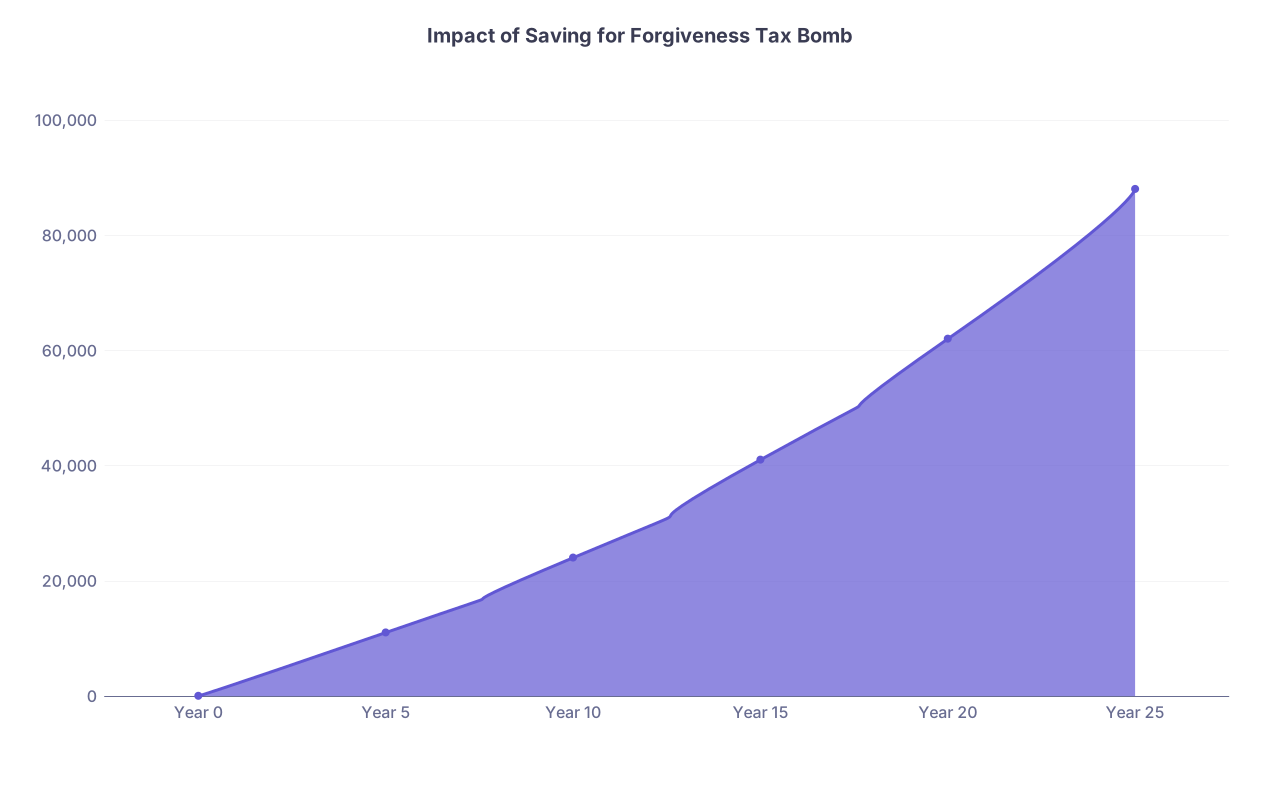
| Category | Value |
|---|---|
| Year 0 | 0 |
| Year 5 | 11000 |
| Year 10 | 24000 |
| Year 15 | 41000 |
| Year 20 | 62000 |
| Year 25 | 88000 |
4. Raise retirement contributions every time your income jumps.
You get a raise, a promotion, or finish training? Before you inflate your lifestyle, bump your retirement percentage:
- From 5% → 8% → 10% → 15%+ over a few years
Don’t wait to “feel ready.” You’re never going to feel ready.
5. Recheck your plan every 1–2 years, not every 1–2 months.
Looking weekly at your loan balance is a recipe for misery. Tracking your plan annually is how you stay on track.
Once a year:
- Confirm PSLF/IDR paperwork
- Check retirement balance and contribution rate
- Recalculate projections briefly
Then go back to living your life.
What If I’m Already “Behind”?
You might be reading this at 40, 45, 50, thinking, “Cool, but I already blew the first decade.”
Alright. Then your job is not to punish yourself. It’s to triage.
If you’re 45 with:
- $100–200k left in loans
- Retirement in the low five figures
You can still:
- Max retirement accounts (401(k) + IRA, maybe backdoor Roth, maybe HSA)
- Put loans on an affordable plan (IDR or refinanced if safe) and steadily pay without letting them dictate your every move
- Reduce lifestyle creep hard for 5–10 years to redirect as much as possible into retirement
Will you have a $4M portfolio at 65? Probably not. Can you still get to $800k–$1.5M depending on income and discipline? Yes. That’s not nothing. That’s the difference between drowning and treading water with support.
The Bottom Line: Do Loans “Eat” Retirement?
They can. If you:
- Never invest because you’re “waiting until loans are gone”
- Don’t understand or plan for your repayment path
- Ignore the tax consequences of forgiveness
- Let shame dictate your decisions instead of math
But having large loans does not automatically mean you won’t retire.
Three key points, stripped down:
Time in the market beats debt perfection. Even small retirement contributions started now are a better defense than waiting for a perfect loan moment that never comes.
Your repayment strategy matters more than your balance. IDR, PSLF, or aggressive payoff can all work—if they’re chosen intentionally and paired with ongoing investing and, if needed, tax-bomb planning.
You’re not as doomed as your 2 a.m. brain says. The “loans will eat my whole retirement” story usually translates to “I haven’t coordinated a real plan yet.” Get the plan. The anxiety drops the second the numbers actually line up on paper.


