
It is 10:45 p.m. You just finished charting the last note, answered the portal messages, and finally sat down at the kitchen table with your laptop. You open your 401(k), your IRA, maybe the taxable account the advisor set up five years ago.
And your stomach drops.
The “moderate” 60/40 portfolio you thought you had? Looks more like 82/18. One fund is way bigger than the others. That “small” tech ETF you bought in 2020 is now 25% of everything. Two bond funds are tiny. One account is sitting on 30% cash.
You know it is off. You also know you do not have three spare weekends to become a financial planner.
Good. You do not need to. You need a protocol.
Below is the practical rebalancing system I use with busy physicians who have lopsided portfolios and limited bandwidth. The goal is simple:
- Get your risk exposure back in line.
- Minimize taxes and friction.
- Turn this into a once-or-twice-a-year, 90-minute job.
Step 1: Diagnose Exactly How Lopsided You Are
You cannot fix what you have not measured. So you start with a clean inventory. One time, done properly.
1.1 Pull all accounts into one view
You want every investment account:
- Employer plans: 401(k), 403(b), 457(b), profit-sharing, cash balance plan
- IRAs: traditional, rollover, Roth
- HSAs (yes, investments there count)
- Taxable brokerage accounts (joint, individual, trust)
- Old orphan accounts from prior employers
If you are still logging into five different custodians, fix that. Use:
- Your main custodian’s portfolio view (Fidelity, Vanguard, Schwab all have this).
- Or an aggregator: Personal Capital/Empower, Mint, or your custodian’s “external accounts” feature.
Do this once. It will save you hours every year thereafter.
1.2 List each holding and its category
Export or write down:
- Ticker symbol or fund name
- Account it is in
- Market value (current balance)
Then assign each holding to a basic asset class:
- U.S. stocks
- International stocks
- Bonds (U.S. and international; fine to lump)
- Alternatives (REITs, commodities, private funds, crypto — if you must)
- Cash or cash-like (money market, stable value)
If you want to be slightly more granular, split:
- U.S. stocks → Large / mid / small
- Bonds → Short / intermediate / long, or nominal vs TIPS
But do not let “perfect” slow you down. The broad buckets are enough to fix most lopsided portfolios.
1.3 Calculate your actual allocation
Either:
- Use your custodian’s allocation report (they usually show “U.S. equity, International equity, Fixed income, Cash, Other”),
- Or drop the data into a simple spreadsheet and calculate percentages for each bucket.
You want one summary line like this:
| Asset Class | Current % | Target % |
|---|---|---|
| U.S. Stocks | 68 | 45 |
| International | 12 | 15 |
| Bonds | 10 | 35 |
| Real Estate / REIT | 5 | 5 |
| Cash | 5 | 0 |
Once you can see the mismatch in one row, the problem is obvious. And solvable.
Step 2: Decide What “Balanced” Means For You (In Writing)
Most physician portfolios are lopsided because the target was vague. “Moderate”, “balanced”, “growth with income”. These are marketing phrases, not instructions.
You need a numerical target allocation. With ranges.
2.1 Pick your stock/bond split like an adult
For a working physician within 10–20 years of retirement, I see a lot of these:
- Age 35–45: 80/20 or 75/25 stock/bond
- Age 45–60: 70/30 or 60/40
- Within ~5 years of retirement: 50/50 or 60/40, maybe 55/45 if you are conservative
If you are 52, plan to retire at 62, and your current 401(k) is 85% stocks, that is not “aggressive.” That is reckless.
Make a call:
- Write: “My target is 60% stocks / 40% bonds.”
- Then split stocks: “Of the 60% stocks, 70% U.S. / 30% international.”
- That becomes: 42% U.S. stocks, 18% international, 40% bonds.
You now have a blueprint.
2.2 Define tolerances (your “rebalance bands”)
You do not want to rebalance every time the S&P moves 3%. You want guardrails.
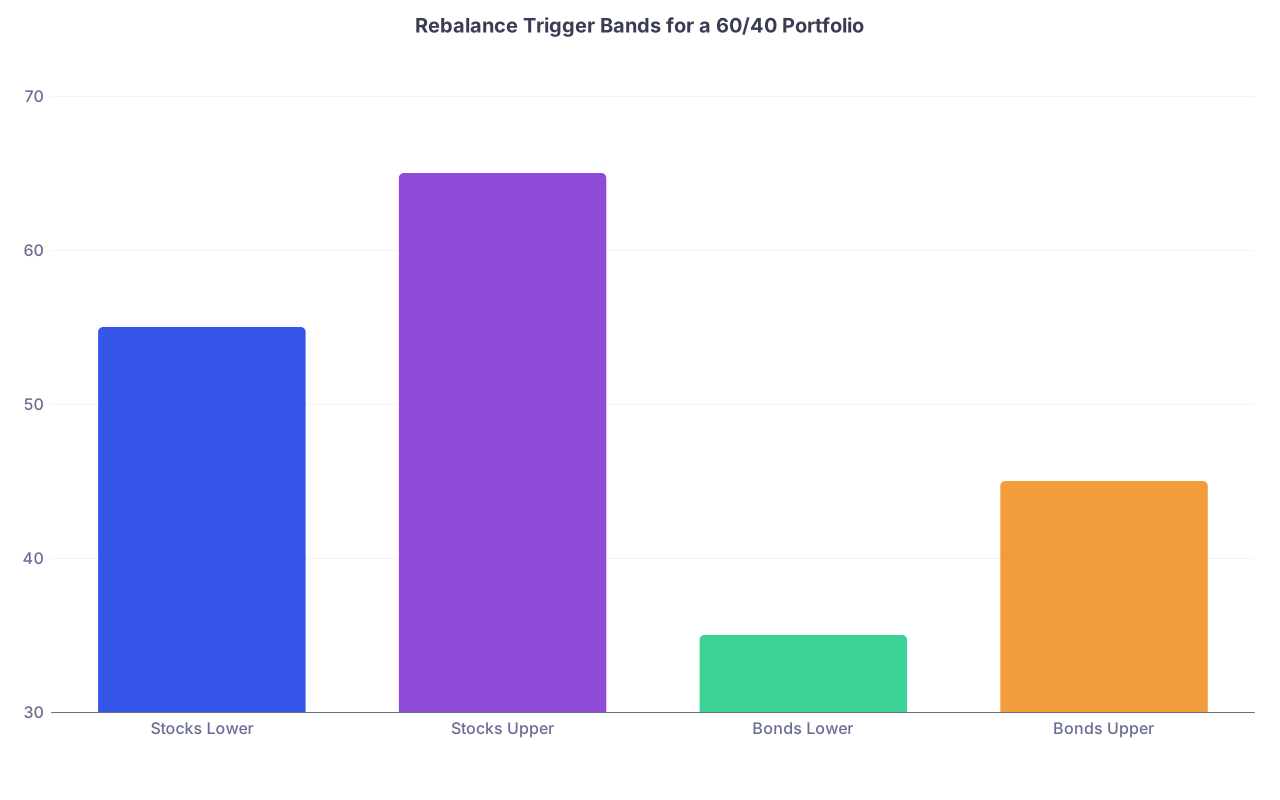
A simple, effective rule:
- ±5 percentage points for major buckets
- Example for a 60/40 portfolio:
- Stocks: rebalance if stocks go below 55% or above 65%
- Bonds: rebalance if bonds go below 35% or above 45%
This avoids constant tinkering but forces action when you are truly lopsided.
| Category | Value |
|---|---|
| Stocks Lower | 55 |
| Stocks Upper | 65 |
| Bonds Lower | 35 |
| Bonds Upper | 45 |
Write your target and bands down. In a note file, in your IPS (Investment Policy Statement), wherever. If it is not written, it will drift.
Step 3: Assign Roles To Accounts (Tax-Aware Structure)
Before you start selling and buying, use the one lever most physicians ignore: which account holds which asset.
This is how you reduce taxes without doing anything fancy.
3.1 General rules of thumb for doctors
Given your typically high marginal tax rate:
- Tax-deferred accounts (401(k), 403(b), 457(b), traditional IRA)
- Best for:
- Bonds (tax-inefficient)
- REITs, high-yield funds, anything that throws off taxable income
- Best for:
- Roth accounts (Roth IRA, Roth 401(k))
- Best for:
- Highest expected growth assets (stocks, especially small-cap / value / emerging, if you use those)
- Best for:
- Taxable brokerage accounts
- Best for:
- Broad, tax-efficient stock index funds / ETFs
- Municipal bond funds (if you must hold bonds there)
- Best for:
So if your bonds are sitting mostly in taxable and your 401(k) is 90% stocks, you are bleeding unnecessary tax, year after year.
3.2 Make each account play a specific role
Example for a 52-year-old physician, target 60/40:
- 401(k): 100% bond funds until you fill your 40% bond target.
- Roth IRA: 100% stock index funds.
- Taxable account: Mostly stock index ETFs; only use bonds if you have filled all tax-advantaged space.
In practice, you might not get to 100% purity in each account due to constraints (limited 401(k) options, etc.), but this is the direction you push.
Step 4: Use New Money First (The Cleanest Fix)
Before selling anything, look at your forward cash flows. You probably:
- Contribute monthly or per-paycheck to 401(k)/403(b)/457(b)
- Contribute annually or monthly to backdoor Roths
- Add periodic lump sums to taxable accounts (bonuses, moonlighting, etc.)
Rebalancing using these contributions is the lowest-friction, lowest-tax move.
4.1 Redirect contributions to the underweight side
Example: You are at 75/25 in a 60/40 target. Portfolio is $1,000,000.
- Target stocks: $600,000
- Target bonds: $400,000
- Current stocks: $750,000
- Current bonds: $250,000
You are off by:
- Stocks: +$150,000 above target
- Bonds: –$150,000 below target
Instead of immediately selling $150,000 of stocks, see what new contributions can do over 6–12 months.
If you are adding:
- $66,000/year to 401(k)/403(b)/457(b)
- $13,000/year to two Roth IRAs
- $30,000/year to taxable
That is $109,000 per year in new money.
Protocol:
- Direct all 401(k)/403(b)/457(b) contributions to bond funds until your bond percentage catches up.
- Direct Roth and taxable contributions to stocks (if your overall stock percentage will not exceed the upper band).
You will not fix a severe imbalance overnight with new money alone, but you may significantly reduce how much you have to sell.
Step 5: When You Must Sell – A Stepwise Rebalancing Protocol
Sometimes the portfolio is so distorted or the balances so large that you cannot fix it quickly with contributions. Then you rebalance directly.
You do this in a specific order:
5.1 Prioritize where you rebalance
Order of preference for making trades:
Tax-deferred accounts (401(k), 403(b), 457(b), traditional IRA)
- Selling here has no immediate tax consequence.
- Ideal for most rebalancing trades.
Roth accounts
- Also no current tax, but I treat these as “precious” growth space. Rebalance here if needed, but prefer step 1 first.
Taxable accounts
- Last resort, because this can trigger capital gains.
5.2 A practical workflow
Let us stick with the $1,000,000 portfolio example, target 60/40, currently 80/20.
Check tax-deferred accounts first
- Suppose you have $600,000 in 401(k)/403(b)/traditional IRAs, 90% stocks / 10% bonds.
- You can usually fix a lot just by:
- Selling stock funds inside those accounts.
- Buying bond funds within the same accounts.
Calculate how much to sell
- You want total bonds at $400,000.
- Current bonds: $200,000 (20% of $1,000,000).
- Need: +$200,000 in bonds.
If tax-deferred accounts hold $600,000 total and only $60,000 is in bonds, you could:
- Sell $140,000 of stock funds inside tax-deferred.
- Buy $140,000 of bond funds.
Now bonds = $340,000. Stocks = $660,000. You are at 66/34. Close enough for phase 1.
Use upcoming contributions to close the remaining gap
- Over the next 6–12 months, steer new money toward bonds until you hit ~40%.
If even after maxing out tax-deferred rebalancing you are still extremely off, then look at taxable.
Step 6: Minimizing Tax Pain in Taxable Accounts
If your lopsided portfolio lives mostly in a big taxable account, you have to be more surgical. The goal: fix risk exposure while kicking the tax bill as far down the road as reasonably possible.
6.1 Get your cost basis and unrealized gains
In your taxable account, pull:
- For each position:
- Current value
- Unrealized gain/loss (short vs long term)
- Cost basis
You are looking for:
- Positions with losses → these are your best friends for rebalancing.
- Positions with small gains → potential candidates.
- Positions with huge embedded gains → handle carefully, maybe over multiple years.
6.2 A tax-aware sell order
When you need to cut stocks and add bonds in taxable:
Harvest losses first
- Sell losing stock positions.
- Immediately buy a similar but not substantially identical stock fund (to avoid a wash sale) if you want to maintain general stock exposure while moving bonds elsewhere.
- Or do not replace them if you are also buying bonds in another account to keep net risk where you want it.
Then trim low-gain winners
- Sell partial positions in funds with smaller long-term gains.
- Aim to stay within your annual capital gains comfort threshold. That number depends on your tax bracket, but many high earners will intentionally realize a modest, controlled amount each year rather than one big hit later.
Avoid triggering large short-term gains
- Short-term gains (held less than one year) are taxed at ordinary income rates. Avoid unless necessary.
Offset gains where possible
- If you have $20,000 in realized losses and $35,000 of realized gains, only $15,000 of gains remain taxable.
- Up to $3,000 of net capital loss can offset ordinary income each year; the rest carries forward.
6.3 Use asset-location to your advantage
Sometimes you do not need to buy the bonds in taxable at all:
- Sell stocks in taxable.
- Use the proceeds to buy a tax-efficient total market stock ETF.
- Simultaneously, inside your 401(k) or IRA, sell equivalent stock funds and buy bonds.
Net effect: your overall stock/bond ratio changes, but you have not increased your taxable bond exposure.
This “exchange across accounts” is one of the cleanest ways to rebalance for busy doctors.
Step 7: Automate As Much As You Can
You are not going to manually calculate percentages every month for the next 25 years. Nor should you. Build an automation layer.
7.1 Turn on automatic contributions with proper allocation
For each account:
401(k)/403(b)/457(b):
- Set default contribution allocation to match your current need, not your original guess on HR day one.
- Example: If you are light on bonds now, set new contributions to 100% bond fund until further notice.
IRA / Roth IRA:
- Set an automatic investment into a specific index fund or ETF on a fixed day each month or quarter.
Taxable:
- Automate monthly transfers from your checking and pre-select what those dollars buy.
7.2 Use target-date or balanced funds selectively
If you genuinely will never look at this again (not ideal), a single-asset-allocation fund (like Vanguard LifeStrategy Moderate Growth, or a target-date fund) within one account can simplify life.
But there are two big caveats:
- Target-date funds in taxable accounts can be tax-inefficient.
- Using them across multiple accounts makes tax-aware rebalancing almost impossible.
If you want simplicity:
- You can use a single balanced fund in each tax-deferred account.
- Then use pure stock ETFs in taxable.
- But recognize you are giving up some optimization for simplicity. That is a fair trade if it keeps you from doing something dumb.
Step 8: Set a Rebalancing Schedule You Will Stick To
The best protocol is useless if it is never applied. You want a schedule and a trigger rule.

| Step | Description |
|---|---|
| Step 1 | Set calendar reminder |
| Step 2 | Pull total portfolio view |
| Step 3 | Do nothing |
| Step 4 | Use new contributions to adjust |
| Step 5 | Rebalance in tax deferred |
| Step 6 | Update IPS notes |
| Step 7 | Tax aware trades in taxable |
| Step 8 | Within bands? |
| Step 9 | Still off target? |
| Step 10 | Still off target? |
8.1 Time-based vs threshold-based
You will use both:
Time-based:
- Once or twice a year (e.g., first weekend in January, and optionally around your birthday or mid-year).
- This is your “full review” day.
Threshold-based:
- Only rebalance if any major bucket (stocks, bonds) is outside its band (e.g., stocks above 65% or below 55% in a 60/40 target).
This combo means:
- You are not glued to market headlines.
- You remove emotion from the decision.
- You rebalance when it matters, not constantly.
8.2 A 90-minute annual checklist
Once a year:
- Log into your main custodian’s consolidated view.
- Confirm current allocation vs target.
- Check whether you hit rebalance bands.
- Adjust 401(k)/403(b)/457(b) contribution allocations if needed.
- If outside bands:
- Rebalance inside tax-deferred accounts first.
- If still off and taxable is huge: plan a controlled, tax-aware rebalance there.
- Update a simple one-page IPS note with:
- Current allocation.
- Trades made.
- Any target changes (rare).
You are done. Back to your life.
Step 9: Special Cases Physicians Actually Run Into
9.1 The single-stock or concentrated-position problem
I have seen this more often than I like:
- Massive position in your employer’s stock.
- Huge gain in one tech stock or sector ETF from a hot tip.
The rule here is blunt: if a single stock or sector is >10% of your liquid net worth, you are taking uncompensated risk.
Protocol:
- Set a formal de-risking schedule over 2–5 years.
- Each year, sell a portion (enough to stay under a pre-set cap, say 5–10% of your portfolio).
- Use proceeds to buy diversified index funds, preferably in a tax-aware manner (offset with losses where you can).
Yes, you might regret selling if it goes to the moon. You will regret not selling if it blows up three months before you plan to retire.
9.2 The near-retirement shift
If you are within 5–10 years of retirement and still heavily equity-weighted, you need a phased plan, not a panic move.
Example:
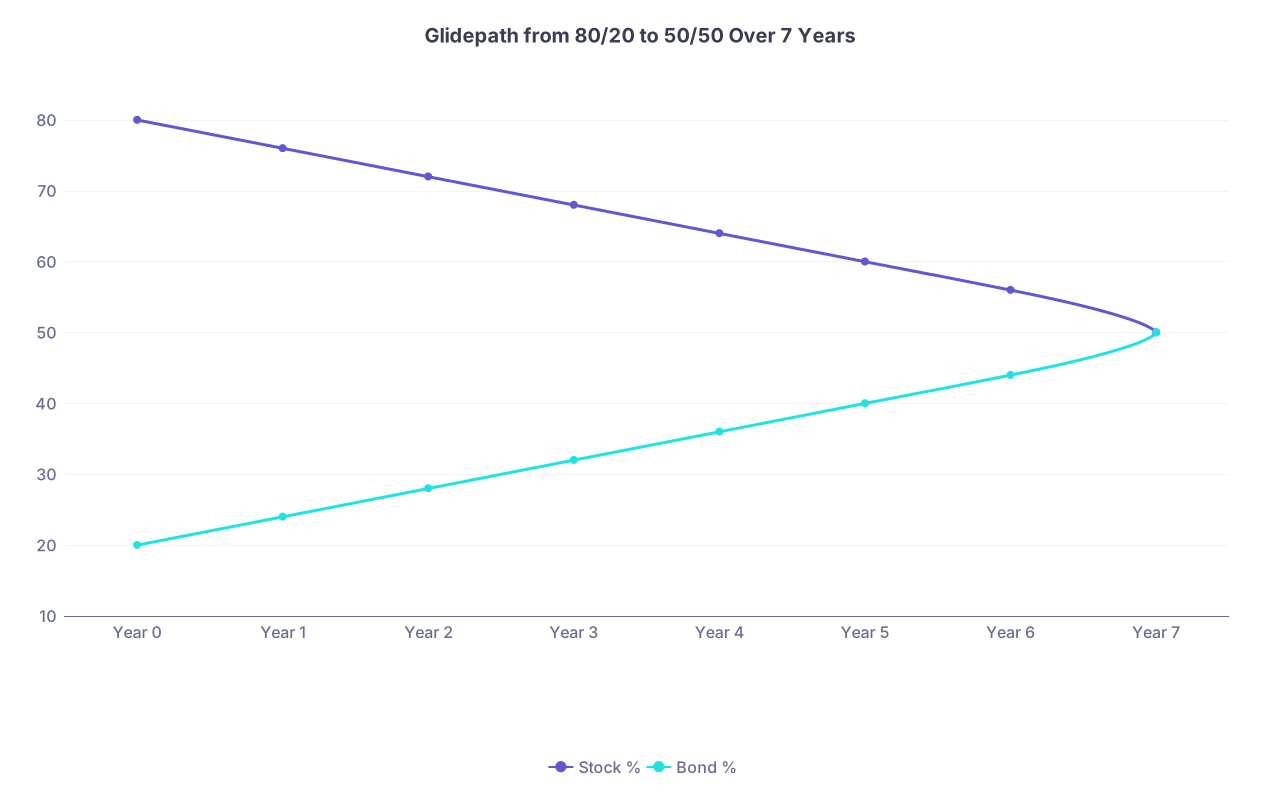
- Age 58, current 80/20, target by retirement age 65 is 50/50.
You have 7 years. That is a 30-point shift, or about 4–5 percentage points per year.
Protocol:
- Each year, deliberately move 4–5% of the total portfolio from stocks to bonds, primarily inside tax-deferred accounts.
- Coordinate this with your annual rebalancing.
- This takes you from 80/20 to 50/50 over 7 years, without a shock to the system.
| Category | Stock % | Bond % |
|---|---|---|
| Year 0 | 80 | 20 |
| Year 1 | 76 | 24 |
| Year 2 | 72 | 28 |
| Year 3 | 68 | 32 |
| Year 4 | 64 | 36 |
| Year 5 | 60 | 40 |
| Year 6 | 56 | 44 |
| Year 7 | 50 | 50 |
This is how you reduce sequence-of-returns risk without pretending you know exactly when the next crash hits.
9.3 The “set-and-ignore” temptation
Many physicians say, “I will just buy a target-date fund and forget it.”
Fine — inside one account. The problem is when:
- You have multiple target-date funds in multiple accounts, plus random index funds, plus taxable positions.
- No one knows what your true allocation is anymore.
If you hate complexity, do this instead:
- In tax-deferred: use a single balanced fund that approximates your chosen stock/bond split.
- In Roth: one or two stock index funds.
- In taxable: one or two broad stock index ETFs.
Then your entire rebalancing question is: “Do I need more or less of the balanced fund in tax-deferred?” Much cleaner.
Step 10: When To Fire or Fix Your Advisor
Sometimes the portfolio is lopsided because an advisor built it that way and then disappeared. Or because they are paid on assets and do not want you trimming their pet funds.
You are paying for a process, not for outperformance fairy dust.
If your advisor:
- Has not proactively rebalanced in years despite obvious drift.
- Cannot clearly state your target allocation and rebalancing policy in plain English.
- Loads you with expensive actively managed funds without a clear, consistent reason.
Then they are not doing the job.
Your options:
- Fix: Demand a clear written IPS with:
- Target asset allocation
- Rebalancing bands and schedule
- Tax management approach
- Fire: Move to a low-cost advisor who uses evidence-based strategies, or self-manage a simple index-fund portfolio using the protocol above.
Your retirement depends more on risk control and savings rate than on exotic products. Lopsided portfolios are a risk-control failure. You now know how to fix that.
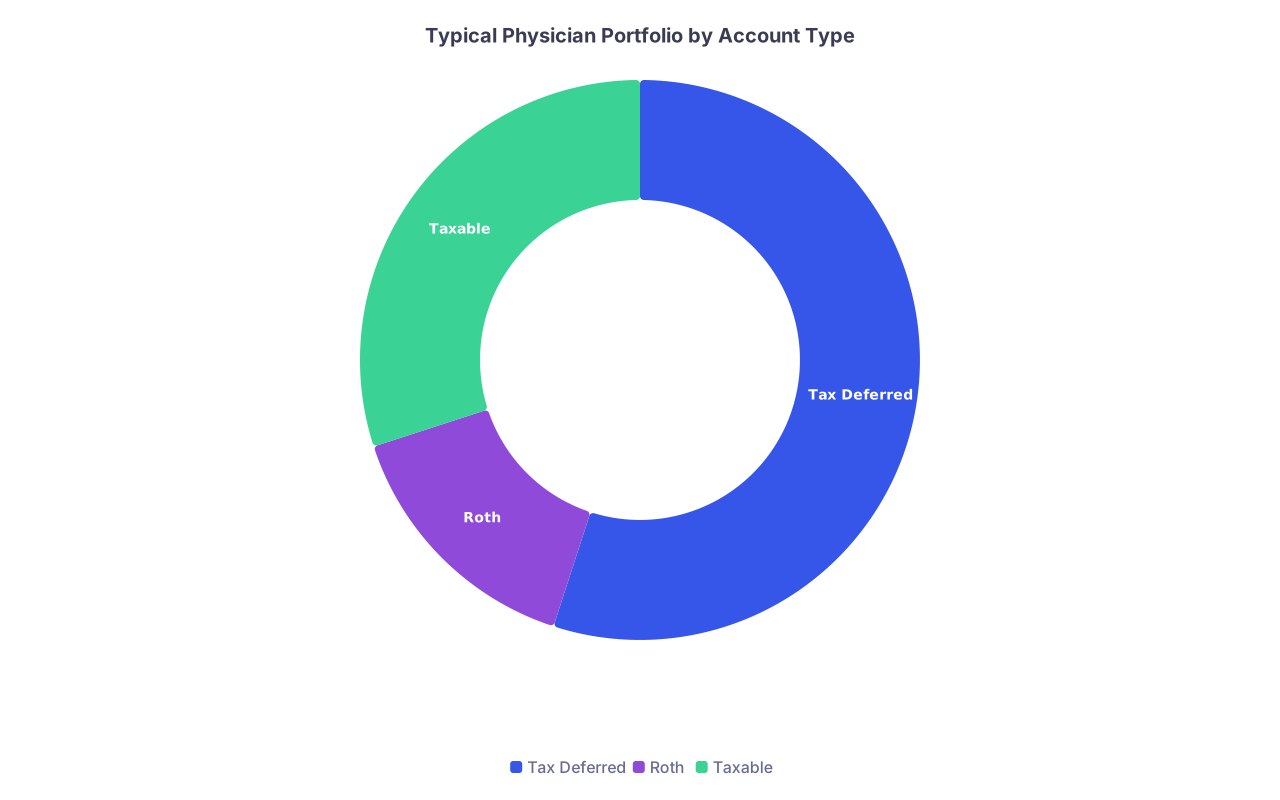
A Quick Visual: Where Your Rebalancing Firepower Lives
| Category | Value |
|---|---|
| Tax Deferred | 55 |
| Roth | 15 |
| Taxable | 30 |
For many physicians, most of the rebalancing power sits inside tax-deferred accounts (where trades are tax-free). That is where you start.
Your Next Step (Do This Tonight)
You do not need to fix everything today. But you do need to start.
Today, do exactly this:
- Log into your main custodian (Fidelity, Vanguard, Schwab, etc.).
- Pull up the “Portfolio allocation” or “Analysis” page that shows your overall breakdown: U.S. stocks, international, bonds, cash.
- Compare it to a written target. If you do not have one, write a one-line target right now: e.g., “My target is 60% stocks / 40% bonds, with 70% of stocks in U.S. and 30% in international.”
- Write down your actual numbers next to it.
If your actual numbers are outside a 5-point band from that target, block 60–90 minutes this weekend to:
- Adjust your 401(k)/403(b)/457(b) contribution allocations.
- Plan one or two trades inside tax-deferred accounts to start pulling you back toward target.
Open your portfolio view right now and look at one number: total stock percentage vs your target. If it is off by more than 5 points, you have your marching orders.