
The way most physicians save for retirement is overly complicated and quietly dangerous.
Too many accounts, random contribution levels, no coherent plan. You end up with five half-funded accounts, three old 401(k)s, and no idea what actually gets you to financial independence.
You do not need that mess.
You need three accounts, one rule, and automation. That is it.
Below is the simple 3‑account system I use and have implemented with many physicians to automate retirement saving and cut the mental load down to almost nothing.
The Core Concept: One Job per Account
Before I walk you through the mechanics, I want you to accept one core principle:
Every account must have exactly one primary job.
- Not “tax optimization plus gambling plus emergency fund.”
- One clear function. One purpose.
Here is the three‑account system, in plain English:
Account #1 – Tax‑Deferred Work Plan
Your 401(k) / 403(b) / 457(b) / PSP / cash balance: the heavy lifter.Account #2 – Roth Growth Bucket
Roth IRA (backdoor if needed) and/or Roth in your work plan: your tax‑free growth engine.Account #3 – Taxable Flex Account
A single, boring brokerage account: your flexibility and early‑retirement bridge.
Nothing exotic. No complex products. No “creative” insurance.
Just three buckets, each with a role:
- Build tax‑deferred base.
- Create tax‑free future.
- Maintain flexible access.
Step 1: Pick Your 3 Accounts (Based on Your Situation)
You likely already have at least two of these. The problem is they are uncoordinated.
We will fix that.
1. Tax‑Deferred Work Plan (Account #1)
This is almost always your largest contribution capacity.
Common forms for physicians:
- W‑2 hospital employed:
- 401(k) or 403(b)
- Sometimes an additional governmental or non‑governmental 457(b)
- Academic / big nonprofit:
- 403(b), possibly with 457(b)
- Private practice owner:
- Solo 401(k), SIMPLE IRA, or defined benefit / cash balance plan
Your main tax‑deferred account is whichever of these:
- Has the highest match or employer contribution.
- Has the lowest fees and decent index funds.
If you have more than one, you can still keep the system simple by treating them as one “Tax‑Deferred” bucket mentally. But automation happens at each employer level.
2. Roth Growth Bucket (Account #2)
This is where your highest‑growth assets should live when possible. It is your “never taxed again” bucket.
For most physicians, it is one or more of:
- Roth IRA via backdoor process (non‑deductible traditional → Roth conversion)
- Roth 401(k) / Roth 403(b) contributions inside the work plan
- Roth 457(b) in newer plans
- Occasional Roth conversions in low‑income years
If your income is above the Roth IRA direct contribution limit (it probably is), the backdoor Roth is your standard move.
3. Taxable Flex Account (Account #3)
This is simply:
- A plain taxable brokerage account in your name (or joint with spouse)
- At a major low‑cost custodian: Fidelity, Vanguard, Schwab, etc.
Its job:
- Hold extra investments once tax‑advantaged space is maxed
- Provide accessible funds for:
- Early retirement before 59½
- Big goals (home upgrade, kids’ college gap, practice buy‑in)
- Strategic tax‑loss harvesting
Do not make this account your playground. Same boring diversified funds as everywhere else.
Step 2: Decide Your Target Annual Savings Number
Automation is useless if you automate the wrong amount.
You need a target.
A physician rule‑of‑thumb I stand by:
- Starting within 5 years of training:
Aim for 20% of gross income going to retirement/investment accounts. - Starting 10+ years late (common):
Push that toward 25–30% of gross.
That includes all 3 accounts combined.
Use this as a starting point, not theology.
Example scenarios:
- Hospitalist making $300,000
- Target 20% → $60,000 per year into these 3 accounts
- Orthopedic surgeon making $650,000, starting 10 years out of fellowship
- Target 25% → about $160,000 per year
If you are already on track and have numbers from a financial plan, perfect. Use those. If not, use the percentages above and adjust.
Step 3: Assign Clear Roles + Contribution Order
Now we convert those three buckets into a specific “fill order.”
Here is the priority framework that works for most physicians:
- Get the Free Money in Account #1
- Contribute at least enough to your 401(k)/403(b) to capture the full employer match.
- Fund Your Roth Bucket (Account #2)
- Backdoor Roth IRA for you (and spouse if applicable).
- Max Out the Primary Work Plan (Account #1)
- Fill to the IRS employee limit (and beyond if there is a profit sharing or cash balance).
- Overflow into Taxable Brokerage (Account #3)
- All extra savings beyond steps 1–3 go here, automatically.
| Step | Account Type | Approx Limit / Amount |
|---|---|---|
| 1 | 401(k)/403(b) Match | Up to match % |
| 2 | Backdoor Roth IRA | $7,000 each (under 50) |
| 3 | 401(k)/403(b) Max | $23,000 employee limit |
| 4 | Taxable Brokerage | Unlimited |
Use current IRS limits; these change regularly.
Step 4: Automate Each Account – Exact Mechanics
Now we move from “concept” to actual clicks and forms.
Account #1 – Tax‑Deferred Work Plan
Your job: lock this in at the HR/payroll level. Then never touch it except once a year.
Steps:
Log into your benefits portal / HR system.
Find “Retirement Plan,” “401(k),” “403(b)” or similar.
Choose percentage of pay, not a flat dollar amount, whenever possible.
- That way, when you get a raise, your savings climbs automatically.
Set contributions based on your target:
Example: You earn $350,000 and want 20% total savings.
Possible allocation:
- Step 1: 5% to get full match.
- Step 3: Increase to ~10–12% to approach the max (depending on employer contribution and pay structure).
- The rest happens in Roth and taxable.
Pick your investment option ONCE.
If available, choose:- A broad low‑cost target date fund (e.g., Vanguard Target Retirement 2055) OR
- A simple 2–3 fund mix (e.g., US total stock index, international stock index, bond index).
Turn on automatic increase (if offered).
- For example, +1% contribution per year until you hit your target.
That is it. Your paycheck is now routing money into Account #1 every pay period.
Account #2 – Roth Growth Bucket
You have two routes here: Roth IRA and Roth inside the work plan.
Backdoor Roth IRA – Clean Protocol
If your income is too high for direct Roth IRA contributions (it likely is), do this every calendar year:
Open two accounts at a low‑cost custodian:
- Traditional IRA (non‑deductible)
- Roth IRA
Set a recurring transfer from your bank to the Traditional IRA.
- For example: $583 monthly → about $7,000 per year.
- Do this for you and spouse if you are both eligible.
Once the contribution clears (usually 1–2 days), set a recurring calendar event:
- “Convert Traditional → Roth” once per month or once per quarter.
- You log in, convert the full traditional IRA balance to Roth.
- Invest in the same kind of low‑cost index funds or target date.
To avoid tax headaches:
- Keep no pre‑tax money in any traditional IRA, SEP IRA, or SIMPLE IRA if you are using the backdoor Roth (pro‑rata rule).
- If you already have those, consider rolling them into your 401(k)/403(b) if allowed.
You can semi‑automate this with reminders. The contribution can be fully automated; the conversion usually requires a few clicks.
Roth in the Work Plan
If your employer plan offers Roth 401(k)/403(b):
- Decide your split:
- High‑earning physician, high current tax bracket → lean more to traditional.
- Early‑career, lower bracket, or planning big Roth conversions later → more Roth.
Practical default many attendings use:
- 70–100% traditional, 0–30% Roth in the work plan.
- 100% of separate Roth IRA set is tax‑free growth.
You can change the split yearly as taxes or income change.
Step 5: Open and Automate the Taxable Flex Account
This is where most physicians drop the ball. They stop once the 401(k) is full.
If you want genuine financial independence and earlier retirement options, this third bucket is non‑negotiable.
Here is the simple build:
Open a taxable brokerage account at:
- Vanguard, Fidelity, or Schwab (pick one and stop shopping).
Link your primary checking account.
Set a recurring monthly transfer.
For example:
- You decided $80,000 yearly savings is your goal.
- $40,000 flows to work plans.
- $14,000 to Roth IRAs (you + spouse).
- Remaining $26,000 → about $2,200 per month into taxable.
Turn on automatic investment:
- Direct each recurring deposit into 1–3 index funds:
- US Total Stock Market
- International Stock Market
- Maybe a bond fund if you want some ballast.
- Direct each recurring deposit into 1–3 index funds:
Enable dividend and capital gain distributions to reinvest automatically.
You now have a third stream of automated investing that does not rely on your willpower each month.
Step 6: Align Asset Allocation Across the 3 Accounts
Three accounts. One unified investment plan.
Most physicians blow this part by treating each account separately:
- 401(k): default target date fund
- Roth: random tech stocks
- Taxable: whatever the advisor put them in
You need a single target allocation. Then you implement that across all accounts.
Pick a Simple Allocation
Reasonable starting points:
- Age 30s–40s, not extremely risk‑averse:
- 80–90% stocks / 10–20% bonds
- Age 50s–early 60s:
- 60–75% stocks / 25–40% bonds
Then split stocks roughly:
- 60–70% US
- 30–40% International
Example master allocation:
- 70% US stock index
- 20% International stock index
- 10% Bond index
Place Assets Intentionally
General approach that works well:
- Roth (Account #2):
Highest growth potential holdings (mostly stocks). - Tax‑Deferred (Account #1):
Mix of stocks and your bond allocation. - Taxable (Account #3):
Tax‑efficient stock index funds; minimal bonds unless you use tax‑exempt bonds.
Example implementation:
- Roth IRA:
- 100% US Total Stock Market
- 401(k)/403(b):
- 60% US Stock Index
- 25% International Index
- 15% Total Bond Index
- Taxable:
- 70% US Total Stock Market
- 30% International Index (preferably tax‑efficient ETFs)
The details can vary; the principle is consistent:
- Treat all accounts as one portfolio.
- Optimize what goes where for tax efficiency.
Step 7: Build the Automation Calendar
Your goal is to reduce active “money thinking” to a couple of intentional sessions per year.
Here is the framework.
Monthly (Automated by Default)
You set these once, then they run:
- Paycheck deferral into 401(k)/403(b)/457(b).
- Bank → Traditional IRA contribution (for backdoor Roth).
- Bank → Taxable brokerage transfer.
- Automatic investment inside each account.
You do not manually move money month to month. The system does.
Quarterly (15–30 Minutes)
You do a quick tactical check:
- Perform backdoor Roth conversions if you batch them.
- Glance at 401(k) to confirm contributions are landing as expected.
- Check that taxable contributions are investing as directed.
- Skim for weird fees or accidental cash buildup.
Annually (60–90 Minutes)
This is your intentional “money summit” with yourself (and spouse if applicable):
- Update income and savings target:
- Did income change materially?
- Do we increase savings rate by 1–2%?
- Confirm contribution rates:
- Adjust 401(k) / 403(b) percentages as needed.
- Update automatic transfers to Roth IRA and taxable.
- Rebalance across all 3 accounts:
- Use new contributions and fund exchanges to get back to your target allocation.
- Reassess Roth vs traditional allocation in your work plan.
- Check for tax‑planning opportunities (Roth conversions in low‑income years, tax‑loss harvesting in taxable).
To make this real: put an actual recurring event on your calendar called “Annual Money Check‑up.”
Step 8: How This System Adapts Across Career Phases
The beauty of the 3‑account system is that you do not have to reinvent the wheel every time your job or life changes. You just adjust contributions within the same structure.
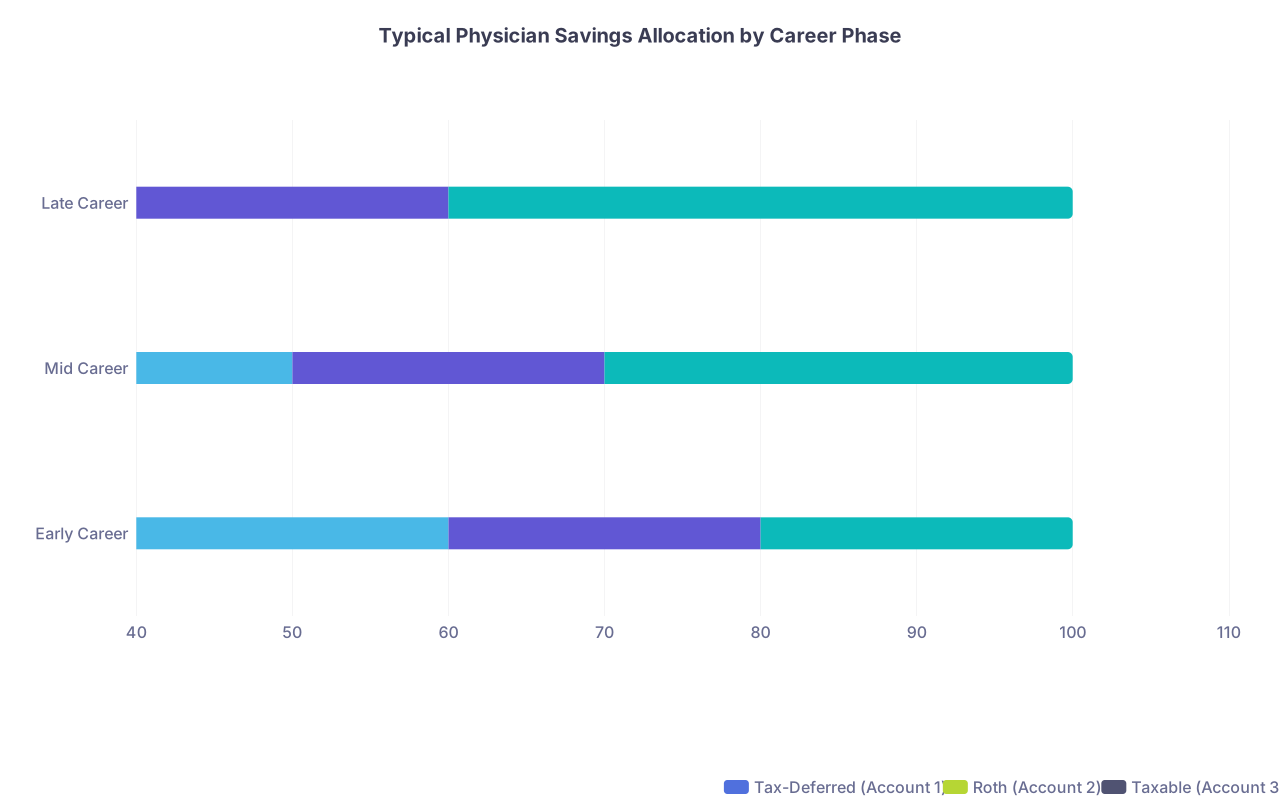
| Category | Tax-Deferred (Account 1) | Roth (Account 2) | Taxable (Account 3) |
|---|---|---|---|
| Early Career | 60 | 20 | 20 |
| Mid Career | 50 | 20 | 30 |
| Late Career | 40 | 20 | 40 |
Early Career (0–5 Years Out of Training)
- High student loans, maybe lower attending income.
- Strategy:
- Still hit 401(k)/403(b) match.
- Still do backdoor Roth IRAs.
- Taxable can start small or even at zero while you prioritize debt.
- Automatons:
- Focus on getting the habit of percent of income into retirement plans.
Mid Career (5–20 Years Out)
- Income peaks, lifestyle expands, kids appear.
- This is when many physicians either become wealthy or quietly fall behind.
Strategy:
- Maintain or increase 20–25% gross savings rate.
- Max out work plans + Roths consistently.
- Taxable brokerage grows into a serious second pillar.
This is also the window where defined benefit / cash balance plans can make sense for practice owners. Those still count as Account #1 – Tax‑Deferred, just with bigger numbers.
Late Career / Pre‑Retirement
- You may start shifting savings toward more taxable and less Roth if you have huge tax‑deferred balances.
Adjustments:
- Slightly increase bond allocation.
- Consider partial Roth conversions if in a temporarily lower bracket (sabbatical, part‑time work, year between jobs).
- Use taxable account as the bridge if planning to retire before 59½.
The structure does not change. Contributions and asset mix do.
Step 9: Common Pitfalls This 3‑Account System Prevents
I have seen the same mistakes sabotage physicians over and over. This system is designed specifically to block them.
Pitfall 1: Too Many Random Accounts
Old 401(k)s all over the place. Taxable accounts opened to chase some “deal.” Five IRAs at different brokers.
Fix:
Consolidate old 401(k)s into:
- Your current 401(k)/403(b), if low‑cost, or
- A single rollover IRA (if you are not using backdoor Roth), or
- Carefully into current plan to keep IRA space clear.
Close stray taxable accounts and IRAs at random firms. Three accounts. One custodian if possible.
Pitfall 2: Emotional, Episodic Investing
Investing only when you get a bonus. Trying to time the market. Dumping cash in during bull markets, hiding during panics.
Fix:
- Automation at the payroll and bank level.
- Same date every month, money moves, markets up or down.
- You rebalance once a year, not every time CNBC screams.
Pitfall 3: Tax‑Inefficient Chaos
High‑yield bond funds in taxable accounts. Constant churning. No awareness of how distributions are taxed.
Fix:
- Explicit asset placement rules:
- Bonds mostly in tax‑deferred.
- Tax‑efficient stock funds in taxable.
- Highest growth assets in Roth.
Pitfall 4: No Early Retirement Flexibility
All money locked up in 401(k)/IRA until 59½. Physician wants to cut back at 52, but cannot.
Fix:
- Regular funding of taxable brokerage (Account #3).
- That becomes the “bridge money” for age 50–59½.
- And a safety valve for career changes, burnout breaks, or practice buy‑in.
Step 10: Example Setup – Numbers on Paper
Let me make this concrete with a realistic attending scenario.
Profile:
- 40‑year‑old cardiologist
- Income: $600,000 W‑2
- Hospital 403(b) with 4% match
- Wants to retire around 60, possibly downshift at 55
- No serious savings plan yet
Target:
- 25% of gross → $150,000 per year into the 3‑account system
Implementation in 12 Months:
Account #1 – 403(b) (Tax‑Deferred)
- Set contribution to 12% of pay (~$72,000; employee limit is $23,000 but there may be employer/non‑elective).
- Confirm at least 4% to capture full match.
- Choose 80/20 target‑date fund or simple index mix.
Account #2 – Roth
- Backdoor Roth IRA:
- $7,000 for physician + $7,000 for spouse = $14,000 per year.
- $583/month auto transfer into Traditional IRAs.
- Quarterly diary reminder to convert to Roth.
- Optional: Leave 403(b) contributions as pre‑tax for now given high bracket.
- Backdoor Roth IRA:
Account #3 – Taxable Brokerage
- Remaining target: $150,000 − 72,000 − 14,000 = $64,000.
- Set automatic transfer: ~$5,350/month from checking → brokerage.
- Auto‑invest:
- 70% US stock index
- 30% international index
Total: $150,000/year, fully automated except a few Roth clicks per quarter and annual rebalance.
Visual: Simple Flow of Money

| Step | Description |
|---|---|
| Step 1 | Paycheck |
| Step 2 | 401k 403b Contributions |
| Step 3 | Checking Account |
| Step 4 | Traditional IRA for Backdoor |
| Step 5 | Roth IRA |
| Step 6 | Taxable Brokerage |
| Step 7 | Tax Deferred Bucket |
| Step 8 | Roth Growth Bucket |
| Step 9 | Taxable Flex Bucket |
You do not need anything beyond this structure to build a serious retirement plan.
When to Get Help (And What Kind)
You may be able to set this up alone in a weekend. Many physicians can.
If you want professional help, make it targeted:
- Fee‑only fiduciary advisor
- Paid hourly or flat fee, not by selling products.
- Task them with:
- Designing your asset allocation.
- Confirming your contribution level hits your retirement needs.
- Reviewing tax implications (backdoor Roth, 457(b) quirks, non‑governmental plans).
This system simplifies the advisory relationship too. Instead of their “proprietary strategy,” you bring a clear, understandable framework. They help refine, not overcomplicate.
Your One Action for Today
Do not try to fix everything at once. You probably will not.
Do this instead:
Log into your main employer retirement plan portal today and change ONE setting: set your contribution as a percentage of income high enough to at least capture the full match.
Once that is in place, schedule a 60‑minute block this weekend called “Set Up 3‑Account System.” In that block you will:
- Open/confirm your Roth IRA and taxable brokerage.
- Set the recurring transfers.
- Pick a simple 2–3 fund allocation.
That is how real progress happens. One decisive change, then automation does the rest.