
It is 10:30 p.m. You just finished a long call day, you are still in half-wrinkled scrubs, and your bank app shows about $1,300 until next payday.
ERAS loans: $260,000.
Hospital 403(b): email from HR saying, “Don’t miss out on your retirement match!”
You are staring at two buttons:
- “Make extra payment on loans”
- “Increase retirement contribution”
You know you cannot max everything. You want to “be smart,” but every blog, attending, and TikTok finance guru seems to say something different.
Let’s fix that.
What you need is a simple, clear decision process for a resident salary:
- How much to put toward retirement.
- How much to throw at loans.
- In what order.
- And how to adapt if your situation is different (PSLF vs private loans, married vs single, etc.).
I am going to walk you through a practical framework I use with residents: step‑by‑step, with explicit priorities. You will not agree with every value judgment I make. That is fine. But you will walk away with a clear plan that actually works on a PGY‑2 paycheck.
Step 1: Lock Down Your Baseline (Numbers, Not Vibes)
Do not talk about “aggressive loan payoff” or “early retirement” until you have hard numbers on the table.
You need five specific pieces of data:
Your loans – broken down, not lumped
- Federal vs private
- Each loan’s:
- Balance
- Interest rate
- Type (Direct Unsubsidized, Grad PLUS, private refinance, etc.)
- Whether you are:
- In REPAYE/SAVE, PAYE, IBR, or standard
- Pursuing PSLF or not
Your resident salary and take-home pay
- Monthly gross (e.g., $62–$75k/year depending on region and PGY)
- Monthly net (after taxes, health insurance, basic retirement, etc.)
-
- 401(k) or 403(b)?
- Do they offer a match? If yes:
- What percentage of salary?
- Is it immediate or after one year?
- Any 457(b) plan? (Many residents do not have this. If you do, it is a bonus tool.)
Your required minimum loan payment
- Under income-driven repayment (IDR), what is your actual monthly payment?
- Under standard, what is the scheduled payment?
Your spouse’s situation (if applicable)
- Income (and whether they are in training or attending already)
- Their loans and retirement accounts
- How you are filing taxes (or planning to): married filing jointly vs separately
If you do not have this in one place, that is step zero: build a basic one-page summary.
| Item | Example Value |
|---|---|
| Annual Gross Salary | $70,000 |
| Monthly Take-Home Pay | $4,200 |
| Federal Loans Total | $240,000 @ 6.5% |
| Private Loans Total | $40,000 @ 9.0% |
| IDR Monthly Payment | $320 (SAVE plan) |
| 403(b) Match | 4% of salary, dollar-for-dollar |
Get this done. If you skip it, everything else is guesswork.
Step 2: Sort Yourself into a Category – PSLF Track vs Non‑PSLF
Your loan strategy as a resident hinges on one question:
Are you realistically on track for Public Service Loan Forgiveness (PSLF)?
You are on a viable PSLF track if:
- You have federal Direct loans (or can consolidate them into Direct), and
- You are at a nonprofit or government hospital (most academic centers), and
- You are making qualifying payments under a PSLF-eligible plan (SAVE, PAYE, IBR, etc.), and
- You are likely to work for a nonprofit/government employer for a total of 10 years (residency + fellowship + early attending years).
If you are PSLF-bound:
- Your goal is not “pay these loans off.”
- Your goal is “maximize forgiveness while minimizing cash outflow and taxable income.”
If you are not PSLF-bound:
- You either:
- Plan to refinance and pay them off yourself, or
- Already have private loans and no federal forgiveness path.
You have to be honest about this. Not “maybe one day I’ll consider academics.” Commit to the likeliest path.
Step 3: Non‑Negotiables Before You Prioritize Anything
Before obsessing over loans vs retirement investing, three basics come first. Every time. I do not negotiate these.
Emergency buffer – at least $1,000–$3,000 quickly, then 1–3 months expenses, over time
- You will have random expenses: board fees, car repairs, moving.
- “I’ll just use credit cards” is not a plan. That is an interest-rate time bomb.
- Goal as a resident: at least 1 month of bare-bones expenses; 3 months is ideal but may take a few years.
Minimum required payments on all loans
- You never sacrifice minimum payments to invest. That is how you wreck your credit and add fees.
High-interest toxic debt first (non-student-loan)
- Any credit card debt over ~10–12% APR:
- That gets attacked before extra retirement contributions and before extra student loan payments.
- Why? Because no safe investment reliably pays you 18–24% like credit cards charge.
- Any credit card debt over ~10–12% APR:
Once those are under control, we can actually talk about prioritizing extra dollars.
Step 4: Understand the Real Tradeoff – Interest Rate vs Expected Return
Resident salary is tight. So every extra $100 must pull its weight.
You are comparing two uses of a dollar:
- Paying debt: Guaranteed “return” equal to the interest rate.
- Investing: Probabilistic return, historically ~7–10% per year in US stock markets, before inflation.
So:
- Paying off a 9% private loan is very likely a better financial move than investing in a standard 403(b) with no match.
- Paying off a 3% federal loan aggressively while ignoring:
- A 4% employer match and
- The tax deduction from retirement contributions
is usually a mistake.
One more piece: time.
Money invested in your 20s has decades to compound. Money you throw at loans in residency does not compound for you; it just reduces a balance.
So the rules of thumb I use:
Employer match = mandatory
If your program offers a match, you contribute at least enough to get 100% of that free money. The 100% instant return beats any loan payoff except extreme outliers.Very high-rate loans (>8–9%) deserve priority
Those behave like credit card debt. Pay them down aggressively unless PSLF is clearly in play.Moderate federal loans (5–7%) vs investing
This is where tax rules and PSLF status matter. You cannot make blanket statements. I will spell out specific structures below.
Step 5: If You Are PSLF-Bound – Your Playbook
If you are realistically going for PSLF, here is the hierarchy that makes sense for most residents.
5.1 Core Idea
You will not be paying your principal in full. The government will, after 120 qualifying payments.
Your job is to:
- Minimize the total you personally pay, and
- Maximize the amount that gets forgiven.
That means:
- Keep your IDR payment as low as legally allowed, and
- Do not throw extra money at those PSLF-eligible loans as a resident.
Here is how to do it properly.
5.2 Specific Steps for PSLF Residents
Consolidate and choose the right plan (often SAVE)
- Consolidate all eligible federal loans into a Direct Consolidation Loan if they are not already Direct.
- Enroll in SAVE (or PAYE/IBR if you have a special case) as soon as possible.
- File your PSLF Employment Certification annually.
Make sure every year of training counts
- Every PGY year at a nonprofit hospital = another 12 qualifying payments.
- That includes fellowship.
Maximize pre-tax retirement contributions to lower IDR payments
- SAVE / PAYE / IBR base payments on AGI (Adjusted Gross Income).
- Contributions to:
- 403(b) / 401(k)
- Some 457(b) plans
reduce AGI. Lower AGI → lower monthly payment → more forgiven later.
- This is the one of the few times where as a resident it can make sense to push retirement contributions higher even if you feel very cash-strapped.
Investment priority stack for PSLF residents
In order:
- Emergency buffer (as above)
- Employer retirement match – contribute enough to get:
- 100% of 3–4% of salary, for example
- Maximize PSLF-optimization contributions
- Put extra into pre-tax 403(b)/401(k) and possibly 457(b)
- Reason: every pre-tax dollar:
- Lowers your current taxes
- Lowers your IDR payment
- Increases the amount forgiven at year 10
- Roth IRA (if cash flow allows and tax bracket is low)
- Many residents are in 12–22% federal tax brackets. Converting some savings into Roth now can be extremely valuable long term.
- Extra payments on high-interest private loans (if you have any)
- PSLF does not touch private loans. If you have a nasty 9–11% private med school loan floating around, that belongs near the top of your payoff list.
What you do not do as a PSLF resident:
- Make extra principal payments on PSLF-eligible federal loans. That is lighting future forgiveness on fire.
5.3 Quick PSLF Scenario Example
- PGY‑2 IM resident at a 501(c)(3) hospital
- Salary: $65,000
- Loans: $250,000 all federal, at ~6%, in SAVE, PSLF-eligible
- Employer 403(b) match: 3% of salary
What I would tell this resident to do:
- Build a $2–3k emergency fund.
- Contribute 3% to get the full match. Non-negotiable.
- Increase pre-tax 403(b) contributions further if possible (maybe to 8–10% total) to:
- Reduce AGI
- Cut SAVE payment
- Boost eventual forgiveness
- Do not pay extra on those loans. None.
- If they have leftover excess (unusual), consider Roth IRA.
This is how you optimize PSLF: retirement contributions become part of your loan strategy.
Step 6: If You Are Not PSLF-Bound – Your Playbook
Now the opposite case: No PSLF. Maybe you are at a for-profit hospital. Maybe you know you will join a private practice or locums early.
Now your federal loans behave like any other debt. You will pay them off, one way or another. That changes the calculus.
6.1 Core Idea
Since the debt is really yours, your extra dollars must balance:
- Getting rid of expensive interest, and
- Not completely sacrificing the power of compounding in your 20s and early 30s.
The rough framework I use:
- Secure free money and basic future security
- Attack any very high-interest loans
- Invest and pay down in parallel once the worst offenders are gone.
6.2 Step-by-Step for Non-PSLF Residents
Emergency fund and minimum payments
Same as before. You never skip this.Employer match
Again: If you have a match, take it. Do not overthink this. It is free and immediate return.Attack the ugliest debt
Break your loans into tiers:
| Tier | Type of Loan | Typical APR | Priority |
|---|---|---|---|
| 1 | Credit cards, store cards | 15–25% | Highest |
| 2 | Private refinanced student loans | 7–10%+ | Very High |
| 3 | Federal unsubsidized / Grad PLUS | 6–7.5% | High |
| 4 | Refi or loans below ~4–5% | 3–5% | Moderate |
- Clear everything in Tier 1 aggressively.
- If you have Tier 2 loans at 9–11%: throw serious extra cash at them as soon as you have the match secured.
- Decide on refinancing timing (for private or fed loans)
Typical mistake: residents refinance too early, lured by lower rates, and lose federal protections.
Rules of thumb:
- If you still have any chance of PSLF or need federal protections (forbearance, disability, IDR), do not refinance federal loans as a resident.
- If you have existing private loans at absurd rates (11–12%), refinancing to ~5–7% may still make sense even while in training, especially if:
- Your specialty is highly employable
- You have good credit and maybe a co-signer
- You understand you are giving up flexibility
- Build a parallel track once the worst is under control
Once you:
- Have the emergency fund
- Get the employer match
- Killed credit cards
- Tamed any 9–12% non-federal loans
Then you move into a dual strategy:
- Put some percent of income (often 10–15% total, including match) into retirement accounts, and
- Direct additional extra dollars to student loans, especially >5–6% rates.
6.3 A Practical Allocation Example (Non-PSLF)
You:
- Are a PGY‑3 at a for-profit hospital
- Will join a private EM group after residency
- Have:
- $180k federal loans at 6.8%
- $30k private loans at 10%
- No 403(b) match
What I would likely recommend:
- Emergency buffer: $2–3k.
- Minimum payments on all loans.
- Aggressively attack the 10% private loan:
- Every spare dollar until it is gone.
- During this phase, keep retirement contributions minimal (e.g., 3–5% of salary) to at least start compounding.
- After that 10% is dead:
- Increase retirement contributions to 10–15% (403(b) and/or Roth IRA), and
- Start sending extra payments toward the 6.8% federal loans as income allows.
- Once you become an attending:
- Reassess. With attending income, you might:
- Refinance the 6.8% loans down to 3–4%
- Decide on a 3–7 year payoff plan while maxing retirement.
- Reassess. With attending income, you might:
Step 7: Roth IRA vs 403(b)/401(k) as a Resident
You will hear a lot of noise about Roth vs traditional. Let me simplify for a resident.
7.1 General Rules
- Residents are usually in lower tax brackets than they will be as attendings.
- That means Roth contributions are very attractive: pay lower tax now, enjoy tax-free withdrawals later.
But PSLF complicates this, because pre-tax contributions lower your AGI and thus your IDR payment.
So:
PSLF-bound resident:
- Lean heavier toward pre-tax 403(b) (and 457(b) if you have it) to lower payments.
- You can still do some Roth, but the PSLF math favors pre-tax.
Non-PSLF resident:
- Often a mix is reasonable:
- Enough pre-tax to reduce taxes
- Some Roth IRA for long-term tax diversification.
- Often a mix is reasonable:
7.2 Priority Order: Where Each New Dollar Goes
For a typical resident (non-PSLF, modest loans, no insane private rates), my default order:
- Emergency fund
- Employer match (403(b)/401(k))
- Kill very high-interest debt
- Roth IRA up to annual limit (if you qualify and can afford it)
- Additional 403(b)/401(k) contributions
- Extra payments on 6–7% loans
For a PSLF-bound resident:
- Emergency fund
- Employer match
- Pre-tax 403(b)/401(k) and 457(b) to reduce AGI
- Possibly Roth IRA (if payment and cash flow still very comfortable)
- Extra payments only on private/non-PSLF loans
Step 8: How Much Should You Actually Invest as a Resident?
You will not hit the textbook personal finance rule of “15–20% of income to retirement” in most residencies. Relax. Your job is to:
- Put something intentional in place now,
- Avoid huge mistakes (like ignoring free matches or PSLF rules), and
- Be ready to scale up as an attending.
Here is a realistic scale based on cash flow:
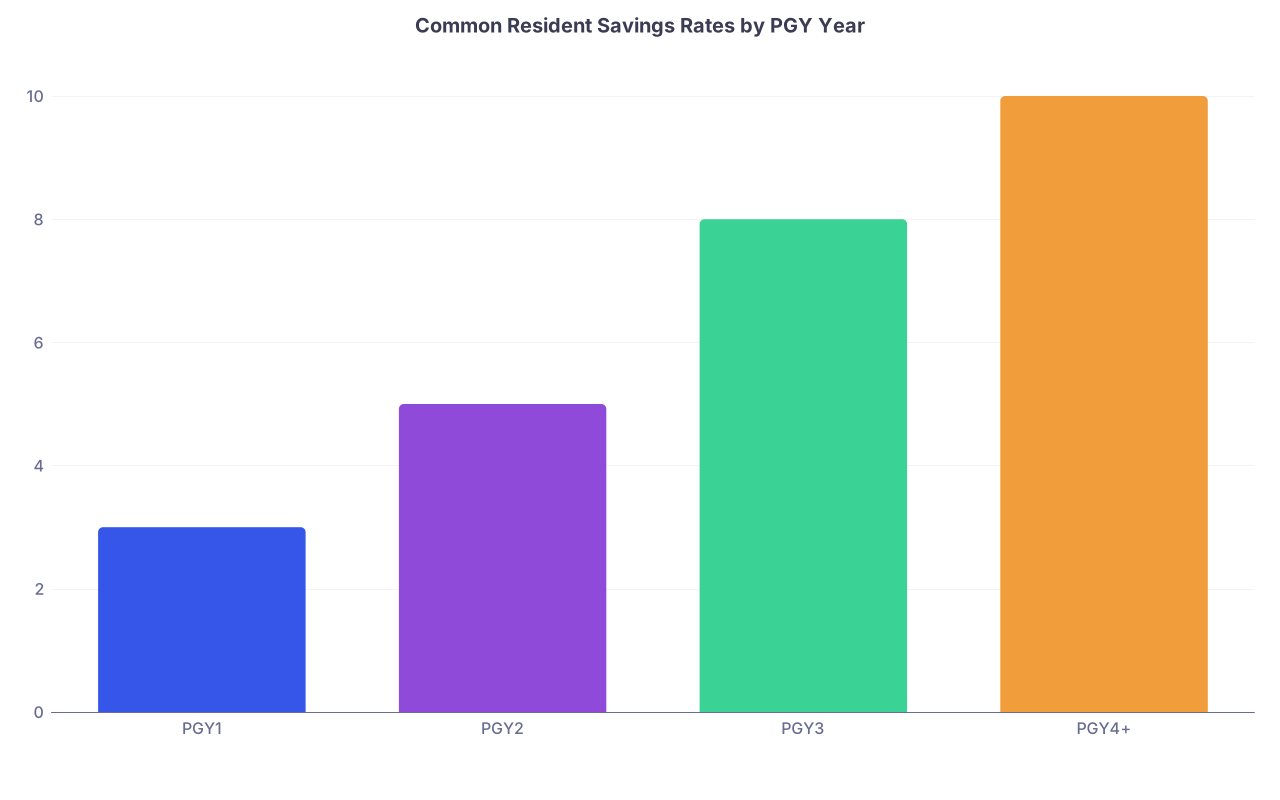
| Category | Value |
|---|---|
| PGY1 | 3 |
| PGY2 | 5 |
| PGY3 | 8 |
| PGY4+ | 10 |
This might look like:
- PGY‑1: 3% to 403(b) just to get the match (or start the habit)
- PGY‑2: 5–6% with small Roth IRA contributions
- PGY‑3+: 8–10% split between Roth IRA and 403(b)/457(b)
If you are PSLF-bound and serious about optimizing, you might push that 403(b)/457(b) up even higher, knowing it is part of your loan plan.
Step 9: Detailed Decision Flow – Loans vs Retirement
Here is a stripped-down decision path. Follow it in order.

| Step | Description |
|---|---|
| Step 1 | Resident with loans |
| Step 2 | Nonprofit employer + Direct loans |
| Step 3 | No PSLF or for-profit |
| Step 4 | Build 1-3 month emergency fund |
| Step 5 | Get employer match in 401k/403b |
| Step 6 | Pay off credit cards and >12% debt |
| Step 7 | Maximize pre-tax 403b/457 to lower IDR |
| Step 8 | Optional - Roth IRA if cash allows |
| Step 9 | No extra payments to PSLF-eligible loans |
| Step 10 | Aggressively pay >8-9% loans |
| Step 11 | Split extra - 10-15% retirement + loan payoff |
| Step 12 | PSLF path? |
| Step 13 | High interest non-student debt? |
| Step 14 | PSLF-bound? |
| Step 15 | Loans >8-9%? |
Hang that mentally above your budget.
Step 10: Edge Cases You Should Not Ignore
A few situations complicate the picture. You still use the same logic, but you tweak the execution.
10.1 Married to an Attending (or High Earner)
Your AGI may be much higher as a couple. That:
- Raises IDR payments (unless filing separately),
- Increases your tax bracket, and
- Makes Roth vs traditional decisions more nuanced.
Basic approach:
- Model both married filing jointly and separately in an IDR payment calculator.
- Consider hiring a student loan specialist for a one-time consult; the tax/IDR/PSLF combo here is easy to screw up.
- Retirement contributions (pre-tax) become more valuable in higher brackets.
10.2 Short Residency, Huge Loans, Sure About Private Practice
Example: EM resident at a for-profit hospital, $400k loans, no PSLF.
Here, I usually advise:
- Be conservative as a resident. Minimum payments, small retirement contributions.
- Do not refinance federal loans yet. You do not have the income or stability.
- Focus on:
- Match
- Basic retirement habit
- Keeping your financial life clean (no new debt, no lifestyle creep)
- Aggressive payoff plan starts once you are an attending, when a 3–5 year payoff is actually realistic.
10.3 Burnout / Disability Concerns
If you have health issues, family responsibilities, or are genuinely unsure you will practice long-term, the value of:
- Federal protections, and
- Liquidity (cash and investments vs aggressively paid-down debt)
goes up.
In that case:
- Avoid early refinancing of federal loans.
- Maintain a stronger cash buffer.
- Still take the employer match, but be cautious about over-committing to illiquid strategies.
Step 11: What a Simple Resident Plan Actually Looks Like
Let me give you a concrete baseline template and you can adjust from there.
Example: PSLF-Bound IM Resident, Year 2
- $250k federal Direct loans, 6–7%
- Nonprofit academic hospital, PSLF-eligible
- Salary: $68k
- 403(b) with 3% match
Monthly (rough):
- Take-home: ~$4,300
- Rent + utilities: $1,400
- Food + transport: $800
- Misc / phone / subscriptions: $400
- SAVE payment: $250
A clean, functional plan:
- $200/month to high-yield savings until emergency fund = $3,000, then slow to $100
- 3% salary to 403(b) for full match (~$170/month)
- Additional 5–7% pre-tax (another ~$300–400/month) to lower AGI and SAVE payment
- No extra payments toward PSLF-eligible loans
- Remainder for living expenses and modest discretionary spending
Total “retirement” contribution: ~8–10% of salary, all while optimizing PSLF.
Example: Non-PSLF Surgery Resident, Mixed Loans
- $200k federal at 6.8%
- $40k private at 10%
- For-profit hospital, no PSLF
- Salary: $70k
- 401(k) match: 4%
Monthly sketch:
- Take-home: ~$4,500
- Expenses (rent, food, transport, basics): ~$2,100
- Federal minimum payment: ~$300
- Private minimum payment: ~$250
A smart plan:
- $250/month to build a $3k emergency fund, then reduce to $100
- 4% to 401(k) to capture full match (~$230/month)
- Extra $300–500/month thrown at the 10% private loan until it is gone
- After private loan is paid off:
- Increase 401(k) contributions to 10–12% total
- Direct any additional extra toward 6.8% federal loans
You are investing and reducing debt simultaneously, but not doing the silly thing (ignoring free match or leaving 10% loans untouched).
Step 12: The Psychological Side – Avoid Dumb Extremes
I have watched residents make two classic mistakes:
“Debt purist” mentality
- They refuse to invest a single dollar until every loan is gone.
- Result: They finally start retirement contributions at 34 or 36. That lost decade of compounding costs them hundreds of thousands by age 65.
“Invest at all costs” mentality
- They love the market and max Roth IRA + 403(b)
- Meanwhile they carry 9–12% private loans for years.
- They are basically borrowing at credit card rates to invest in the S&P 500. That is not sophistication. That is leverage with a residency paycheck.
Be an adult about it.
Take the free match. Respect interest rates over 8–9%. Use the PSLF rules when they work for you.
You can absolutely:
- Grow your net worth
- Make real progress on loans
- And arrive at attending life not feeling 10 years behind.
Your Specific Next Step Today
Do not let this stay abstract.
Tonight, do this:
- Open a blank page (or spreadsheet).
- Write down:
- Total federal loans, each with interest rate
- Total private loans, each with interest rate
- Your current monthly payments and plan (SAVE, PAYE, standard, private)
- Your employer retirement plan and exact match policy
- In one sentence, answer:
“Am I realistically on a PSLF path?” Yes or no.
Once you have that, apply the relevant playbook from above:
- PSLF-bound: Prioritize match + pre-tax contributions, no extra PSLF loan payments.
- Non-PSLF: Match → kill very high-rate loans → start parallel retirement + payoff.
Then log in to your HR portal and your loan servicer and make one concrete change:
- Increase retirement contribution to capture the full match, or
- Increase payment on that 10% private loan by even $50–100/month, or
- Switch into SAVE / file PSLF certification if you have been procrastinating.
One change. Today.
The residents who fix this early do not magically earn more. They just stop guessing and start using a system.