
The way most physicians “plan” retirement in their last year of practice is dangerously lazy. You cannot wing the transition from attending to retired and expect it to go well.
You have 12 months. That is enough time to set up a clean, tax‑efficient, legally safe exit. If you treat it like another consult and follow a protocol.
Below is that protocol.
The Big Picture: Your 12‑Month Retirement Objective
You are not just “stopping work.” You are:
- Turning your human capital into a predictable income stream
- Shutting down or exiting a business (your practice/employment)
- Rewiring your legal and financial structure for the next 30+ years
- Protecting yourself from taxes, lawsuits, and bad decisions
Your 12‑month plan has 6 core jobs:
- Lock in your retirement “number” and timing
- Harden your legal and risk structure
- Convert your accounts from accumulation to distribution mode
- Optimize taxes over a 3–5‑year window (not just this year)
- Engineer cash flow for the first 3 years
- Document everything so your spouse / family are not guessing
We will walk month‑by‑month through a practical setup. If you are already inside 12 months, compress the timeline. Do not skip the steps.
Month 12–10: Diagnose Before You Operate
The mistake I see most often: people jump into annuities, “income funds,” or Social Security decisions without a top‑down diagnosis. You would not operate without imaging. Same idea.
1. Build a One‑Page Financial Statement
You need a brutally clear snapshot. One page. No fluff.
Assets:
- Taxable accounts (brokerage, bank, CDs)
- Pre‑tax retirement (401(k), 403(b), 457(b), traditional IRA)
- Roth accounts (Roth IRA, Roth 401(k))
- Practice equity (if any), surgery center shares, real estate LPs
- Real estate (rental, office building, second home)
- Cash value life insurance (surrender value, not face value)
Liabilities:
- Mortgage(s)
- Student loans (if any)
- Practice loans / equipment leases
- Credit cards / personal loans
Action steps (within 2–3 weeks):
- Download last 3 statements from every account.
- Enter balances into a simple spreadsheet or personal finance app.
- Mark each asset as:
- Liquid (cash, brokerage)
- Semi‑liquid (retirement accounts, HELOC)
- Illiquid (practice equity, real estate partnerships)
If you cannot see everything on one page, you are not ready to make retirement decisions.
2. Define Your Retirement Spending Target
Not a fantasy number. A hard number.
Start with:
- Current after‑tax monthly spending (use last 6–12 months of bank/credit card data)
- Add:
- Extra travel / hobbies you actually intend to do
- Health insurance / Medicare premiums
- Long‑term care premiums (if applicable)
- Subtract:
- Debt payments that will be gone at retirement
- Work‑related costs (commute, licensure fees, CME, staff gifts)
Aim for a monthly after‑tax number. Example: “We need $15,000 per month after tax.”
Then convert it to an annual gross income target considering taxes and inflation:
- If you need $180,000 after tax
- Assume effective tax rate in retirement ~15–20% (varies)
- You may need ~$210,000–$225,000 before tax annually
Write that number down. That is your treatment goal.
3. Compare Your Number to Your Assets
Use a simple rule of thumb: 3.5% safe withdrawal rate as a starting estimate (not gospel).
- Total investable assets (liquid + semi‑liquid, exclude primary home) × 3.5%
- If you have $5,000,000: 5,000,000 × 0.035 = $175,000 per year withdrawal capacity (inflation‑adjusted)
- Add:
- Social Security estimates
- Pension income
- Rental income
If the combined annual income is clearly below your target, you have 12 months to:
- Adjust expectations (later retirement, lower spending), or
- Redesign the plan (part‑time work, sell assets, downsize)
Do this reality check upfront. Not six months after you retire.
Month 10–8: Legal & Risk Architecture
This is the part physicians neglect until something ugly happens. Before you flip the retirement switch, your legal and risk scaffolding must be solid.

4. Update Core Estate Documents
You need a competent estate attorney, preferably one who has multiple physician clients.
Bare minimum:
- Will
- Revocable living trust (often recommended for probate avoidance)
- Financial power of attorney
- Healthcare proxy / medical power of attorney
- Living will / advance directive
- HIPAA authorization forms
Action steps (over 4–6 weeks):
- Make a list:
- Who gets what
- Who is executor
- Who is trustee
- Who makes health decisions if you cannot
- Schedule an estate planning meeting and bring:
- Your one‑page financial statement
- Current beneficiary designations (retirement accounts, life insurance)
- Explicitly coordinate beneficiary designations with your will/trust:
- 401(k)/IRA beneficiaries override the will
- Same for life insurance
Do not leave ex‑spouses, deceased parents, or “estate” as default beneficiaries. I have seen all three. It gets ugly.
5. Tighten Asset Protection
You are a high‑value lawsuit target, even after retirement. Some states protect more than others.
Have your attorney review:
- Titling of assets:
- Tenants by the entirety for married couples (in some states) for home
- Separate vs joint ownership of real estate and large investment accounts
- Use of LLCs:
- For rental properties
- For side businesses / consulting
- Umbrella liability insurance:
- At least $2–5 million for most physicians with significant assets
- Ensure underlying home/auto policies meet umbrella requirements
Do this before you stop clinical work and lose some leverage/income flexibility.
Month 8–6: Tax Positioning Before the Switch
Here is where you win or lose six figures over your retirement. Not exaggerating.
Your last full attending income year is usually your peak tax year. Retirement years can be significantly lower income. You want to shift income and deductions smartly across these years.
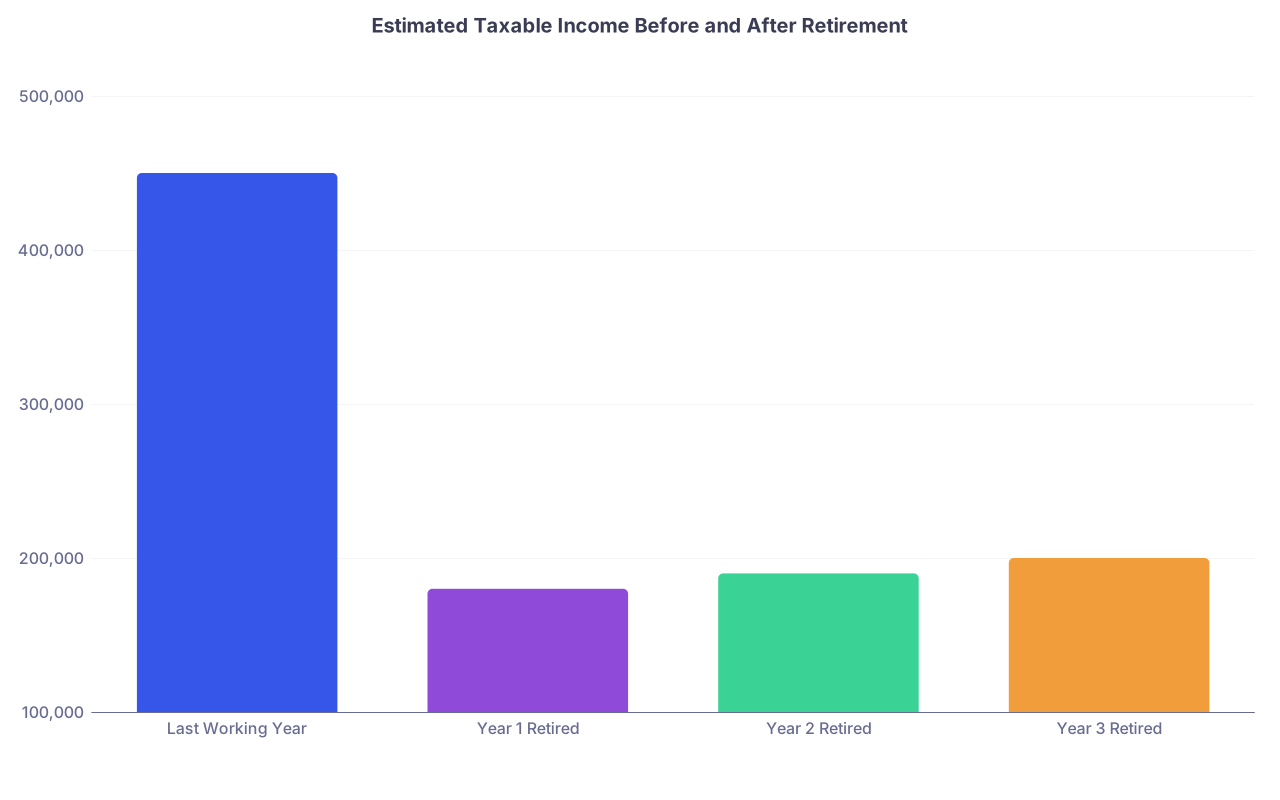
| Category | Value |
|---|---|
| Last Working Year | 450000 |
| Year 1 Retired | 180000 |
| Year 2 Retired | 190000 |
| Year 3 Retired | 200000 |
6. Decide on Retirement Date and Practice Exit Terms
If you are employed:
- Clarify:
- Last working day
- Treatment of unused PTO
- Final bonus eligibility
- Vesting of retirement plans and stock options
- Confirm:
- How long you stay on group health coverage
- COBRA options and costs
If you own a practice:
- Nail down:
- Sale date and structure (asset sale vs stock sale)
- Payment terms (lump sum vs earn‑out)
- Tax consequences (capital gains vs ordinary income)
- Coordinate:
- Malpractice tail coverage
- Patient notification requirements
- Chart storage / record‑keeping obligations
Do not guess. Get contracts and numbers in writing.
7. Design a 3‑Year Tax Strategy
Sit down with a CPA or tax attorney who actually understands physicians. You want a written 3‑year projection:
- Year 0: Last full work year
- Year 1–2: Early retirement years, before Social Security Required Minimum Distributions (RMDs) and possibly before taking Social Security
Key levers:
- Max out all pre‑tax accounts in your final year:
- 401(k)/403(b)/457(b)
- HSA
- Cash balance / defined benefit plan (if applicable)
- Consider bunching deductions:
- Charitable giving in your last high‑income year (possibly via Donor‑Advised Fund)
- Plan for Roth conversions in early retirement years (see next section)
You are trying to shape your lifetime tax bill, not just next April’s refund.
Month 6–4: Convert from Growth to Income Mode
You have spent decades optimizing for growth. Now the priority is reliable, tax‑efficient distributions.

8. Create a Bucketed Investment and Cash‑Flow Plan
I use a simple three‑bucket model with physicians because it is easy to run and you are used to thinking in time horizons.
Bucket 1 – Cash (0–2 years of spending)
- Hold 12–24 months of expenses in:
- High‑yield savings
- Money market funds
- Short‑term Treasury funds
- Purpose:
- Protects you from being forced to sell stocks in a downturn
- Gives psychological breathing room
Bucket 2 – Income / Stability (3–7 years)
- Investment‑grade bond funds
- Short‑ to intermediate‑term Treasuries
- Possibly some high‑quality dividend stocks or conservative balanced funds
Bucket 3 – Growth (8+ years)
- Broad stock index funds (US + international)
- Real estate funds if appropriate
Action steps (over 4–8 weeks):
- Calculate:
- Year 1–3 expected withdrawals
- Fund Bucket 1 and 2 accordingly by gradually rebalancing:
- Do not sell everything at once in a taxable account if it creates a tax bomb; stage sales over two tax years if needed
- Set rules:
- Refill Bucket 1 from Bucket 2 annually
- Refill Bucket 2 from Bucket 3 during good market years
This is your distribution framework. It prevents panic selling.
9. Sequence Withdrawals in a Tax‑Smart Order
There is no one perfect order, but there are clear patterns that are usually bad:
- Draining Roth IRAs first (wasting tax‑free growth)
- Leaving large pre‑tax balances untouched until RMDs force huge withdrawals in your 70s
- Triggering high IRMAA Medicare premiums accidentally
A common, reasonable starting strategy:
- Use:
- Interest, dividends, and rental income
- Plus withdrawals from taxable accounts (selling high‑basis holdings first)
- In “low‑income” years before RMDs:
- Consider partial Roth conversions of pre‑tax IRAs/401(k)s up to the top of a favorable tax bracket (e.g., 22% or 24% federal)
- Delay Social Security if possible (up to age 70), especially for the higher‑earning spouse, to lock in larger inflation‑adjusted benefits
This needs to be modeled with real numbers, not rules of thumb.
Month 4–3: Health Insurance, Malpractice, and Legal Loose Ends
People obsess over portfolio returns and then completely botch this section. Do not be that person.
10. Lock Down Health Coverage
Your options will depend on age and employer, but the checklist is the same.
| Situation | Likely Path |
|---|---|
| Under 65, employed with group plan | COBRA 18 months, then ACA exchange |
| Under 65, spouse still working | Move to spouse's employer plan |
| 65+ at retirement | Enroll in Medicare A/B, choose Medigap or Advantage |
| 65+ with younger spouse | Medicare for you, ACA / COBRA / employer for spouse |
Action steps:
- Get exact COBRA costs in writing.
- Compare ACA marketplace plans (look at net premiums after potential subsidies and IRMAA‑related income planning).
- If turning 65 near retirement:
- Enroll in Medicare Part A on time
- Decide on Part B start date (coordinate with employer coverage end date)
- Choose between Medigap + Part D vs Medicare Advantage
- Check whether your existing physicians are in‑network under the new plan.
Do this at least 3 months before your coverage changes. Medicare has penalties for late enrollment.
11. Malpractice and Professional Liability
If you are a clinician, you must resolve this properly:
- Claims‑made policies require tail coverage when you stop practicing (or a nose policy from your next employer if you continue part‑time elsewhere).
- Occurrence policies do not need tail.
Steps:
- Contact your malpractice carrier:
- Confirm your policy type
- Get tail coverage quotes
- Negotiate:
- Some groups/hospitals will cover part or all of tail as part of exit
- Ask:
- How long you must keep records
- Any ongoing obligations (e.g., responding to legal inquiries)
Do not walk away assuming “I retired, so I am done.” Claims can show up years later.
Month 3–1: Operational Shutdown and Launching Retirement Cash Flow
This is where everything gets real. You are moving from theory to actual account moves and new income streams.
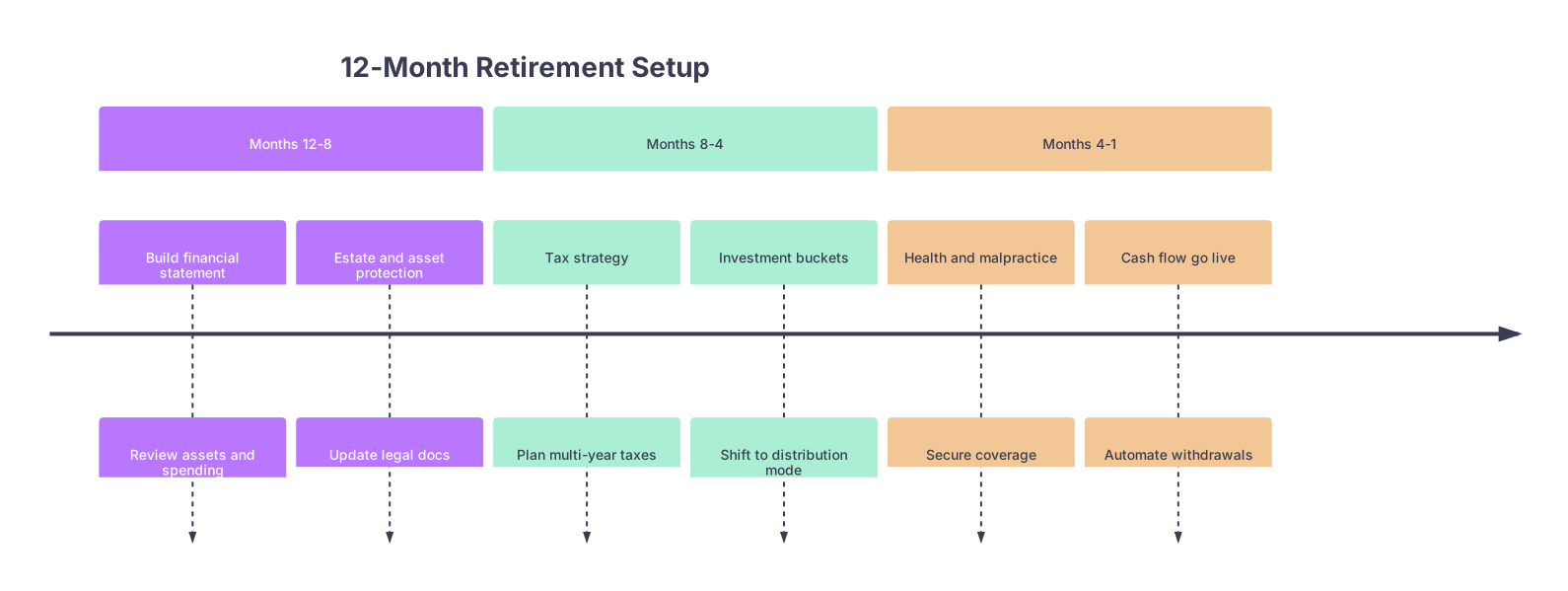
| Period | Event |
|---|---|
| Months 12-8 - Build financial statement | Review assets and spending |
| Months 12-8 - Estate and asset protection | Update legal docs |
| Months 8-4 - Tax strategy | Plan multi-year taxes |
| Months 8-4 - Investment buckets | Shift to distribution mode |
| Months 4-1 - Health and malpractice | Secure coverage |
| Months 4-1 - Cash flow go live | Automate withdrawals |
12. Turn On Your Income Streams
You want a written cash‑flow map for Year 1 and a draft for Years 2–3. Not a vague idea.
Typical Year 1 structure:
- Source 1: Part‑time/prn income (if any)
- Source 2: Dividends/interest/rental income
- Source 3: Scheduled monthly draw from a specific account (e.g., taxable brokerage)
- Source 4: Social Security or pension (if already started)
Action steps:
- Decide on which account will fund your monthly shortfall.
- Set up:
- Monthly automatic transfer from that account to your checking
- Quarterly tax withholdings or estimated payments as needed
- Test:
- Run a “simulation” for 1–2 months before retirement by:
- Living off the planned retirement cash flow while you are still getting your attending paycheck (bank the surplus)
- Adjust if the budget is obviously wrong
- Run a “simulation” for 1–2 months before retirement by:
You are debugging your retirement system before you rely on it.
13. Clean Up Account Titling and Access
Your spouse or executor needs to be able to step in without a scavenger hunt.
Checklist:
- All major accounts:
- Correct titling (individual / joint / trust)
- Primary and contingent beneficiaries updated
- Shared access:
- Spouse or trusted person knows where:
- Account list is stored
- Password manager access
- Key legal documents
- Spouse or trusted person knows where:
- Practice shutdown (if applicable):
- Bank accounts closed or repurposed
- Lines of credit settled
- Remaining staff issues resolved
- Business entity kept or dissolved as advised by CPA/attorney
Document location:
- Create a 2–3 page “Retirement and Estate Roadmap”:
- Assets list
- Contact info for:
- Financial advisor
- CPA
- Estate attorney
- Insurance agents
- Location of will/trust and healthcare directives
Put a printed copy in a clearly labeled folder. Tell your spouse where it is.
The First 3 Months After Retirement: Monitor, Don’t Meddle
Once retirement starts, your job is not to constantly tweak everything. Your job is to run the plan and monitor.
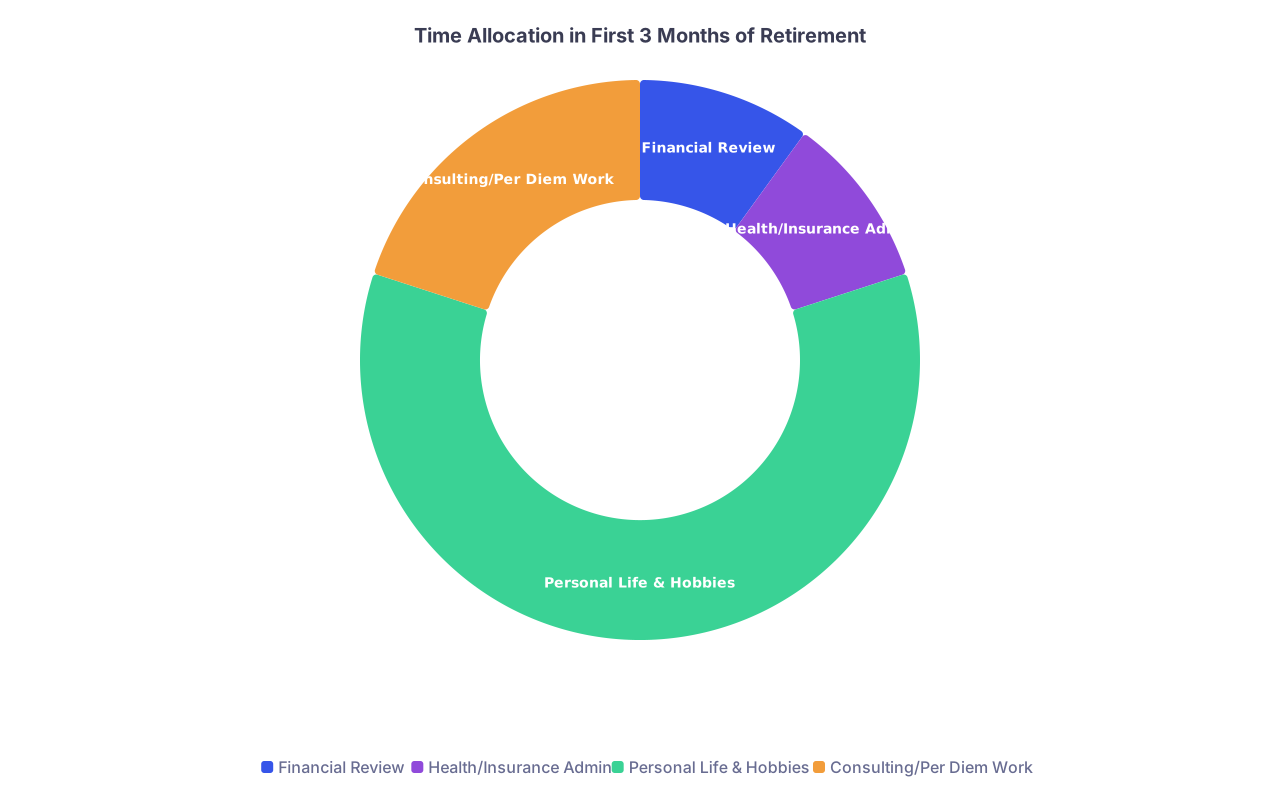
| Category | Value |
|---|---|
| Financial Review | 10 |
| Health/Insurance Admin | 10 |
| Personal Life & Hobbies | 60 |
| Consulting/Per Diem Work | 20 |
Set a simple quarterly rhythm:
- Quarter 1:
- Confirm:
- Cash flow feels right
- Tax withholdings seem adequate
- Spot‑check investment buckets are funded correctly
- Confirm:
- Quarter 2–3:
- Review with advisor/CPA:
- Any opportunities for Roth conversions this year
- Charitable giving / tax loss harvesting
- Review with advisor/CPA:
- Quarter 4:
- Confirm:
- RMD strategy (if applicable)
- Health coverage renewals or Medicare changes
- Any estate updates (births, deaths, divorces in family)
- Confirm:
Minor adjustments are normal. Wholesale changes every month are a sign your plan was not thought through in the first place.
Common Pitfalls You Need to Avoid
I see the same mistakes over and over. You can avoid them by simply being aware.
Retiring on a “magic number” without running the math.
“Everyone says 25× expenses is fine” is not a plan. Your taxes, health insurance, and lifestyle are unique.Ignoring sequence‑of‑returns risk.
If the market drops 30% in your first 3 years and you are fully in equities and withdrawing aggressively, you can permanently damage your portfolio.Starting Social Security too early by default.
Many physicians do not need it at 62 but take it anyway. That can be short‑sighted for the higher‑earning spouse.Leaving retirement accounts and insurance with old employers.
Fragmentation means no one has a full view. Consolidate where it makes sense (but be careful with 457(b)s and certain state plans).No written plan.
“It’s all in my head” is useless if you are hospitalized, impaired, or dead. Brutal but true.
Quick Recap: What Actually Matters
You can ignore 90% of the noise in the retirement planning space. For a physician transitioning from full‑time attending to retirement in 12 months, the critical moves are:
- Get brutally clear on your numbers – one‑page statement, realistic spending target, and a simple safe‑withdrawal analysis.
- Lock in your legal, tax, and risk foundation – updated estate plan, asset protection, health insurance, malpractice tail, and a 3‑year tax map.
- Engineer your cash flow before you need it – bucketed investment structure, tax‑smart withdrawal order, and automated monthly distributions tested while you still work.
Do these three well and your retirement will feel like a deliberate handoff, not a cliff.