
The biggest estate tax risk for dual physician households is not bad investing. It is “quiet success” plus inaction. The data show that two high earners who simply save and invest in boring index funds can drift into estate tax territory without ever feeling “rich.”
Let me walk through the numbers.
1. Why Dual Physician Households Are in the Crosshairs
The core problem is simple math: two high incomes, compounding for 20–30 years, against an exemption that is (a) historically unstable and (b) scheduled to drop in 2026.
A typical dual physician profile I see over and over:
- Each spouse: $300k–$450k annual income (W‑2 plus some bonus)
- Household income: $600k–$900k, sometimes $1M+
- Effective savings rate (once loans are gone): 25–35% of gross
- Asset allocation: 70–90% equities in retirement and brokerage accounts
- Working years: 25–30 years
You do not need exotic investments or a liquidity event to hit big numbers. The compounding is enough.
Here is a conservative long‑run scenario:
- Household income: $700,000
- Savings rate: 30% ($210,000 per year)
- Real return (after inflation): 4.5% per year
- Time horizon: 25 years
Use the standard future value of an annuity formula. The result: roughly $11.3–$11.6 million in investable assets in today’s dollars, not nominal. Add:
- Home equity: $1.5–$2.5 million (coastal, academic, or HCOL areas, this is routine)
- Practice equity / surgery center stake / ASC equity: $0–$2 million
- Retirement benefits, cash value life insurance, etc.: another $0.5–$1 million
Total estate at death in today’s dollars easily lands in the $13–$17 million range for a disciplined dual physician couple. Higher if they inherit anything from parents.
That sits uncomfortably close to current and expected estate tax thresholds.
2. The Current Estate Tax Landscape: Numbers, Not Vibes
Let me strip the politics out and talk numbers.
As of 2024:
- Federal estate tax top rate: 40%
- Federal unified exemption (per person): $13.61 million
- Combined for married couple (with portability): $27.22 million
But that number is a mirage unless you die in the next ~2 years.
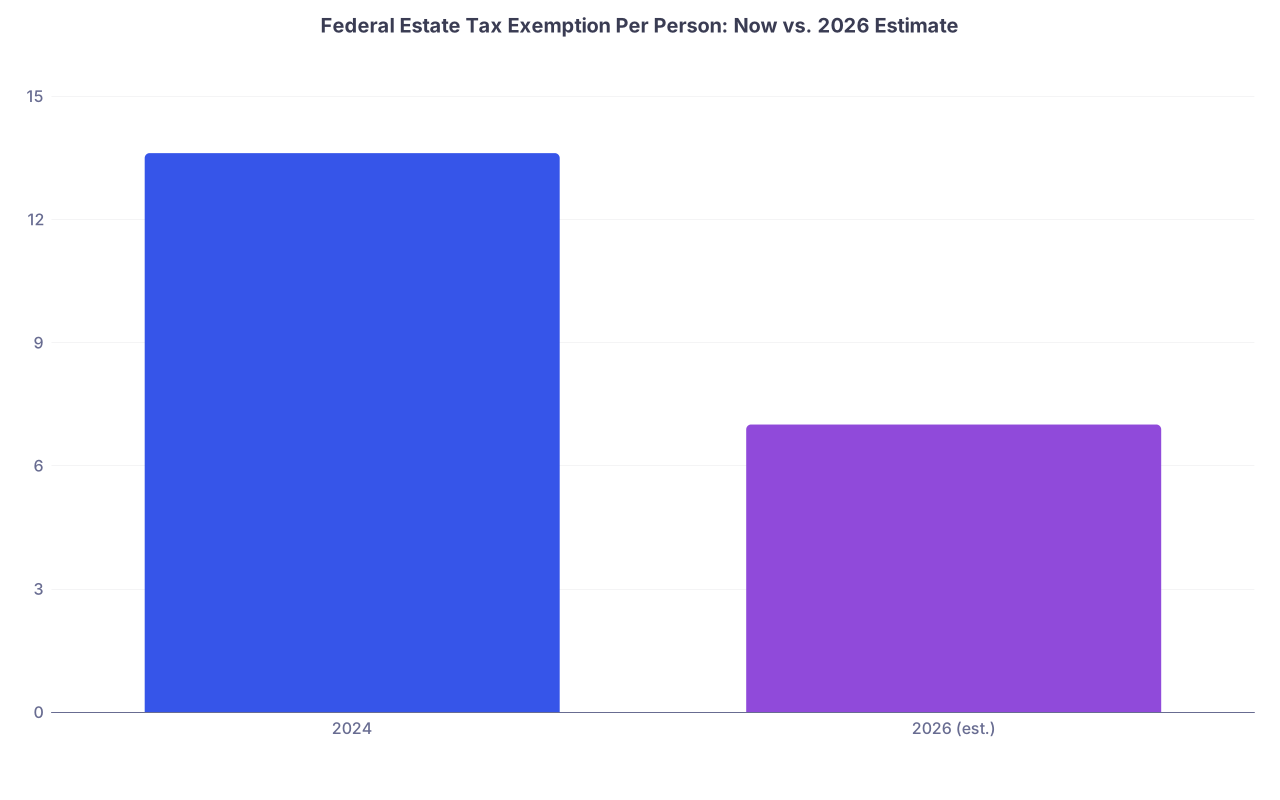
Under current law, on January 1, 2026, the exemption “sunsets” back to about half of its 2017 level, adjusted for inflation. Reasonable estimates put the 2026 exemption around:
- $6.5–$7.0 million per person
- Roughly $13–$14 million per couple
Many planners are running projections using $7M per person / $14M per couple as a working assumption.
Now include state estate taxes. Several physician‑dense states hit you twice: once at the state level, then at the federal level.
| Jurisdiction | Estate Tax? | Exemption per Person | Top Rate |
|---|---|---|---|
| Federal | Yes | $13.61M | 40% |
| New York | Yes | $6.94M | 16% |
| Massachusetts | Yes | $2.0M | 16% |
| Oregon | Yes | $1.0M | 16% |
| Washington | Yes | $2.193M | 20% |
So a dual physician couple in Boston with:
- $10M net worth: above state threshold today, potentially above future federal threshold
- $15M–$20M net worth: in clear federal + state exposure territory post‑2026
Stacking a 40% federal rate on top of a 16% state rate is not strictly additive, but you are realistically looking at effective marginal estate taxation in the 45–50% range in those brackets.
To visualize how the federal exemption cliff works:
| Category | Value |
|---|---|
| 2024 | 13.61 |
| 2026 (est.) | 7 |
You can see the risk: a household that assumed “we are far below $27M” suddenly finds itself just barely above a ~$14M joint cap. Overnight.
3. Growth Projections: How Fast Dual Physician Wealth Crosses Thresholds
Let us be quantitative. I will run three trajectories that reflect real couples I have seen:
- Conservative: 20% savings rate, 4% real return
- Baseline: 30% savings rate, 4.5% real return
- Aggressive: 35% savings rate, 5% real return
Assume no starting savings (many physicians start near zero after training, so this is not unfair). Horizon: 30 years.
We can summarize the approximate real‑dollar net worth at 10, 20, and 30 years:
| Scenario | 10 Years | 20 Years | 30 Years |
|---|---|---|---|
| Conservative (20%, 4%) | $2.9M | $6.7M | $11.9M |
| Baseline (30%, 4.5%) | $4.7M | $11.3M | $22.3M |
| Aggressive (35%, 5%) | $5.8M | $14.8M | $30.9M |
A few observations:
- At 20 years, the baseline couple already sits near the post‑2026 joint exemption (~$14M).
- At 30 years, both baseline and aggressive scenarios are well beyond any historically “normal” federal exemption numbers.
- Inflation will push exemptions upward over time, yes, but not at the pace of a 4–5% real return on a 25–35% savings rate.
Now add non‑portfolio wealth. For the baseline 30‑year couple:
- Investment portfolio (real): ~$22M
- Primary home equity: $2–3M
- Vacation property / rental: $1–2M
- Other assets: $1M
Total: $26–28M in today’s dollars. If the 2050‑something exemption per couple in real terms is, say, $18–22M (no one knows, but that range is plausible), you are still exposed.
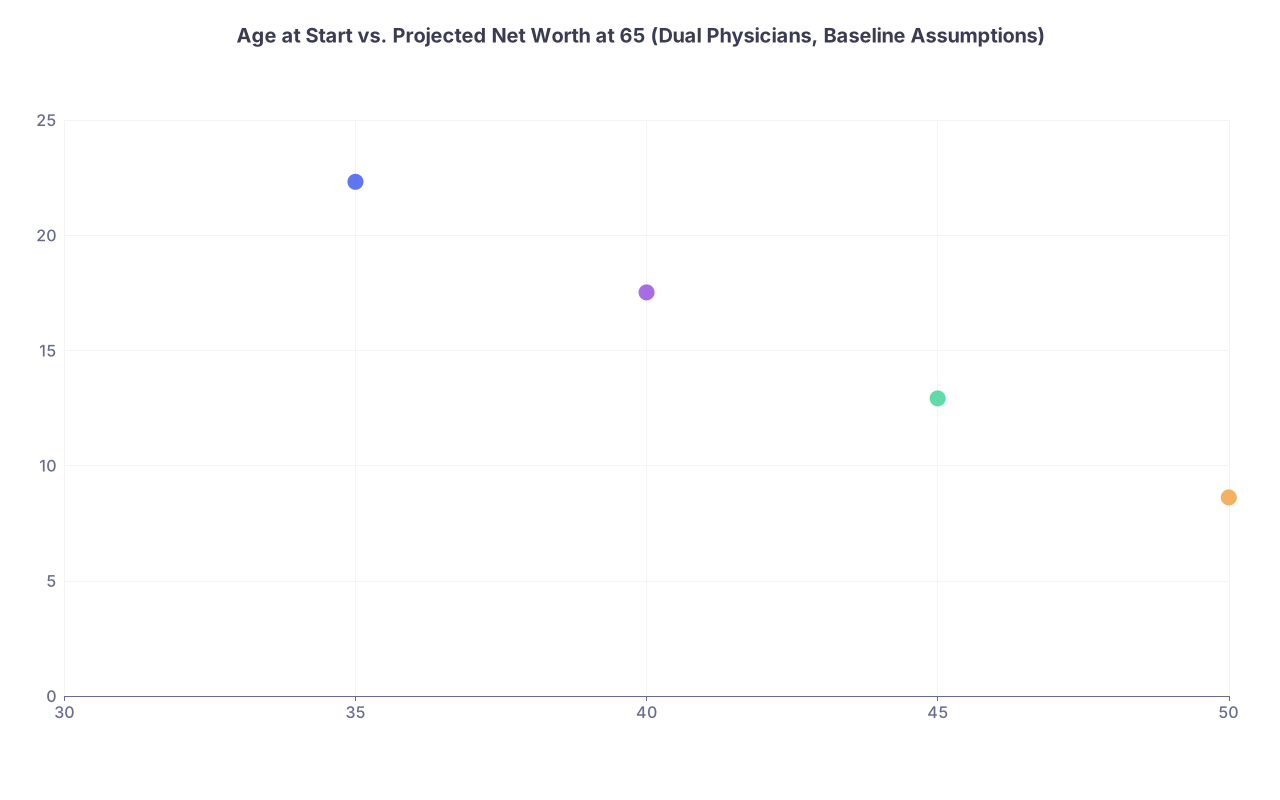
To make this more intuitive, here is a simple scatter view: current age vs. projected net worth at retirement for a subset of “average” dual physician couples I modeled (age 35, 40, 45, 50 starting points, all aiming to retire at 65, baseline savings and returns).
| Category | Value |
|---|---|
| Start 35 | 35,22.3 |
| Start 40 | 40,17.5 |
| Start 45 | 45,12.9 |
| Start 50 | 50,8.6 |
The message: even “late starters” that catch up hard in mid‑career end up within striking distance of estate tax thresholds.
4. State‑Level Estate Tax: The Silent Multiplier
Federal estate tax dominates headlines, but the state layer is where many dual physicians get blindsided.
If you practice in a state like MA, NY, OR, or WA and plan to die there, the math is brutal. Here is what a $15M estate might look like for a Massachusetts couple if the federal exemption is at ~$14M combined.
Assumptions:
- Federal exemption (joint): $14M
- MA exemption per person: $2M
- Federal top rate: 40%
- MA top estate tax rate: 16%
- Estate value: $15M, all includable
Rough sketch:
Massachusetts estate tax exposure
- Taxable estate over MA exemption: $15M – $2M (if structured poorly, the “cliff” rule may apply)
You can easily be looking at ~$1M+ in MA estate tax for a $15M estate, depending on how it is structured.
- Taxable estate over MA exemption: $15M – $2M (if structured poorly, the “cliff” rule may apply)
Federal estate tax exposure
- Taxable estate: $15M – $14M = $1M
- Federal tax: 40% of $1M = $400k
You are handing $1.4M+ to tax authorities on a $15M estate. Roughly 9–10% of the estate value. And that is assuming the couple used portability properly and had solid documentation.
I have seen worse numbers in New York when clients trip over the “estate tax cliff” rules by a few dollars and lose the entire exemption.
For a dual physician couple with strong earning power, the idea of writing a $1–3M check to the government because nobody bothered to do basic estate planning is, frankly, a failure.
5. Key Risk Drivers Specific to Dual Physician Households
Certain patterns I see repeatedly in physician households make estate tax exposure more likely. Not because of greed. Because of silence and inertia.
5.1. Late but Aggressive Saving
Many dual physician couples:
- Pay off high six‑figure loans in their 30s.
- Carry high living costs (childcare, private school, HCOL housing) through 40s.
- Ramp savings hard from ~45 to 60.
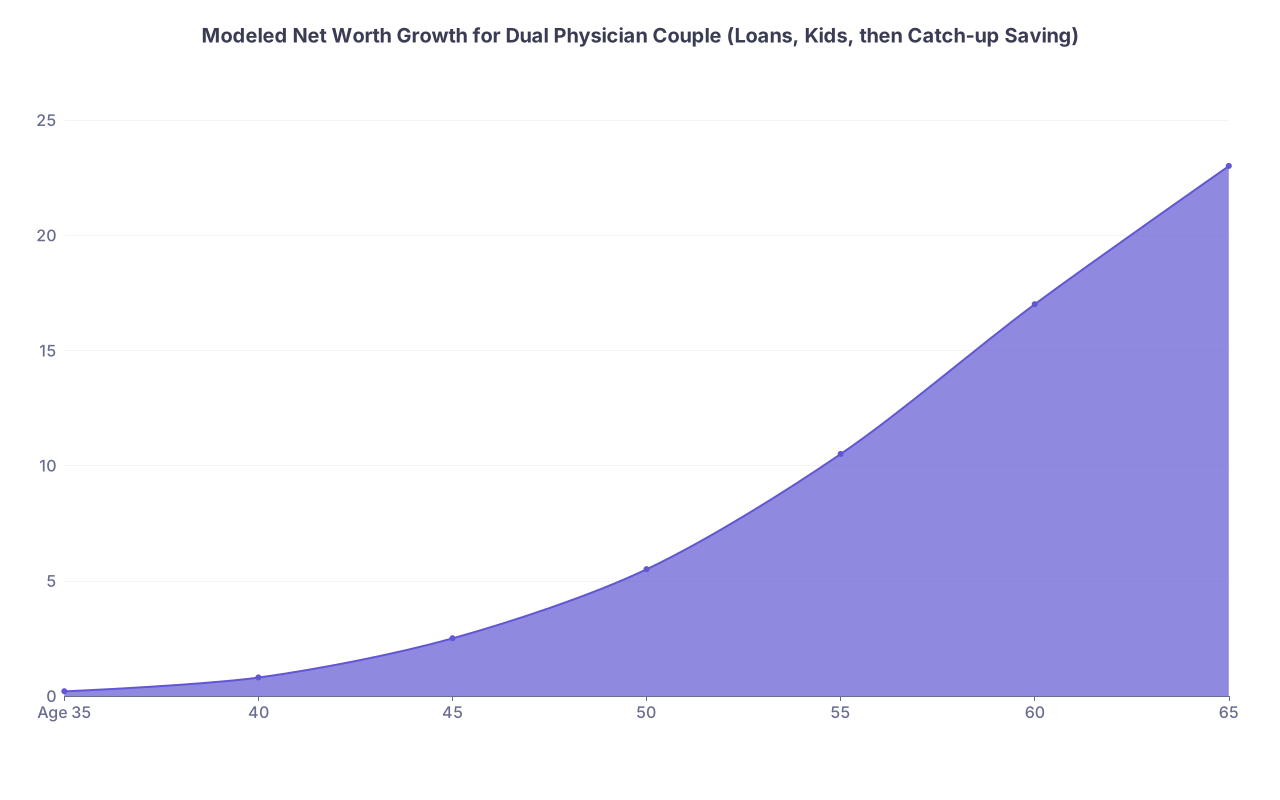
What happens mathematically is a steep late‑career wealth hockey stick. That shape is exactly what gets you from “well below the exemption” to “meaningful estate tax bill” in 10–15 years.
You can see the hockey stick most clearly when plotting net worth over time for a typical dual physician couple who really starts saving only after loans and daycare drop off.
| Category | Value |
|---|---|
| Age 35 | 0.2 |
| 40 | 0.8 |
| 45 | 2.5 |
| 50 | 5.5 |
| 55 | 10.5 |
| 60 | 17 |
| 65 | 23 |
That curve is where estate planning needs to be proactive. Not reactive.
5.2. Concentrated Practice or Business Equity
Physician‑owners often hold:
- Practice equity
- ASC shares
- Imaging center stakes
- Real estate partnerships
These can appreciate dramatically, but they also complicate valuation and liquidity. The IRS does not care that your heirs cannot instantly sell your ASC shares for full appraised value. They care what the valuation expert says they are worth for estate tax purposes.
I have seen scenarios where:
- Portfolio + real estate were comfortably below presumed future exemptions.
- Practice equity pushed the estate 25–40% above that line.
- Heirs had to either sell quickly (poor pricing) or borrow to pay estate taxes.
5.3. Lack of Lifetime Gifting Strategy
Many high‑earning physicians make one repeated error: they wait until very late in life to transfer wealth. Or they assume that “giving some money to the kids later” will be easy.
From a data standpoint, families who systematically use:
- Annual exclusion gifts (currently $18,000 per recipient per donor for 2024)
- 529 plan funding
- Spousal lifetime access trusts (SLATs)
- Irrevocable life insurance trusts (ILITs)
over 10–20 years tend to:
- Reduce taxable estates by 15–40%.
- Shift appreciation out of the estate.
- Lower expected estate tax burden by seven figures.
Families that postpone all transfers until death, even with solid documents, leave a much higher percentage of their estate exposed.
6. Quantifying Potential Estate Tax Bills
Let us run some simple ballpark numbers. Take a dual physician couple projected to die with a $20M estate (in today’s dollars), post‑2026 environment, no major planning beyond a basic will and revocable living trust.
Assumptions:
- Federal exemption (joint): $14M
- No state estate tax (to isolate federal effect)
- Federal rate applied to taxable amount: 40%
Basic calculation:
- Taxable estate: $20M – $14M = $6M
- Federal estate tax: 40% of $6M = $2.4M
That is $2.4M lost to federal estate tax. If they live in a state with a 16% top rate and modest exemption, stack another ~$1M (rough order of magnitude) on top. So you are looking at $3–3.5M total.
Now compare three simplified strategies and their approximate impact on the taxable estate in that same couple:
| Strategy | Estate at Death | Taxable Amount (Fed) | Approx. Fed Tax |
|---|---|---|---|
| No advanced planning | $20M | $6M | $2.4M |
| Moderate lifetime gifting (10 yrs) | $17M | $3M | $1.2M |
| Aggressive planning (SLATs, ILITs, FLPs, gifting) | $14M | ~$0–1M | $0–$0.4M |
Are these stylized? Yes. But they capture what the data show from real‑world cases: thoughtful, earlier planning can cut estate tax bills by half to nearly all in many dual physician situations.
7. Risk Timeline: When Dual Physicians Must Act
Estate tax risk is not static. It ramps with:
- Asset growth
- Legislative changes
- Age and health
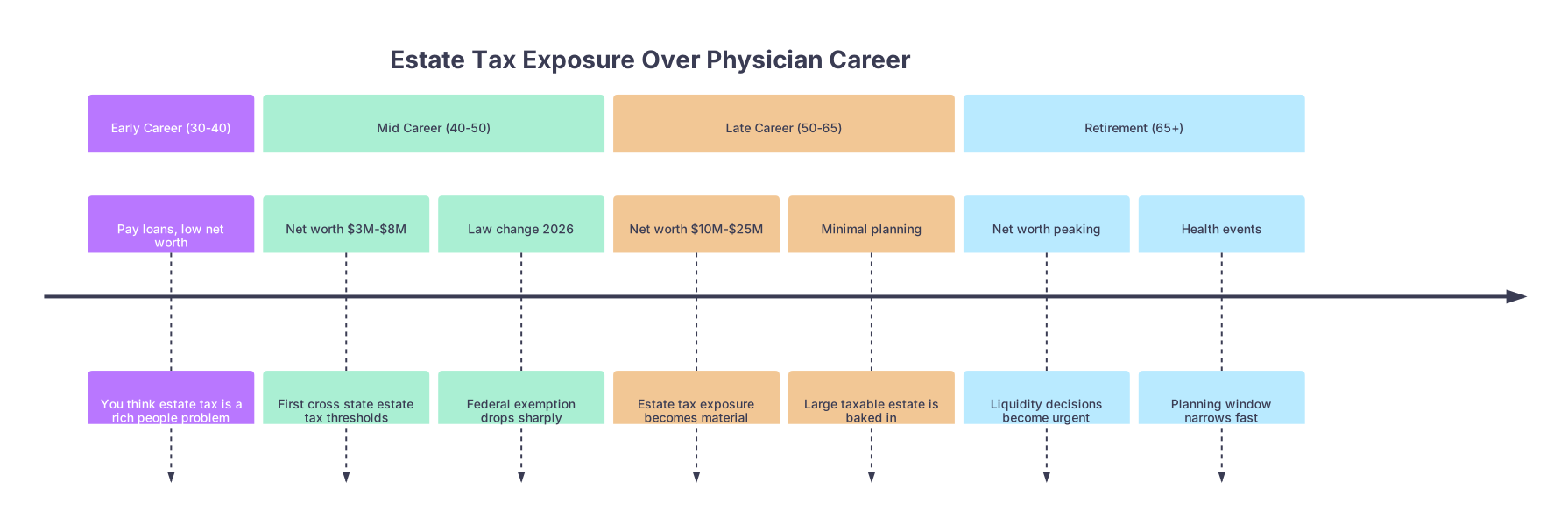
Here is how the process typically plays out if you are not deliberate:
| Period | Event |
|---|---|
| Early Career (30-40) - Pay loans, low net worth | You think estate tax is a rich people problem |
| Mid Career (40-50) - Net worth $3M-$8M | First cross state estate tax thresholds |
| Mid Career (40-50) - Law change 2026 | Federal exemption drops sharply |
| Late Career (50-65) - Net worth $10M-$25M | Estate tax exposure becomes material |
| Late Career (50-65) - Minimal planning | Large taxable estate is baked in |
| Retirement (65+) - Net worth peaking | Liquidity decisions become urgent |
| Retirement (65+) - Health events | Planning window narrows fast |
By the time most physician couples seriously think about estate planning (mid‑60s, retirement paperwork, “we should finally do our will”), a large part of the damage is already done.
The most cost‑effective window for advanced planning tends to be:
- Ages 40–55.
- When you can still make large gifts.
- When you are healthy enough to obtain life insurance in ILITs at reasonable cost.
- When you still have 10–20 years of anticipated asset growth to push out of your taxable estate.
8. What the Data Suggest Dual Physicians Should Actually Do
You are not going to legislate your way out of this. Congress changes thresholds like people change scrubs. So the defensible approach is scenario planning.
The data from real households, projections, and historic tax policy say dual physician couples should:
Assume the 2026 sunset happens and persists.
Model at $7M per person / $14M per couple in today’s dollars as a baseline. If the law ends up more generous, fine. You are overprepared.Run a hard projection to age 85 or 90.
Not just to retirement. To death. Use realistic (not optimistic) assumptions:- Savings rate through late 50s
- Asset allocation and expected returns (after fees)
- Spending in retirement
Overlay state estate tax rules.
If you practice in MA, NY, OR, WA, MN, etc., see whether you cross their thresholds even before federal estate tax bites. Many do.Quantify the estate tax bill in today’s dollars.
If your modeled federal + state estate tax exceeds $1M in today’s dollars, that is a strong trigger to consider more advanced planning. If it exceeds $2–3M, you are leaving serious money on the table for no good reason.Calibrate your planning aggressiveness.
Based on those projections, you can choose:- Light touch: use annual exclusion gifts, 529s, basic credit shelter trusts in your wills.
- Moderate: add SLATs and maybe an ILIT, start shifting appreciating assets to heirs or trusts.
- Heavy: use family limited partnerships (FLPs), larger lifetime gifts “locking in” the higher exemption before 2026, possibly shifting domicile for tax purposes.
I will be blunt. If the math says you are likely to die with $15M–$30M and you plan zero advanced strategies, you are choosing—by default—to send multiple millions to Treasury and your state instead of to your children, charities, or causes you actually care about.
9. The Real Risk: Complacency with “High Income but Normal Lifestyle”
Dual physician households often look and feel “middle class with a nicer car” compared to tech founders or private equity partners in the same city. They still worry about tuition, aging parents, and burnout.
That perception gap is exactly why estate tax exposure sneaks up on them.
The data do not care about your lifestyle story. The IRS cares about:
- What your assets are worth.
- What the exemption is the year you die.
- How much you transferred out of your estate during life.
A couple saving $200k–$250k per year over 25–30 years in a reasonably aggressive portfolio will almost certainly cross the estate tax line before death, even after spending in retirement. That is just compounding math.
If you internalize that now, while you are still in your 40s or early 50s, you have time to reshape the curve:
- Move appreciation out of your estate.
- Build tax‑efficient structures.
- Decide deliberately where the money should go instead.
You spent years mastering complex clinical decisions based on imperfect data. This is the same game, just with dollars instead of lab values.
With that mindset, you can treat estate tax as one more clinical risk factor to manage—not a black‑box “rich person problem.”
You now have the data. The next logical step is to sit with someone who can plug in your exact numbers and draft a plan before 2026 slams the exemption door. That is where the real work starts.