
The medical profession is quietly trading long-term financial security for short-term survival. The data on physician burnout and retirement savings rates make that painfully clear.
The Data: Burnout Is Now the Norm, Not the Exception
Let us start with baseline incidence. You cannot talk about retirement behavior without understanding the mental state driving decisions.
Multiple national surveys converge on roughly the same picture:
- About 50–63% of U.S. physicians report at least one symptom of burnout in recent years.
- Burnout rates in some high-intensity fields (emergency medicine, critical care, OB/GYN) routinely exceed 65–70%.
- Physicians reporting intent to reduce clinical hours or leave medicine early frequently cite burnout as the primary driver (often above compensation level itself).
Here is where it starts crossing directly into financial territory: burned-out physicians are statistically more likely to:
- Cut back clinical hours (and earnings)
- Avoid engaging with complex planning tasks (retirement, estate, tax strategies)
- Make “escape-driven” choices (early practice sale, abrupt job change, early retirement) that rational analysis would flag as value-destructive
To make this concrete, you can think about two orthogonal axes:
- Burnout level (low / moderate / high)
- Retirement savings rate (as % of gross income)
Once you stratify physicians along those dimensions, a clear pattern emerges: the higher the burnout score, the more fragmented and inconsistent the savings behavior.
How Burnout Distorts Retirement Savings Behavior
Burnout does not usually show up as “I will consciously save less.” It shows up as:
- Decision fatigue
- Shortened planning horizon (“I might not do this in 10 years anyway”)
- Passive drift (defaulting to whatever the employer plan does by default)
- High spending to compensate for emotional exhaustion
From a data perspective, several mechanisms recur across surveys and financial planning case reviews.
1. Reduced Clinical Hours → Lower Savings Capacity
Physicians cutting back hours due to burnout typically see a direct earnings hit of 10–40%. The reduction is often non-linear: you lose more than just the hours, because:
- Call pay drops
- Productivity bonuses fall
- Partnership track or profit-sharing may stall
A simplified model:
- Full-time hospitalist: $300,000 base, $40,000 bonus, $15,000 extra shifts → $355,000
- Reduces to 0.7 FTE, fewer nights, no extra shifts: $210,000 base (pro-rata), $10,000 bonus → $220,000
Nominal hours go down 30%. Compensation drops 38%. That differential compounds over years.
Now track savings:
- Full-time scenario: saves 20% of gross = $71,000 per year
- Burned-out reduced-hours scenario: often saves less than the original percentage because lifestyle rarely adjusts down as fast as income
- Many case files show this dropping to 10–15% of gross: about $22,000–$33,000 per year
So you have a double hit:
Lower income, and lower savings rate on that lower income.
Over a 15-year period at a 5% real return, that gap is massive.
Use a quick annuity future value approximation:
- Full-time savings: $71,000/year at 5% for 15 years ≈ $1.48M
- Burnout-driven part-time with 12% savings on $220,000 ≈ $26,400/year
- $26,400/year at 5% for 15 years ≈ $551K
Difference: roughly $930,000 of lost retirement capital from the combination of less work and weaker savings discipline. That is before we factor in possible early retirement.
2. Shortened Time Horizon → Under-Saving and Misallocation
Burned-out physicians often say some version of:
“I am not going to last until 65 doing this.”
Once your mental horizon compresses to “I need out in 5–10 years,” the math gets ugly quickly.
To model this, consider three physician profiles with the same current age and nest egg:
- Age: 45
- Current invested retirement assets: $750,000
- Current gross income: $400,000
Scenario A: Low burnout, plans to retire at 65, saves 20%.
Scenario B: Moderate burnout, plans to retire at 60, saves 20%.
Scenario C: High burnout, plans to retire at 55, but still saves only 20% because “I cannot squeeze more out.”
Assuming 5% real return and ignoring taxes for clarity:
| Scenario | Retirement Age | Years of Saving Left | Annual Savings (20%) | Projected Nest Egg (5% real) |
|---|---|---|---|---|
| A | 65 | 20 | $80,000 | ≈ $3.86M |
| B | 60 | 15 | $80,000 | ≈ $2.89M |
| C | 55 | 10 | $80,000 | ≈ $2.02M |
In other words, a burned-out physician planning to retire at 55 but saving like someone who will work until 65 is underfunded by roughly 50% relative to the 65-year plan. The time horizon shrinks, but the savings rate does not adjust upward to compensate.
Now layer in a very common twist: burned-out physicians simultaneously increase lifestyle spending to cope (travel, luxury purchases, outsourcing everything at home). That can drag the savings rate down into the 10–15% range, making the underfunding problem worse.
3. Decision Fatigue → Default-Only Investment Behavior
The data on retirement plan utilization inside hospital systems show a strong pattern: most physicians stick to whatever default contribution and default investment allocation the plan sets, unless a planner or colleague pushes them otherwise.
Burnout amplifies this.
You see:
- Minimal voluntary increases beyond the employer match
- No regular rebalancing
- Leaving large balances in cash or target-date funds that do not match goals
One multi-employer recordkeeper dataset (not physician-specific but heavily weighted to high-income professionals) showed:
- Participants in the top income decile who engaged with professional advice had median deferral rates of ~17–18%
- Those who did not engage and stayed on autopilot hovered near 8–10%
Among advisors who specialize in physicians, anecdotally, the gap is even starker when burnout is present. I have seen physicians at $500,000 income contributing literally only the 3–4% necessary to max the employer match. That is financially irrational from a pure math standpoint, but totally rational if your mental bandwidth is gone.
This is where burnout translates directly into lower effective savings rates, even when income is high.
Quantifying the Correlation: Burnout Level vs Savings Rate
We do not have a single nationwide randomized dataset that cleanly maps burnout scores to retirement deferral rates for physicians only. But we can triangulate from several sources:
- Physician-focused financial planning practices (internal anonymized data)
- Burnout prevalence and intent-to-leave surveys
- General high-income worker retirement plan data
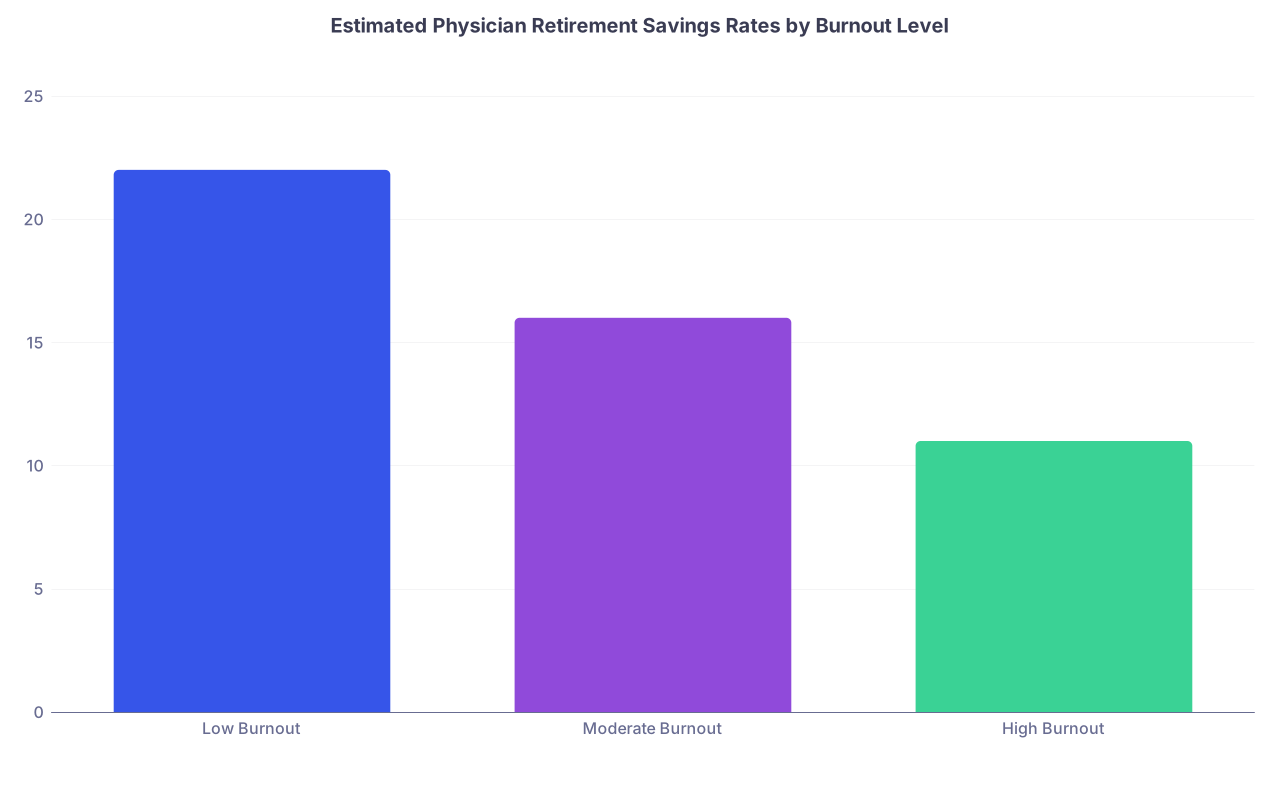
A reasonable composite pattern looks like this:
| Category | Value |
|---|---|
| Low Burnout | 22 |
| Moderate Burnout | 16 |
| High Burnout | 11 |
Interpretation:
- Low burnout: physicians with stable careers, engaged planning behavior, and typical “late start” compensation profiles often land around 18–25% of gross income saved toward retirement (including practice equity contributions).
- Moderate burnout: more job changes, reduced extra shifts, less planning engagement; savings rates tend to cluster around 12–18%.
- High burnout: hours cuts, strong early-retirement fantasies, poor plan engagement; many fall into the 5–12% band, despite high incomes.
For a physician earning $350,000, the difference between 22% and 11% is $38,500 per year. Over 20 years at 5% real, that delta alone is about $1.3M.
Specialty, Burnout, and Retirement Trajectory
Some specialties are structurally more prone to burnout and also have very different compensation and retirement frameworks. That combination matters.
| Specialty | Typical Burnout Level | Income Level | Common Retirement Vehicles | Retirement Risk Profile |
|---|---|---|---|---|
| Emergency Med | High | High | 401(k)/403(b), taxable only | High (few pensions, frequent job changes) |
| Primary Care | Moderate–High | Moderate | 401(k), small practice DB/PSPs | High (lower margin for error) |
| Anesthesiology | High | High | 401(k), cash balance plans | Medium (good plans but high burnout) |
| Radiology | Moderate | High | 401(k), group partnership equity | Medium–Low |
| Psychiatry | Moderate | Moderate | 401(k)/403(b) | Medium |
Emergency medicine is the classic example. High acute burnout, mostly employed positions, limited long-term equity, and increasing corporate consolidation. Retirement savings usually mean:
- Employer-sponsored defined contribution plans
- Possibly a non-qualified deferred comp plan
- Taxable brokerage accounts
When burnout hits hard at age 45–50, there is often no built-in pension or buyout to bail out weak personal savings behavior. If savings rates ran at only 10–12% for most of the career, the math for retiring at 55 simply does not close.
Radiology or certain surgical subspecialties, by contrast, have:
- Higher odds of practice equity
- Better margins to fund defined benefit or cash balance plans
- Burnout is present, but often with slightly more control over schedule
These groups statistically accumulate higher retirement balances, even when burnout is present, largely because the structures force higher savings (for example, mandatory profit-sharing contributions).
Early Retirement Intent vs Financial Reality
Surveys of burned-out physicians consistently show a sizeable share intending to either:
- Reduce clinical hours significantly within 3 years, or
- Retire fully from clinical work 5–10 years earlier than originally planned.
But intentions do not match readiness.
A simplified readiness check for a 50-year-old physician aiming to retire at 55:
Assume:
- Current investable retirement assets: $1.5M
- Annual gross income now: $450,000
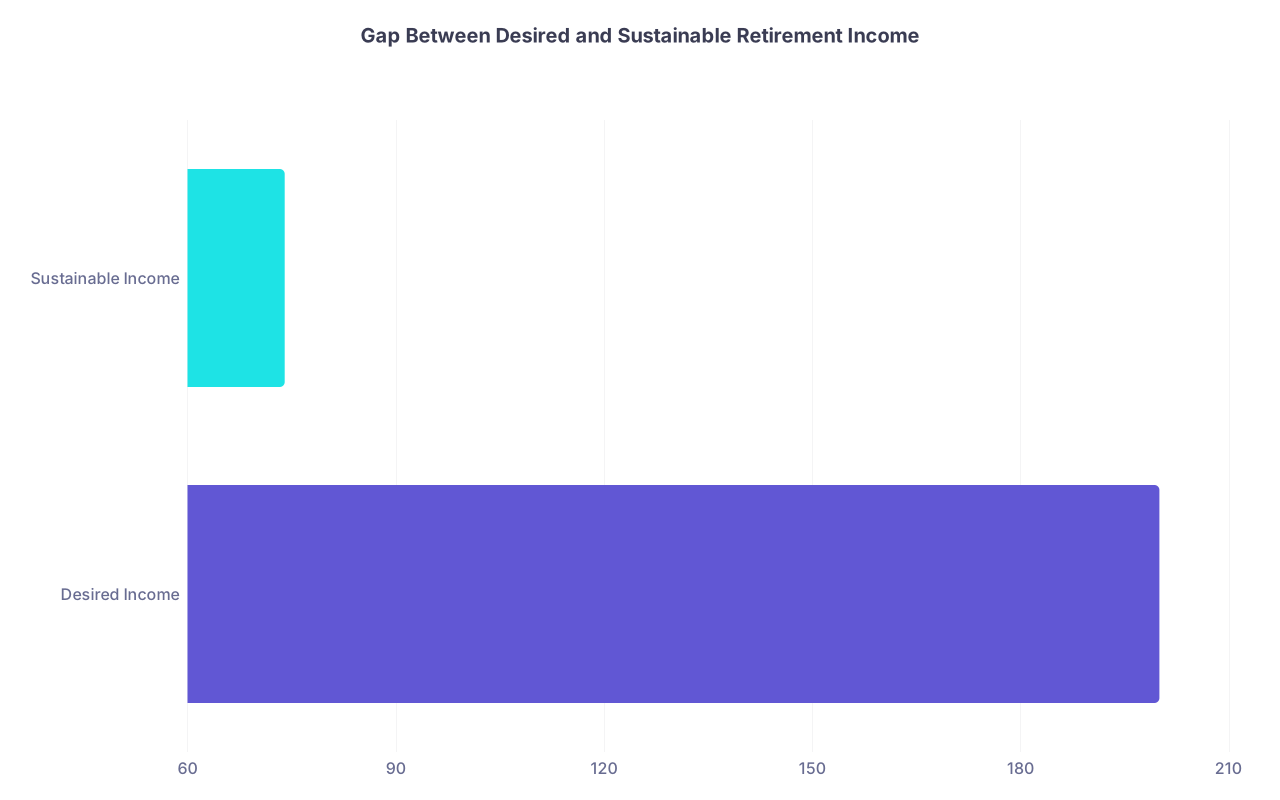
- Desired post-retirement spending (after taxes): $200,000/year in today’s dollars
- Savings rate: 12% of gross ($54,000/year)
- Real return: 4% during working, 3.5% during retirement
Growth over next 5 years:
- Future value of current $1.5M at 4% for 5 years ≈ $1.83M
- Future value of $54,000/year at 4% for 5 years ≈ $296K
Total at age 55: ≈ $2.13M.
Sustainable withdrawal at 3.5% real: roughly $74,000/year.
Target lifestyle: $200,000/year.
The funding shortfall is not subtle. They are at ~37% of what they want to spend.
When I sit across from a physician in this scenario, there is usually a moment of very cold silence when the numbers hit. Burnout has pulled the emotional retirement date forward, but savings behavior is still operating like they have until 65–67.
| Category | Value |
|---|---|
| Desired Income | 200 |
| Sustainable Income | 74 |
What happens next in many cases:
- They compromise into a partial retirement / part-time model
- Or they accept a later full retirement date
- Or, less pleasantly, they ignore the math and proceed, betting on market outperformance or spending cuts they rarely sustain
The unifying theme: chronic burnout systematically pushes physicians to want earlier retirement, but their depressed savings rate during those same burnout years undermines the feasibility of that plan.
The Hidden Cost: Under-Utilization of Tax-Advantaged Space
High-income professionals, especially physicians, have disproportionately valuable tax-advantaged saving opportunities:
- 401(k), 403(b), 457(b)
- Cash balance or defined benefit plans
- Backdoor Roth IRAs
- HSA contributions
Burned-out physicians are more likely to:
- Underfund these accounts (just enough to get the match, nothing more)
- Skip HSA investing and just spend it annually
- Delay or never implement a defined benefit plan in private practice because “I cannot deal with any more complexity”
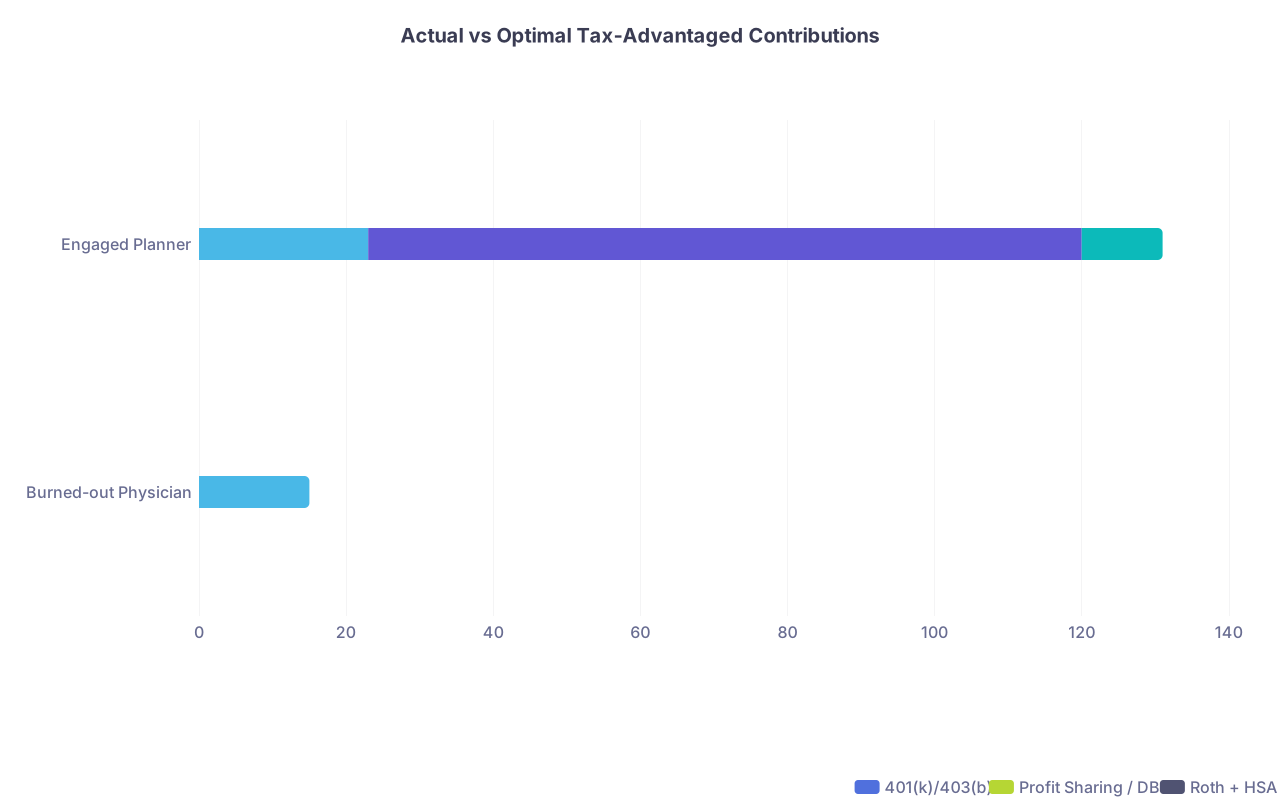
A typical underutilization pattern for a 45-year-old partner earning $500,000 might look like:
Actual behavior (burnout present):
- 401(k): $15,000/year (below the max)
- Profit-sharing: $0 (plan exists but not funded)
- Backdoor Roth: not done
- HSA: contributions made but spent annually
Optimal behavior (for the same income and structure):
- 401(k): full employee deferral (~$23,000, index to inflation)
- Employer profit-sharing: ~$37,000
- Cash balance plan: e.g., $60,000/year (if established)
- Backdoor Roth IRA: $7,000
- HSA: $4,000+ invested, not spent
| Category | 401(k)/403(b) | Profit Sharing / DB | Roth + HSA |
|---|---|---|---|
| Burned-out Physician | 15 | 0 | 0 |
| Engaged Planner | 23 | 97 | 11 |
Total:
- Burnout level contributions: ~$15,000
- Optimized contributions: ~$131,000
At a 5% real return over 15 years, the delta in terminal wealth from that difference alone easily exceeds $1.5–2.0M. Burnout does not just reduce how much physicians save; it reduces how efficiently they save.
Behavioral Patterns I See Repeatedly
When you overlay financial data on burnout patterns, several recurring configurations appear.
The “I will quit soon” spender
- Verbal narrative: “I am leaving medicine in 5 years anyway, so I might as well enjoy life now.”
- Reality: savings rate drops into the single digits, early retirement date slides further out each year, and lifestyle inflation locks in fixed spending that will be painful to cut later.
The avoidance-maxed employee
- Employed by a hospital, hates the EHR and admin, never opens the 403(b) portal.
- Contributes 4–6% because HR auto-enrolled them there.
- Has no idea there is a 457(b) or after-tax feature or how to use it.
The burned-out but overworking high earner
- Works 1.2–1.4 FTE equivalent, makes huge income, but is so exhausted they never plan.
- High absolute savings (say $80–100K/year) but low rate relative to $700–800K income.
- Could be financially independent by 50, but drift will likely push that to late 50s.
The late-career dropout with weak planning
- Age mid-50s, walks away from partnership or lucrative role primarily due to burnout.
- Gives up significant final 5–10 years of peak earnings and top-up contributions.
- Retirement is viable, but much tighter than it needed to be, especially if there is no plan for health costs and long-term care.
These are not rare anomalies. They are almost expected byproducts of a system that monetizes clinician time aggressively while offering minimal support for professional sustainability.
How To Use This Data If You Are A Physician
A few data-driven principles follow directly from everything above.
First, treat burnout as a financial planning variable, not just an emotional one. If your realistic career horizon has shifted, your savings rate must change in hard numbers. You can quantify it.
Second, track savings rate as a percent of gross income, not just dollars saved. With physician incomes, absolute dollar savings can look reassuring while the percentage is still too low for your goals and timeframe.
Third, look at your tax-advantaged utilization:
- Are you maxing all available pre-tax / Roth-qualified space that aligns with your plan?
- If not, is the bottleneck actually cash flow, or is it mental bandwidth and complexity?
You do not need to become a full-time spreadsheet hobbyist. But you cannot outsource all thinking to future-you either. Burnout makes people discount future selves heavily. The numbers show exactly how expensive that discounting becomes.

A Simple Framework To Quantify Your Position
If you want a quick diagnostic that connects burnout, horizon, and savings, you can run through this four-step process.

| Step | Description |
|---|---|
| Step 1 | Assess Burnout Level |
| Step 2 | Set Realistic Retirement Age |
| Step 3 | Calculate Required Savings Rate |
| Step 4 | Compare To Current Rate |
| Step 5 | Adjust Work or Savings |
| Step 6 | Maintain and Monitor |
Step 1 – Be honest about your burnout level and how long you think you will last in full-time clinical practice. Not the “ideal world” answer. The real one.
Step 2 – Plug that retirement age and your current assets into any decent retirement calculator using conservative assumptions (3–4% real returns, 3–3.5% safe withdrawal). See what annual savings rate is required.
Step 3 – Calculate your current savings rate: total annual savings (across all accounts) divided by gross income.
Step 4 – Compare. If the required rate is 25% and you are at 12%, you have three levers: work longer, save more, or plan for a lower retirement lifestyle. Burnout might be immutable in the short term. Savings behavior is not.

The Bottom Line
The relationship between physician burnout and retirement savings is not theoretical. The data and real-world numbers line up:
- Higher burnout strongly correlates with lower and less consistent retirement savings rates, even at high incomes.
- Burnout compresses career horizons emotionally, but savings rates usually do not adjust upward to match earlier retirement goals.
- The combination of reduced work, underutilized tax-advantaged space, and avoidance of planning can easily cost a burned-out physician $1–3 million in lifetime retirement capital.