
The average doctor is underestimating retirement needs by several million dollars. The data is not subtle about this.
Most physicians anchor on current income or rules-of-thumb like “25x expenses.” For medicine, that is often wrong. Specialty income dispersion, late career start, high fixed costs, and lifestyle creep distort nearly every generic retirement formula.
Let’s walk through what the numbers actually say when you project retirement needs specialty by specialty.
1. The Core Math: What Drives Retirement Needs
You do not plan retirement based on vibes. You plan it based on a few levers:
- Target annual spending in retirement (after-tax).
- How long you need the portfolio to last.
- Safe withdrawal rate (SWR) or annuity-like cash flow.
- Non-portfolio income: Social Security, pensions, rental income, practice sale.
The standard FIRE-world “4% rule” implies 25x annual spending. That rule is based on historical U.S. data for 30‑year retirements, not 40–45 years, and not for individuals who routinely front‑load career stress and back‑load life enjoyment. Many physicians want “partial retirement” in their 60s and full retirement into their 90s. That is closer to a 3–3.5% withdrawal reality.
So the working rule I use:
- Conservative: 3% SWR → need ~33x annual spending
- Moderate: 3.5% SWR → need ~29x annual spending
Then I layer on physician‑specific constraints:
- Later start: first full attending income often at age 30–33, sometimes later.
- High current standard of living relative to national median.
- Specialty-specific burnout and earlier retirement risk (especially procedural fields).
That combination means your retirement number is heavily specialty dependent, because your expected lifestyle and your realistic retirement age both change by field.
2. Baseline Income and Savings Capacity by Specialty
The data here will use rough, blended figures from large surveys (Medscape comp reports, MGMA ranges, etc.). Your numbers will differ, but the structure is what matters.
I will group specialties into four broad income tiers:
- Primary care / cognitive lower-income
- Hospital-based / mid-range
- Surgical and procedural high-income
- Ultra-high income (ortho, neurosurg, cardiology, etc.)
| Tier | Example Specialties | Typical Income Range |
|---|---|---|
| 1. Primary Care | Family Med, Pediatrics, Internal Med (outpatient) | $230k–$320k |
| 2. Mid-Range | Hospitalist, EM, Psych, Anesthesia (academic), Heme/Onc | $320k–$450k |
| 3. High Surgical | General Surgery, OB/GYN, ENT, Urology | $400k–$600k |
| 4. Ultra-High | Ortho, Neurosurg, Cards, GI, Radiology | $550k–$900k+ |
The next critical metric is savings rate, not income. The data from physician finance surveys shows a rough pattern:
- Savings rate around 15% of gross for many physicians who are “doing fine.”
- 20–25% for those who will actually hit financial independence on time.
- 30%+ for aggressive savers.
The high-income specialties can save a much larger fraction, but in practice lifestyle creep eats a lot of it. I have seen too many radiologists earning $800k saving less (in absolute dollars) than a frugal pediatrician.
So let us model some realistic—not idealized—savings:
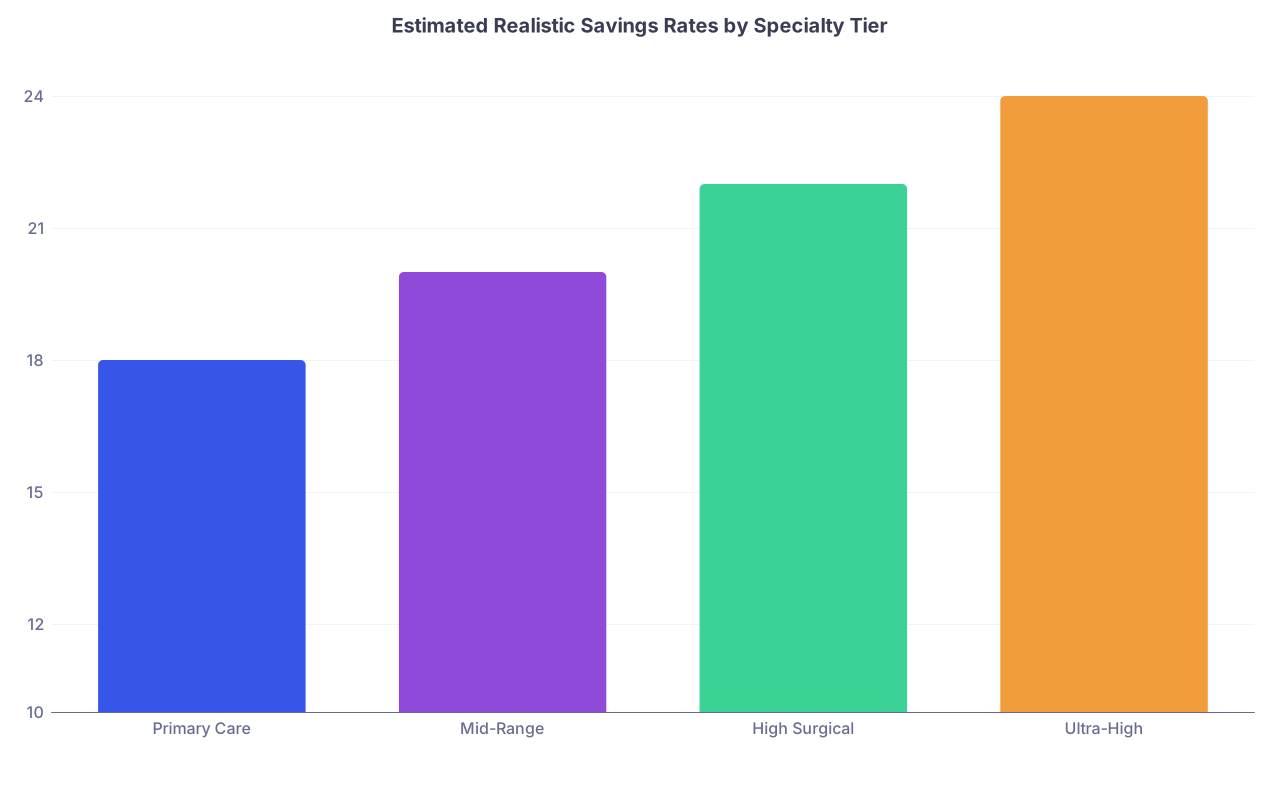
| Category | Value |
|---|---|
| Primary Care | 18 |
| Mid-Range | 20 |
| High Surgical | 22 |
| Ultra-High | 24 |
Those are percentages of gross income going to true long-term investing (401(k), 403(b), 457(b), Roth, after-tax brokerage contributions), not just loan payments.
3. Projected Nest Egg by Age 65: What the Data Suggests
Assume:
- Start serious saving at age 32.
- Retire at 65.
- Real (inflation-adjusted) return: 4–5%. I will use 4.5% as a middle ground.
The future value of annual savings S over n years at real return r:
FV = S × [((1 + r)^n − 1) / r]
Let’s take the midpoint income for each tier and multiply by the savings rate, then run 33 years of saving.
Tier 1: Primary Care
- Income midpoint: $275,000
- Savings rate: 18%
- Annual savings: ≈ $49,500
FV (33 years, 4.5% real):
Factor ≈ 94.6
Nest egg ≈ 49,500 × 94.6 ≈ $4.7M (in today’s dollars)
Tier 2: Mid-Range
- Income midpoint: $385,000
- Savings rate: 20%
- Annual savings: ≈ $77,000
Nest egg ≈ 77,000 × 94.6 ≈ $7.3M
Tier 3: High Surgical
- Income midpoint: $500,000
- Savings rate: 22%
- Annual savings: ≈ $110,000
Nest egg ≈ 110,000 × 94.6 ≈ $10.4M
Tier 4: Ultra-High
- Income midpoint: $725,000
- Savings rate: 24%
- Annual savings: ≈ $174,000
Nest egg ≈ 174,000 × 94.6 ≈ $16.5M
Visualizing these:
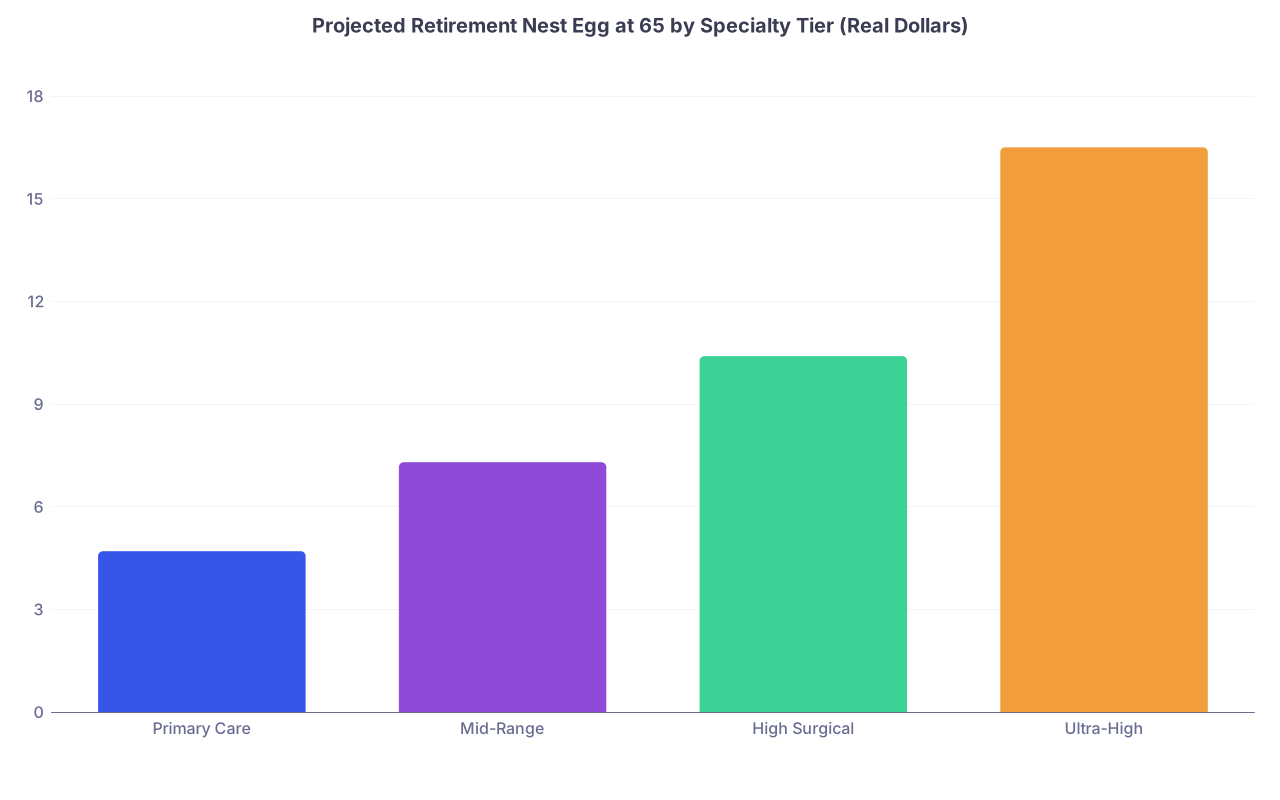
| Category | Value |
|---|---|
| Primary Care | 4.7 |
| Mid-Range | 7.3 |
| High Surgical | 10.4 |
| Ultra-High | 16.5 |
Millions, not thousands. That is what the math supports if you maintain those savings rates consistently, invest broadly, and avoid catastrophic mistakes.
The problem: many physicians are not actually hitting those savings rates. A 10% saver in any tier cuts those figures nearly in half.
4. How Much Is Enough by Specialty?
The other side of the equation: retirement spending.
Retirement spending is usually some fraction of peak working spending. Physicians in lifestyle-frugal fields often maintain a lower baseline. But as incomes grow with more competitive specialties, so do fixed costs: private schools, bigger houses, more travel, practice ownership overhead, extended family support.
Let’s assign a plausible target retirement spending (after-tax, in today’s dollars) for a “comfortable but not extravagant” lifestyle that matches typical physician expectations by tier:
- Tier 1 Primary Care: $120,000/year
- Tier 2 Mid-Range: $150,000/year
- Tier 3 High Surgical: $190,000/year
- Tier 4 Ultra-High: $240,000/year
These are not peak earning years’ spending. They are dialed-back targets in retirement.
At a 3.5% withdrawal rate (about 29x spending), needed portfolio size:
- Tier 1: 120k × 29 ≈ $3.5M
- Tier 2: 150k × 29 ≈ $4.4M
- Tier 3: 190k × 29 ≈ $5.5M
- Tier 4: 240k × 29 ≈ $7.0M
| Tier | Target Retirement Spending | Required Portfolio (3.5% SWR) |
|---|---|---|
| Primary Care | $120k | $3.5M |
| Mid-Range | $150k | $4.4M |
| High Surgical | $190k | $5.5M |
| Ultra-High | $240k | $7.0M |
Compare this with the projected nest egg figures if you save decently:
- Primary Care: Projected ≈ $4.7M vs Need ≈ $3.5M → Gap: +$1.2M (surplus)
- Mid-Range: ≈ $7.3M vs $4.4M → +$2.9M
- High Surgical: ≈ $10.4M vs $5.5M → +$4.9M
- Ultra-High: ≈ $16.5M vs $7.0M → +$9.5M
The data says: if you actually behave like a responsible saver for 30+ years, most specialties overshoot the retirement need by a wide margin.
But that is the theoretical world.
In the real world, I see three patterns that derail this:
- Lower actual savings rates (often 8–12% of gross, not 18–24%)
- Delayed or inconsistent saving (starting at 40, not 32; frequent pauses)
- Lifestyle inflation pushing desired retirement spending much higher
Let me show you how sensitive this is.
5. Impact of Savings Rate and Retirement Age by Specialty
Take an ultra-high income cardiologist starting at 32:
Scenario A:
- Savings rate 24% on $725k = $174k/year
- Save for 33 years (to 65), 4.5% real → ≈ $16.5M
Scenario B:
- Savings rate 12% on $725k = $87k/year
- Same horizon → ≈ $8.3M
Scenario C:
- Savings 12%
- Burnout → retire at 60 (28 years) → factor ≈ 73.7
- Nest egg ≈ 87k × 73.7 ≈ $6.4M
Now align that with spending:
If this cardiologist has normalized $350k/year in lifestyle and wants $250k/year in retirement, at 3.5% SWR that is about $7.1M needed. Scenario C is now tight. Scenario B is fine. Scenario A is overfunded.
You see the pattern: in high-income specialties, behavior dominates. In primary care, math is much tighter, but the baseline expectations for lifestyle (and sometimes retirement age) are often more modest.
Let me layer one more reality: earlier retirement.
6. Specialty-Specific Retirement Age Reality
The data from various physician surveys and Social Security records suggests:
- Many primary care docs go into part-time or lighter roles and extend into late 60s.
- Procedural/surgical fields see more 55–62 “soft retirements” because of physical and cognitive load.
- Hospital-based shift work (EM, anesthesia) is particularly prone to earlier burnout.
So we should not model everyone to 65. That is lazy analysis.
Rough realistic retirement age targets by specialty cluster, based on actual attrition patterns:
- Primary Care: retire or semi-retire age 65–68
- Cognitive subspecialties (rheum, endo, psych): 63–67
- Hospitalist / EM / Anesthesia: 58–62
- High-risk Surgery (ortho, neurosurg, trauma): 58–62
- Non-procedural radiology, pathology: 62–66
Here is the impact: shaving 5 years off saving at 4.5% real reduces final nest egg by ~25–30%.
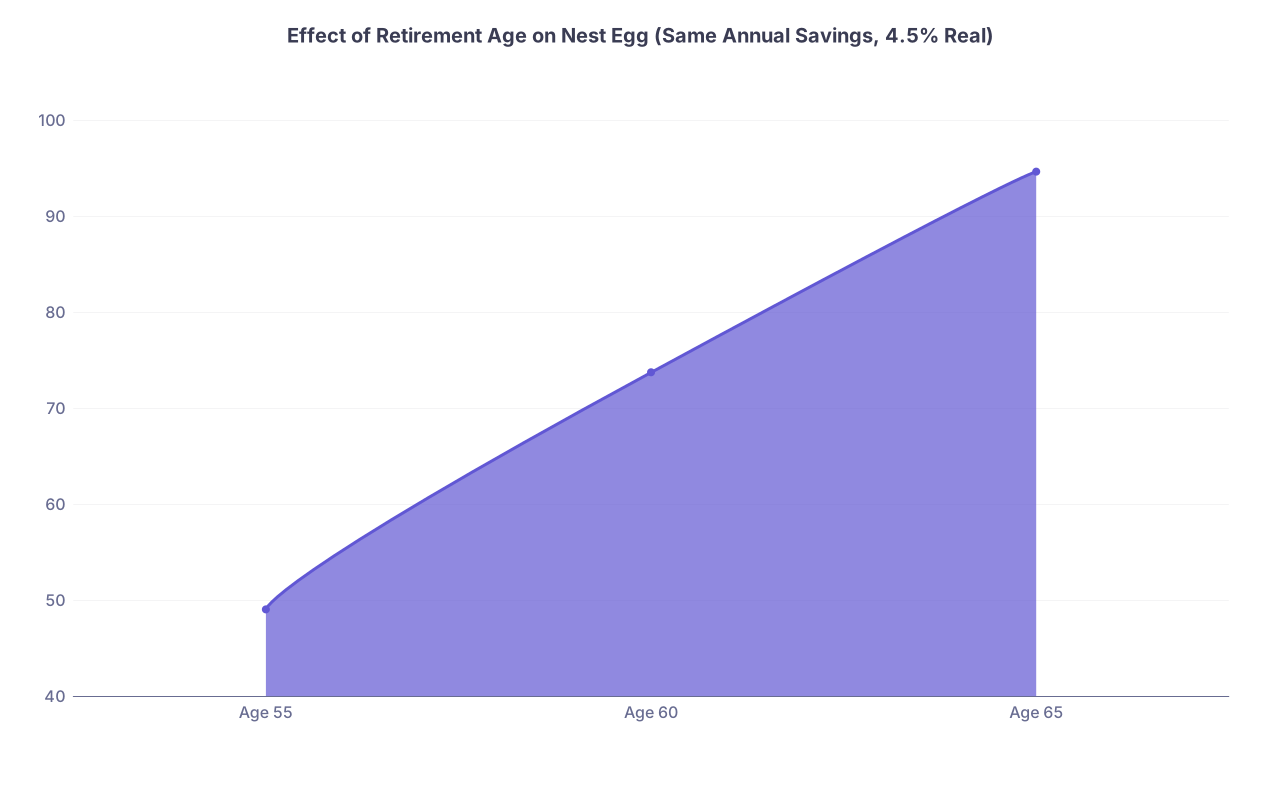
| Category | Value |
|---|---|
| Age 55 | 49 |
| Age 60 | 73.7 |
| Age 65 | 94.6 |
Those values are the “growth factor” for level annual contributions. Age 55 vs 65? Almost half the final nest egg.
So apply this to a realistic example:
Example: Emergency Medicine Physician
- Income: $400k
- Savings: 20% → $80k/year
- Start: age 32
- Retirement: very likely between 58–60
Two variants:
- Retire at 60: 28 years saving, factor 73.7 → nest egg ≈ $5.9M
- Retire at 58: 26 years, factor ≈ 63.1 → ≈ $5.0M
If the EM doc wants $160k/year in retirement, need ≈ $4.6M at 3.5% SWR. They are ok. If lifestyle is $220k/year, need ≈ $6.3M. Now it is tight, especially with earlier retirement.
This is why EM and other shift-based, burnout-heavy fields need higher savings rates earlier than a pediatrician who is likely to work longer in a less physically brutal way.
7. Social Security, Practice Equity, and Other Offsets
So far I have treated the portfolio as the sole source of retirement income. That is intentionally conservative but hides some nuance.
For most U.S. physicians:
- Social Security will replace somewhere between $30k and $45k per year in today’s dollars (higher if you maximize taxable wages over 35+ years, lower if late start or more 1099 income with poor SE tax planning).
- Some will have defined benefit pensions (VA, academic systems, older hospital contracts).
- Practice sale or buyout can add a one-time lump sum or annuity.
Let us quantify Social Security for a typical dual high-income household:
- Physician + spouse both work, decent but not max SS earnings.
- Combined benefit at full retirement age: say $50–60k/year (real).
That $60k/year is the equivalent of ~ $1.7M of portfolio at 3.5% SWR.
So a Tier 2 doc targeting $150k/year may only actually need to cover $90–100k/year from the portfolio, not the full $150k. That cuts the portfolio need from ~$4.4M to $2.6–2.9M.
However, physicians often front-load their peak standard of living above what Social Security fills. If you are used to $300k/year net lifestyle and want $220k in retirement, SS covering $60k still leaves a $160k gap → $4.6M portfolio.
The point: Social Security softens the landing but does not give most physicians an excuse to undersave.
8. Specialty-Specific Retiree Profiles: Where the Gaps Actually Are
Let me sketch what the data tends to show in practice, after you control for income and savings behavior.
Primary Care (FM, IM, Peds)
- Typical retirement age: later (65+), mixed full/part time tapering.
- Retirement lifestyle target: moderate, often <$120k/year.
- Real risk: under-saving in early years due to student loans, late ramp-up.
- Projection: If saving 15–18% from early 30s, most hit or slightly exceed their needed number, especially with Social Security. The truly frugal PCP can retire comfortably on $3–4M.
Cognitive Subspecialties (Rheum, Endo, Heme/Onc, Psych)
- Incomes mid to high-mid ($350–500k).
- Retirement age: somewhat later than proceduralists.
- Risk: practice ownership volatility, variable call burden.
- Projection: With 20%+ savings, very likely to overshoot needs. Problems occur when lifestyle scales aggressively to high incomes and savings lag.
Hospital-Based Shift Work (EM, Anesthesia, Hospitalist)
- Incomes solid mid-range to high.
- Retirement age: compressed by burnout to 55–62.
- Risk: fewer years of compounding and sometimes poor savings discipline because “there is always time later.”
- Projection: These specialties must front-load saving (20–25%+), or they will hit 55 with a portfolio that mathematically forces them to either (a) work longer in a role they hate or (b) accept a much lower lifestyle.
Surgical / Procedural (General Surg, OB/GYN, Ortho, Neuro, ENT, GI, Cards, Urology)
- Incomes high to very high, especially in private practice.
- Retirement age: often surprisingly early. Shoulders, backs, and call do not care about your spreadsheets.
- Risk: over-reliance on practice value, underestimation of burnout.
- Projection: If they behave like average Americans (savings ~10%), they will not be remotely close to funding the lifestyle they think they deserve post-retirement. If they behave like high-income professionals (25–30% saving), they will end up with very large surpluses and high optionality in their 50s.
Radiology / Pathology
- Incomes high but with some reimbursement and job-market uncertainty.
- Retirement age: moderate; less physically brutal, can extend into late 60s with part-time or teleradiology.
- Risk: complacency due to good pay and manageable work, leading to undersaving.
- Projection: Mathematically one of the easiest combos for financial independence if savings rate is even modestly aggressive.
9. Pulling It Together: Are Physicians On Track?
You can ask a simpler question: given typical physician behavior, how many are actually on track?
Surveys of physicians in their 50s often show:
- 25–30% have < $1M in retirement accounts.
- A big cluster around $1–3M.
- A minority with $3–5M+.
If a 55-year-old physician has $1.5M invested and wants $180k/year from age 65 to 95, here is the math:
- Need ≈ $5.2M (3.5% SWR × 180k).
- They have $1.5M.
- With 10 years to go, at 4.5% real, $1.5M → ≈ $2.3M.
- To hit $5.2M, they must add new savings that grow to ≈ $2.9M over 10 years.
- Annual contributions required: Solve S × factor (10 years) where factor ≈ 12.2 → S ≈ 2.9M / 12.2 ≈ $238k/year.
That is about the entire after-tax income of many mid-range physicians. So no, most are not suddenly catching up in their 50s. The data shows that if you are behind by 50, it is very hard to fully correct without major lifestyle cuts or working much longer.
10. Practical Targets by Specialty: Hard Numbers
Let me give you hard, data-informed targets by mid-career stage. These are “you are probably on track” portfolio checkpoints (not including home equity), assuming retirement near 65 and 3.5% SWR.
| Tier | Age 40 Target | Age 50 Target | Age 60 Target |
|---|---|---|---|
| Primary Care | $400k–$700k | $1.1M–$2.0M | $2.2M–$3.5M |
| Mid-Range | $600k–$1.0M | $1.8M–$3.0M | $3.5M–$5.0M |
| High Surgical | $800k–$1.4M | $2.5M–$4.0M | $4.5M–$6.5M |
| Ultra-High | $1.0M–$1.8M | $3.0M–$5.5M | $6.0M–$9.0M |
These ranges assume a 15–25% savings rate starting near 32 and consistent investing into diversified stock/bond portfolios.
If you are significantly under the low end of your range by age 50, the data is clear: your future self will not be thrilled unless you change one of the following:
- Raise savings rate dramatically.
- Push retirement age out several years.
- Lower expected retirement lifestyle.
That is basically your three-variable equation. Income level (specialty) sets the ceiling, but your personal behavior writes the actual story.
11. Actionable Takeaways by Specialty Cluster
I will keep this short and blunt.
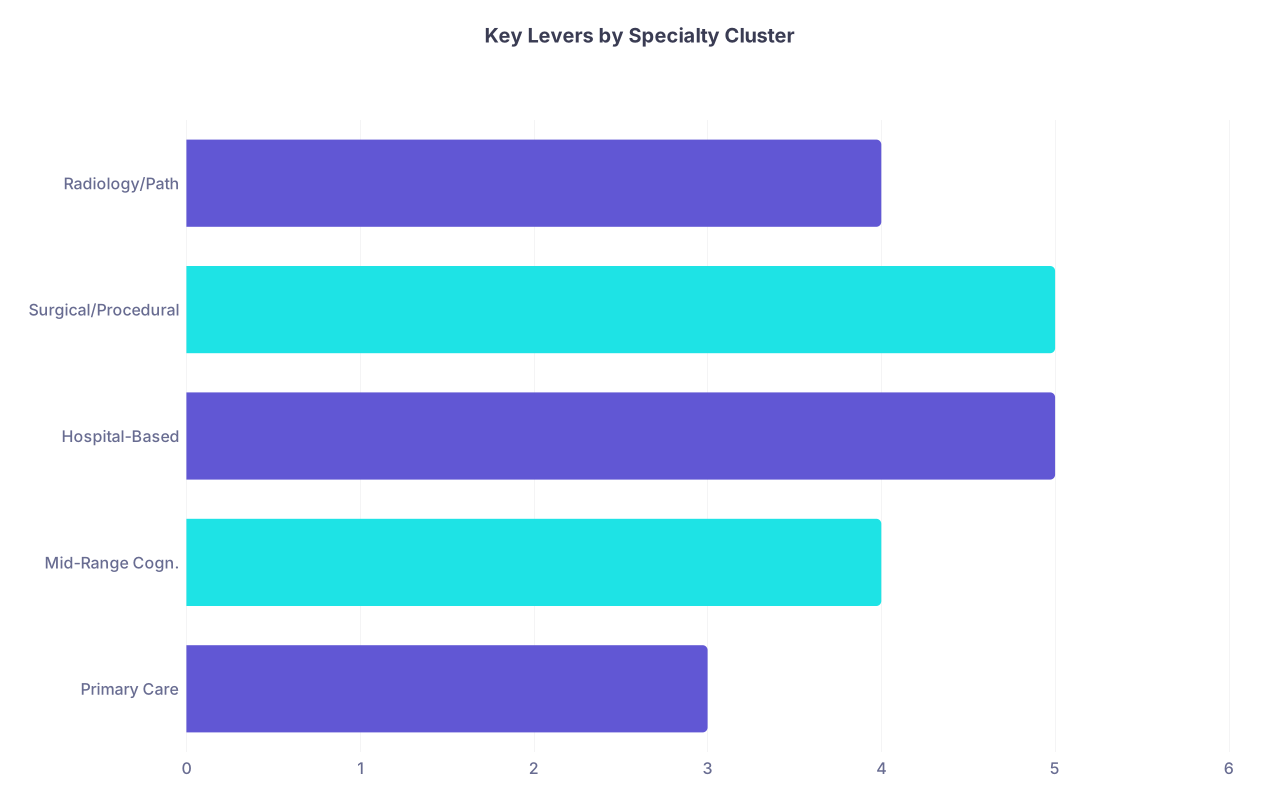
| Category | Value |
|---|---|
| Primary Care | 3 |
| Mid-Range Cogn. | 4 |
| Hospital-Based | 5 |
| Surgical/Procedural | 5 |
| Radiology/Path | 4 |
Values here reflect “urgency of aggressive early saving” on a 1–5 scale.
- Primary Care: You do not have a lot of fat in the system. Aim for 20%+ savings early. Control housing and car spending. Work longer if needed; your field allows it.
- Mid-Range Cognitive: You have some margin. Use it. 20–25% savings and avoid lifestyle traps; you will be fine.
- Hospital-Based (EM, Anesthesia, Hospitalist): Front-load 25–30% savings from day one. Plan for retirement or serious hours reduction by 58–60. Your body and brain are not infinite.
- Surgical / Procedural: Your income is a weapon—or a trap. Act like a high earner, not a high spender. Save 25–35% in your prime years and you can buy back your time in your 50s.
- Radiology / Pathology: Quietly one of the strongest positions for wealth building. Do not coast. A consistent 20–25% savings rate will give you enormous flexibility.
FAQ (Exactly 3 Questions)
1. How much should a physician target as a retirement portfolio number, on average?
For most physicians, the realistic target falls between $3.5M and $7M in today’s dollars, depending on specialty and lifestyle. Primary care physicians with modest retirement spending might be fine at $3–4M. High-income specialists who want a high-end lifestyle and earlier retirement often require $6–8M or more. Use 25–30x your desired annual retirement spending (not your current income) as a starting point, then adjust for Social Security and any pension income.
2. Is the “4% rule” safe for physicians, or should they use a different withdrawal rate?
Physicians who retire in their early 60s or later can often use something close to 3.5–4% as a starting point, especially with flexible spending and a diversified portfolio. Those who retire in their 50s, or who expect a 40+ year retirement horizon, should plan nearer to 3% to reduce sequence-of-returns risk. In practice, dynamic withdrawal strategies (tightening spending after bad market years) tend to work better than a rigid fixed percentage.
3. Do physicians need to invest differently by specialty for retirement?
The portfolio structure (high global equity exposure early, gradually adding bonds with age) does not change dramatically by specialty. What changes is savings rate, retirement age, and risk capacity. Shorter careers with higher burnout risk (EM, surgical fields) benefit more from aggressive early saving and avoiding speculative investments that could derail the plan. Longer-working specialties can tolerate somewhat more variability, but all physicians benefit more from consistent contributions and low-cost indexing than from trying to outsmart the market.
Key points: Physician retirement needs are driven more by spending, savings behavior, and retirement age than by specialty income alone; most generic rules underestimate the capital required for long, high-lifestyle retirements; and the data shows that early, aggressive, specialty-aware saving is the single most reliable lever for closing the retirement gap.