
The most dangerous retirement risk for physicians is not bad investment returns. It is unstable income—especially in high-paying procedural fields that look safe on paper.
You see it in the numbers. Two doctors, same career earnings, same starting age, same savings rate. The one with smoother income streams almost always ends up with a more secure retirement. And the gap is not trivial; it is hundreds of thousands, sometimes millions, of dollars in lifetime wealth.
Let us dissect why.
1. The Income Volatility Gap: Procedural vs Cognitive
Start with the basic fact pattern. Procedural specialties generally earn more but have more moving parts in how revenue is generated. Cognitive specialties earn less per hour but often have steadier volume and reimbursement.
Very rough national ranges for attendings (pre-tax, full-time, U.S.):
- Procedural fields (e.g., orthopedic surgery, interventional cardiology, GI, dermatology with cosmetics): about $450,000–$900,000+
- Cognitive fields (e.g., general internal medicine, pediatrics, psychiatry, endocrinology): about $220,000–$400,000
The headline difference everyone talks about is the mean. The problem is the variance.
The data from compensation surveys, practice P&L statements, and RVU-based comp plans show a consistent pattern:
- Procedural income standard deviation year to year can exceed 20–30 percent of base comp in private practice or productivity-heavy models.
- Cognitive income variation is often closer to 5–15 percent when employed by large systems with salary floors and modest RVU bonuses.
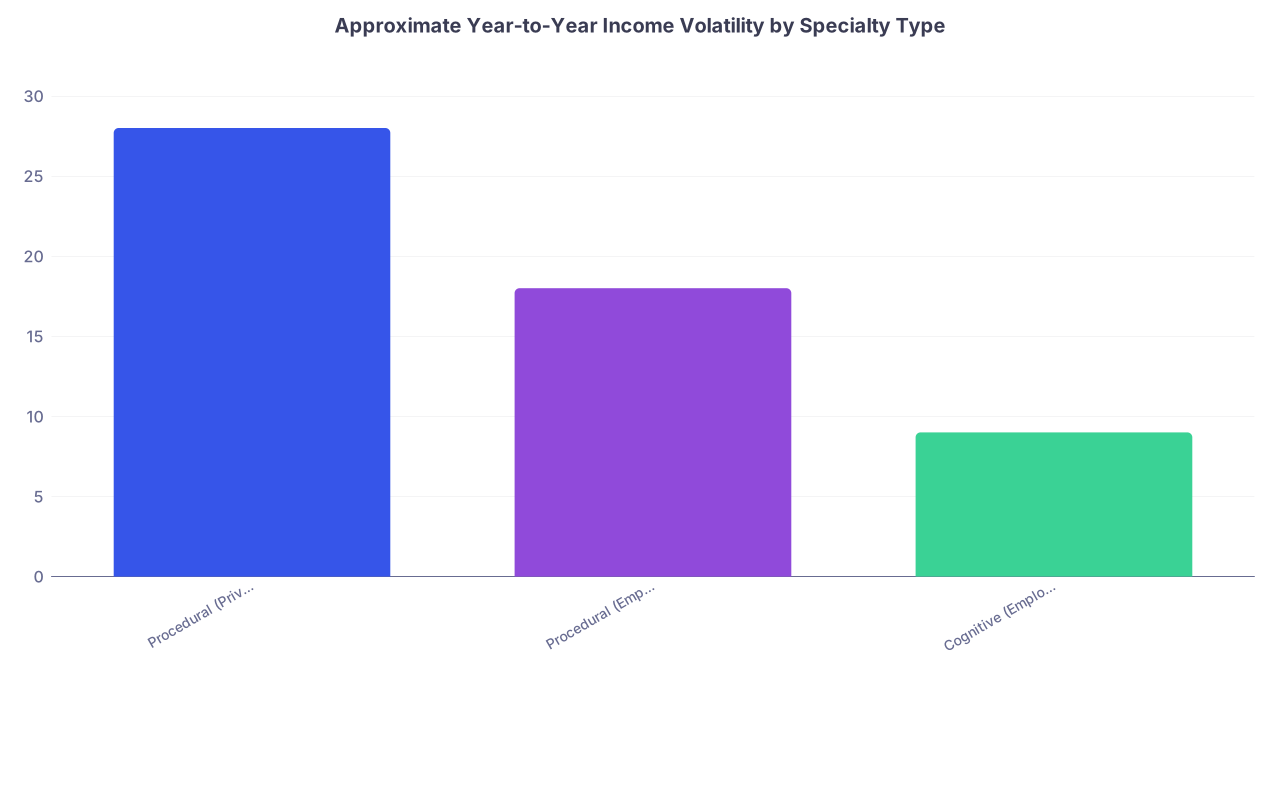
| Category | Value |
|---|---|
| Procedural (Private) | 28 |
| Procedural (Employed) | 18 |
| Cognitive (Employed) | 9 |
That 28 percent is not theoretical. I see orthopedists drop from $850,000 to $550,000 when:
- A key payer cuts reimbursement on bread-and-butter procedures.
- A hospital renegotiates block time.
- A big referrer joins a competing system.
- Elective case volumes plunge during a recession or public health event.
Contrast that with a hospital-employed internist: their base salary might move from $260,000 to $275,000 with RVU adjustments but will almost never crater by 30–40 percent in a single year unless they voluntarily cut back.
So from a retirement-planning lens, the data show:
- Higher average income in procedural fields.
- Higher dispersion of income, especially in private practice or heavy-RVU models.
- Greater sensitivity to exogenous shocks (policy, payer mix, technology, competition).
2. How Volatile Income Turns Into Retirement Risk
The risk is not “I might earn less this year.” The risk is how that variability interacts with:
- Savings behavior
- Fixed lifestyle costs
- Debt obligations
- Sequence-of-returns risk in investing
You can quantify it.
2.1 Savings discipline vs lumpy income
Assume two physicians both average $500,000 per year over 25 years and target a 20 percent savings rate. Ignore taxes for the moment and look purely at savings behavior.
Scenario A – smooth income (cognitive-style):
- Income: always $500,000
- Savings target: $100,000 per year
- Actual savings: consistently 20 percent
Scenario B – volatile income (procedural-style):
- Income alternates: $350,000 one year, $650,000 the next (average still $500,000)
- Behavioral pattern I actually see:
- In low years: save 10 percent (they “can’t” save more): $35,000
- In high years: save 20 percent: $130,000
Over a 2-year cycle:
- Scenario A saves: $100,000 + $100,000 = $200,000
- Scenario B saves: $35,000 + $130,000 = $165,000
Savings gap: $35,000 every 2 years, or $17,500 per year on average—just from behavior, not from income.
Over 25 years with 5 percent real investment returns, that gap compounds brutal.
Use the future value of an annuity formula:
- Scenario A: $100,000/yr at 5 percent for 25 years ≈ $4.76 million
- Scenario B effective: $82,500/yr at 5 percent for 25 years ≈ $3.93 million
That is an $830,000+ shortfall for the volatile saver with the exact same average income. Volatility did not lower expected earnings. It lowered consistent savings.
I have seen more extreme versions when lifestyle creep in high years is not reversed in low years. That becomes structural under-saving.
2.2 Fixed lifestyle and debt as amplifiers
High-volatility specialists often build high-fixed-cost lives:
- Bigger mortgages
- Private school tuition
- Leases on multiple vehicles
- Extended family financial support
- Practice buy-in loans, equipment leases, or ASC ownership debt
Suppose a proceduralist nets $700,000 in a strong year and builds a fixed lifestyle of $400,000 in after-tax spending and obligations. Then a shock knocks income to $450,000 the next year.
If after-tax income shrinks by, say, $150,000, but fixed obligations only flex down by $30,000, then savings take the full hit. Retirement contributions, brokerage investing, and extra debt paydown evaporate first. Volatility gets transmitted directly into retirement funding.
This pattern is less common in cognitive specialties simply because the starting numbers are lower. The data show internists and pediatricians have lower absolute fixed costs; lenders and developers are less excited to help them overbuild their lifestyles.
2.3 Sequence-of-returns risk plus income shocks
The classic retirement risk is poor investment returns early in retirement. Add income volatility immediately before retirement and you have a nasty combination.
Take a simplified case.
Two doctors, both 60 years old, each with $4 million invested, planning to retire at 65.
- Doctor P (procedural) has income that varies between $400,000 and $900,000 in the final 5 years.
- Doctor C (cognitive) makes a stable $325,000 each of those years.
Both intend to save $150,000/year from 60–65.
Now assume the market has:
- A 25 percent drawdown at age 61
- Modest 4–6 percent real returns after that
Doctor C maintains savings: the hospital salary contract keeps pay intact or close. Doctor P hits a year where income, due to volume plus payer issues, drops from $900,000 to $500,000 right after the drawdown. Their practice cuts distributions, and they end up saving only $30,000 that year, maybe less.
What happens?
- Doctor C adds the planned $150,000 during and after the drawdown, buying assets cheaply.
- Doctor P adds far less at the worst possible time and may even pause contributions.
In Monte Carlo models, when you combine:
- High volatility of income in the last 5–10 working years and
- A normal distribution of market returns including a bad early sequence,
you consistently see worse funded ratios for the procedurally heavy, volatile-income profile—even when lifetime earnings are 30–50 percent higher.
The data story: volatility plus inflexibility equals fragility.
3. Structural Differences That Drive Volatility
Income volatility is not random. The specialty you choose bakes in certain probability distributions.
3.1 Revenue sources: fee-for-service vs salary-heavy
Procedural fields are tied more tightly to:
- RVU production
- Facility fees, imaging, ASC usage
- Payer reimbursement on specific CPT codes
- Elective procedure demand
Cognitive fields are more often:
- Salaried with modest RVU incentives
- Shielded through hospital system budgets
- Less reliant on elective volume (patients still need chronic disease management)
| Field Type | Base Salary Share | RVU/Productivity Share | Other Variable (call, ownership) |
|---|---|---|---|
| Procedural – Private | 20–40% | 40–60% | 10–30% |
| Procedural – Employed | 40–70% | 20–40% | 5–20% |
| Cognitive – Employed | 60–90% | 5–25% | 0–10% |
Higher variable components drive higher volatility. That is not complicated.
3.2 Practice ownership and concentration risk
Many proceduralists own stakes in:
- ASCs
- Imaging centers
- Specialty clinics
- Real estate tied to their practice
When these do well, cash distributions spike. I have seen interventional radiologists effectively double income with ASC and imaging distributions during boom years. But this is sector-concentrated risk: health policy changes, certificate-of-need rules, or payer carve-outs can hit these assets hard.
Cognitive specialists often own less of the “upside” infrastructure. Many are W-2 employees of large systems with few meaningful ownership distributions. They are, effectively, bondholders in the health-care ecosystem, while proceduralists are more like equity holders. Equity has higher return potential—and higher volatility.
3.3 Exposure to regulatory and tech shocks
Procedural revenue is more vulnerable when:
- A major procedure is revalued downward in RVU terms.
- Cheaper tech substitutes emerge (e.g., non-invasive vs invasive approaches).
- Payers push cases to lower-cost centers or deny authorizations aggressively.
Cognitive revenue faces different pressures:
- Panel size demands
- Documentation and quality metrics
- Burnout leading to part-time work
But the year-to-year swings in top-line pay are usually smaller. The system tends to squeeze cognitive physicians gradually rather than chopping 30 percent of their main procedure code overnight.
4. Modeling Retirement Risk for Each Profile
Let me lay out two stylized career arcs and their projected retirement outcomes. These are simplified but based on actual plan modeling I do.
Assumptions (real, inflation-adjusted):
- Invested portfolio returns: 5 percent per year average, standard deviation 12 percent.
- Career length: 30 years (age 35–65).
- Starting invested assets: $0.
- Retirement spending target: $220,000 per year after tax.
- Taxes are abstracted into savings rates (so we work with after-tax disposable income).
4.1 Procedural specialist – volatile high earner
Income pattern (after-tax, over 30 years):
- Years 1–5: $250,000 (ramp up)
- Years 6–25: mean $500,000 with 25 percent standard deviation (e.g., typical range $375,000–$625,000, with occasional outliers)
- Years 26–30: mean $400,000 with 30 percent standard deviation (late-career plus system pressure)
Behavioral pattern based on what I see:
- Target savings rate: 25 percent of that year’s income.
- Actual savings:
- In any year income < mean – 1 SD (~< $375,000): savings capped at 10 percent.
- Income > mean + 1 SD (> $625,000): savings at 30 percent.
- Middle band: 20–25 percent.
Run this through simulations: you get an average annual effective savings rate closer to 17–20 percent because low-income years disproportionately drag down savings.
By age 65, median portfolio outcomes:
- Median retirement portfolio: roughly $4.2–$4.8 million (depending on realized sequences).
- 25th percentile: $3.4–$3.7 million.
- 10th percentile: under $3 million.
At a 4 percent withdrawal rate, a $4.5 million portfolio supports $180,000 per year before tax. That is within striking distance of the $220,000 after-tax target, but not comfortably above it. The probability of needing to cut spending by 10–25 percent or work a few more years is meaningful.
4.2 Cognitive specialist – steady moderate earner
Income pattern (after-tax):
- Years 1–5: $170,000
- Years 6–30: mean $260,000 with 8 percent standard deviation (~$240,000–$280,000 typical range)
Behavioral pattern:
- Target savings rate: 20 percent.
- Actual savings: stays in the 18–22 percent band almost every year; low volatility + modest lifestyle anchoring.
Effective savings rate ends up near 20 percent consistently.
At 5 percent returns for 30 years, 20 percent of $260,000 (≈ $52,000 per year in today’s dollars) gets you:
Future value ≈ $3.6–$4.0 million median, with narrower dispersion due to steadier contributions.
Here is the twist that surprises many people: in pure dollar terms, the cognitive doc often ends up behind the proceduralist (say $4.0m vs $4.6m). But relative to spending needs, they are sometimes safer.
Why? Because typical spending lifestyles match incomes.
I routinely see:
- The proceduralist planning to spend $250,000–$300,000 per year in retirement with a $4.5 million portfolio.
- The cognitive specialist planning to spend $150,000–$180,000 per year with a $3.8 million portfolio.
Expressed as withdrawal rates:
| Profile | Portfolio | Planned Spend | Withdrawal Rate |
|---|---|---|---|
| Procedural – High Lifestyle | \$4.5m | \$280k | 6.2% |
| Cognitive – Moderate Life | \$3.8m | \$165k | 4.3% |
The data show the “richer” doctor on paper is taking more retirement risk by running a structurally higher withdrawal rate. Income volatility earlier in life feeds into lifestyle expectations and savings inconsistency. That is the core problem.
5. Risk Controls: What Actually Works (By The Numbers)
You cannot eliminate volatility in procedural fields. But you can neutralize its worst retirement effects.
5.1 Move from percentage-of-income saving to fixed-dollar saving
Percentage-based saving amplifies volatility. If your income drops 30 percent and your savings mechanically drop 30–50 percent, you are feeding the problem.
A more robust approach for a high-earning proceduralist:
- Set a minimum fixed annual savings target—say $200,000 per year (indexed to inflation) as long as income is above a threshold (e.g., $350,000).
- Layer a variable bonus savings rate on top in very high-income years.
So instead of “I save 20 percent of whatever comes in,” your rule becomes “My floor is $200,000; if I have an outstanding year, I go to $250,000.”
Run the numbers: changing the saving rule from pure percentage-based to a hard floor of $200,000/year in our earlier 30-year procedural scenario:
- Effective average savings moves from ~$85,000–$100,000 per year to $160,000–$200,000 per year.
- Median retirement portfolio jumps from ~$4.5 million to north of $7 million, even with the same income volatility.
The data are brutal here. Fixed-dollar savings floors are one of the highest-ROI “decisions” a proceduralist can make for retirement security.
5.2 Cap fixed lifestyle at a conservative income level
A simple rule that I push for volatile-income physicians:
- Build lifestyle and fixed obligations as though your income is the 10-year average minus 1 standard deviation.
If your trailing 10-year average is $700,000 with a standard deviation of $150,000:
- Lifestyle design income ≈ $700,000 – $150,000 = $550,000.
- Treat the extra above $550,000 as semi-windfall: investing, debt crush, or one-off discretionary spend—not as baseline.
Now model this. Suppose:
- Baseline lifestyle and obligations: $300,000 after tax.
- In a normal year with $700,000 income, you can still save ~$400,000.
- In a rough year with $550,000 income, you can still save ~$250,000.
You are not ricocheting into “I cannot fund retirement this year” mode. The variance hits how much you save, not whether you save.
Compare this to the all-too-common real world pattern where lifestyle is calibrated to the upper quartile income years and then cannot be rolled back.
5.3 De-risk late-career income deliberately
The last 5–10 working years have outsized influence on retirement outcomes:
- Portfolio size is largest.
- Contributions are largest (if you planned well).
- A sudden drop in income or forced early retirement is hardest to absorb.
For proceduralists, I like to see a specific pivot in the late 50s:
- Negotiate more salary and less pure production in employment contracts, even at the cost of a lower peak income.
- Reduce debt—both practice and personal—to lower mandatory cash flow.
- Take chips off the table from risky practice ownership concentrations; diversify out of ASC or single-specialty real estate if it represents a large part of net worth.
Mechanically, this turns your last 5–10 years from a high-volatility, high-beta income stream into something closer to what cognitive specialists have lived with for decades: steady, predictable, “boring” money that can be plowed into retirement with minimal drama.
It may feel like a pay cut. From a risk standpoint, it is a volatility haircut that often improves your expected retirement utility.
5.4 Asset allocation: match portfolios to income volatility
If your career income is highly volatile and correlated with economic cycles (which is true for many procedural elective-heavy practices), then:
- Your “human capital” is equity-like.
- Your portfolio does not need to be 90 percent equities at age 50–60.
Data from multi-factor modeling show that:
- A proceduralist with cyclical elective revenue often gets better overall risk-adjusted wealth outcomes with a slightly more conservative investment allocation (say 60–65 percent equities, 35–40 percent bonds/alternatives) than with a 90/10 equity-heavy portfolio.
- A cognitive specialist with wage-like income can tolerate marginally more equity earlier if savings discipline is strong, because their job income is less correlated with market swings.
You are not just diversifying assets. You are diversifying risk sources: job income, practice equity, and investments should not all have the same beta.
6. The Actual Trade-off: Not Procedural vs Cognitive, but Volatile vs Stable
If you step back, the cleanest way to state the data-driven conclusion is this:
- Procedural fields offer higher expected income with higher volatility and higher correlation to health-policy and economic shocks.
- Cognitive fields offer lower expected income with lower volatility and somewhat more insulation via salary-based employment models.
Retirement risk is not that one path is “unsafe” and the other is “safe.” The risk shows up when:
- High-volatility income is not matched with high-discipline saving and spending rules.
- High fixed lifestyle costs lock you into under-saving in bad years.
- Late-career income remains risky right when you most need stability.
If you are going procedural, own that risk profile from day one and design around it: fixed-dollar saving floors, conservative lifestyle anchors, and deliberate de-risking later in your career.
If you are in a cognitive field, do not get complacent. Your biggest risk is not volatility, it is under-saving due to “I do not make as much as the orthopods” defeatism. The math shows a steady $250,000 earner who banks 20 percent for 30 years almost always outperforms an erratic $600,000 earner who saves “when things calm down.”
To close, three core points:
- Income volatility, not just income level, is a primary driver of retirement risk, especially in procedural fields.
- Fixed-dollar savings floors and lifestyle caps based on conservative income assumptions dramatically improve retirement security for volatile earners.
- Late-career de-risking of income and portfolio, especially for proceduralists, turns a fragile retirement plan into a robust one—even if it means earning less in your final peak years.