
The way most physicians approach retirement in their first five years is dangerously naive.
You’re earning more than you ever have. You’re exhausted. And you’re one or two sloppy decisions away from losing millions of future dollars without even realizing it. I’ve watched smart, well-trained doctors do exactly that.
Let’s walk through the seven big retirement mistakes physicians make early in their careers—and how to avoid stepping on those landmines.
1. Treating Retirement as “Future You’s Problem”
The biggest mistake is psychological, not mathematical: acting like retirement is a distant, abstract event that can be “fixed later.”
Here’s what I’ve heard from new attendings more times than I can count:
- “Let me just get my loans under control first.”
- “I’ll start maxing out once I’m making partner.”
- “I need to settle into the new job before I worry about that.”
Translation: “I’m kicking this can down the road because I’m overwhelmed.”
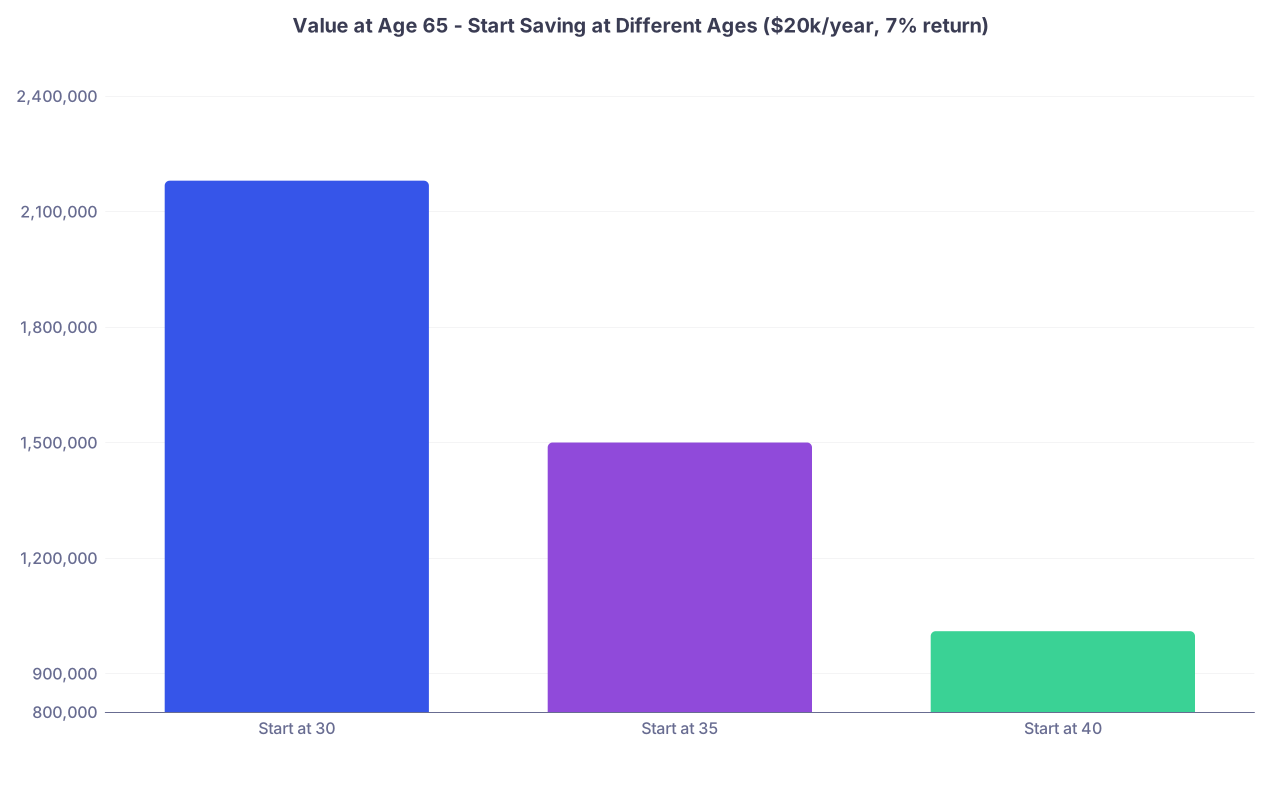
The problem is compounding does not care that you’re tired. Every year you delay meaningful retirement saving in your 30s is brutal. You don’t just lose that year’s savings; you lose decades of growth.
| Category | Value |
|---|---|
| Start at 30 | 2180000 |
| Start at 35 | 1500000 |
| Start at 40 | 1010000 |
Those are ballpark numbers, but they tell the story. Waiting from 30 to 40 to take retirement seriously can easily cost you over a million dollars in future money.
How physicians mess this up
You’re unique because your real earnings start late. You’ve already lost 8–10 years of compounding compared to your engineer or finance friends. You can’t afford another 5 years of “I’ll get to that.”
Common early-career traps:
- Focusing only on loan payments and minimum 401(k) match
- Letting lifestyle inflate to match income, then saying “there’s nothing left to save”
- Assuming future higher income will magically catch up your retirement later
That last one is the most dangerous lie. Future higher income usually comes with:
- Bigger house
- Private school
- Aging parents needing help
- Maybe a divorce settlement if you really want to spice things up
If you do not build the retirement habit in the first 5 years, odds are you will always feel “too squeezed” to fully fund it.
How to avoid this mistake
Set a hard rule for yourself:
“From my first attending paycheck, at least 15–20% of gross income goes toward retirement accounts.”
Not after bonuses. Not “if the month goes well.” As a fixed part of your financial life.
If your employer offers a 401(k)/403(b) with match, start there. Then add:
- Backdoor Roth IRA (if appropriate)
- 457(b) if you have a good one
- Taxable brokerage once the tax-advantaged buckets are reasonably filled
Do not wait to “learn everything” before starting. Start with simple, boring investments and refine later. The biggest win is starting now, not being fancy.
2. Ignoring the Power (and Limits) of Tax-Advantaged Accounts
Physicians love to panic about taxes but then ignore the most basic tax tools sitting right in front of them.
I’ve seen attendings earning $350k leave $30k–$40k of tax-advantaged space unused each year because “HR emails are annoying” or “I didn’t really understand the options so I just skipped it.”
That’s like walking past free OR staff and choosing to operate alone.

The common rookie errors
Not maxing primary retirement accounts
Skimming the HR packet and picking a random contribution number like $500/month. For a high-income physician, that’s laughably low.
Not understanding 401(k)/403(b) vs 457(b)
I routinely see docs think “457 is just another 401(k)” and either:- avoid it completely out of confusion, or
- overuse a risky non-governmental 457(b) without understanding the creditor risk.
Thinking a taxable account is “just as good”
It’s not. You’re voluntarily giving up massive tax-deferral advantages because you couldn’t be bothered to fill out a form.
Rough idea of how much space you’re probably wasting
| Account Type | Annual Limit (Approx) | Who Can Use It |
|---|---|---|
| 401(k) / 403(b) | $23,000 employee | Most hospital-employed docs |
| 457(b) | $23,000 employee | Many academic / non-profit |
| Backdoor Roth IRA | $7,000 per person | Most high-income physicians |
| HSA (if eligible) | $8,300 family | High-deductible plan holders |
You may not have all of these, but you likely have more than one.
How to avoid this mistake
Your first 5 years, your default should be:
- Max the 401(k)/403(b) every single year
- Strongly consider 457(b) if it’s governmental or your job stability is high
- Do backdoor Roths for you (and spouse if applicable)
- Use HSA as a stealth retirement account if you have one and can cashflow medical costs
Do not get perfectionistic about this. The mistake isn’t picking a target-date fund instead of building the “perfect” three-fund portfolio. The mistake is leaving $23,000 of tax-advantaged space empty because you procrastinated.
3. Getting Seduced by Lifestyle Before You’ve Built a Base
You knew this one was coming. Lifestyle creep kills more retirements than bad investments ever will.
Every year, I see some version of this:
Year 1: “I’ve been suffering for a decade, I deserve a nice place.”
Year 2: “Interest rates are low, let’s buy the forever house.”
Year 3: “We need two new cars, daycare, and maybe a vacation home near the ski resort.”
Year 4–5: “I’m making $400k; how am I still living paycheck to paycheck?”
You’re not a bad person for wanting comfort. You are, however, sabotaging your 65-year-old self if you lock in massive fixed costs before your retirement savings rate is solid.
| Category | Value |
|---|---|
| 10% Saved | 35 |
| 20% Saved | 25 |
| 30% Saved | 20 |
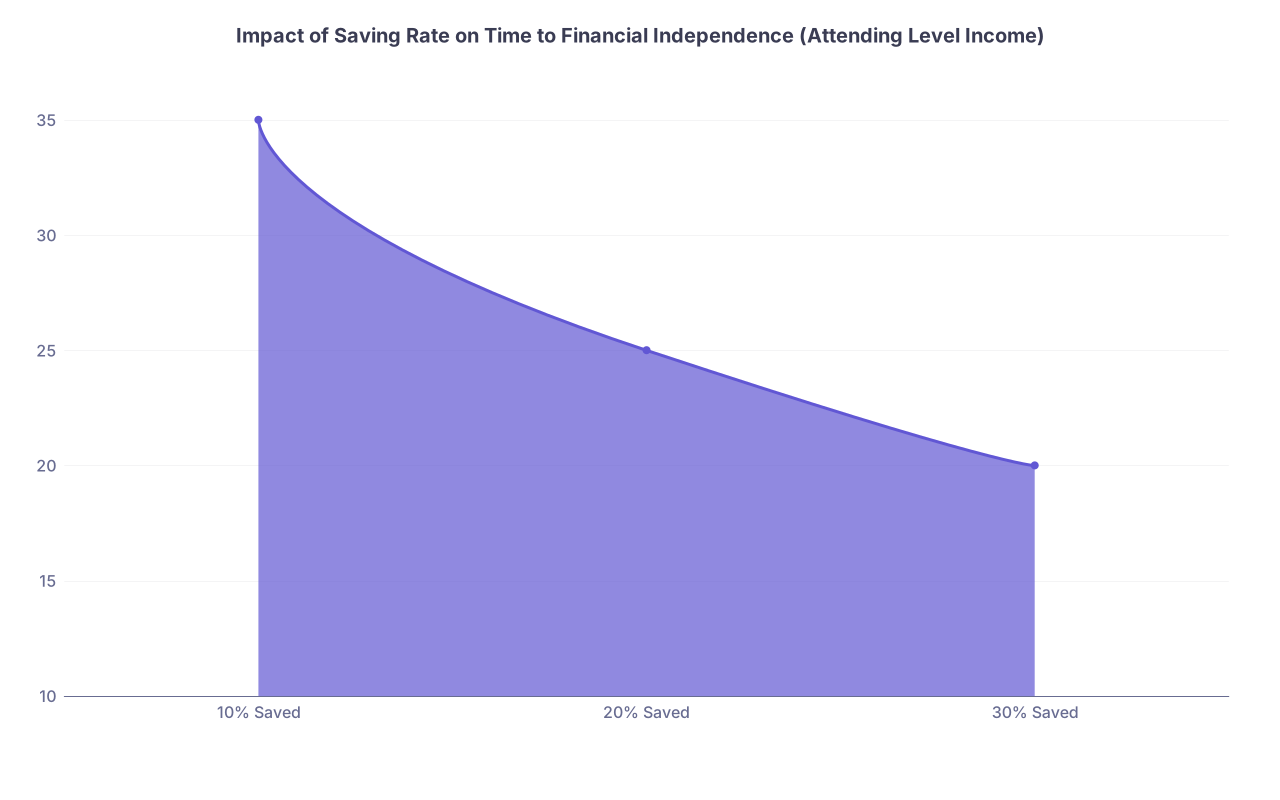
Those numbers are rough but directionally true: Your savings rate matters far more than your investment picking skills.
The subtle retirement impact
Early lifestyle lock-in means:
- You can’t max accounts without feeling “broke”
- Every raise disappears into more spending instead of more saving
- You stay stuck at a 5–10% savings rate instead of 20–30%
Then one day you wake up at 50, realize your nest egg is half what it should be, and start asking about “more aggressive investments” to make up for it. That’s not an investment problem. It’s a lifestyle problem from your first 5 years.
How to avoid this mistake
Adopt a simple rule for your first 5 years out:
“Retirement savings rate must hit 20% before I upgrade anything big.”
No forever house until:
- You’re maxing primary retirement accounts
- You have a reasonable emergency fund
- You’re not carrying high-interest debt
If your dream house kills your ability to fund retirement, it’s not a dream. It’s a slow-motion financial trap.
4. Confusing “Investment Products” with a Retirement Plan
If a “financial professional” led with a product in your first meeting—whole life, annuity, some complex structured note—you are not getting retirement planning. You are getting sold.
I’ve sat in on enough “wealth management” pitches to know the script:
- Start with flattery about your income
- Sprinkle in some anxiety about taxes and market crashes
- Present a shiny, complicated solution you don’t fully understand but are told is “safe” or “guaranteed”
Physicians fall for this constantly, especially in years 1–5 when the paychecks finally feel big and the tax bill stings.

The classic mistakes here
Whole life insurance sold as a “retirement vehicle”
“Tax-free income in retirement!” they say. They’ll gloss over:- High commissions
- Low early returns
- Poor flexibility compared to just investing in low-cost index funds
Complex annuities early in your career
Using heavy, expensive, inflexible vehicles before you’ve even filled your basic retirement accounts is backwards.Overconcentrated portfolios
Owning random private REITs, “exclusive” funds, or single-company stock because someone said it was safe or special.
The red flags to watch for
If you hear any of this, your guard should spike:
- “This is what I do for all my physician clients.”
- “This product solves your tax problem and gives you guaranteed growth.”
- “I’d be happy to show you the 40-page illustration, but the key point is…”
They rely on complexity to shut down your questions. Do not fall for it.
How to avoid this mistake
Your retirement plan in the first 5 years should be boring:
- Max tax-advantaged accounts
- Use diversified, low-cost index funds
- Make sure you’re properly insured (term life, disability)
- Build a basic written plan: savings rate, target retirement age range, ballpark needed number
If someone pitches you a product before understanding your saving rate, debt, goals, family situation, and work plans, they are not your planner. They’re a commissioned salesperson.
You can always add complexity later. You can’t easily unwind 10 years in a bad contract.
5. Misunderstanding Risk: Too Scared or Way Too Aggressive
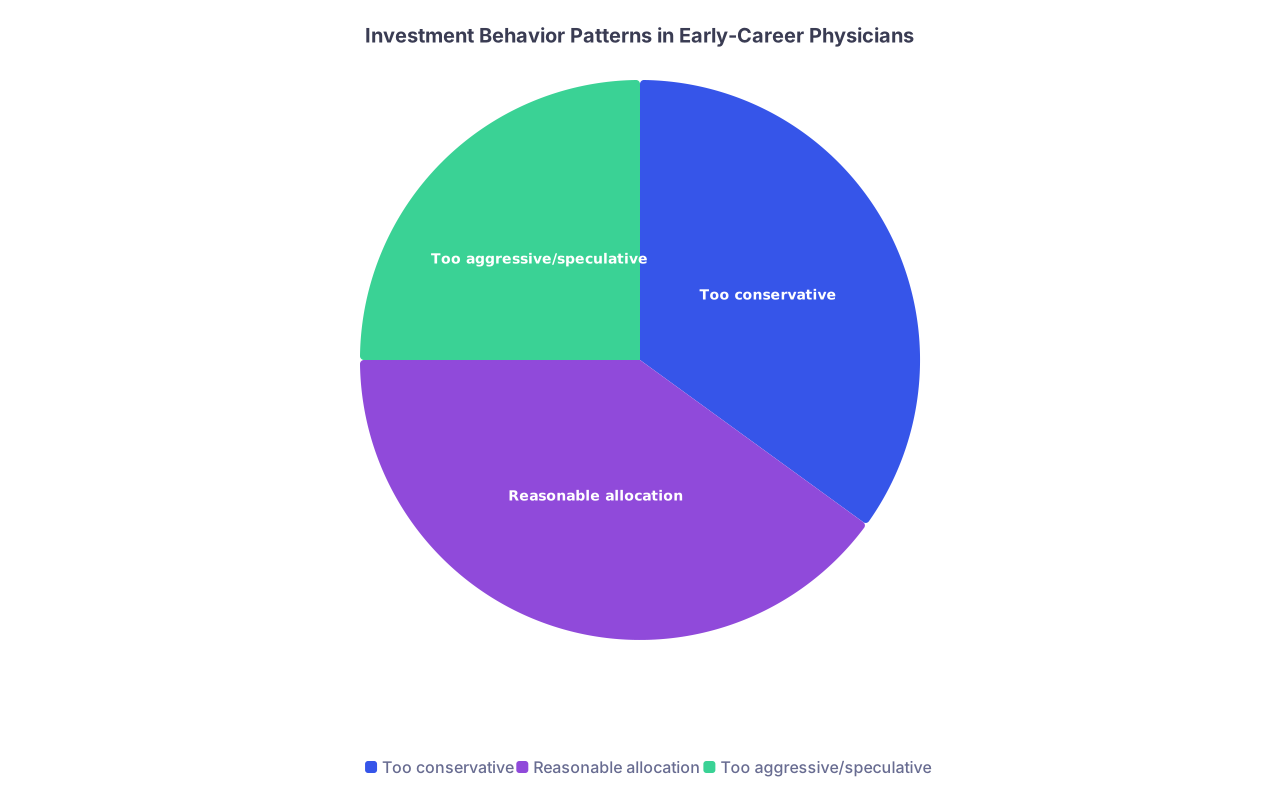
New physicians often sit at one of two extremes with investment risk:
- Terrified of market volatility because “I worked too hard to lose this”
- Overconfident because they finally have money and want to “make it work harder”
Both attitudes can wreck retirement.
The overly conservative mistake
Keeping huge chunks of money in:
- Savings accounts
- CDs
- Money market funds
Because “I don’t want to lose what I earned in residency.”
I’ve seen young attendings with $200k–$300k in cash for years while worrying they’re “behind” on retirement. Yes. Because inflation quietly ate them alive.
The gambler mistake
On the flip side, some new docs:
- Day trade
- Load up on individual tech stocks
- Go heavy into speculative crypto, private deals, or random real estate schemes
Because they’re behind and want to “catch up.” Or because a colleague brags about a lucky win.
Neither group has a retirement strategy. They have emotions running the show.
| Category | Value |
|---|---|
| Too conservative | 35 |
| Reasonable allocation | 40 |
| Too aggressive/speculative | 25 |
Why this matters specifically in the first 5 years
Your risk capacity in your early attending years is massive:
- Long time to retirement
- High earning potential
- Ability to work more or adjust lifestyle if needed
If you invest like a 70-year-old now, your nest egg will be anemic later.
At the same time, big losses from concentrated bets early on hurt more than you think. You lose:
- The money
- The years of compounding that money would have had
That’s not easily fixed.
How to avoid this mistake
Pick a sane, age-appropriate asset allocation and stick with it:
- Many physicians in their early 30s: 80–90% stocks / 10–20% bonds/cash is reasonable
- As you age, gradually tilt more conservative
Use broad, diversified index funds. Not:
- Single stocks
- Sector bets
- Friends’ startups
- Crypto as a major allocation
Boring wins. Consistent contributions to a sensible portfolio in your first 5 years beat hero trades every single time.
6. Completely Ignoring Legal and Protection Pieces
Retirement planning is not just investments. If you neglect the legal and protection side, one lawsuit, accident, or illness can nuke everything you’ve built.
Here’s what I still see all the time:
- No disability insurance beyond a weak employer policy
- No term life insurance despite kids and a mortgage
- No will, no healthcare proxy, no basic estate documents
- No idea how your state handles malpractice judgments and personal assets
This isn’t “nice to have.” This is core retirement protection.

| Step | Description |
|---|---|
| Step 1 | Physician Income |
| Step 2 | Save for Retirement |
| Step 3 | Protect Income |
| Step 4 | Protect Assets |
| Step 5 | Disability Insurance |
| Step 6 | Emergency Fund |
| Step 7 | Term Life Insurance |
| Step 8 | Basic Estate Plan |
| Step 9 | Liability Coverage |
The catastrophic mistake
Early attending, married with young kids, big new mortgage, spouse not working, minimal savings.
No individual disability policy. Then:
- Car accident
- Cancer
- MS diagnosis
You’re out of clinical work or massively limited. That “future large retirement” vanishes overnight.
I’ve seen families scramble to sell houses, move states, rely on extended family, all because they never got around to the protection side.
Asset protection matters too
Depending on your state:
- Some accounts (401(k), some IRAs) are strongly protected from creditors
- Some assets (home equity, life insurance cash value) may be partially protected
- Taxable accounts in your name alone may be exposed
If you’re in a high-risk specialty—OB, neurosurgery, EM—you can’t pretend this doesn’t apply to you.
How to avoid this mistake
In your first 1–2 years as an attending, get these done:
- Strong individual own-occupation disability policy
- Adequate term life insurance (usually 10–20x income if you have dependents)
- Basic estate docs: will, healthcare proxy, power of attorney
- Umbrella liability policy (often $1M–$2M, very cheap)
- At least a general understanding of how your accounts and state laws treat creditor protection
None of this is fun. Do it anyway. It’s part of a real retirement plan, not an optional bonus.
7. Flying Blind Without Any Actual Retirement Numbers
The last mistake is simple: most early-career physicians have no concrete sense of:
- How much they actually need for retirement
- Whether their current saving rate is adequate
- What age they’re roughly on track to retire
They’re “saving something” and hoping it’ll be okay. That’s not a plan; that’s denial with mutual funds.

Why this hurts the first 5 years especially
If you don’t run any numbers, you fall into two traps:
- Under-saving because you think you’re doing “pretty well” compared to colleagues
- Over-stressing because you assume you’ll never be able to retire
So you either under-fund your accounts or you throw money randomly at every possible account and product without a cohesive plan.
A rough but real approach
You do not need a 60-page Monte Carlo simulation in year one. You do need ballparks. Things like:
- “We spend about $X per year now; in retirement it might be 70–80% of that.”
- “If we want $Y per year in today’s dollars, we probably need somewhere between 20–30 times that as a nest egg.”
Then ask: “At our current savings rate, are we anywhere near that trajectory?”
Most physicians are shocked when they see the gap. And honestly, better to be shocked at 32 than at 57.
How to avoid this mistake
In your first 5 years, do one of these:
- Sit down with a fee-only fiduciary planner for a one-time plan (not product sales)
- Or, use a reputable retirement calculator with conservative assumptions and actually plug in your numbers
Then:
- Decide on a target savings rate (often 20–25% of gross across all retirement vehicles)
- Track your progress annually—no more flying blind
- Adjust lifestyle and savings early if you’re way off. It’s much easier at 35 than at 55.
FAQ (Exactly 3 Questions)
1. Should I prioritize student loan payoff or retirement savings in my first 5 years?
The mistake is going all-in on one while ignoring the other. You should usually do both: at least get your full employer match and a reasonable retirement contribution rate (often 10–15% of gross to start), while pursuing a structured loan strategy (refinancing and aggressive payoff, or committed PSLF/forgiveness plan). Waiting to touch retirement until loans are gone is how you lose a decade of compounding.
2. Is it really necessary to max my 401(k)/403(b) as a new attending, or is “some contribution” enough?
“Some contribution” is how high-income docs end up working until 70. If you’re in your first 5 years and already at attending income, you should be aiming to move toward the max as fast as reasonably possible. Maybe you can’t hit it month one, but it should be on a short runway, not a vague someday goal.
3. Do I need a financial advisor, or can I handle retirement planning myself?
You can absolutely do this yourself if you’re willing to learn the basics and stay disciplined. The mistake is either:
- outsourcing everything to a commissioned salesperson who stuffs you into products, or
- refusing all help and never actually building a plan.
If you hire someone, make sure they are fee-only, fiduciary, and transparent. If you DIY, keep it simple: high savings rate, low-cost diversified funds, strong protection (insurance/legal), and periodic reality checks on your numbers.
Key takeaways:
Do not treat retirement as a future luxury project; your first five years set the trajectory. Use every reasonable tax-advantaged tool, protect your income and assets, and keep your investments boring and diversified. Most importantly, stop flying blind—get actual numbers, commit to a meaningful savings rate, and avoid “solutions” that are really just expensive products in disguise.