
The biggest retirement risk for doctors isn’t the stock market. It’s false confidence.
Most physicians are quietly walking around with retirement numbers in their heads that are wrong by six or seven figures. Too low, too high, or built on fantasy assumptions that will not survive real life. I’ve watched smart, careful clinicians — people who triple-check chemo doses and verify consent forms — wing their retirement math on the back of an envelope.
Let’s fix that before it hurts you.
1. The First Big Lie: “I’m a Doctor, I’ll Be Fine”
The most dangerous sentence physicians tell themselves about money is, “I make good money, I’ll figure it out later.”
No, you won’t. Not if you keep making these specific mistakes:
- Confusing high income with high net worth
- Assuming you can “always work a few more years”
- Underestimating what it costs to maintain your current life
- Ignoring how late you started real saving (post-training lag is brutal)
I’ve seen attending physicians in their mid‑50s with $500k–$800k saved, believing they’re “on track” because their 401(k) balance looks big compared to their co-residents. Then we run the actual numbers for a $250k–$300k lifestyle in retirement. They’re stunned.
Here’s the problem: as a doctor, your burn rate is usually much higher than you realize. Private school. Big house in a good district. Two newer cars. Travel. Helping parents. Helping kids.
If you’re living on $250k–$350k after tax now, you’re not going to be happy on $80k in retirement. But mentally, many of you are doing retirement math like you will.
That mismatch is where the disaster starts.
2. The “Safe Withdrawal” Myth Doctors Love to Misuse
You’ve probably heard of the “4% rule” — the idea that you can withdraw 4% of your portfolio in the first year of retirement, adjust for inflation each year, and be “safe.”
The way most doctors apply it? Completely wrong.
The common screw‑ups
Using 4% on a too-small number
“I’ll need $200k/year. 4% of $5 million is $200k, so I’m good if I hit $5M.”
That sounds clean. It ignores taxes, healthcare costs, sequence risk, and the fact that your portfolio might not behave like a perfect spreadsheet.Using 4% on the wrong portfolio type
The 4% rule was built assuming:- A balanced stock/bond portfolio
- 30-year retirement horizon
- Historical U.S. market returns (which may not repeat neatly)
But many physicians:
- Want to retire in their late 50s (so 35–40 years of retirement)
- Keep way too much in cash or “safe” assets
- Or go the other way: extremely aggressive, hoping high returns bail them out
Ignoring taxes
Most physicians will have a big chunk of their money in tax‑deferred accounts (401(k), 403(b), 457). That’s pre‑tax money.You don’t have $5M. You have $5M minus the IRS’s cut.
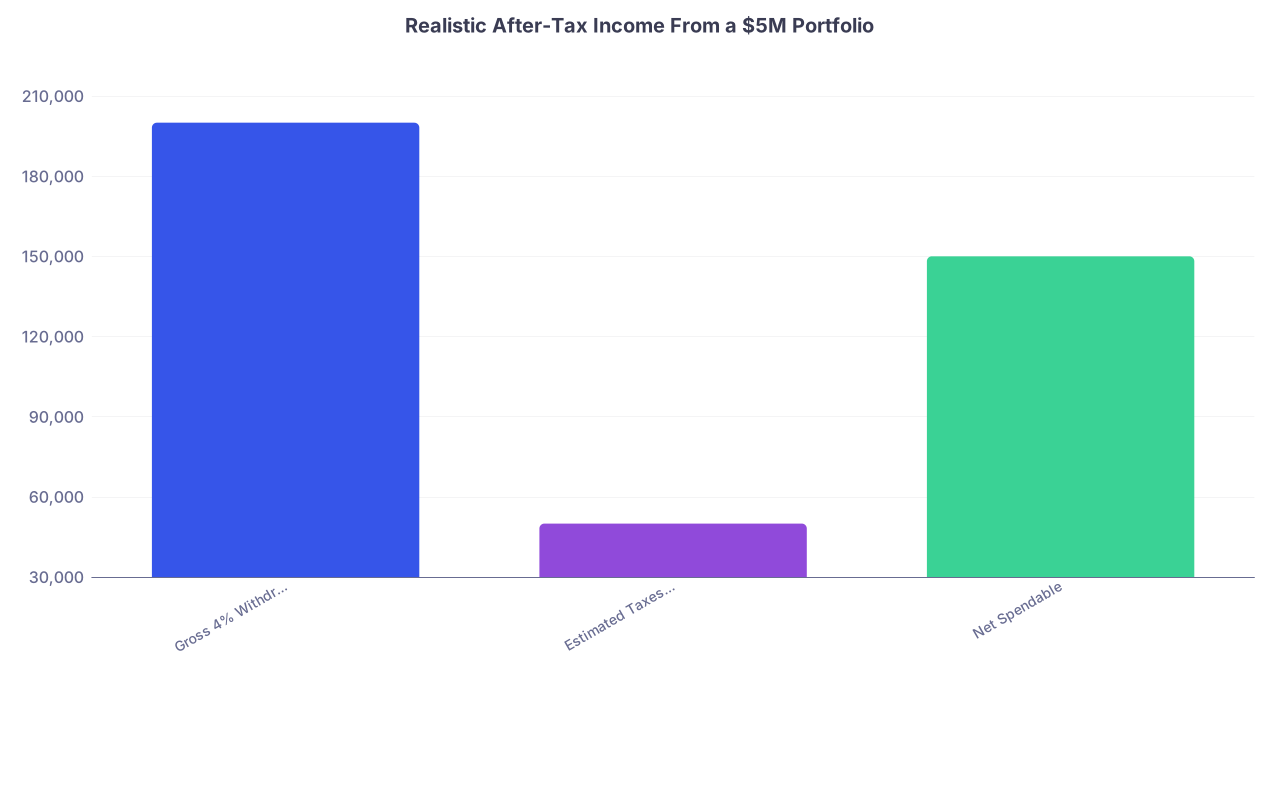
For many high-income docs, an effective tax drag of 20–30% on withdrawals is realistic. So 4% of $5M doesn’t mean $200k to spend. Maybe it’s more like $140k–$160k after taxes.
Let’s put numbers in your face:
| Category | Value |
|---|---|
| Gross 4% Withdrawal | 200000 |
| Estimated Taxes (25%) | 50000 |
| Net Spendable | 150000 |
If you’re used to living on $250k–$300k after tax, $150k in retirement is a massive lifestyle cut. That’s not a rounding error. That’s a different life.
What to do instead
- For early retirement (before 65), many physicians should be thinking 3–3.5% as a safer withdrawal rate if they want the money to last.
- Plan with taxes included, not on gross numbers.
- Run conservative market assumptions, not “average return of the last bull market.”
If your plan only works if the next 30 years look like the best 30 years in stock market history, it’s not a plan. It’s a wish.
3. Underestimating the Real Cost of Your Lifestyle
Doctors routinely misjudge their future needs because they don’t actually know what their current life costs.
They know the mortgage. Maybe daycare. But they do not know their annual burn rate with any precision.
They guess low.
The mental trap: “I’ll spend less in retirement”
You might work less. You will not automatically spend less.
What really happens for many physicians:
- Work stops → time expands
- Time expands → travel, hobbies, and “finally doing things” expand
- Those things cost real money
Then you add rising healthcare costs and helping adult children and aging parents. The idea that your cost of living magically collapses at 65 is fantasy for most attending physicians.
Common miscalculations I see:
Forgetting to include:
- Property taxes that keep climbing
- Home maintenance on a large expensive house
- Supporting kids for longer than planned (grad school, failed launch, helping with grandkids)
- Long‑term care risks (nursing homes can easily run $100k/year)
Assuming:
- “The house will be paid off, so we’ll be fine” — but then you keep the expensive house and layer travel on top
- “We’ll travel early, then slow down” — often the opposite of what actually happens for high‑energy, driven people
Take a minute and be specific. If you want to avoid the classic doctor mistake, you need to quantify, not daydream.
4. Ignoring Healthcare and Long-Term Care: The Silent Budget Killers
You want a fast way to blow up a “looks fine on paper” retirement projection? Ignore healthcare.
The nasty surprises
Bridge to Medicare (if you retire before 65)
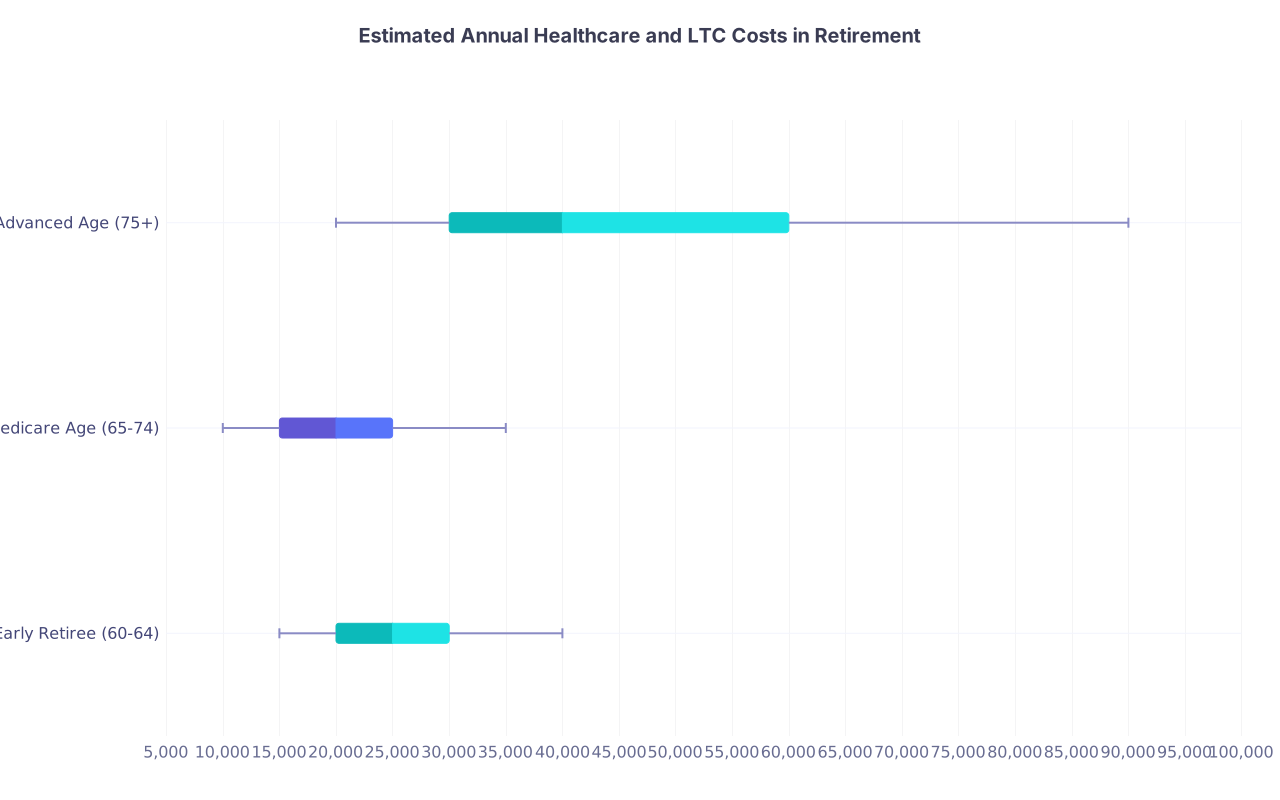
Many physicians fantasize about pulling back in their late 50s. Good idea emotionally and physically. Financially? Only if you’ve actually priced health insurance.Private coverage or ACA exchange plans for a couple in their 50s or early 60s can run:
- $15k–$30k+ per year
- With high deductibles and out-of-pocket costs
That’s before long-term care even enters the picture.
Medicare is not free and not all-inclusive
Physicians should know this, but plenty still treat Medicare like a magic safety net. You’ll still face:- Part B premiums
- Medigap or Advantage plan costs
- Drug costs
- Dental, vision, hearing (largely not covered)
Long-term care
This is the landmine everyone hopes to step around. Many will not.Assisted living, memory care, and nursing homes are frighteningly expensive. And they last years, not months.
If you’re thinking, “My kids will help,” make sure they know that. Most adult children of doctors assume you’ve got it handled.
| Category | Min | Q1 | Median | Q3 | Max |
|---|---|---|---|---|---|
| Early Retiree (60-64) | 15000 | 20000 | 25000 | 30000 | 40000 |
| Medicare Age (65-74) | 10000 | 15000 | 20000 | 25000 | 35000 |
| Advanced Age (75+) | 20000 | 30000 | 40000 | 60000 | 90000 |
If your “I think we’ll need about $150k/year” retirement plan doesn’t explicitly include a healthcare and long-term care line item, it’s fantasy.
5. Overconfidence in Practice or Business Value
Here’s a particularly dangerous doctor-specific mistake: mentally counting your practice as part of your retirement plan at full fantasy value.
“I’ll sell my practice for $2 million.”
“Someone will buy into the partnership.”
“The building is my retirement.”
Sometimes that works out. Often it does not. Not at the number you’re carrying in your head.
Where doctors get burned
- Solo or small-group practices in saturated markets: buyers are scarce, valuations are lower than you expect.
- Hospital employment creeps in, and private practices become less attractive, or reimbursement trends make the business less profitable.
- Key-person risk: If you are the practice, the value without you isn’t what you think.
Many mid‑career physicians walk around with a silent assumption: “I’ll work to 65–70 and cash out the practice.” Then corporate consolidation, burnout, or health problems show up, and that exit doesn’t happen as planned.
You cannot build a responsible retirement plan assuming a top-dollar buyout of your practice unless:
- You know the realistic valuation today
- You have a clear buyer profile
- You’ve seen actual transactions in your area, not myths
Otherwise, count your practice as a bonus, not the core of your retirement math.
6. Misjudging Time: Starting Late and Expecting Compounding to Save You
Most doctors effectively lose a decade or more of compounding:
- 4 years of med school
- 3–7 years of residency/fellowship
- Often underpaid, overworked, and not saving much
So real accumulation starts later — 30s or even early 40s.
What I see:
- A 45-year-old attending waking up to retirement for the first time, wanting to “hit $5M by 60”
- They run an online calculator using 8–10% annual returns and conclude it’s easy
But those optimistic calculators don’t:
- Penalize you for sequence of returns risk
- Consider future tax rates
- Account for your likely periods of part-time work, disability, burnout, or needing to help family

If you start seriously saving at 42 and want to retire at 60, you have 18 years. That’s short. It can be done. But it requires:
- High savings rate (often 25–35% of gross income)
- Realistic return assumptions (5–7% nominal, not 10–12%)
- Very little room for major missteps (massive house, expensive private schools, “doctor toys” on credit)
The mistake is not that you started late — the career demanded that. The mistake is acting like you didn’t.
7. Tax Blindness: Pretending Gross = Yours
Another classic trap: treating every dollar in your 401(k)/403(b)/457 as if it belongs to you.
It does not. A large chunk belongs to the IRS and your state.
Here’s how doctors misjudge:
- Forgetting required minimum distributions (RMDs) will force taxable income later
- Not realizing how large pre-tax balances can push you into higher brackets in retirement
- Assuming they’ll be in a “much lower” tax bracket later — often untrue for physicians with solid pensions, Social Security, and sizable pre-tax balances
Let me spell it out:
You’re 55. You have:
- $3M in tax‑deferred accounts (401(k), 403(b), 457)
- $500k in Roth accounts
- $500k in taxable brokerage
On paper: $4M.
In reality: a good portion of that $3M has a tax lien attached.
You need to run your retirement plan on after-tax expected values, not headline balances.
8. Misaligning Portfolio Risk With Reality
Some physicians misjudge retirement needs because their portfolio doesn’t match their plan. Two common, opposite mistakes:
Too conservative too early
Burned by a market drop, they pile into:- Cash
- CDs
- Bond-heavy portfolios in their 40s and early 50s
Then they run retirement math assuming they’ll be fine. But 2–4% returns won’t get them to what they actually need if they’re starting in mid-career.
Too aggressive for the timeline
On the flip side, some physicians go nearly all-in on risky assets:- Individual stocks
- Concentrated positions
- Speculative real estate ventures
Their plan “works” as long as returns are stellar. But a big hit five years before retirement can force them to work much longer or permanently cut spending.
You cannot sensibly judge how much you need to retire without connecting:
- Your retirement timeline
- Your expected spending
- Your portfolio risk level and realistic returns
If those three don’t align, your “magic number” is fiction.
9. The Phantom Income Problem: “We’ll Always Have Something Coming In”
Doctors often underestimate retirement needs because, deep down, they don’t believe they’ll fully retire. They expect:
- Consulting income
- Speaking gigs
- Chart review
- Locums
- Small side businesses
Then they quietly build those assumptions into their retirement math. “We only need $4M because we’ll earn about $50k–$100k/year doing some light work.”
Maybe you will. Maybe you won’t. Burnout, health issues, family demands, or simple disinterest can kill that plan fast.
Here’s the safe way to think about it:
- Base retirement plan on no earned income.
- Treat any consulting/locums/side-work income as upside, not a pillar.
If your retirement plan only works because you keep working, that’s not retirement. That’s a pay cut.
10. How to Stop Misjudging and Actually Get the Number Right
You don’t need perfection. But you do need something better than “$5 million sounds about right.”
Here’s a cleaner way — which avoids almost all the mistakes above:
Step 1: Get brutally honest about your current lifestyle cost
Don’t “estimate.” Measure:
- Pull 12 months of bank and credit card statements
- Categorize where the money actually goes
- Total your true annual spending
You’ll likely find:
- The number is higher than you thought
- A big chunk is non-negotiable (housing, healthcare, family support)
Step 2: Define your retirement lifestyle in concrete terms
Not “live comfortably.” That means nothing.
Spell it out:
- Where will you live?
- What kind of travel each year?
- Will you help kids with weddings, house down payments, grandkids’ education?
- Are you keeping a second home? Memberships? Expensive hobbies?
Then assign dollar amounts. Rough is fine. Delusional is not.
Step 3: Add the non-negotiables: taxes + healthcare + LTC
- Estimate federal and state taxes based on likely retirement income
- Put explicit line items in your plan for:
- Health insurance (pre‑65)
- Medicare + supplements (65+)
- Out-of-pocket costs
- Long-term care either:
- via insurance premiums, or
- via setting aside a dedicated pool of assets
Step 4: Use safer assumptions
Withdrawal rate: Consider 3–3.5% as your planning number, especially if:
- You want to retire before 65
- You have longevity in your family
- You want a buffer, not to die with your portfolio on life support
Returns: Don’t plan on 10–12%. Use 5–7% nominal for long-range planning.
Step 5: Stress-test, don’t daydream
Run scenarios:
- You retire at 60 and the first 5 years of returns are lousy
- One spouse needs long-term care for 5–7 years
- You help a child or parent at a level you didn’t expect
If your plan collapses under any reasonable stress test, you need either:
- More savings
- Lower expected spending
- Longer work horizon
- Or some combination of the three

| Assumption | Safer Reality Check |
|---|---|
| 4% withdrawal is always safe | Use 3–3.5% if retiring before 65 |
| $5M portfolio = $200k to spend | Plan on taxes cutting that to ~$140k–$160k |
| I’ll spend much less in retirement | Many docs spend similar or more early on |
| Practice sale will fund retirement | Treat it as bonus, not core plan |
| I can always work longer if needed | Health, burnout, or market may say no |
The Bottom Line: Don’t Be the Overconfident Doctor With a Flimsy Plan
If you skimmed everything, remember this:
Your current lifestyle is more expensive than you think, and your future medical costs will be higher than you’re assuming. Don’t build a retirement plan on fantasy spending cuts that you’ve never once practiced.
Headline portfolio numbers lie. Taxes, withdrawal rates, and market reality mean your $3M, $5M, or $7M doesn’t translate into the annual income you’re casually assuming.
Hope is not a strategy. Counting on practice sales, endless consulting, or permanent good health to fill gaps is how physicians with strong careers end up financially trapped in their 60s.
You’ve built a life on data, sober judgment, and not trusting your first impression. Apply that same discipline to your retirement. Or you’ll be the doctor who can’t afford to stop being a doctor.