
It’s five years after residency. You’re finally attending-level. The paycheck is real. Your medical school friends are posting photos of new construction homes, German cars, and vacations that definitely are not budget trips.
You open your banking app and something feels… off.
Your income has tripled since fellowship, but your checking account still scrapes bottom at the end of the month. Retirement contributions? Bare minimum. Student loans? Barely moving. The “I’ll save later when I’m making more” plan quietly died three promotions ago.
You did not get here by accident. You got here by lifestyle inflation.
Let me be blunt: physicians almost never fail to retire comfortably because they didn’t earn enough. They fail because they let lifestyle creep swallow the one thing you cannot get back—your high-earning years.
You are in one of the highest-income professions on the planet. You can still blow it. Many do.
This is how.
The Core Mistake: Thinking Income Automatically = Security
The worst financial lie physicians tell themselves is simple: “I make a lot of money, so I’ll be fine.”
No. You will not be fine if your spending scales with your income dollar-for-dollar.
Here’s the trap: You finish training in your early 30s, maybe late 30s. You tell yourself you “deserve it.” And you do deserve some relief after residency-level misery. The problem is not a few smart upgrades. It’s the expectation that your baseline lifestyle should track your highest-ever paycheck.
That’s how doctors with $600K incomes end up with $0 in taxable investments, maxed HELOCs, and retirement projections that only work if they never get sick, never burn out, never change jobs, and never have a market downturn.
If you remember one rule from this whole thing, make it this:
If your savings rate doesn’t rise when your income rises, your future doesn’t actually improve. It just looks fancier today.
Trap #1: The Doctor House That Eats Your Future
This is the first big landmine attendings step on. Right out of training.
You go from a cramped apartment to scrolling Zillow for half-million-plus houses in good school districts. Your mortgage broker grins and says, “You’re approved up to $1.8 million on a physician loan!” Like that’s a favor.
It’s not a favor. It’s a loaded gun.
How the “Doctor House” Blows Up Retirement
Common pattern I see:
- PGY-6: $70K income, modest rent.
- New attending: $350K income, immediately buys $1.2M house with 0–5% down, 30-year mortgage, property tax, insurance, and a homeowner association fee.
On paper the monthly payment “fits.” But you forgot:
- Property taxes that creep up every reassessment
- Lawn care, pest control, cleaning, pool, snow removal
- Furniture (you will not put IKEA in that house, and you know it)
- Repairs: water heaters, roofs, HVAC, random disasters
Suddenly your “$5K mortgage” is effectively $7–8K/month all-in. That’s $84–96K per year going to housing before you even fix a leaky pipe.
That’s money that could have been compounding for you in a retirement account.
Instead, it’s locked in a house that costs you more every year.
Safer Rule of Thumb You Should Not Ignore
Here’s the rule that saves a ton of doctors from wrecking their retirement:
- Keep all housing costs (mortgage, taxes, insurance, HOA) under 2x your annual gross income for the house price, and under 25–28% of your take-home pay for the monthly burn.
So if you earn $350K:
- Target house price: not more than ~$700K
- Total monthly housing: under 25–28% of your net pay
If that means delaying the dream house, good. Delay it.
The mistake is buying the max house your lender approves instead of the house your retirement plan approves.
Trap #2: Cars, Leases, and the “I Can Afford the Payment” Lie
Drive into any physician parking lot and it’s obvious: your colleagues are parking six figures in depreciating metal.
You’ll hear the same phrase over and over: “The payment isn’t bad.”
That’s how you know it’s bad.
Why Cars Quietly Crush Your Savings Rate
Let’s say you:
- Lease a $90K SUV for $1,200/month
- Spouse leases a $70K sedan for $900/month
- Add insurance, gas, maintenance: conservatively $600/month
You’re burning $2,700/month on transportation. That’s $32,400 per year.
If that same $2,700/month went into a low-cost index fund from age 32 to 60 earning 7% annually, we’re talking multiple millions at retirement.
Instead, it all dissolved into road noise, leather seats, and a slightly nicer badge.
And you will repeat this cycle every 3–5 years if you normalize “always having a new car.”
Safer Car Rules For Physicians Who Don’t Want to Be Broke at 65
You very likely make enough to drive nice cars. The point isn’t suffering. It’s not crippling your future power.
Simple safeguards:
- No more than 10% of your gross income on car purchase price (per vehicle)
- If you must finance, keep loans ≤3 years and total car payments under 8–10% of take-home
- Better: buy used, pay cash, then drive it for 8–10 years
If you feel physical resistance reading that last line—good. That resistance is your ego trying to bankrupt your future self.
Trap #3: Private School and Activities as a “Non-Negotiable”
Nothing wrecks a budget like guilt spending on kids.
The logic goes like this: “I had to sacrifice so much to become a doctor. My kids should have the best.”
Translation: “I will future-borrow hundreds of thousands from my 70-year-old self so my 10-year-old can go to a school where everyone drives a Range Rover.”
The Math You Really Do Not Want to Ignore
Private K–12 at $25K per kid per year is:
- 1 kid: $325K from K-12
- 2 kids: $650K
- 3 kids: $975K
Now tack on:
- Travel sports
- Tutors
- Summer programs
- “Enrichment” everything
You’re easily past $1M over a couple of decades if you go full throttle.
If at the same time you’re barely funding retirement, you’re transferring your security to your kids’ lifestyle. That’s upside down.
The brutal reality: your kids would rather have sane parents and a secure, not-working-into-the-grave retirement than a private school their entire childhood.
When Private School Makes Sense—And When It’s a Trap
Reasonable:
- Kid has specific needs not met by local public schools
- You’re already saving 20%+ of gross income for retirement and have a long-term plan
- You run the numbers and it actually fits without sacrificing future security
Danger zone:
- You choose private because “everyone at the hospital does it”
- You cannot max retirement accounts and fund private tuition concurrently
- You’re planning to “refinance the house later” to help with college
If private school kills your ability to save for retirement, it’s not an upgrade. It’s theft—from your future self.
Trap #4: Subscription and Service Creep (The “Nothing Big, Everything Bleeds” Problem)
Most doctors don’t go broke from one big stupid purchase.
They go broke from slow, painless bleeding.
Here’s what I see when I sit down with people and look at their actual transactions:
- Three streaming services you barely use
- Multiple professional society dues you don’t remember joining
- App subscriptions
- Gym plus boutique fitness classes plus golf membership
- Meal kits three nights a week
- Housekeeper, lawn service, pool company, dog walker, grocery delivery
Individually, none of these are insane. Together, they’re devastating.
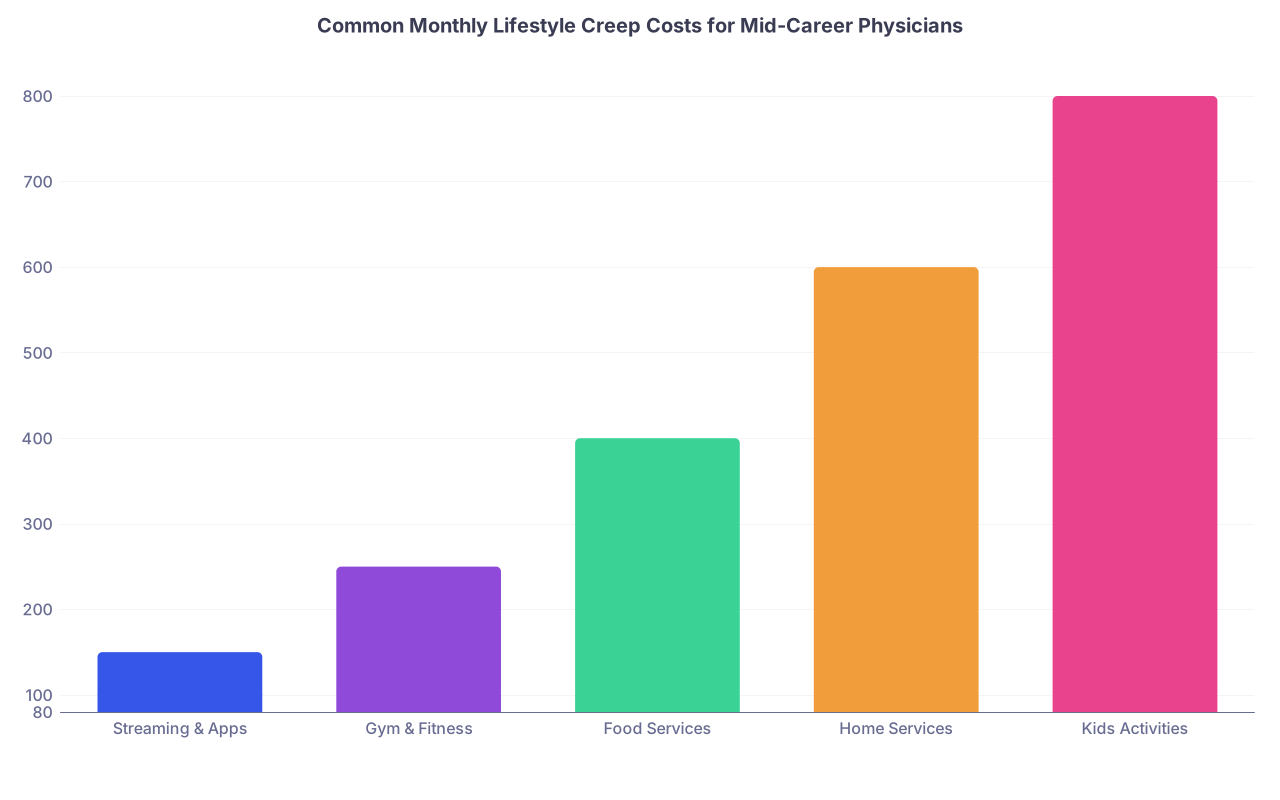
| Category | Value |
|---|---|
| Streaming & Apps | 150 |
| Gym & Fitness | 250 |
| Food Services | 400 |
| Home Services | 600 |
| Kids Activities | 800 |
You shrug at $150/month here, $300/month there. Before you know it, $2–3K a month is leaving your account for stuff you wouldn’t even miss in 3 weeks.
That’s $24–36K/year that could be building your retirement. Instead, it’s buying convenience you barely register.
The Simple Fix You’re Avoiding Because It’s Annoying
Once a year, sit down and:
- Pull 3–6 months of credit card/bank statements
- Highlight every recurring charge
- Ask: “If I was laid off tomorrow, would I keep this?”
If the answer is no, cancel it now, not when you “have more time.”
You will probably free up four figures a month. That’s your retirement, bleeding out through autopay.
Trap #5: Doctor Social Circles and the Comparison Game
This one is more psychological but just as dangerous.
Your peer group subtly sets your “normal.” If everyone you work with:
- Flies business class
- Has a second home
- Eats out 4–5 nights a week
- Replaces their car every 3 years
- Renovates their kitchen because the white is “last decade”
You start to feel poor if you don’t.
The problem is, you only see the front-stage version of their lives. You don’t see:
- Their retirement account balances
- The 0% down vacation home mortgages
- The private loans for “emergency renovations”
- The lack of disability insurance or emergency funds
I’ve seen physicians at top academic centers making $400–500K per year with literally negative net worth in their late 40s. Perfect cars. Perfect house. Perfect Instagram. Disaster underneath.
Guardrails Against Lifestyle Peer Pressure
A few blunt truths:
- Most of your colleagues have no real retirement plan
- Many are drowning in hidden debt while projecting wealth
- Copying their spending is copying their (often invisible) problems
Instead of comparing cars, compare savings rates. Compare net worth as a percentage of income. If you must.
Better, quietly build your own rules and stick to them regardless of what your chief or neighbor is doing.
Trap #6: Delaying Retirement Saving “Until Things Settle Down”
This one destroys more physician retirements than any BMW or private school.
You tell yourself:
- “I’ll start maxing retirement once the loans are lower.”
- “Once daycare is done, I’ll really ramp up.”
- “After this move / this renovation / this fellowship…”
Let me be clear: your first 10 years as an attending are the most valuable investing years of your life. Every year you delay is massively expensive.

| Step | Description |
|---|---|
| Step 1 | Start at 32 saving 50K per year |
| Step 2 | Stop at 42 let grow |
| Step 3 | Start at 42 saving 50K per year |
| Step 4 | Save until 62 |
| Step 5 | End at 62 with significantly more |
The doctor who saves aggressively from 32–42 then coasts often ends with more than the one who waits until 42 then tries to catch up, even if the latter saves longer. That’s the power of compounding.
You do not get those early years back. Once gone, they’re gone.
The Minimum You Should Do From Day One as an Attending
Non-negotiable if you care about future you:
- At least 20% of gross income to retirement/investments from your first year as an attending
- 25–30% if you start late (mid-30s+), or want flexibility for early retirement / part-time later
If that sounds impossible, that’s your signal that your lifestyle expectations are too high for your income.
Not the other way around.
Trap #7: Underestimating Taxes and Overestimating Future Earnings
Two big lies physicians internalize:
- “I can always just work more.”
- “My income will keep going up.”
Maybe. Until:
- You burn out
- Reimbursement cuts hit your specialty
- Hospital changes your comp model
- Health issues show up
I’ve watched surgeons go from 7-figure incomes to disabled and living on a fraction of that. I’ve watched hospital-employed docs have RVU thresholds shifted, call pay cut, or bonuses vanish.
At the same time, high earners are tax targets. If you don’t plan for that, you think you’re “making” $500K, but after federal, state, payroll taxes, and high spending? It feels like $120K.
| Scenario | Gross Income | Approx Taxes | Net Income |
|---|---|---|---|
| Hospitalist, no planning | $280,000 | $90,000 | $190,000 |
| Specialist, no planning | $500,000 | $190,000 | $310,000 |
| Specialist, max tax-adv. | $500,000 | $165,000 | $335,000 |
If you inflate your lifestyle to match the gross instead of the net, you are guaranteeing constant financial stress.
(See also: Why Paying Off Loans First Can Backfire on Your Retirement Plan for more.)
Must-Do Protections Most Doctors Skip
Let me be very clear: skipping these is reckless.
- Strong own-occupation disability insurance
- Adequate term life insurance while you have dependents and debt
- Deliberate use of tax-advantaged accounts (401k/403b, 457b, HSA, backdoor Roth, etc.)
These are not “advanced techniques.” These are basic armor. Lifestyle inflation often crowds them out. Then one bad event detonates your retirement.
Trap #8: “I Deserve This” Purchases Without a Plan
This is the emotional side of lifestyle creep.
You’ve missed holidays, worked nights, held dying kids, been yelled at over pain meds—your brain is screaming for relief.
So you say yes to everything that feels like a reward:
- First-class flights
- Luxury resorts
- Designer wardrobe
- $10K+ “bucket list” trips every year
You do deserve joy. But here’s the trick: joy isn’t the problem. Unplanned, reflexive, never-accounted-for “deserve it” purchases are the problem.
When every hard week turns into a four-figure “I earned this,” your retirement account is the one paying for your coping mechanism.
A better approach: build “fun” into your plan on purpose. Decide a percentage of income that goes to guilt-free spending, then actually respect that limit. Don’t unconsciously turn every dopamine hit into a permanent fixed expense.
What a Non-Inflated Physician Lifestyle Actually Looks Like
Let’s get concrete. Here’s what an attending who avoids lifestyle inflation might look like on $350K income:
- House: $650K, 20% down, total housing under 25% of net
- Cars: two used vehicles, no payments, total value ≈ $60–70K
- Kids: good public schools or selective private with tradeoffs elsewhere, not both maxed
- Retirement: 20–25% gross to 401k/403b + Roth/backdoor Roth + taxable account
- Subscriptions/services: filtered hard once a year
- Travel: a couple modest trips/year, one bigger trip every 2–3 years, all planned and paid in cash
Is it flashy? No. Is it comfortable, sane, and on track for retirement? Yes.
You absolutely can upgrade pieces of this as your net worth grows. The key is sequencing: build a solid retirement trajectory first, then layer in upgrades.
Not the other way around.
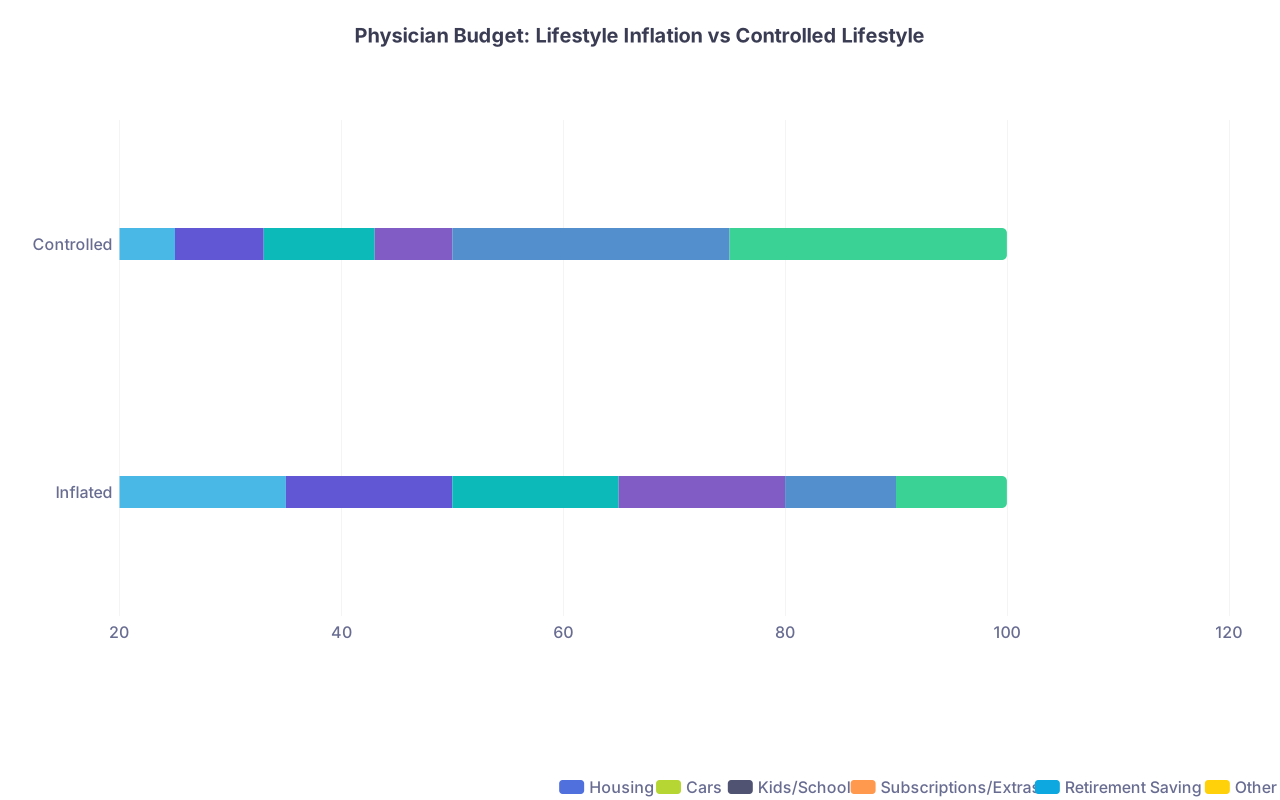
| Category | Housing | Cars | Kids/School | Subscriptions/Extras | Retirement Saving | Other |
|---|---|---|---|---|---|---|
| Inflated | 35 | 15 | 15 | 15 | 10 | 10 |
| Controlled | 25 | 8 | 10 | 7 | 25 | 25 |
See the difference? In the inflated version, retirement is what’s left over. In the controlled version, retirement is a core line item.
A Simple Framework to Keep Lifestyle Inflation in Check
You do not need a 50-line spreadsheet to not blow this. You just need hierarchy.
Here’s a blunt framework that works:
Decide your savings rate first
- Minimum 20% of gross to retirement/investments
- Lock it in with automatic contributions
Cap the big rocks
- Housing cap: under 2x income for price, under 25–28% of net pay monthly
- Car cap: under 10% of gross income per vehicle, avoid payments, used is fine
- School/children: only once savings targets are comfortably met
Freeze your lifestyle after big jumps
- Each time your income jumps, don’t upgrade lifestyle for 6–12 months
- Use that jump to crush debt or boost savings
Audit once a year
- Subscriptions, services, memberships, leakage
- Ask “Would future me be okay with this trade?”

If you simply do these four, you’ll avoid 90% of the traps your peers step into.
FAQs
1. How much should a physician actually be saving for retirement to avoid these problems?
If you start early in your attending years (early 30s), aim for at least 20% of gross income toward retirement and long-term investing. If you’re late 30s or 40s with minimal savings, push that to 25–30%. That includes:
- Employer retirement accounts (401k/403b, 457b)
- IRAs/backdoor Roths
- Taxable brokerage accounts earmarked for long-term investing
If your current lifestyle makes 20% impossible, that’s your red flag that you’ve already inflated too far.
2. Is it ever okay to buy the “doctor house” or dream car?
Yes—after your financial engine is built. Meaning:
- You’re consistently saving 20–25%+ of gross
- You have an emergency fund (3–6 months of expenses)
- You’re properly insured (disability, term life)
- Your student loans are under control with a clear payoff or forgiveness plan
Then buy the nicer stuff. Just still stay within sane caps (2x income for house, ~10% of income for cars). The mistake is making the dream house and car your first attending purchase instead of a mid-career reward.
3. I already fell into lifestyle inflation. Is it too late to fix this?
It’s only too late if you refuse to change. I’ve watched physicians in their late 40s course-correct by:
- Downsizing homes
- Selling expensive cars and paying cash for reasonable ones
- Switching kids from private to public schools
- Cutting $2–3K/month of recurring extras
- Increasing retirement savings from 5–8% up to 20–25%
It stings at first. Your ego will scream. Then your net worth starts moving and the anxiety quiets down. The worst move is pretending it’s fine and hoping a future raise miraculously bails you out.
4. How do I talk to my spouse/partner about dialing back lifestyle without starting a war?
Skip vague guilt like “we spend too much” and go straight to concrete tradeoffs:
- “If we keep this house and car, we’ll need to work full-time until at least 68.”
- “If we cut X and Y, we can retire by 60 and take extended trips every year.”
- Show numbers: project retirement balances under current spending vs trimmed spending.
Frame it as protecting both of you from burnout and future stress, not as punishment. And be ready to give up some of your luxuries too—this cannot be a one-sided lecture.
Open your last three months of bank and credit card statements today. Highlight every recurring charge and every purchase over $500. Then ask one question for each: “Would I buy this again if it meant working five extra years?” Cancel or cut at least three things before you close the laptop.