
The most dangerous retirement mistake isn’t overspending. It’s being “too responsible” in the wrong way.
Specifically: aggressively paying off loans while starving your retirement plan.
That hyper-focus on debt can quietly wreck your future more reliably than almost any bad purchase you’ll ever make.
Let me be blunt:
“I’ll max out my loans first, then I’ll get serious about retirement” is how people end up 52 years old with no savings, a paid‑off car, and a sinking feeling in their stomach.
Let’s walk through how this goes wrong – and how to avoid backing yourself into a corner you cannot fix later.
The Seductive but Dangerous “Debt First” Story
You probably know this script:
- “Debt is bad. I want to be debt-free.”
- “I can’t even think about investing until these loans are gone.”
- “Once the loans are paid off, I’ll have plenty of time to save.”
Sounds responsible. Disciplined. Even virtuous.
And yet, this mindset quietly creates a set of problems:
- You lose years of compound growth you can never get back.
- You train yourself to see investing as “optional” and debt as “urgent.”
- You put all your risk on one bet: that future you will have the same income, health, and discipline as today.
That’s not a plan. That’s hope dressed up as prudence.
Here’s the core mistake:
You’re comparing “interest rate vs interest rate” and ignoring time, taxes, and risk.
The Math Trap: Why 6% vs 7% Isn’t the Real Comparison
People tell me:
“My loan APR is 6%. My 401(k) might only earn 7–8%. I’d rather lock in a guaranteed 6% return by paying debt off.”
Looks smart. It’s not. Here’s what you’re missing.
1. You’re ignoring tax benefits
Retirement contributions often come with:
- Tax deductions (traditional 401(k)/IRA)
- Employer match (free money, often 3–6% of salary)
- Tax‑free growth (Roth accounts)
So if:
- Your loan rate is 5–7%
- Your employer matches 4%
- You’re in a 22% tax bracket
You’re not comparing 5–7% vs 7–8%. You’re comparing:
- After‑tax loan cost (maybe less than the sticker APR, especially for some student loan interest)
against - Employer match (100% immediate return on that first chunk)
- Plus tax savings
- Plus decades of compounding
Skipping a match to pay extra on a loan is one of the worst “responsible” mistakes you can make.
2. You’re ignoring compound time
A lot of you say, “Once I’m 40 and debt-free, I’ll ramp up saving.”
Here’s what that really means:
If you invest $6,000/year from age 30–40 (10 years) at 7%, then stop, and let it grow to age 65:
- You’ll have roughly $629,000.
If instead you pay loans aggressively and only start investing $6,000/year at age 40, and do it every year until 65 (25 years):
- You’ll end with about $379,000.
Same annual savings amount.
The “responsible” debt killer ends with about $250,000 less – and saves more years to get there.
The mistake? Underestimating how violently early compounding works in your favor.
3. You’re ignoring risk concentration
Paying debt is risk-free in one sense: you know the “return.”
But the concentrated risk is this: you’re betting everything on your future earning years.
- What if you get laid off at 50?
- What if your industry changes?
- What if health issues knock you out of work in your 40s?
If all your “good years” went to knocking $0 off your retirement balance while crushing a 4–6% loan, you’ve traded a manageable debt for an unfixable time gap.
Loans have terms. Retirement doesn’t.
The Emotional Trap: Debt Shame vs Retirement Apathy
Another quiet problem: psychology.
I hear versions of this all the time:
- “I can’t sleep owing $80k in student loans.”
- “I hate seeing that balance every month.”
- “The debt feels like a weight; retirement just feels…abstract.”
Here’s the catch: your feelings do not care about math.
So people:
- Throw every spare dollar at the loan
- Feel a brief high as the balance drops
- Tell themselves, “I’m being good, I’m being disciplined”
- Meanwhile, another year passes with no IRA, no 401(k) contributions, no Roth
The result?
- At 35: “I’m almost debt-free. I’ll start saving soon.”
- At 40: “The kids’ activities and house repairs are killing me. Soon.”
- At 45: “College is coming. I’ll start when that’s over.”
- At 50: “I don’t know where the last decade went.”
The danger is not one bad decision. It’s ten years of “just this year” choices.
You can’t “make up” 10–15 lost compounding years in your 50s without radically painful savings levels. Most people simply won’t do it.
The Employer Match Mistake: Walking Past Free Money
Let me be crystal clear:
If your employer offers a match and you’re not contributing at least to get the full match because you’re paying extra on loans instead – that’s a mistake. Full stop.
Let’s compare choices for someone making $70,000 with a 4% match and a 6% loan:
- Employee contributes 4% ($2,800)
- Employer matches 4% ($2,800)
- Total into retirement: $5,600
- Loan: they pay minimums, not extra
Versus:
- They refuse to contribute until loans are gone
- They send that $2,800 extra to loans
- Employer contributes $0
- Total “benefit”: 6% interest avoided on $2,800 = $168 “return” in year one
They walked away from:
- An immediate $2,800 employer contribution
- Over years, potential growth on that contribution
They did this to “earn” a guaranteed $168.
That’s not caution. That’s self-sabotage dressed as discipline.
The Liquidity Trap: Being Debt-Free and Cash-Poor
Another underappreciated risk: lack of flexibility.
When you pour everything into loans:
- Those dollars are gone. No liquidity.
- You can’t call your lender and say, “Hey, can I have back those 18 months of extra payments? I need them now.”
Life, meanwhile, does what life does:
- Car dies
- Roof leaks
- Job loss
- Medical issue
If you’ve:
- Paid your loans to zero
but - Have no emergency fund
- No investment accounts
- No retirement cushion
You’re right back into debt the moment something goes wrong. Maybe at worse terms.
You “won” the race to $0 balance and then lost the war on resilience.
When Paying Loans First Really Backfires: Common Scenarios
Let me walk you through a few real‑world patterns I’ve seen. Names changed, story unchanged.
Scenario 1: The Late Starter with No Time Left
- Age 32: “I’ve got $90k in student loans at ~5.5%. I’m going to crush them in 5 years, then focus on retirement.”
- Age 37: Loans gone. Feels great.
- Retirement accounts: basically $0.
- Now they finally start saving. But now they also have:
- Two kids
- A bigger house
- Higher lifestyle expectations
Savings progress is slower than promised. At 45, they realize they’re far behind. Now it takes insanely high savings rates (25–30% of income) to catch up.
They never planned for how expensive their 40s and 50s would feel.
Scenario 2: The Career Curveball
- Age 30: High‑earning professional, big student loans. Refuses to invest until debt is gone.
- Age 38: Loans mostly gone. Career hit – burnout, health issue, or industry shift.
- Income drops or becomes unstable.
If they’d been investing consistently since 30:
- They might have $200k–$300k+ working for them.
- They’d have options: downshift, lateral moves, partial retirement later.
But they spent the “healthy, high earning” decade buying themselves a nice $0 debt number and no assets.
Once your good earning years get interrupted, you don’t just “choose” to catch up.
Scenario 3: The House‑Poor Overcorrector
- They buy a house early.
- Now they feel “bad” being in debt twice (mortgage + loans).
- They panic and send every extra dollar into mortgage principal and student loans.
- No retirement, tiny emergency fund.
Then:
- House needs repairs
- Or job changes
- Or kid arrives
They turn right back to credit cards or HELOCs. They never give their net worth a chance to grow; they just move liabilities around.
Reasonable Exceptions: When Paying Debt Aggressively Does Make Sense
I’m not saying “never pay extra on debt.” I’m saying “don’t blindly prioritize it over retirement.”
There are times when going harder on debt is reasonable:
Toxic high‑interest debt (10–20%+)
- Credit cards, some personal loans.
- Yes, this should usually be priority #1 once you have a small emergency fund.
- You’re not “choosing” between 18% APR and 7% market returns. You kill 18% first.
Very unstable income / near‑term risk
- If job loss is likely next year, having lower fixed monthly obligations can help.
- But even then, you still need some liquidity. Zero savings is just as dangerous.
Tiny remaining loan balance
- If you’re down to, say, $3–5k and you want it gone for psychological reasons, fine.
- That’s not the same as a 7‑year crusade to wipe $100k before opening an IRA.
What you do not do is use these edge cases to justify not saving for 10–15 years.
A Safer Framework: How to Avoid the “Debt First, Regret Later” Trap
Let me give you a simple structure that keeps you from making the classic mistake.

Step 1: Build a small but real emergency fund
- Goal: 1–3 months of bare‑bones expenses at minimum.
- This is before you get aggressive with any debt, but alongside minimum loan payments.
- Why? To avoid the cycle of “pay debt down, then re-borrow when life happens.”
Step 2: Take the free money (employer match)
Non‑negotiable rule:
If there is a retirement match, you contribute at least enough to get the full match.
- That’s your baseline.
- No “I’ll wait until loans are gone.”
- Matching dollars are part of your pay. Declining them is just a pay cut.
Step 3: Decide based on categories of debt, not emotions
Break your debts into:
High interest (10%+) – credit cards, some personal loans
→ Priority: aggressively pay these down after getting the match and emergency fund started.Medium interest (5–9%) – many private loans, some car loans
→ Mixed approach:- Continue minimums
- Still fund retirement at least to a healthy base (match + some extra)
- Then split extra cash between this and more investing, depending on comfort.
Low interest (below ~4–5%) – certain mortgages, subsidized loans, refinanced student loans
→ Often better to:- Pay minimums
- Save/invest more aggressively
- Consider only modest extra payments if it helps you sleep.
Don’t throw a 12% credit card and a 3.5% mortgage in the same emotional bucket of “bad debt.” They are not equal. Treat them differently.
Step 4: Set a minimum retirement “floor” contribution
Even with loans, set a rule for yourself:
- “I will always save at least X% of my income for retirement, no matter what.”
For many people, X should not be less than 10% total (you + employer) once you’re out of pure crisis mode. More is better if you started late.
This:
- Keeps compounding working on your side.
- Prevents the “I’ll start later” fantasy from eating decades.
Step 5: Revisit yearly – and actually shift dollars later
There is a happy story that doesn’t get told enough:
Years 1–5:
- You build a small emergency fund.
- You get your match.
- You chip away at high‑interest stuff.
- You make progress.
Year 6:
- High‑interest debt gone.
- Now you redirect those same debt payments straight into retirement.
The key is: you don’t start at 0% savings and hope you’ll magically go to 20% after debt. You:
- Start at, say, 10% (including match) while paying debt.
- Later, you jump that to 18–25% once debt is lighter.
The mistake to avoid is waiting to go from 0% to hero. Most people never flip that switch.
The Real Question: What Would 65‑Year‑Old You Say?
Forget what feels best today. Imagine you’re 65, looking back.
Which regret would hurt more?
- “I carried some low‑interest student loans for a while, but I consistently invested and now I’m financially secure”?
or
- “I was debt‑free at 40. Then I woke up at 55 with almost nothing invested and not enough years left to fix it”?
I’ve seen both. The second kind of regret is brutal. There’s a specific look people get when they realize compounding only works if you actually give it time.
Your 65‑year‑old self does not care whether your car was paid off at 38 or 41. They care whether you have enough invested to retire without panic.
Quick Comparison: How Priorities Change the Outcome
| Strategy | Retirement Savings by Year 10* | Debt Balance by Year 10 | Flexibility / Risk |
|---|---|---|---|
| Debt-First (no saving) | ~$0 | Low or $0 | High risk, no cushion |
| Match-Only + Debt | Moderate (tens of thousands) | Moderate to low | Some cushion, some risk |
| Balanced (match + extra saving + targeted debt paydown) | Higher (potentially 2–3x match-only) | Moderate | Lower risk, growing options |
*Assuming typical market returns. Not a guarantee, but directionally accurate.
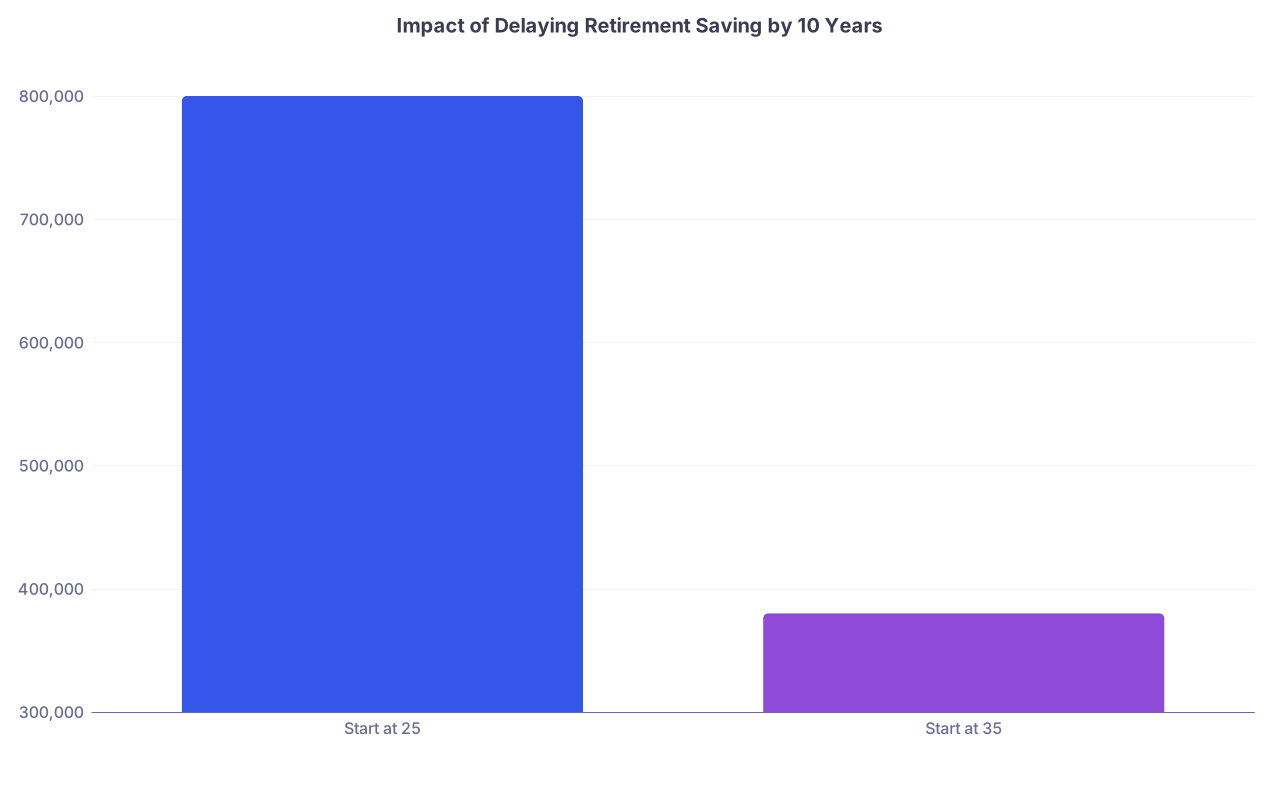
| Category | Value |
|---|---|
| Start at 25 | 800000 |
| Start at 35 | 380000 |
You don’t have to love investing. You just have to not sabotage it.
The Bottom Line
Three key points to keep you out of trouble:
Do not sacrifice years of retirement compounding just to see a $0 loan balance faster. Time in the market usually beats tiny differences in interest rates.
Never walk away from employer matches to pay extra on non‑toxic debt. That’s not caution – it’s burning free money.
Adopt a balanced plan: small emergency fund, get the match, pay down high‑interest debt, and always maintain a minimum retirement savings floor.
Do that, and you avoid the “debt-free but unprepared” future that traps far too many people who thought they were doing everything right.