
You wake up on a Saturday, mid-40s or early 50s, and realize something uncomfortable: you have a 401(k), maybe an IRA, definitely some random investments… but no actual plan. No written rules. Every market drop triggers a mini panic, every headline makes you wonder if you should “move to cash,” and you keep promising yourself you will “get organized.”
You are here: tired of guessing, worried about big mistakes, and ready to put real structure around your retirement investing. You do not want a 3-month project. You want one solid day that produces a real document you can use.
Good. That is exactly what we will build: a one-day, written Investment Policy for your retirement. Not theory. A document you can print, sign, and follow.
Below is a step-by-step protocol you can knock out in a single focused day (3 blocks of ~2–3 hours). I will give you the structure, the questions to answer, and sample language you can literally copy and modify.
Block 1 (Morning): Define the Mission and the Math
Forget funds and tickers for a moment. First you define what this portfolio is for and what numbers you are solving for. This is where most people stay vague. You will not.
Step 1: Set a clear retirement mission statement
Open a blank document. Put this at the top:
“Retirement Investment Policy for [Your Name(s)]
Created: [Date]
Next Required Review: [Date, one year from now]”
Now, write a 2–4 sentence mission statement that answers three things: what this portfolio is for, when you need it, and what matters most (security vs growth vs legacy).
Example (single, age 45):
The purpose of this portfolio is to support my retirement lifestyle starting around age 65 and lasting at least 30 years. My primary objective is to maintain financial independence without running out of money, with secondary goals of leaving a modest inheritance and supporting charities. I will accept moderate short-term volatility to achieve long-term growth that outpaces inflation.
Example (married couple, early 50s):
Our retirement portfolio is designed to provide inflation-adjusted income beginning at age 62 for [Name] and 65 for [Name]. Our main priority is protecting our ability to cover essential living expenses while allowing for growth to fund travel and healthcare. We prefer a stable, rules-based approach rather than frequent changes based on market news.
Do not overthink this. Write something true and move on. You can revise next year.
Step 2: Define your time horizon and retirement date
Write a short section:
“Time Horizon”
Answer these, in plain language:
- Current age(s)
- Target retirement age(s)
- Whether you expect to add to these accounts or mostly withdraw going forward
Example:
I am 47 and plan to fully retire at 65, though partial retirement at 62 is possible. I expect to continue contributing to retirement accounts for at least the next 15 years. Once withdrawals begin, the portfolio must sustain at least 30 years of retirement.
This drives risk decisions later. Longer horizon = more ability to handle volatility.
Step 3: Estimate your retirement spending and funding gap
No spreadsheet wizardry here. Just ballpark:
Write down your target retirement income (today’s dollars)
Example: “I want about $80,000 per year after tax in retirement, in today’s dollars.”List your expected guaranteed income
- Social Security estimate (from SSA.gov)
- Pensions (if any)
- Annuities (if any)
Calculate the annual “gap” that must come from investments.
| Item | Amount (Annual, Today’s Dollars) |
|---|---|
| Desired Retirement Income | $80,000 |
| Estimated Social Security | $32,000 |
| Pension Income | $8,000 |
| Required From Investments | $40,000 |
Document this in a section titled “Retirement Income Target and Funding Gap.”
Example language:
My goal is to support approximately $80,000 per year in after-tax retirement spending in today's dollars. I estimate Social Security benefits of about $32,000 per year and a small pension of $8,000, leaving roughly $40,000 per year to be funded by my retirement portfolio. This policy is designed to manage the portfolio to reasonably support that level of withdrawals.
Is it perfect? No. Is it a lot better than “I have no idea”? Yes.
Step 4: Choose a withdrawal framework (for later)
You are not retired yet (probably), but your investment policy must say how you intend to pull money out when the time comes. Otherwise, you will wing it.
Pick one of these frameworks and write it down:
4% rule starting point:
Plan to start around 4% of portfolio value per year, adjusted for inflation, and be prepared to tighten in bad markets.Guardrails approach:
Start with a target (say 4–4.5%), but if the portfolio drops significantly, you temporarily reduce withdrawals; if it grows a lot, you allow some increase.Strict needs-based:
Withdraw only what is needed to cover the gap after guaranteed income, with a hard cap (e.g., 5% of portfolio in any year).
Example statement:
My baseline withdrawal rule in retirement will be to start at 4% of the portfolio value in the first year of retirement, adjusted for inflation in subsequent years. If the portfolio experiences a drop of 20% or more from a prior high, I will temporarily freeze inflation increases and consider reducing withdrawals by up to 10–15% until the portfolio recovers.
You can refine this later, but writing something now prevents panic decisions.
Block 2 (Midday): Lock in Risk, Allocation, and Investment Rules
Now we decide what level of risk you are willing to live with and what kind of portfolio follows from that.
Step 5: Decide your risk tolerance and capacity—explicitly
Two parts: emotional and financial.
Add a section: “Risk Tolerance and Risk Capacity.”
Answer these questions directly:
- How much temporary loss (in %) could you realistically withstand without bailing?
- How much loss would mathematically endanger your plan (if any)?
- Which matters more to you: avoiding regret from losing money, or regret from missing growth?
Use clear statements:
Emotionally, I can tolerate a temporary portfolio decline of about 20–25% without feeling compelled to sell. A decline of 30% or more would be highly uncomfortable but still tolerable if it aligns with my plan.
Financially, because I have 17+ years until planned retirement and expect Social Security to cover a portion of my expenses, I have moderate to high risk capacity. However, I prioritize avoiding catastrophic losses near retirement over maximizing gains.
If you are within 5–10 years of retirement, be honest: your capacity for a 50% stock-like drawdown is a lot lower.
Step 6: Choose your strategic asset allocation
This is the backbone of your policy. Not “which fund,” but the broad mix of:
- Stocks (domestic + international)
- Bonds (and cash)
- Optional: real estate (REITs), other diversifiers
Most retirement-focused investors land somewhere between 40/60 and 80/20 (stocks/bonds). Extreme ends are usually a mistake for non-professionals.
Pick one target mix and a tolerance band.
Example allocations:
- Age ~40–50, long horizon, comfortable with volatility:
- 70% stocks / 30% bonds
- Age ~55–60, medium horizon, more cautious:
- 60% stocks / 40% bonds
- Age ~65+, in retirement, risk averse:
- 40–50% stocks / 50–60% bonds
Write a section: “Strategic Asset Allocation.”
Example:
My target long-term allocation for retirement investments is:
- 60% stocks
- 40% bonds and cash
Within stocks:
- 40% of total portfolio in US stocks
- 20% of total portfolio in international stocks
Within bonds:
- 30% of total portfolio in investment-grade bonds (intermediate term)
- Up to 10% of total portfolio in cash or short-term bonds for liquidity.
I will allow each major asset class (stocks vs bonds/cash) to drift up to 5 percentage points from target before rebalancing (e.g., stocks can range between 55% and 65% of the portfolio).
Lock this in. This is now your default, not your feelings on a given day.
Step 7: Choose your investment vehicles (fund types, not brands)
Your policy should define what kinds of investments are allowed, not just what you own today. You keep it simple:
- Prefer:
- Low-cost, broadly diversified index funds or ETFs
- Plain-vanilla bond funds (US aggregate, Treasuries, high-quality corporates)
- Limit or exclude:
- Single stocks beyond a small percentage
- Sector funds, leveraged ETFs, speculative products, crypto, private deals
Section: “Approved Investment Types and Constraints.”
Example:
Approved investment types:
- Broad US stock index funds (e.g., total market or S&P 500)
- Broad international stock index funds (developed and emerging markets)
- Investment-grade bond funds (US aggregate, Treasury, municipal where tax-efficient)
- Money market funds or high-yield savings for cash reserves
Constraints:
- No more than 5% of the total portfolio in any single individual stock.
- No investments in leveraged or inverse ETFs.
- No more than 10% of the total portfolio in “satellite” or non-core strategies (sector funds, factor tilts, REITs, etc.).
- Cryptocurrency or speculative assets, if held at all, limited to 1–2% of net worth and excluded from the retirement portfolio calculations.
Note: you are not picking ticker symbols in the policy. You are defining the sandbox.
Block 3 (Afternoon): Funding, Behavior Rules, and Implementation Plan
Now you anchor the behavior: how you will contribute, rebalance, and not lose your mind when markets misbehave.
Step 8: Set contribution and savings rules
If you are still in accumulation mode, your policy should say exactly:
- Which accounts you fund (e.g., 401(k), IRA, Roth IRA, taxable)
- In what order ( prioritization )
- Target annual or percentage savings
Section: “Contribution Policy.”
Example:
While employed, I will:
- Contribute at least enough to my employer 401(k) to receive the full match each year.
- Aim to save a minimum of 15% of gross income toward retirement across all accounts.
- Prioritize contributions in the following order:
- 401(k) up to employer match
- Roth IRA (if eligible) or traditional IRA
- Additional 401(k) contributions up to annual limit
- Taxable brokerage account for any surplus savings
Contributions will be invested according to my strategic asset allocation using automatic investments where available.
If you are already retired, this section can be shorter and focused on withdrawal logistics instead of contributions.
Step 9: Define your rebalancing rules
Rebalancing is where most people “mean to” act but never do. You will write exactly when and how.
Decide:
- Frequency: at least once per year, maybe semi-annually or with thresholds
- Method: bring back to target allocation within defined bands
- Tax sensitivity: more active in tax-advantaged accounts, gentler in taxable
Section: “Rebalancing Policy.”
Example:
I will review the portfolio allocation at least twice per year, in June and December. Rebalancing will be triggered if:
- The stock allocation deviates by more than 5 percentage points from the 60% target (i.e., below 55% or above 65%), or
- Any single asset class (US stocks, international stocks, bonds, cash) deviates by more than 5 percentage points from its target.
Rebalancing actions:
- First, direct new contributions to the underweight asset classes.
- Second, within tax-advantaged accounts (401(k), IRA), exchange between funds to restore target weights.
- In taxable accounts, consider tax consequences and avoid realizing large capital gains unless the deviation is extreme or risk is inappropriate.
Now market moves tell you what to do. You are not guessing.
Step 10: Codify your behavior rules in bad markets
This is where most policies are weak. You need written rules for what you will not do and what you must do during turmoil.
Section: “Market Volatility and Behavioral Rules.”
You want statements like:
- When markets drop X%, what actions are allowed?
- What is explicitly forbidden?
- Under what conditions do you reduce risk (if any)?
Example language:
In the event of a market decline:
- I will not sell stock funds solely due to market volatility or alarming news headlines.
- I will not make allocation changes based on short-term predictions from media, friends, or internet commentators.
- If the total portfolio declines by 20% or more from a recent high, I will:
- Review this Investment Policy Statement,
- Confirm my time horizon and need for funds, and
- Consider rebalancing by buying more stocks to return to my target allocation, rather than selling.
The only reasons to materially reduce risk (e.g., lower stock allocation) are:
- A change in my time horizon (e.g., unexpected early retirement or job loss),
- A change in my essential spending needs, or
- A documented change in my risk tolerance, confirmed during the annual review and not in the middle of panic.
This is the firewall between you and your emotions. Use it.
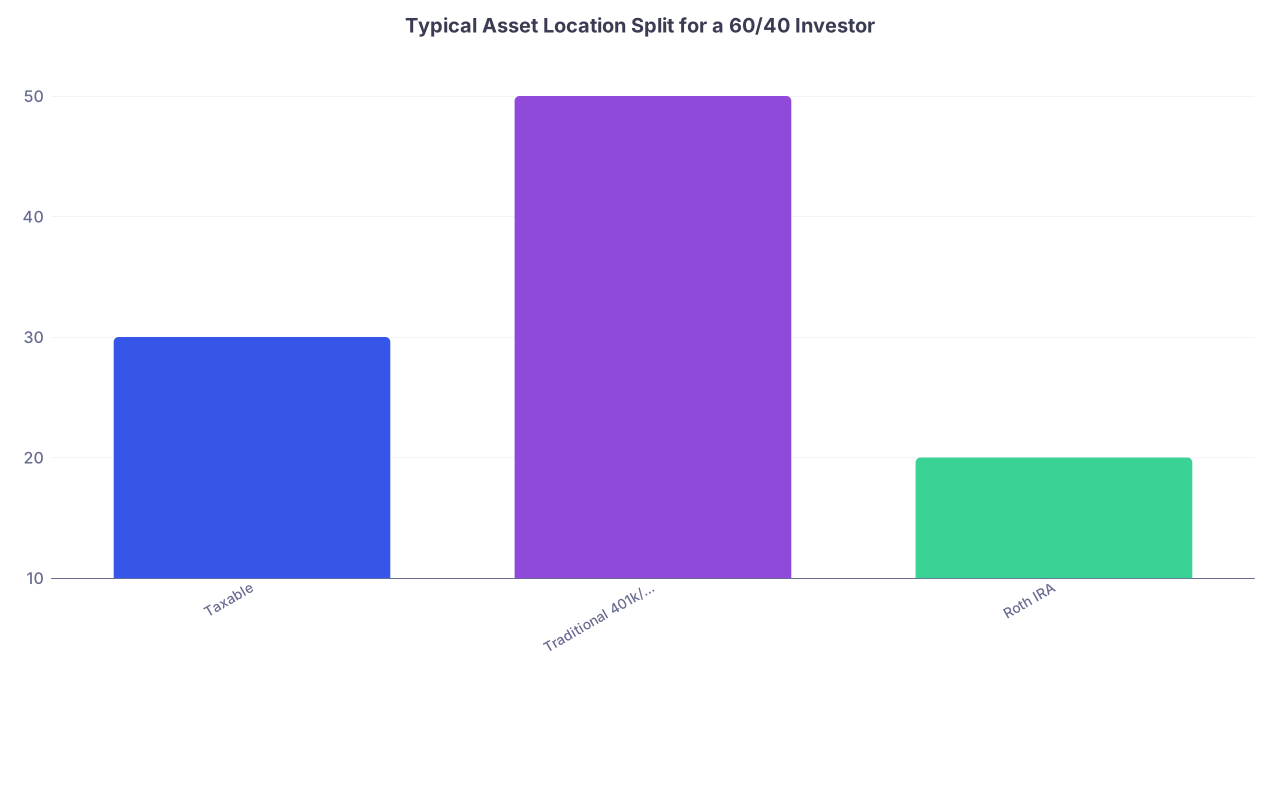
Step 11: Handle taxes, account types, and asset location
Now you decide where to hold which assets across different accounts:
- 401(k) / traditional IRA = tax-deferred
- Roth accounts = tax-free growth
- Taxable brokerages = fully taxable
Your policy should set simple asset-location rules:
Section: “Account Types and Asset Location.”
Example:
I will maintain a unified asset allocation across all retirement accounts combined, rather than targeting each account individually.
Asset location guidelines:
- Hold most bond funds in tax-deferred accounts (401(k), traditional IRA) when possible.
- Hold stock index funds in both tax-deferred and taxable accounts, prioritizing tax-efficient funds (e.g., total market or large-cap index funds) in taxable accounts.
- Use Roth accounts for the highest expected growth assets (e.g., stock index funds) and avoid holding bonds in Roth unless necessary.
When rebalancing, I will prioritize changes inside tax-advantaged accounts to minimize taxable events.
This prevents random scattering of funds that becomes impossible to manage.
| Category | Value |
|---|---|
| Taxable | 30 |
| Traditional 401k/IRA | 50 |
| Roth IRA | 20 |
Step 12: Spell out your investment selection criteria
Now you connect your approved fund types (from Step 7) to how you actually choose specific funds or ETFs.
Section: “Investment Selection Criteria.”
Specify the rules:
When selecting specific funds or ETFs, I will prioritize:
- Expense ratios below 0.20% for core stock index funds and below 0.30% for bond funds whenever available.
- Funds that track broad, well-known indices (e.g., total US market, S&P 500, total international).
- Sufficient fund size and liquidity (e.g., at least $500 million in assets for ETFs).
I will avoid:
- Actively managed funds with high turnover and expense ratios above 0.75% unless there is a clear, documented reason.
- Funds with complex strategies I do not fully understand.
Once selected, I will not change core funds more than once per year, except in the case of fund closures, major strategy changes, or significantly better low-cost options becoming available.
This stops you from constantly fund-hopping based on recent performance.
Step 13: Create a one-page summary and decision flow
Your Investment Policy Statement (IPS) might run 3–6 pages. That is fine. But you also want a one-page summary that you can glance at during stressful moments.
Your one-pager should include:
- Mission statement (1–2 sentences)
- Target asset allocation
- Contribution rules (1–2 bullets)
- Rebalancing triggers (1–2 bullets)
- Behavioral rules (3–4 short bullets)
- Next review date
You can also have a simple decision flow for changes:

| Step | Description |
|---|---|
| Step 1 | Market News or Portfolio Concern |
| Step 2 | Review IPS and adjust plan at next scheduled review |
| Step 3 | Rebalance according to IPS |
| Step 4 | Take no action. Re read behavioral rules |
| Step 5 | Document reason. Consider change at annual review |
| Step 6 | Has life or time horizon changed |
| Step 7 | Is allocation outside rebalancing bands |
| Step 8 | Is this panic or FOMO |
Print this page. Stick it in the same folder as your full IPS.
Step 14: Set your review protocol and change rules
An IPS is not a stone tablet. It is a living document—with rules for how it changes.
Section: “Review and Amendment Policy.”
Write this:
This Investment Policy Statement will be formally reviewed at least once per year, in [Month], or sooner if there is a significant life change, including:
- Marriage, divorce, or death of a spouse
- Major change in employment or income
- Significant health events
- Large inheritance or windfall
- Decision to retire earlier or later than planned
Any changes to this policy will be:
- Documented in writing with the date and reason for the change,
- Not made in the middle of acute market stress unless absolutely necessary for liquidity or risk management, and
- Evaluated for consistency with my long-term goals and risk tolerance.
Then, at the end of the document, add a signature line:
[Your Name]
Date: ___________
Yes, sign it. You are making a commitment to yourself.
Step 15: Sanity-check with actual numbers and current holdings
Before you call the day done, connect your policy to reality.
1. List all current accounts and balances:
- 401(k) at [Employer]
- Traditional IRA at [Firm]
- Roth IRA at [Firm]
- Taxable brokerage at [Firm]
For each, list current funds and approximate allocation:
- US stocks, international stocks, bonds, cash, other
Compare current allocation to your target.
| Asset Class | Current % | Target % |
|---|---|---|
| US Stocks | 50% | 40% |
| International | 10% | 20% |
| Bonds | 30% | 30% |
| Cash | 10% | 10% |
- Write a short “Transition Plan”:
Over the next 3–6 months, I will adjust my current holdings to align with the strategic asset allocation in this policy by:
- Redirecting new contributions to underweight asset classes (e.g., international stocks),
- Exchanging within tax-advantaged accounts to reduce overweight asset classes (e.g., US stocks) and increase bonds, and
- Minimizing taxable events by limiting sales in taxable accounts unless there are significant misalignments.
You do not have to fix everything in one trade today. The policy just guarantees you move in the right direction.
Example: One-Day Structure
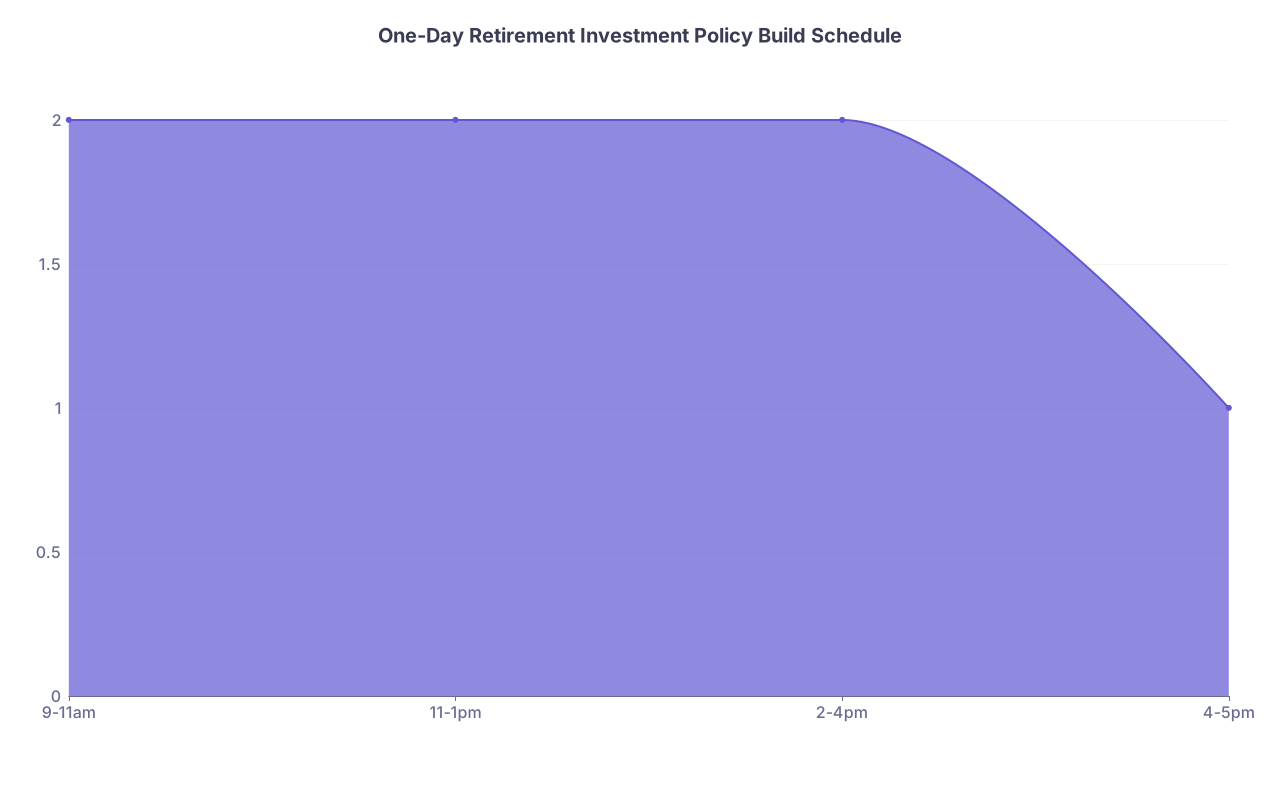
If you want an hour-by-hour template, here is a simple breakdown:
| Category | Value |
|---|---|
| 9-11am | 2 |
| 11-1pm | 2 |
| 2-4pm | 2 |
| 4-5pm | 1 |
- 9–11 am: Steps 1–4 (mission, time horizon, spending gap, withdrawal framework)
- 11–1 pm: Steps 5–7 (risk, allocation, allowed investments)
- 2–4 pm: Steps 8–12 (contributions, rebalancing, behavior rules, taxes, fund criteria)
- 4–5 pm: Steps 13–15 (summary page, review rules, transition plan, sign)
Take short breaks, but do not let this drag across weeks. One focused day beats endless “research” that leads nowhere.

Common Mistakes This One-Day Policy Prevents
Let me be blunt. I have watched people blow up decades of savings from a lack of structure. Your written policy directly prevents several classic errors:
Panic selling in bear markets
Your behavioral rules and rebalancing policy are designed to do the opposite: buy low, not bail out low.Random fund collecting
Without fund selection criteria and asset allocation, portfolios turn into 20+ overlapping funds with no logic. You now have a clear target mix and a filter for what belongs.Overreacting to “hot tips”
The “approved investment types” section gives you permission to ignore crypto hype, day-trading friends, or “disruptive innovation” funds that do not fit your plan.Ignoring taxes and account structure
Your asset location rules keep you from making tax-inefficient choices that cost you quietly every year.Drifting into too much risk near retirement
The policy forces you to re-express risk tolerance and capacity and gives you a mechanism to actually adjust.

If You Want Professional Eyes Without Losing Control
You may decide to have a financial planner review your IPS. Good idea, as long as you remember this:
- You bring the policy.
- They bring technical refinement.
If an advisor constantly pushes changes that conflict with your written policy for no good reason, that is a red flag. The right expert helps you stress-test assumptions, refine withdrawal rates, and optimize taxes, but does not throw out your entire structure every year.
Final Tight Summary
Three things matter most:
- Put it in writing. A real Investment Policy Statement is just your long-term decisions made once, calmly, and then followed consistently.
- Decide your allocation and rules upfront. Target mix, rebalancing triggers, and behavior rules during market stress are non-negotiable parts of a functional plan.
- Review annually, not constantly. Adjust only for real life changes, not for every market headline.
Do this in one focused day, sign it, and you will be miles ahead of the average investor who is still winging it.