
The default advice physicians get about old 401(k)s is lazy and expensive.
“Just leave it where it is.”
“Roll everything into your current plan.”
“Call a financial advisor.”
That is how you end up with five accounts, three fee layers, and no idea what you actually own.
You can do this yourself. In a structured way. Without blowing up your taxes or triggering penalties.
Below is a step‑by‑step process I use with physicians to consolidate old 401(k)s cleanly and safely.
Step 1: Get the Full Inventory (No Guessing)
You cannot consolidate what you cannot name.
Make a one‑page master list of every retirement account you have. Not “I think there’s one at the old hospital.” Exact accounts.
Use this checklist:
- Employer plans
- 401(k)
- 403(b)
- 401(a)
- 457(b) (governmental vs non‑governmental)
- Individual accounts
- Traditional IRA
- Roth IRA
- SEP IRA (from 1099 work)
- SIMPLE IRA (if you ever had one)
- Other
- Pension cash balance accounts
- Solo 401(k) if you have moonlighting income
For each old plan you might consolidate, create a line with:
- Employer name
- Plan type (401(k), 403(b), 457(b), etc.)
- Provider (Fidelity, Vanguard, TIAA, Empower, Prudential, etc.)
- Approximate balance
- Whether there is any employer stock in the account (critical for tax reasons)
- Whether you made Roth contributions in that plan
You do not guess. You log in or call HR/benefits to confirm.
If you are not sure where an old plan is, use:
- Old paystubs or W‑2s – look at the retirement box and provider names.
- Your email – search for “401k”, “403b”, “retirement plan”, “Fidelity”, “TIAA”, “Empower”, etc.
- Your state’s unclaimed property website if the account was abandoned (rare, but it happens).
Once you have the list, you are ready to decide where things should end up.
Step 2: Choose Your “Home Base” Account
Consolidation is pointless if you move accounts into another bad, expensive, or inflexible plan.
You need a destination. Usually one of these:
- Your current employer’s 401(k)/403(b)
- A traditional IRA at a low‑cost brokerage (Vanguard, Fidelity, Schwab)
- A solo 401(k) if you have 1099 income and want backdoor Roths to stay clean
Your goal: One main pre‑tax bucket, one main Roth bucket. Maybe a separate solo 401(k) if you are serious about 1099.
Here is how I rank the usual options for most physicians:
| Destination | Typical Pros | Typical Cons |
|---|---|---|
| IRA at Brokerage | Max flexibility, low cost funds | Can interfere with backdoor Roth |
| Current 401(k)/403(b) | Keeps backdoor Roth clean, creditor protection | Limited investment menu, some plans expensive |
| Solo 401(k) | Great for 1099 income, backdoor friendly | Paperwork to set up/maintain |
When an IRA is best
Roll old 401(k)s into a traditional IRA if:
- Your current employer plan is garbage (high fees, loaded funds, no index options).
- You do not care about doing backdoor Roth IRAs now or in the near future.
- You want full control over your investment lineup.
When your current 401(k)/403(b) is best
Use the current employer plan if:
- You are doing or plan to do backdoor Roth IRAs (pro‑rata rule makes IRA rollovers messy).
- The plan has:
- At least one good S&P 500 or total US stock index fund
- A decent international stock index fund
- A low‑cost bond index fund
- Fees are reasonable (0.05%–0.40% on core funds, no crazy wrap or advisory fees).
When a solo 401(k) is best
If you have meaningful 1099 income (locums, consulting, call coverage), a solo 401(k) at Fidelity, Vanguard, or Schwab is often superior to an IRA because:
- You can roll old pre‑tax accounts into it.
- It does not interfere with backdoor Roth IRAs.
- You can make additional employer contributions from 1099 income.
Pick the home base before you touch anything.
Step 3: Know Exactly What You’re Rolling (Pre‑tax vs Roth vs After‑Tax)
Here is where many physicians accidentally create a tax mess.
Every old employer plan can have up to three different money types:
- Pre‑tax (traditional)
- Roth (designated Roth contributions)
- After‑tax, non‑Roth (less common, but powerful if you had mega backdoor Roth options)
You do not treat these the same.
Call the old plan and ask:
“Can you tell me the breakdown of my balance by source – pre‑tax, Roth, and after‑tax? And are there any employer stock holdings in the account?”
Then write it down for each plan:
- Pre‑tax amount
- Roth amount
- After‑tax basis (your contributions)
- Earnings on the after‑tax part
- Employer stock cost basis and market value (for NUA – explained shortly)
Your end goal:
- Pre‑tax money → rolled to pre‑tax destination (traditional IRA, current 401(k), solo 401(k))
- Roth money → rolled to Roth IRA or Roth 401(k)
- After‑tax money → likely into Roth IRA with correct handling of earnings
If the plan cannot give you this breakdown, push harder. They have it.
Step 4: Decide Account-by-Account: Keep, Roll, or Cash Out (Rare)
You do not automatically roll everything. Some accounts are better left alone; a tiny few are better cashed out.
Use this triage:
1. Old 401(k)/403(b) with good funds and very low fees
You can reasonably leave these in place if:
- Expense ratios on index funds are under ~0.20%.
- You are not overwhelmed by account sprawl.
- You might use special features (stable value funds, good fixed income options).
But be honest: most people never look at these again. Which leads to neglect.
2. Small “orphan” accounts under ~$5,000–$10,000
These are often not worth keeping separate. Good candidates to roll into your chosen home base.
Exceptions:
- Old 401(k) with employer stock that has huge unrealized gains – you might use NUA instead of rolling.
- 457(b) plans – discussed separately below.
3. 457(b) plans (tricky)
Governmental and non‑governmental 457(b) plans are very different.
- Governmental 457(b):
- Usually can be rolled into an IRA or 401(k) when you separate.
- Generally similar to 401(k) from a tax and protection standpoint.
- Non‑governmental 457(b):
- Technically the employer’s asset, not yours.
- Subject to employer’s creditors.
- Often cannot be rolled into an IRA or new 401(k); distributions must come directly from the plan.
For non‑governmental 457(b):
- Read the plan document or summary carefully.
- Many physicians choose to take distributions over a few years after leaving rather than keeping assets tied to a potentially shaky hospital system.
Do not cavalierly roll or consolidate 457s without understanding which type you have.
4. Accounts you should almost never cash out
Cash out only in extreme situations (e.g., absolute emergency, tiny balance). Otherwise:
- You pay ordinary income tax.
- Possibly a 10% early withdrawal penalty if under 59½.
- You permanently shrink your tax‑advantaged space.
The bar to cash out an old 401(k) should be very, very high.
Step 5: Set Up the Destination Accounts Correctly
Before you initiate any rollovers, the receiving accounts must exist.
For each destination:
If using a traditional IRA
- Open a rollover IRA or standard traditional IRA at your chosen brokerage.
- Name it something clear: “Dr. Smith – Traditional IRA (Rollover).”
- Do not contribute new money yet if you plan to keep backdoor Roth IRA options open and might later roll this into a 401(k). (Labeling as “rollover” preserves some employer plan options.)
If using your current employer 401(k)/403(b)
- Confirm with HR/plan provider that they accept rollovers from prior employer plans and/or IRAs.
- Ask what paperwork or online forms are required.
- Get the exact payee name for rollover checks, e.g.,
“Fidelity Investments FBO [Your Name] [Your Plan Account Number]”
If using a solo 401(k)
- Set it up at your chosen brokerage.
- Ensure the plan document explicitly allows roll‑in from other qualified plans (most do).
Once the destination exists and you know how checks should be titled, you are ready for the actual rollover mechanics.
Step 6: Do Only Direct Rollovers (Trustee-to-Trustee)
There are two ways to move money: one is clean; the other is a booby trap.
You want a direct rollover / trustee‑to‑trustee transfer. Not an indirect rollover.
Here is the difference:
Direct rollover:
- Money moves directly from old custodian to new custodian.
- Either electronically (best) or via a check made payable to new custodian FBO you, mailed to you or to them.
- No withholding, no 60‑day rule risk.
Indirect rollover (avoid):
- Old plan cuts a check to you personally.
- They usually withhold 20% for taxes.
- You have 60 days to deposit the full amount, including the withheld 20%, into a new account.
- If you do not, part or all is treated as a taxable distribution.
So when you call the old plan, use very specific language:
“I want to do a direct rollover of my account to [New Custodian]. I do not want an indirect rollover. Please send the funds directly to the new custodian or make the check payable to [Custodian] FBO [Your Name], account number [X].”
If they insist on mailing the check to your home address, that is fine, as long as the payee is the new custodian, not you.
Step 7: Handle Roth and After‑Tax Money Correctly
You must keep Roth and pre‑tax money in their lanes.
For Roth 401(k)/403(b) balances
Best move for most physicians:
- Roll Roth 401(k) → Roth IRA in your name.
This gives:
- More control over investments.
- No required minimum distributions (RMDs) in retirement (unlike Roth 401(k)s under current law).
- Simpler tracking.
Be careful that the plan sends:
- Roth sources → directly to a Roth IRA or Roth 401(k) at the new employer.
- Pre‑tax sources → directly to a traditional IRA or pre‑tax 401(k).
Do not let them blend Roth and pre‑tax dollars in the wrong destination.
For after‑tax (non‑Roth) contributions
If your old plan allowed after‑tax contributions (not Roth) above the regular 401(k) limit, you may have:
- After‑tax basis (your contributions)
- Earnings on those after‑tax dollars
You can potentially do a favorable split:
- After‑tax basis → Roth IRA (tax free)
- Earnings → traditional IRA or 401(k) (still pre‑tax)
Ask the plan explicitly:
“Do you support split rollovers of after‑tax contributions to a Roth IRA and pre‑tax amounts to a traditional IRA in a single distribution?”
If yes, do that. If no, you may need a more careful strategy or accept that the entire amount goes to pre‑tax.
Step 8: Special Case – Employer Stock and NUA
If your old 401(k) holds employer stock that has grown a lot, you need to pause before rolling it into an IRA.
Why? Because of Net Unrealized Appreciation (NUA) rules.
Very short version:
- Normally, if you roll employer stock into an IRA, the whole amount is taxed as ordinary income when withdrawn later.
- With NUA, you may move the stock itself to a taxable brokerage account, paying ordinary income tax only on the cost basis now.
- The unrealized gain above basis becomes long‑term capital gains when you eventually sell the stock.
For example:
- You have $100,000 of employer stock in the 401(k).
- Cost basis is $20,000.
- Unrealized gain is $80,000.
NUA route:
- Pay ordinary income tax on $20,000 now.
- When you sell later, the $80,000 is taxed at long‑term capital gains rates.
This can be materially better than ordinary income on the full $100,000 later, depending on your situation.
Use NUA only if:
- The gains are significant.
- You are comfortable managing the tax hit and position risk.
- You understand you are concentrating in a single stock in taxable.
If you suspect NUA might matter, stop and get skilled tax help before rolling that employer stock.
Step 9: Execute the Rollovers in a Logical Order
Do not hit everything at once. You are a physician; you know better than to start every new med on the same day.
Use an order that reduces risk and confusion:
- Open / confirm destination accounts (Step 5).
- Roll smallest, simplest account first:
- No Roth, no after‑tax, no employer stock, just pre‑tax 401(k) → traditional IRA or current 401(k).
- This lets you confirm the process works and the new custodian received it correctly.
- Then tackle medium/large straightforward accounts.
- Then handle Roth accounts (Roth 401(k) → Roth IRA).
- Last: any complex cases (after‑tax, NUA employer stock, odd 457(b) restrictions).
Each time you complete a rollover:
- Log in to both old and new accounts.
- Confirm:
- Old balance is $0 (or shows “terminated/closed”).
- New account shows correct amount and correct type (traditional vs Roth).
- Download or print:
- Rollover confirmation from the old plan.
- Deposit/transfer record from the new custodian.
Create a single PDF or folder: “401k Rollovers – [Year]” and save everything. You will thank yourself when some IRS notice shows up in 3 years.
Step 10: Clean Up Your Investments After the Dust Settles
Once everything has landed, your job is not done. You need to rationalize the portfolio.
Common problem I see: someone consolidates three old 401(k)s into a new IRA… and just leaves the 18 legacy funds as‑is.
No.
Pick a simple target allocation and implement it across the consolidated accounts.
Typical physician example (not advice, just a pattern):
- Age 35–45, still in accumulation:
- 70–80% stocks, 20–30% bonds.
- Of the stock portion: 60–70% US, 30–40% international.
Implementation in your new main pre‑tax account might be as simple as:
- US Total Stock Index fund
- International Stock Index fund
- Total Bond or Intermediate Bond Index fund
Within each tax‑advantaged account:
- Replace expensive, active, redundant funds with your chosen core index funds.
- Minimize the number of funds. Three funds can do the job for most people.
Do this after all the money has arrived, so you are only trading on one platform per account.
Step 11: Protect Your Backdoor Roth Strategy (If You Use It)
Many physicians use the backdoor Roth IRA method:
- Contribute non‑deductible $6,500–$7,500 to a traditional IRA.
- Convert to Roth IRA shortly thereafter.
The catch: IRS pro‑rata rule.
If you have large pre‑tax balances sitting in any traditional, SEP, or SIMPLE IRA at year‑end, your conversion gets prorated, and you effectively pay tax on a portion of each conversion.
Consolidating old 401(k)s into an IRA can accidentally nuke this strategy.
If you care about backdoor Roths:
- Strongly prefer rolling old pre‑tax 401(k) money into:
- Your current 401(k)/403(b), or
- A solo 401(k) (if you can open one),
- Rather than into a traditional IRA.
If you already rolled into an IRA but want backdoor Roths:
- Sometimes you can later roll the IRA into a 401(k) that accepts roll‑ins, clearing the pro‑rata issue.
The right move depends on your timeline and employer plan quality. But you must at least be aware of the interaction.
Step 12: Lock in a Simple Ongoing Process
Consolidation is not a one‑time adulting task. Every job change is a new fork in the road.
Set a simple rule for yourself:
- When you leave a job, you will decide within 6 months what to do with that plan.
- You will not leave zombie 401(k)s scattered for decades.
Your process from now on:
- On accepting a new job, review the new employer’s plan:
- Are there good index fund options?
- Do they accept roll‑ins?
- When you leave the prior job:
- Add that plan to your inventory sheet.
- Decide: roll to new employer plan vs existing IRA/solo 401(k).
- Execute using the same steps you just used.
One or two rounds of this, and it becomes routine.
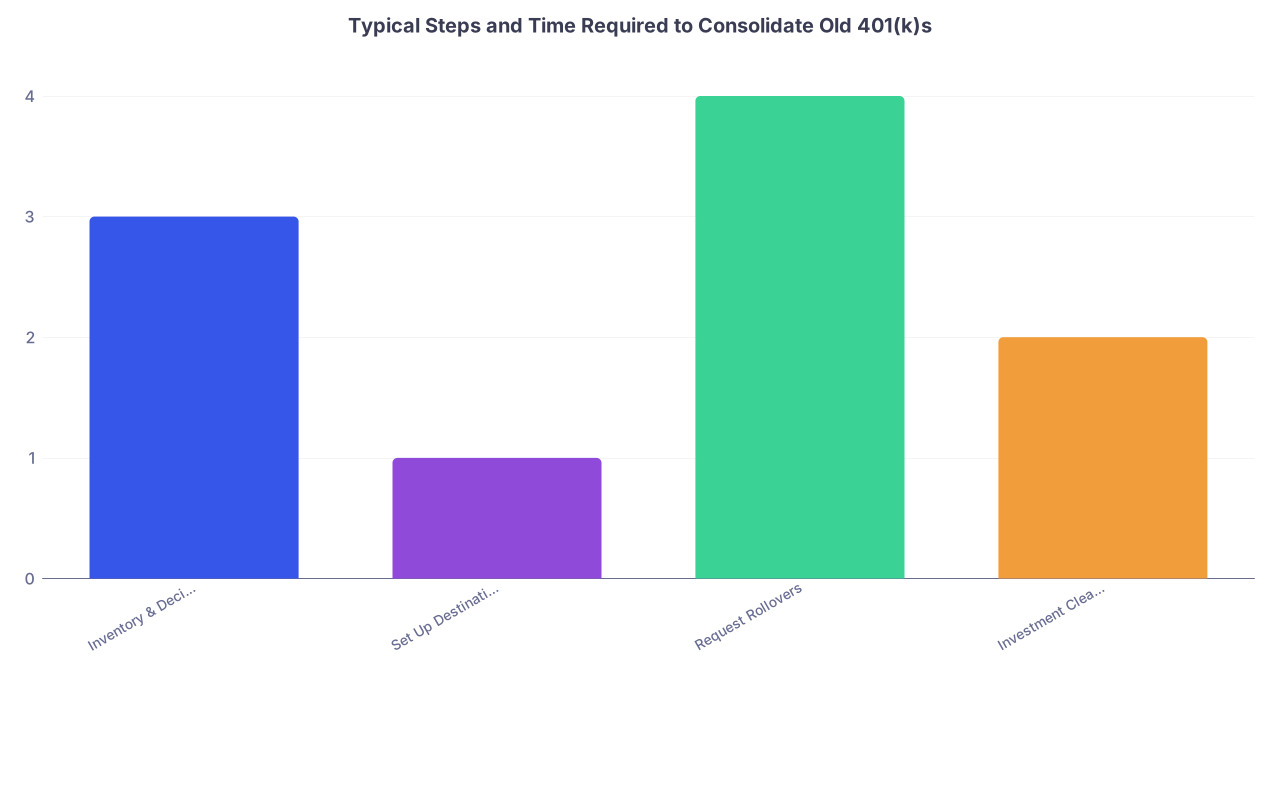
| Category | Value |
|---|---|
| Inventory & Decisions | 3 |
| Set Up Destinations | 1 |
| Request Rollovers | 4 |
| Investment Cleanup | 2 |
Common Pitfalls to Avoid
Save yourself from the mistakes I see over and over:
Indirect rollovers with 20% withholding
- You receive a check made out to you.
- You forget to redeposit full amount in 60 days.
- Tax and penalties show up later.
Rolling everything into an IRA, then discovering you want backdoor Roths
- Fixable but annoying – may require rolling IRA into a 401(k) later.
Ignoring Roth and after‑tax components
- Letting Roth 401(k) money land in a traditional IRA – that is just setting money on fire.
- Letting after‑tax basis end up in pre‑tax buckets needlessly.
Not verifying receipt
- Assuming the money made it.
- 6 months later, you realize one old 401(k) never moved and you lost track again.
Complex NUA / 457 situations without advice
- These two are where a bump of professional time is usually worth it.

| Step | Description |
|---|---|
| Step 1 | List All Old Accounts |
| Step 2 | Choose Home Base |
| Step 3 | Confirm Money Types |
| Step 4 | Open Destination Accounts |
| Step 5 | Direct Rollover Simple Accounts |
| Step 6 | Handle Roth and After Tax |
| Step 7 | Address Special Cases - 457 and NUA |
| Step 8 | Clean Up Investments |
| Step 9 | Set Future Job Change Rule |

Quick Example: How This Plays Out in Real Life
Let me run one realistic scenario.
You are a 40‑year‑old hospitalist. You have:
- Old 403(b) at Hospital A – $120,000, all pre‑tax, with TIAA.
- Old 401(k) at Locums Group – $35,000, mix of pre‑tax and $5,000 Roth.
- Current 401(k) at Hospital B – $90,000, excellent low‑cost index funds, accepts roll‑ins.
- Roth IRA at Vanguard – $60,000.
- No current 1099 income. You want to keep doing annual backdoor Roth IRAs.
Clean solution:
Decide your home base:
- Pre‑tax → current 401(k) at Hospital B (keeps backdoor Roth clean).
- Roth → Roth IRA at Vanguard.
Call TIAA (Hospital A 403(b)):
- Confirm it is all pre‑tax.
- Request direct rollover of full balance to Hospital B 401(k), using their rollover form.
Call Locums 401(k) provider:
- Get breakdown: $30,000 pre‑tax, $5,000 Roth.
- Request:
- Pre‑tax portion → direct rollover to Hospital B 401(k).
- Roth portion → direct rollover to your Roth IRA at Vanguard.
After all funds land:
- Log in to Hospital B 401(k): now has $90k + $120k + $30k = $240k.
- Rebalance to your chosen 3‑fund mix.
- Log in to Vanguard Roth IRA: now $60k + $5k = $65k.
End state:
- One main pre‑tax bucket (current 401(k)).
- One main Roth bucket (Roth IRA).
- Clean path to continue backdoor Roth IRA annually with no pro‑rata issues.
That is what “done correctly” looks like.

FAQs
1. Should I always roll old 401(k)s into my current employer plan?
No. Many employer plans are mediocre or outright bad. If your current plan has:
- High expense ratios,
- No decent index funds,
- Or extra advisory/wrap fees,
then a low‑cost IRA is often better, unless you need to preserve backdoor Roth IRA flexibility. Decide based on fees, investment options, and your Roth strategy, not convenience alone.
2. How many old accounts is “too many” before I must consolidate?
There is no legal limit, but from a practical standpoint:
- More than 2–3 old employer plans usually leads to neglect, bad asset allocation, and forgotten rebalancing.
- I advise most physicians to aim for one main pre‑tax account and one main Roth account, unless there is a specific reason to keep something separate (unique 457(b), pension cash balance, or NUA stock).
If you cannot list each account and approximate balance from memory, you have too many.
3. Does consolidating old 401(k)s hurt my creditor protection?
Usually not, if you keep money in qualified plans and IRAs under current federal and state rules. In general:
- 401(k)/403(b) plans have strong federal ERISA protection from creditors.
- Traditional and Roth IRAs have federal protection in bankruptcy (over $1 million in most cases) and varying protection in non‑bankruptcy depending on your state.
- Rolling from a 401(k) to an IRA generally preserves bankruptcy protection but may change non‑bankruptcy protection depending on state law.
If you have high litigation risk or practice in a particularly hostile state, talk with an asset protection attorney before moving large balances from ERISA plans to IRAs.
4. Do I need a financial advisor to do all this?
No. The mechanics are straightforward if you are methodical:
- Inventory accounts.
- Choose the right destination.
- Request direct rollovers only.
- Keep Roth/pre‑tax/after‑tax separated correctly.
Where an advisor or CPA can be worth paying for a one‑time consult is:
- Complex NUA employer stock decisions,
- Non‑governmental 457(b) strategies,
- High‑income multi‑entity practices with solo 401(k) and defined benefit layers.
Use expertise surgically, not as a default excuse to avoid understanding your own money.
Key points to remember:
- Pick your consolidation home base carefully, especially if you use backdoor Roth IRAs.
- Use only direct rollovers, keep Roth and pre‑tax money in separate lanes, and document every move.
- Once consolidated, simplify your investments into a coherent, low‑cost allocation you can actually manage.