
The mega backdoor Roth is the most underused tax strategy in hospital 403(b) plans—and most physicians are leaving tens of thousands of dollars on the table every year.
Let me break this down specifically, because this is not generic “max your 403(b)” advice. This is about turning an ordinary hospital retirement plan into a Roth conversion machine, using rules the IRS has already written and your HR department barely understands.
1. The Core Concept: What a Mega Backdoor Roth Actually Is
At its core, a “mega backdoor Roth” is very simple:
You use after-tax contributions (not Roth, not pre-tax) in your 403(b) up to the overall plan limit, then you move those contributions—ideally plus their earnings—into a Roth account as quickly as the plan allows.
There are three different buckets you must keep straight:
Employee elective deferrals
- Traditional pre-tax or Roth 403(b) contributions
- 2025 limit (under 50): $23,000
- Age 50+ catch-up: extra $7,500 (total $30,500)
Employer contributions
- Match, non-elective, or “discretionary” contributions
- These do NOT use your employee deferral limit
- But they DO count toward the overall 403(b) limit
Employee after-tax contributions (this is the mega backdoor Roth fuel)
- Not Roth. These are traditional after-tax contributions inside the 403(b)
- They do not reduce taxable income
- They fill the gap between what you and your employer have already put in and the overall plan limit
The IRS overall limit for a 403(b) (employee + employer + after-tax) is the same section 415(c) limit used for 401(k) and 403(b) plans.
For 2025, assume (because this is usually how it moves) something in the ballpark of the 2024 limit:
- Overall 403(b) annual addition limit: $69,000 (under 50)
- Age 50+ can also do catch-up deferrals, but catch-up does not raise the $69,000 cap
So the rough structure is:
- First, you fill your employee deferral bucket (pre-tax or Roth) up to $23,000 (or $30,500 if 50+).
- Your employer adds their match/non-elective contributions.
- Whatever space is left below $69,000 is your potential after-tax contribution room.
That after-tax space is what you can convert to Roth—through in-plan Roth conversion or distribution to a Roth IRA. That’s the mega backdoor.
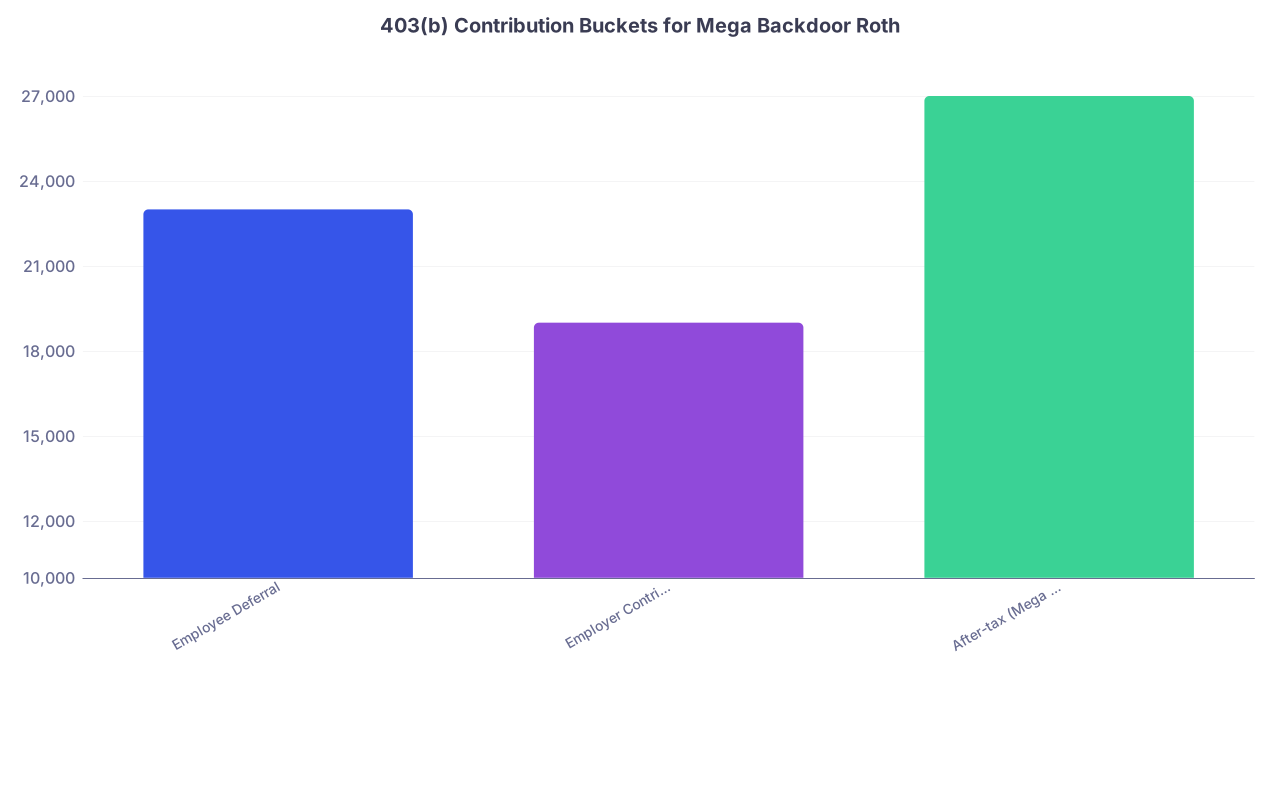
| Category | Value |
|---|---|
| Employee Deferral | 23000 |
| Employer Contribution | 19000 |
| After-tax (Mega Backdoor) | 27000 |
Example:
Hospital-employed physician, age 42
- You contribute $23,000 pre-tax.
- Employer contributes $15,000 (match + fixed).
- Total so far: $38,000.
- Remaining space under $69,000: $31,000.
- That $31,000 is what you can potentially send in as after-tax and then convert to Roth.
That is not chump change. Repeat for 10 years at 6–8% returns and you will see why this matters.
2. 403(b) vs 401(k): Why Hospital Docs Get Confused
Most mega backdoor Roth discussions online assume a 401(k) plan. Hospital-employed physicians usually have:
- A 403(b) (often with decent vendor options like Fidelity, Vanguard, TIAA, etc.)
- Sometimes also a 401(a) or 457(b)
- Sometimes a cash balance/defined benefit plan layered on top
The rules are similar, but a few details trip people up.
Key similarities (things you can rely on)
- The employee deferral limit applies across 401(k) + 403(b) + 401(a) elective deferrals at all employers in a year. So if you change jobs mid-year from a private 401(k) practice to a hospital 403(b), your combined employee deferrals cannot exceed $23,000 (under 50).
- The overall annual additions limit (the 415(c) limit—$69,000) is per employer, not per plan type. So if your hospital has both a 403(b) and a 401(a), those typically share the same 69k umbrella.
- Employer contributions and after-tax contributions both count toward that same annual additions limit.
Key differences / 403(b) quirks
- Many hospital 403(b) plans do not permit after-tax contributions at all. End of story. If that line is missing from the plan doc, the mega backdoor dies right there.
- Some 403(b)s allow after-tax but do not permit in-service distributions of those dollars until age 59½. That turns a mega backdoor into a long-delay Roth strategy. Still useful, but slower.
- A smaller subset will allow:
- After-tax contributions
- In-plan Roth conversions of after-tax amounts
- Or in-service rollover of after-tax amounts to a Roth IRA
This is the holy grail. That is where a real mega backdoor Roth strategy becomes viable.
You need to stop guessing and actually read your Summary Plan Description (SPD). Or better: email HR or the plan administrator and ask very specific questions (I will give you a script later).
3. The Legal Skeleton: Why This Strategy Works
This is not a loophole. It is a direct use of several well-established rules:
After-tax employee contributions in qualified plans
- Authorized by Internal Revenue Code §401(m) and applicable to 403(b) as designed by plan documents
- These contributions are made from already-taxed money but grow tax-deferred inside the plan.
Roth IRA rollovers of after-tax money
- IRS Notice 2014-54 clarified that when you roll funds out of a qualified plan with a mix of pre-tax and after-tax money, you can split the distributions in a tax-efficient way.
- You can send:
- Pre-tax money + earnings to a traditional IRA
- After-tax basis to a Roth IRA
- That is the technical backbone of the mega backdoor.
In-plan Roth conversions
- Many 403(b)s now offer Roth 403(b) subaccounts and permit “in-plan Roth rollovers” or “in-plan conversions” of pre-tax or after-tax funds into the Roth bucket.
- Converting after-tax principal is generally tax-free; converting its earnings is taxable.
Nondiscrimination and ACP testing (for non-government/non-church 403(b)s)
- After-tax contributions by highly compensated employees can be limited or refunded if the plan fails tests.
- Hospitals with a large non-physician employee base often impose percentage-of-pay caps on after-tax for physicians, so the plan stays compliant.
The point: the IRS already told you how to do this. The bottleneck is not legality. It is your plan document and your plan admin’s competence.
4. Does Your Hospital 403(b) Allow a Mega Backdoor Roth? Step-by-Step Check
Most physicians ask the wrong question: “Do we have a mega backdoor Roth?” Your HR rep will say “No, we do not offer that” because the phrase means nothing to them.
The right move is to break the problem into specific, yes/no components.
Step 1: Find or request the Summary Plan Description
The SPD is the legal user manual for your plan. Do not rely on the glossy brochure.
Look for sections titled something like:
- “Types of Contributions”
- “After-tax Employee Contributions”
- “Roth Contributions”
- “In-Service Withdrawals”
- “In-plan Roth Rollover / Roth Conversion”
- “Rollover Provisions”
If you cannot find it on the benefits portal, email Benefits or HR and say:
“Can you send me the current Summary Plan Description and any amendments for the 403(b) retirement plan? I am specifically interested in contribution types and in-service distribution rules.”
Step 2: Confirm whether after-tax employee contributions are allowed
You are looking for language like:
“In addition to pre-tax and Roth salary deferrals, you may also designate a portion of your compensation as after-tax employee contributions. These contributions are not excluded from current taxable income.”
If the only contribution types listed are:
- pre-tax elective deferrals
- Roth elective deferrals
- employer match or employer nonelective
…then there is no after-tax bucket, and therefore no mega backdoor Roth in this plan. You are done.
Step 3: Check in-service distribution or conversion rules
You want at least one of these to be explicitly allowed:
In-plan Roth rollover of after-tax contributions
Wording might be:- “The Plan permits in-plan Roth rollovers of vested account balances, including after-tax contributions and earnings.”
In-service distributions of after-tax contributions to an IRA
Wording might be:- “You may take an in-service distribution of your after-tax employee contributions at any time, regardless of age.”
Or: - “In-service withdrawals of after-tax contributions are permitted once per year.”
- “You may take an in-service distribution of your after-tax employee contributions at any time, regardless of age.”
If the plan only allows in-service distributions at age 59½ or upon separation, then you can still do a mega backdoor Roth—just not annually. More like a “delayed mega backdoor Roth.”
Step 4: Confirm Roth IRA rollover mechanics
Ask the recordkeeper (Fidelity, TIAA, Vanguard, etc.):
“If I take an in-service distribution of after-tax employee contributions from my 403(b), can you process a split rollover with the pre-tax portion going to a traditional IRA and the after-tax basis going directly to a Roth IRA, in accordance with IRS Notice 2014-54?”
If they say “yes”—good. If they sound confused, ask to be escalated to a retirement specialist. I have heard frontline reps give completely wrong answers more times than I can count.
5. Concrete Numbers: How Much You Can Actually Move to Roth
Let’s work through a few realistic physician scenarios.

For simplicity, I will use:
- Employee deferral limit: $23,000
- Overall 403(b) limit: $69,000
- Age < 50 (no catch-up)
Scenario A: Academic hospitalist with strong employer contributions
- Salary: $260,000
- You contribute: $23,000 pre-tax
- Employer: 10% nonelective = $26,000
- Total so far: $49,000
- Available space under $69,000: $20,000
Mega backdoor window: Up to $20,000 in after-tax contributions, then convert to Roth.
Scenario B: Community hospital surgeon with modest match
- Salary: $400,000
- You contribute: $23,000 Roth 403(b)
- Employer match: 4% of pay = $16,000
- Total so far: $39,000
- Space under $69,000: $30,000
Mega backdoor window: Up to $30,000 annually into after-tax, then Roth.
Scenario C: High salary, heavy employer contributions via 401(a)
Hospitals sometimes run a 401(a) with fixed contributions in addition to the 403(b). But both share the same 69k cap.
- Salary: $350,000
- 403(b) employee deferral: $23,000 pre-tax
- 401(a) employer contribution: 10% of pay = $35,000
- Employer match to 403(b): $11,000
- Combined 403(b) + 401(a) contributions: $69,000 exactly
Result: There is no room for after-tax 403(b) contributions. Your overall annual additions limit is already maxed. In this structure, mega backdoor Roth via 403(b) is dead.
This is why you cannot copy a friend’s strategy from another hospital. The plan design and employer contribution structure absolutely determine your available space.
6. The Actual Mechanics: How to Execute a Mega Backdoor Roth in a Hospital 403(b)
Once you have confirmed the plan supports:
- After-tax employee contributions, and
- Either in-plan Roth conversion or in-service distributions of those after-tax amounts
…then you can set up a repeatable process.
6.1 Contribution order and payroll setup
In most hospitals, you set three separate contribution types in the HR portal:
- Pre-tax 403(b) deferral (or Roth 403(b) deferral)
- Roth 403(b) deferral (if offered)
- After-tax employee contributions
The practical sequence most high-income physicians use:
- Max the employee deferral bucket first (pre-tax or Roth, or split) to $23,000.
- Once that is locked in and employer match is set, calculate your remaining 69k space.
- Set an after-tax contribution percentage of your salary that will roughly hit that annual target, adjusting mid-year as needed.
| Component | Amount |
|---|---|
| Employee deferral (pre-tax) | $23,000 |
| Employer contributions (estimated) | $18,000 |
| Target after-tax contributions | $28,000 |
| Total toward 69k limit | $69,000 |
Common pitfall: People set an after-tax percentage too high and blow past the annual additions limit. The plan must correct this. That can mean refunds, messy 1099-R tax reporting, and headaches.
6.2 Timing the conversions or rollovers
Two main models:
In-plan Roth conversion model (cleanest if allowed)
- Each pay period or quarterly, you convert your new after-tax contributions into the Roth 403(b) subaccount.
- This minimizes earnings in the after-tax subaccount, so the conversion is mostly non-taxable (only the small earnings portion is taxable).
- Everything continues to grow tax-free inside the Roth 403(b).
Roth IRA rollover model (requires in-service distributions)
- Once or a few times a year, you request an in-service distribution of your after-tax subaccount.
- Under IRS Notice 2014-54, you ask the recordkeeper to:
- Send pre-tax portion (earnings on after-tax) to a traditional IRA.
- Send after-tax basis directly to a Roth IRA.
- Over time, this builds a separate Roth IRA pile, independent of the hospital plan.

| Step | Description |
|---|---|
| Step 1 | Salary Paid |
| Step 2 | Employee Deferrals Pre-tax or Roth |
| Step 3 | After-tax 403b Contributions |
| Step 4 | 403b Account |
| Step 5 | After-tax Subaccount |
| Step 6 | Roth 403b |
| Step 7 | Split Rollover |
| Step 8 | Traditional IRA Pre-tax |
| Step 9 | Roth IRA After-tax |
If you have the choice, I generally prefer in-plan Roth conversions if:
- The plan has low-cost institutional funds;
- You already have a large pre-tax IRA that complicates pro-rata rules for backdoor Roth IRAs;
- You want to keep things simple with fewer accounts.
If the 403(b) investment options are terrible or expensive, and the Roth IRA platform (Fidelity, Vanguard, Schwab) is better, then rolling out to a Roth IRA makes more sense.
7. Tax Consequences: What Gets Taxed, What Does Not
This is where people overcomplicate or underthink. Let’s strip it down.
Contributions
After-tax 403(b) contributions:
- Do not reduce taxable income. You pay income tax on that money in the year earned.
- They create “basis” inside the plan.
Employer contributions and pre-tax deferrals:
- Reduce taxable income (for pre-tax deferrals).
- Entirely pre-tax when contributed.
During the Roth move (conversion or rollover)
When you convert/roll:
- The after-tax principal (your contributions) is not taxed again.
- Any earnings on those after-tax contributions (interest, dividends, capital gains inside the 403(b)) are pre-tax and taxable when converted to Roth.
This is why timing matters. If you wait 5 years to convert, you might have significant earnings in the after-tax subaccount, and converting that will create a bigger tax bill.
Run an example.
You contribute $25,000 in after-tax 403(b) contributions over a year. By the time you convert:
- After-tax basis: $25,000
- Earnings: $1,000
If you do an in-plan Roth conversion of the full $26,000:
- $25,000 is tax-free conversion.
- $1,000 will be added to your taxable income for the year (ordinary income).
You have effectively paid tax once on $25,000 (when earned), and once on $1,000 (conversion earnings), and from that point forward everything inside the Roth bucket grows tax-free.
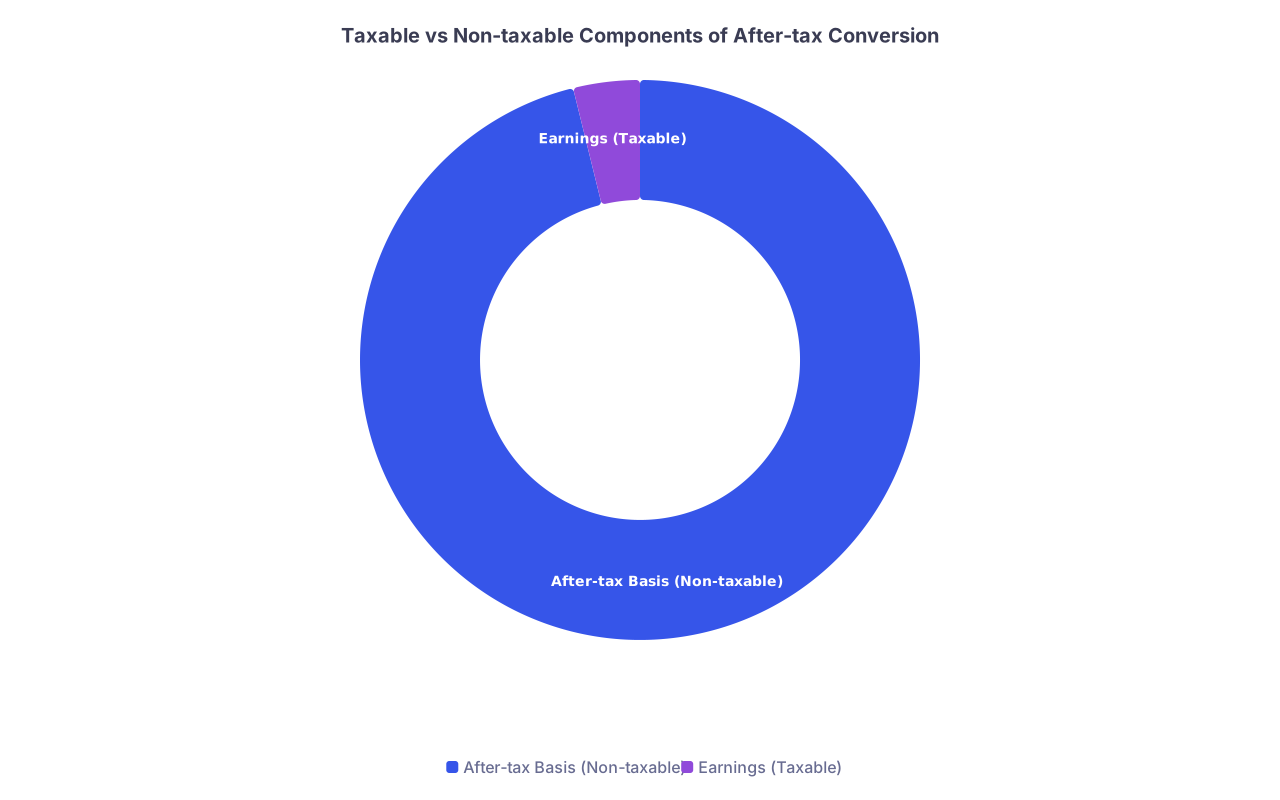
| Category | Value |
|---|---|
| After-tax Basis (Non-taxable) | 25000 |
| Earnings (Taxable) | 1000 |
8. Interaction With the “Regular” Backdoor Roth and 457(b)
Physicians often have:
- A standard backdoor Roth IRA process (non-deductible traditional IRA -> Roth IRA).
- A 457(b) plan from the hospital.
- Sometimes a defined benefit / cash balance plan.
Let’s sort the interactions.
Backdoor Roth IRA vs Mega Backdoor Roth
Different pipelines:
Backdoor Roth IRA:
- Limited to $7,000 (or $8,000 age 50+) per year.
- Based on IRA contribution limits.
- Uses non-deductible IRA contributions and Roth conversion.
- Complicated by the pro-rata rule if you hold pre-tax IRA balances.
Mega backdoor Roth:
- Limited by the space between your total 403(b) employee+employer contributions and the $69,000 cap.
- Often tens of thousands of dollars per year.
- Implemented entirely inside employer plans (403(b)), not IRA contribution limits.
- Not affected by the IRA pro-rata rule unless you roll money out to IRAs and mix pre-tax sources.
You can absolutely do both in the same year. Many high-income physicians do:
- Max 403(b) employee deferral.
- Fill mega backdoor space with after-tax 403(b) + conversion.
- Contribute non-deductible IRA and convert via backdoor Roth.
Just do not forget: large pre-tax IRA balances (from old rollovers) complicate the standard backdoor Roth, but they do not affect in-plan Roth conversions in your 403(b).
457(b) plan
If your hospital offers a governmental 457(b):
- The deferral limit for 457(b) is separate from the 403(b) limit.
- You can put $23,000 in the 403(b) + $23,000 into the 457(b) in the same year.
- 457(b) does not share the 69k annual additions cap with the 403(b). Different code section.
Bottom line:
- 457(b) does not hurt or help the mega backdoor Roth directly.
- It just gives you another powerful tax-deferred pipe.

9. Real-World Plan Limitations and Pitfalls
This is where idealized blog posts go off the rails. Hospital 403(b)s are not designed for physicians to run advanced tax strategies. They are designed so HR can say: “We offer a competitive retirement package.”
Here are the actual obstacles I have seen:
1. No explicit after-tax provision
The most common. The plan literally does not permit after-tax employee contributions. No fix. You either lobby for a future plan amendment (unlikely in the short term) or move on.
2. After-tax allowed, but in-service distribution blocked until 59½
This becomes a “slow-cooker” mega backdoor:
- You can still fund after-tax contributions.
- They grow tax-deferred (not Roth) until age 59½.
- Then you retire or hit the qualifying age, take distribution, and finally move after-tax to Roth.
Is it useful? Yes. Instead of building a pure pre-tax 403(b), you are building a mixed-basis account that can be unwound tax-efficiently later. But it does not give you active, yearly Roth funding.
3. No in-plan Roth conversion mechanism
If the plan has:
- After-tax contributions, but
- No Roth 403(b) subaccount, and
- No in-service distributions allowed before 59½
…you simply have an after-tax bucket with no realistic Roth path until separation. Weak setup.
4. ACP testing / cap on HCE after-tax contributions
Highly compensated employees (HCEs), which for hospitals usually includes physicians, can be limited if non-HCEs do not use after-tax contributions.
Result: You might be limited to something like 5% of pay in after-tax contributions, or you get mid-year or year-end refunds. That eats into the power of the mega backdoor, and creates tax forms (1099-R) you need to handle.
5. Plan admin or recordkeeper ignorance
The mega backdoor Roth is legal. But many plan reps have no clue how to operationalize it.
I have seen:
- Recordkeepers insist you cannot split after-tax and pre-tax components for rollover (directly contradicting Notice 2014-54).
- HR staff telling physicians that “after-tax is the same as Roth” (it is not).
- Providers using terrible terminology in the online portal so you have no idea what you are clicking.
If you smell incompetence, slow down. Document every step. Get confirmation in writing when you request strategy changes or distributions.
10. Implementation Blueprint for a Hospital Physician
Let me give you a clean version of “do this, in this order” so you are not piecing it together from ten sources.
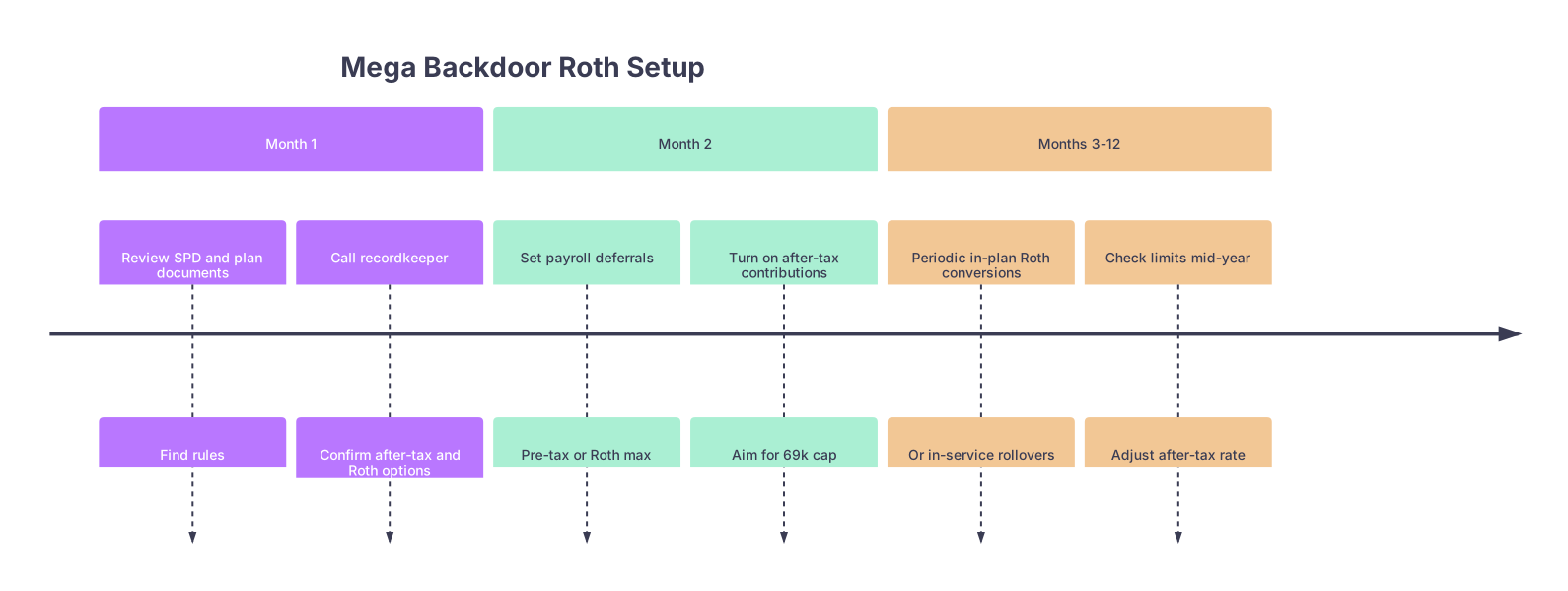
| Period | Event |
|---|---|
| Month 1 - Review SPD and plan documents | Find rules |
| Month 1 - Call recordkeeper | Confirm after-tax and Roth options |
| Month 2 - Set payroll deferrals | Pre-tax or Roth max |
| Month 2 - Turn on after-tax contributions | Aim for 69k cap |
| Months 3-12 - Periodic in-plan Roth conversions | Or in-service rollovers |
| Months 3-12 - Check limits mid-year | Adjust after-tax rate |
Step-by-step playbook
Confirm plan capabilities
- After-tax allowed?
- In-plan Roth conversion or in-service distribution of after-tax allowed before 59½?
Max core 403(b) employee deferral
- Decide what mix of pre-tax vs Roth deferral makes sense given your current marginal tax bracket.
- Set the payroll percentage to hit $23,000 by year-end.
Estimate employer contributions
- Look at prior year W-2 or benefits statement to see what percentage of pay the hospital contributed.
- Project this year’s amount based on current salary.
Calculate after-tax target
- Take $69,000 minus your projected employee + employer contributions.
- That number is your maximum after-tax target.
Set after-tax percentage in the portal
- If you need, say, $28,000 of after-tax on a $350,000 salary, that is 8% of pay.
- Start a little under that, review mid-year, then adjust.
Plan conversion/rollover cadence
- If in-plan Roth conversions are allowed self-service online, do them monthly or quarterly.
- If in-service distributions to Roth IRA are allowed, set a reminder for a mid-year and year-end rollover.
Track tax reporting
- Save all confirmations of conversions/rollovers.
- At tax time, match 1099-Rs to your actions:
- In-plan Roth conversions → taxable portion shown, no early distribution penalty if done right.
- Rollovers to Roth IRA and traditional IRA → properly coded as rollovers.
Reassess annually
- If employer contribution formulas or compensation change, your available after-tax space changes.
- If the plan is amended (for example, they add Roth 403(b) or now allow in-plan conversions), adjust your strategy.

11. Who Should Not Bother With a Mega Backdoor Roth?
This strategy is powerful, not mandatory. There are situations where I would not prioritize it.
- You are not yet maxing standard 403(b) deferrals and 457(b) deferrals.
- You have high-interest debt that dwarfs the value of extra Roth savings.
- Your hospital 403(b) has terrible investment options and high fees, while your taxable brokerage accounts can hold low-cost ETFs with better tax efficiency.
- The administrative friction (no in-plan conversion, clunky in-service distribution rules) is high enough that the juice is not worth the squeeze for modest contribution amounts.
For a typical attending at a medium or large hospital who is already maxing the basic options, though, the mega backdoor Roth is usually one of the cleanest ways to accelerate tax-advantaged, asset-protected Roth accumulation.
The Bottom Line
Three key points:
- The mega backdoor Roth in a hospital 403(b) is entirely a plan design question. If your SPD does not allow after-tax contributions and some form of conversion/distribution, the strategy is dead before it starts.
- When the features do exist, you can often shift $10,000–$30,000+ per year into Roth space on top of everything else you are doing—legally and efficiently.
- Execution is technical but repeatable: max deferrals, fill the 69k cap with after-tax, convert or roll those dollars to Roth quickly, and document every step so tax reporting stays clean.