
The biggest leak in most physician retirement plans is not investment performance. It is bad asset location and unnecessary taxes.
You can have the same funds, the same risk profile, the same savings rate as your colleague across the hall—yet end up with hundreds of thousands less because you stuffed the wrong assets into the wrong accounts. I see this constantly with high-income attendings who “max out everything” but never think about where to hold what.
Let’s fix that.
The Core Idea: Asset Location, Not Just Asset Allocation
Most physicians obsess over asset allocation (60/40 vs 70/30, growth vs value, etc.) and ignore asset location. That is backwards.
Asset allocation = what percent in stocks, bonds, real estate, etc.
Asset location = which account each of those investments lives in (taxable, pre-tax, Roth, HSA, etc.).
Same allocation, different locations → different after-tax outcomes.
At your income level, that difference is not trivial. A 2–3% annual tax drag in your taxable account, compounded over 25–30 years on a seven-figure portfolio, will erase a shocking amount of wealth. Asset location is about reducing that drag with simple, rules-based placement of assets.
The core framework:
- Understand your account “buckets” and their tax rules.
- Understand which assets are tax-ugly vs tax-friendly.
- Match ugly assets with protective buckets and let tax-friendly stuff live where it is less sheltered.
- Keep the whole thing coordinated across all accounts, not just each account in isolation.
), Taxable Brokerage, HSA](https://cdn.residencyadvisor.com/images/articles_svg/chart-typical-physician-portfolio-by-tax-bucket-9349.svg "Typical Physician Portfolio by Tax Bucket")
| Category | Value |
|---|---|
| Pre-tax (401k/403b/457) | 55 |
| Roth (Roth IRA/[Backdoor Roth](https://residencyadvisor.com/resources/retirement-planning-for-doctors/backdoor-roth-iras-for-physicians-step-by-step-with-tax-pitfalls)) | 25 |
| Taxable Brokerage | 15 |
| HSA | 5 |
Step 1: Know Your Account Buckets Cold
If you do not understand how each type of account is taxed, you cannot do asset location. Period.
Tax-Deferred Accounts (Traditional 401(k), 403(b), 457(b), SEP, Traditional IRA)
Tax mechanics:
- Contributions: Usually pre-tax, reduce current taxable income.
- Growth: Tax-deferred. You do not pay annual tax on dividends, interest, or realized gains.
- Withdrawals: All withdrawals taxed as ordinary income.
- RMDs: Required minimum distributions starting in your early-to-mid 70s (current law).
For most physicians still in their peak-earning years, this is your biggest bucket by far. It behaves like a “tax wrapper” around whatever you hold inside. That means you should use it to hide the most tax-inefficient assets.
Roth Accounts (Roth 401(k), Roth 403(b), Roth IRA, Backdoor Roth, Mega Backdoor Roth)
Tax mechanics:
- Contributions: After-tax; no current deduction.
- Growth: Tax-free.
- Withdrawals: Qualified withdrawals are tax-free.
- RMDs: None for Roth IRAs; Roth 401(k)/403(b) currently still have RMDs unless rolled to Roth IRA (laws may shift; stay current).
Roth space is scarce and extremely valuable for a physician. You want high-growth, tax-inefficient assets here, especially if you expect high marginal tax rates in retirement (common for dual-physician couples with big RMDs, pensions, and taxable income).
Taxable Brokerage Accounts
Tax mechanics:
- Contributions: After-tax dollars.
- Dividends:
- Qualified dividends taxed at long-term capital gains (LTCG) rates.
- Non-qualified dividends taxed at ordinary income rates.
- Interest: Taxed at ordinary income rates (unless muni bonds, etc.).
- Capital gains: Realized gains taxed when you sell; LTCG if held > 1 year, otherwise short-term (ordinary income bracket).
- No RMDs. Full flexibility.
Taxable is where many physicians make the worst mistakes: putting high-turnover funds, REITs, actively traded strategies, junk bond funds—all spewing out ordinary income you did not need.
HSA (Health Savings Account)
This is the stealth retirement account and is absurdly underused in medicine.
Tax mechanics (“triple tax advantage” when used correctly):
- Contributions: Pre-tax (or tax-deductible if made personally).
- Growth: Tax-free.
- Withdrawals: Tax-free if used for qualified medical expenses at any age; taxable as ordinary income if used for non-medical expenses after age 65.
Savvy move: Pay current medical expenses out-of-pocket, save the receipts, and leave the HSA invested for decades. Then reimburse yourself later in retirement. Functionally behaves like an extra Roth bucket dedicated to healthcare.
Step 2: Classify Your Assets by Tax Efficiency
Now the other side of the equation: which assets are tax-ugly vs reasonably tax-efficient.
Tax-Inefficient Assets (High Priority for Tax-Advantaged Accounts)
Taxable bond funds and individual taxable bonds
- Interest taxed at ordinary income rates.
- High yield or “income” bond funds are even worse.
REITs and REIT funds/ETFs
- REIT dividends are mostly non-qualified; taxed at ordinary income rates.
- Historically high yields → big annual tax bill if in taxable.
Actively managed funds with high turnover
- Constant capital gains distributions, often short-term.
- You get taxed even if you did not sell.
High-turnover factor funds or smart-beta with frequent trading
- Some are better designed; many are not.
- If you see big annual capital gains distributions, that is a problem in taxable.
Alternatives with ordinary income characteristics
- Certain interval funds, private credit, some hedge-fund-like products.
- Often spin off ordinary income or short-term gains.
Tax-Efficient Assets (More Acceptable in Taxable)
Broad-market equity index funds and ETFs
- Low turnover → low capital gains distributions.
- High percentage of qualified dividends.
- ETF structure itself is tax-efficient in the U.S.
Municipal bond funds (for taxable accounts)
- Interest is federal tax-free; sometimes state tax-free if in-state munis.
- Yield is lower, but after-tax yield can be superior at physician tax brackets.
Individual stocks in a buy-and-hold strategy
- No tax until you sell.
- Real risk and behavioral issues, but tax-wise they can be fine.
Low-turnover factor index funds specifically engineered for tax efficiency
- Some DFA, Avantis, and similar options are reasonably tax-conscious.

Step 3: The Basic Asset Location Hierarchy for Physicians
Now we match buckets with assets. This is the core playbook I walk through with physicians in practice.
1. Fill Tax-Advantaged Accounts with Tax-Ugly Assets First
In your pre-tax 401(k)/403(b)/457/HSA, you prioritize:
- Taxable bond funds
- REIT index funds or REIT-focused strategies
- Any high-turnover, less tax-efficient equity strategies you insist on holding
The simplest pattern:
- Use your 401(k)/403(b) as the core bond + REIT bucket.
- Use your HSA as an aggressive equity bucket (you want max tax-free growth here).
- Use taxable for broad equity index funds and, where appropriate, municipal bonds instead of taxable bonds.
2. Use Roth Space for Highest Expected Growth, Especially If Tax-Inefficient
Roth is where you put the stuff with:
- Highest expected long-term return
- Reasonable risk profile (you do not want to blow up your Roth)
- Potentially higher tax cost if held elsewhere
Typical Roth candidates:
- Small-cap value or tilts with higher expected return
- Equity funds with slightly higher turnover but strong long-term expectation
- REITs if you do not have room in pre-tax accounts (debatable but often reasonable)
3. Let Taxable Hold the “Cleanest” Assets
You want:
- Total U.S./international stock index funds (VTSAX, VTI, FSKAX, ITOT, etc.)
- Total international index funds that are reasonably tax-efficient (with foreign tax credit potential)
- Municipal bond funds if you must hold bonds in taxable
What you do not want in taxable:
- Target date funds (these contain bonds and rebalance tax-inefficiently)
- REIT funds
- High-yield bond funds
- Actively managed funds with big annual distributions
| Asset Type | Best Location | Acceptable Location |
|---|---|---|
| Taxable bonds | Pre-tax 401k/403b/457 | Roth (if needed) |
| REIT funds | Pre-tax 401k/403b/457 | Roth |
| Broad stock index funds | Taxable or Roth | Pre-tax (if needed) |
| Small-cap/value tilts | Roth | Taxable (if efficient) |
| Municipal bond funds | Taxable | Not needed in tax-sheltered |
Step 4: Coordinate Across All Accounts Like One Portfolio
Here is where most physicians mess up: they try to make each individual account “balanced” rather than treating all their accounts as one integrated portfolio.
The right mindset:
You have one unified portfolio spread across multiple containers with different tax rules. Allocation targets apply to the whole, not to each container.
Concrete Example
Say you want a 70/30 stock/bond allocation, with 10% of the portfolio in REITs as part of the stock slice.
You have:
- $1,000,000 in pre-tax 401(k)/403(b)
- $400,000 in taxable brokerage
- $150,000 in Roth IRAs
- $50,000 in HSA
Total: $1.6M
Target portfolio:
- $1,120,000 stocks (70%)
- $480,000 bonds (30%)
- REITs: 10% of stocks → $112,000
Implementation pattern:
- Load most or all $480,000 of bonds into the pre-tax 401(k)/403(b).
- Add $112,000 of REIT index fund inside those same pre-tax accounts.
- Fill the rest of pre-tax with whatever mix of stock index funds helps you hit targets after looking at what is in taxable/Roth.
- Put aggressive stock funds (e.g., small-cap value tilt) inside Roth and HSA.
- Hold broad stock index funds (VTI, VXUS, etc.) in taxable to “top off” the stock allocation.
If you do this precisely, your taxable account may be 100% equities. Your 401(k) may be bond heavy. That is fine. The unified view is what matters.
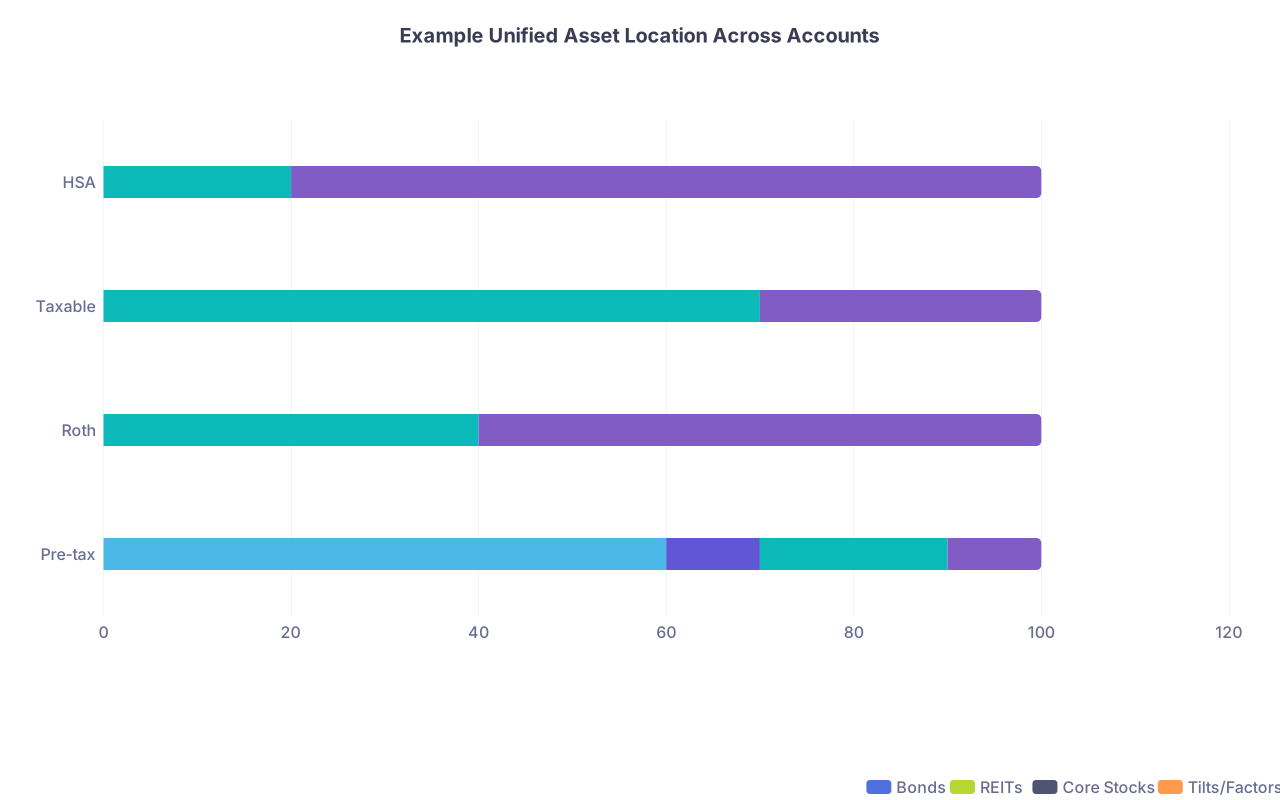
| Category | Bonds | REITs | Core Stocks | Tilts/Factors |
|---|---|---|---|---|
| Pre-tax | 60 | 10 | 20 | 10 |
| Roth | 0 | 0 | 40 | 60 |
| Taxable | 0 | 0 | 70 | 30 |
| HSA | 0 | 0 | 20 | 80 |
The percentages here are within each account, not the portfolio. But you see the idea: bonds/REITs stuffed into pre-tax, high-growth equity in Roth/HSA, clean stock index funds in taxable.
Step 5: Layer in Your Tax Bracket and Time Horizon
Physicians are not all the same. Two key variables change the playbook: current and expected future tax brackets, and time horizon to retirement.
High-Income Attending 15–20+ Years from Retirement
Typical scenario: Age 35–45, attending income $400–800k, high-cost-of-living market, saving aggressively.
For this group:
- Max all tax-advantaged space first (401(k), 403(b), 457, HSA, backdoor Roth).
- Load bonds and REITs into pre-tax; keep Roth and HSA equity-heavy.
- Taxable accounts mostly broad equity index funds.
- Consider municipal bonds in taxable only when your fixed income need exceeds available pre-tax capacity.
Future risk: massive RMDs and very high taxable income in retirement. That is a “good problem,” but it argues for seriously using Roth space and, for some, Roth conversions in lower-income years later.
Late-Career Physician Approaching Retirement
Different problem. You may have:
- Large pre-tax balances ($3M+).
- Lower new contributions.
- A need to control RMD explosion in your 70s.
For this group:
- Asset location still matters, but the tax planning broadens to include Roth conversions, Qualified Charitable Distributions, and withdrawal sequencing.
- You may actually want more equity in Roth and taxable, and slightly more bonds in pre-tax to control RMD-driven ordinary income.
- Municipal bonds vs taxable bonds decision becomes very tax-bracket-specific.
This is nuanced enough that a detailed retirement income plan—ideally with someone who actually understands physician tax issues—is worth it.

| Step | Description |
|---|---|
| Step 1 | Start - Review Accounts |
| Step 2 | Max pre-tax and Roth |
| Step 3 | Assess RMD size |
| Step 4 | Place bonds in pre-tax |
| Step 5 | Place high growth in Roth |
| Step 6 | Use index funds in taxable |
| Step 7 | Consider Roth conversions |
| Step 8 | Standard withdrawal plan |
| Step 9 | Finalize retirement income strategy |
| Step 10 | Age under 50 |
| Step 11 | Large RMD projected |
Step 6: The Ugly Realities – Pitfalls I See All the Time
Let me be blunt. These are the patterns that sink tax efficiency in real physician portfolios.
1. Target Date Funds in Taxable Accounts
Target date funds are not evil. They are extremely convenient in 401(k) plans. In taxable? They are a tax headache.
Why:
- They contain both stocks and bonds.
- They rebalance internally, realizing gains.
- Bond income is taxed at ordinary rates in taxable.
Result: higher tax drag than separately holding stock index funds and municipal bonds in taxable.
If you already own a large target date fund in taxable with big embedded gains, unwinding it requires careful tax analysis and staged selling. But stop adding to it.
2. “Income” Funds for High Earners in Taxable
This one is almost comical. A physician in the 35–37% federal bracket buying “strategic income” or “high income” bond funds in taxable for the yield, then wondering why their tax bill exploded.
If your fund is spinning off 5–7% income that is taxed at your marginal rate, you can easily lose 2–3% of that to federal tax alone, plus state. That yield is not what you think it is.
3. Shoving Bonds into Roth Because “Bonds Are Safer”
The “bonds in Roth because you do not want to risk your tax-free account” argument sounds conservative but is usually backwards.
Roth growth is never taxed. You want more of your lifetime growth to happen there, not less. If you stuff low-return bonds in Roth and hold more stocks in pre-tax, you are basically shifting future high-tax ordinary income into your highest-growth bucket and putting low-growth stuff into your tax-free bucket. That is silly.
Yes, risk management matters. No, your Roth should not be 100% leveraged microcaps. But generally: higher expected return assets belong in Roth and HSA, not in your pre-tax.
4. Ignoring State Tax and Muni Bonds
A California neurosurgeon holding a big chunk of investment-grade taxable bond funds in a brokerage account is lighting money on fire.
At high combined federal + state marginal rates, the after-tax yield on taxable bonds can be punishing. In many cases, a lower-yielding in-state municipal bond fund will produce higher after-tax income.
Run the math on after-tax yield. Do not guess.
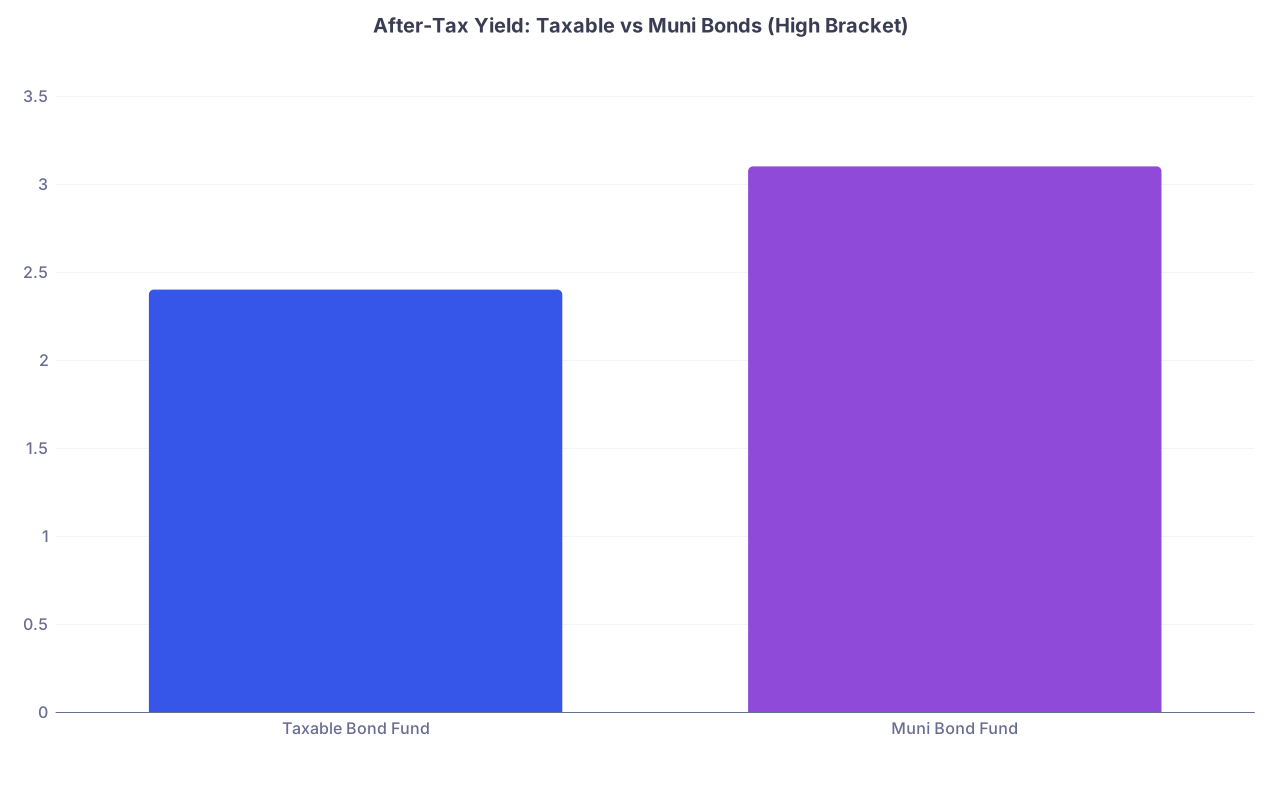
| Category | Value |
|---|---|
| Taxable Bond Fund | 2.4 |
| Muni Bond Fund | 3.1 |
(Example: taxable fund 4.0% yield taxed at 40% total = 2.4% after-tax vs muni fund 3.1% tax-free at same risk level.)
Implementation Tactics: How to Fix a Messy Existing Portfolio
If you are reading this as an attending 10 years into practice with several hundred thousand in each bucket and no coherent asset location, you are not alone. Here is the triage.
1. Inventory Everything
No shortcuts. You need a simple spreadsheet listing:
- Each account (401(k), 403(b), 457, Roth IRA, taxable, HSA).
- Current balance.
- Holdings in each (fund names, tickers, and percentages).
- Asset class breakdown (U.S. stock, int’l stock, bonds, REITs, other).
- Annual distributions (look them up for taxable holdings).
This is maybe 60–90 minutes of work. Do not outsource awareness of your own accounts.
2. Define a Target Allocation and Location Strategy
First, decide:
- Your overall stock/bond mix and any tilts (REITs, small value, etc.).
- How much of each asset class you ultimately want.
Then, define where each should ideally live based on what we covered:
- Bonds and REITs: fill pre-tax first.
- Highest expected return equities: Roth/HSA.
- Core equity index funds + munis: taxable.
3. Reposition Gradually, With Tax in Mind
Inside tax-advantaged accounts, you can sell and rebalance freely. No tax friction.
In taxable, be careful:
- First, stop reinvesting dividends into bad positions. Redirect them to more tax-efficient funds.
- Realize losses where available (tax-loss harvesting).
- Prioritize selling high-distribution, tax-inefficient funds with minimal gains or with losses.
- Stage larger position changes over multiple years if embedded gains are big.
Key rule: do not let the tax tail wag the dog, but also do not set your portfolio on fire just to “clean it up” in a single month. You can migrate over 2–5 years while still getting much of the benefit.
When to Get Help (And What Kind)
There are two categories of “advisors” who will not help you much here:
- Product salespeople masquerading as planners.
- Advisors who understand investments but are weak on tax nuances for high-income professionals.
What you want is someone who:
- Actually models after-tax outcomes and withdrawal strategies.
- Understands backdoor Roths, mega backdoor Roths, 457(b) risk, NUA (net unrealized appreciation) issues, etc.
- Has seen multiple physician households through accumulation and decumulation.
You do not necessarily need ongoing AUM-based management if you are comfortable implementing. A flat-fee, one-time plan that includes a detailed asset location and tax map can be enough for many.
Key Takeaways
- Asset location is a multi–six-figure issue for physicians, not a rounding error. Same funds, different locations can mean massively different after-tax outcomes.
- Put tax-inefficient assets (bonds, REITs, high-turnover funds) in tax-advantaged accounts, and keep taxable accounts for clean, low-turnover stock index funds and, when needed, municipal bonds.
- Treat all your accounts as one integrated portfolio. Ignore the urge to make each account balanced; optimize the whole for after-tax return and long-term flexibility.