
Only 23% of physicians nearing retirement have any direct real estate investments beyond their primary home. Yet among high‑net‑worth physicians already retired, more than half report meaningful rental or real estate partnership income.
That gap is not accidental. It is design. Or the lack of it.
You can practice 30 years, max out retirement accounts, buy a big house, and still end up with a retirement that is 100% dependent on market returns and how long you live. Or you can deliberately weave real estate into your retirement structure so that, at 65, you are not praying for a 7% sequence of returns on a volatile portfolio.
Let me break this down specifically.
1. What Role Should Real Estate Play In a Physician’s Retirement?
Start with the “job description” of your retirement assets. They are not there to make you rich. They are there to:
- Pay your fixed lifestyle costs
- Protect against inflation and tax creep
- Reduce how often you have to sell volatile assets at the wrong time
- Give your future self options: work less, change locations, help kids, fund legacy gifts
Real estate can cover all four if you do it right. Or blow them up if you do it badly.
At a high level, you have three levers in a retirement design:
Guaranteed or quasi‑guaranteed income
(pensions, Social Security, annuities, physician mortgage notes you hold, etc.)Market‑based growth assets
(401(k), 403(b), brokerage accounts, practice equity pre‑sale)Cash‑flowing real assets
(rentals, syndications, REITs, physician‑owned medical office buildings)
Most physicians are over‑weighted in #2, under‑weighted in #3, and basically trusting that a 60/40 portfolio and Social Security will play nice.
The most robust physician retirement plans I have seen use real estate to:
- Cover 50–80% of core living expenses via net rental/passive income
- Allow equity portfolios to be drawn more sparingly and flexibly
- Hedge inflation, especially healthcare and housing costs
Not as a speculative “I heard my colleague made a killing in Airbnb” side project. As a designed income engine.
2. The Concrete Real Estate Options That Actually Fit Physicians
You do not need to love tenants, toilets, or dealing with a water heater at 2 a.m. You do need to know the menu.
2.1 Direct ownership: residential rentals
Single‑family, small multifamily (2–4 units), or larger apartment buildings.
Pros:
- Control over asset, financing, and operations
- Strong tax benefits (depreciation, interest deductions, cost segregation on larger buildings)
- Flexible timing of sales, 1031 exchanges into other properties
Cons:
- Time and mental bandwidth, which you already lack
- Execution risk (poor property manager, bad tenant selection)
- Concentration risk if you own one or two properties locally
Where this fits:
Great for physicians who are 10–20 years from retirement and willing to build a small, well‑managed portfolio over time. Terrible for someone 2 years from retirement who “needs income now” and buys a fixer in a marginal neighborhood.
2.2 Direct ownership: medical office / practice real estate
This is the most underused but tailored option for physicians.
Structures you see in the real world:
- You buy the building your group practices in, either alone or with partners
- A real estate LLC (owned by you / partners) leases to the practice at market rent
- On retirement or practice sale, you keep the building and continue to collect rent from the new group
Pros:
- You know your tenant (your practice or successor group)
- Stickier leases, often 5–10 years with extensions
- You control improvements that increase value (e.g., imaging, procedure space)
Cons:
- Ties your real estate risk to the viability of your specialty and local market
- Requires negotiation to avoid conflicts of interest, especially in group practices
- Less liquid than a stock or REIT position if you need cash
Where this fits:
Ideal if you are mid‑career, in a fairly stable specialty and market, and expect your building to be usable for multiple groups over time (e.g., general medical office, not hyper‑specialized build‑out that nobody else wants).
2.3 Syndications and private real estate funds
You see these constantly in physician Facebook groups and at conference booths.
Structures:
- Syndication: you invest as a limited partner in a specific property or portfolio, usually with a defined hold period (5–7 years)
- Fund: blind‑pool or semi‑blind‑pool vehicle that buys multiple properties over time
Pros:
- Truly passive once you wire the money (if the sponsor is competent)
- Diversification across more units and geographies than most individuals can buy
- Some have strong tax efficiency with bonus depreciation
Cons:
- Illiquidity: your money is tied up, and timelines slip—often
- Sponsor risk: the biggest risk is not the building; it is who runs it
- Opaque fees and waterfall structures that favor the GP
Where this fits:
For physicians who want real estate exposure but have no interest in direct management. But you must treat sponsor vetting like you treat a high‑risk procedure: read the op report (PPM), know the complication rates (track record), and know what happens if things go wrong.
2.4 REITs (public) and real estate mutual funds/ETFs
These are securities that own real estate or mortgages.
You buy them like stocks.
Pros:
- Highly liquid, cheap to buy and sell
- Diversified across many properties and regions
- Reasonable yields with some inflation protection
Cons:
- Correlate with equity markets far more than direct real estate
- No control over leverage, property selection, or timing of sales
- Less powerful tax benefits compared with direct ownership
Where this fits:
As a complement, not a replacement. Perfect for earlier career physicians dollar‑cost averaging into broad market funds who want some real estate tilt without operational complexity.
3. Designing Around the Phases of Your Career
Real estate does not live in a vacuum. It has to mesh with your lifestyle, call schedule, kids’ ages, and mental bandwidth.
3.1 Early career (PGY through first 5–7 attending years)
Your primary jobs:
- Building clinical competence and reputation
- Paying down high‑interest debt
- Establishing core investing habits (retirement accounts, basic brokerage)
Real estate here should be simple and reversible.
No, you do not “need” a fourplex in residency.
Reasonable moves:
- Max out tax‑advantaged accounts first
- If you want exposure, use low‑cost REIT ETFs inside retirement accounts
- Learn: follow a handful of high‑quality real estate educators, read actual offering docs as practice
If you are on a physician loan buying a primary home, do not lie to yourself and call it an “investment property” unless the numbers work on paper as a rental. Most do not.
3.2 Mid‑career (roughly 35–50)
This is the golden window to integrate real estate with intention.
You usually have:
- Higher and more stable income
- Better underwriting profile for banks
- Some capital to deploy outside basic retirement accounts
This is where you decide:
- Do I want to build a small direct portfolio of 3–10 rentals?
- Do I want meaningful exposure via syndications or a fund?
- Do I have a path to owning my practice building?
A typical mid‑career design I see working:
- Continue maxing qualified plans (401(k), cash balance plan if offered)
- Layer in targeted real estate to build a future income stream equal to at least 30–60% of desired retirement spending
- Keep enough liquidity in taxable accounts to avoid being “asset‑rich and cash‑poor”
3.3 Pre‑retirement (last 5–10 working years)
The decisions here are surgical. You are no longer in accumulation mode only. You are shaping income and tax profiles for the next 30 years.
Key moves:
- Clean up: sell the dogs. The underperforming rental in the wrong market that you kept out of inertia? Decide if it belongs in your retirement picture or needs to go, possibly via 1031 to something more stable.
- De‑risk leverage: I do not like retiring with high LTV across multiple properties in a market you barely understand. Refinance or pay down where logical.
- Stabilize income: lock in longer leases, especially on medical office or commercial spaces, so you are not re‑tenanting at 68.
4. How Much Real Estate? Structuring Allocation and Cash Flow
You are not trying to win the landlord Olympics. You are trying to meet a cash flow target.
Let us put actual numbers on it.
Assume:
- Target retirement spending: $300,000 per year (post‑tax, in today’s dollars)
- You want 60% of that covered by relatively stable real estate income
- That is $180,000 per year of net, after‑expense, pre‑tax real estate income
If your real estate portfolio yields a conservative 4–5% net cash‑on‑equity in retirement (after expenses, vacancies, management, and some reserves), you are looking at roughly:
- $180,000 ÷ 0.05 = $3.6M equity in real estate
or - $180,000 ÷ 0.04 = $4.5M for more margin of safety
That equity might be:
- 3–4 well‑located small apartment buildings
- 1–2 medical office properties
- A mix of direct properties and seasoned syndications that have de‑levered
Now link that to your broader allocation.
| Asset Type | Target Allocation |
|---|---|
| Public Equities/Bonds | 45% |
| Direct Real Estate Equity | 30% |
| Private Real Estate (LPs) | 15% |
| Cash and Short-Term Bonds | 10% |
This is a sample, not a prescription. But it shows the direction: real estate is a major sleeve, not a rounding error.
5. Tax and Legal Structure: Where Physicians Screw This Up
You are already a high‑risk litigation target. Do not layer sloppy real estate on top of that.
5.1 Entity structure
Basic reality: putting rental properties in your personal name as a practicing physician is lazy and risky.
Common structures:
- Single‑member LLCs for individual properties, owned by a holding LLC
- Series LLC in certain states (if your attorney gives the green light)
- For medical office buildings: a dedicated LLC that leases to the practice entity
You also want clear separation:
- Your practice entity is not your real estate entity
- Your personal brokerage is not commingled with rental accounts
- You maintain separate books and bank accounts for each entity
Is this extra work? Yes. That is why most physicians do not do it until they have a close call. Do it early.
5.2 Tax considerations specific to physicians
You are usually:
- High W‑2 income
- Phased out of many deductions
- Looking for tax deferral / mitigation, not clever games that will get you audited
Real estate offers:
- Depreciation shielding rental income
- 1031 exchanges to defer capital gains when you trade up or reposition
- Potential partial sheltering of active income with Real Estate Professional Status (REPS) in some family structures
But here is the part many physicians misunderstand:
If you are full‑time clinical, you almost certainly do not qualify for REPS yourself. Your spouse might. Or you might later in semi‑retirement when clinical hours drop.
You need a CPA who:
- Understands both physician comp structures and real estate
- Has actually filed returns with 1031s, bonus depreciation, and passive loss rules—not just “read about them”
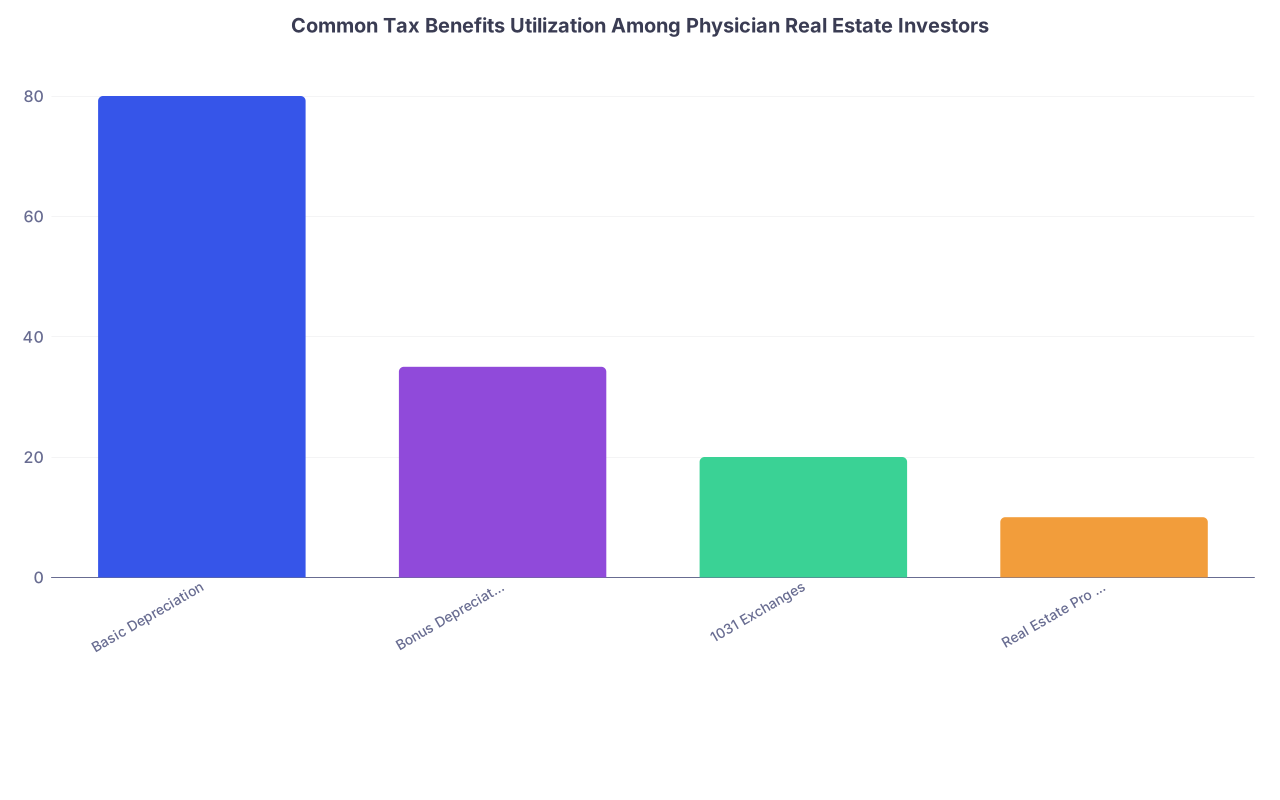
| Category | Value |
|---|---|
| Basic Depreciation | 80 |
| Bonus Depreciation | 35 |
| 1031 Exchanges | 20 |
| Real Estate Pro Status | 10 |
Those percentages are roughly what I see in practice. Most use basic depreciation, very few execute 1031s or properly structured REPS.
5.3 Asset protection and malpractice risk
Reality check: plaintiffs’ attorneys do look at your real estate portfolio. But they also know how hard it is to pierce well‑structured entities and well‑drafted operating agreements.
Baseline defenses:
- Adequate malpractice coverage and umbrella personal liability policies
- Separate, respected entities for properties (no commingling, proper capitalization)
- Use of charging‑order‑protected entities where state law supports it (e.g., multi‑member LLCs)
Skip the nonsense:
- “Anonymous” Wyoming LLC shells advertised on sketchy sites
- Over‑aggressive offshore structures when your actual risk is basic slip‑and‑fall
Get one competent asset protection attorney to review your entire picture once, when you start to cross $2–3M net worth, and revisit as complexity grows.
6. Building a Real Estate Income Ladder for Retirement
You do not flip a switch at 65 and suddenly your portfolio pays you. You build rungs.
Think of a “real estate income ladder” the way people talk about bond ladders.
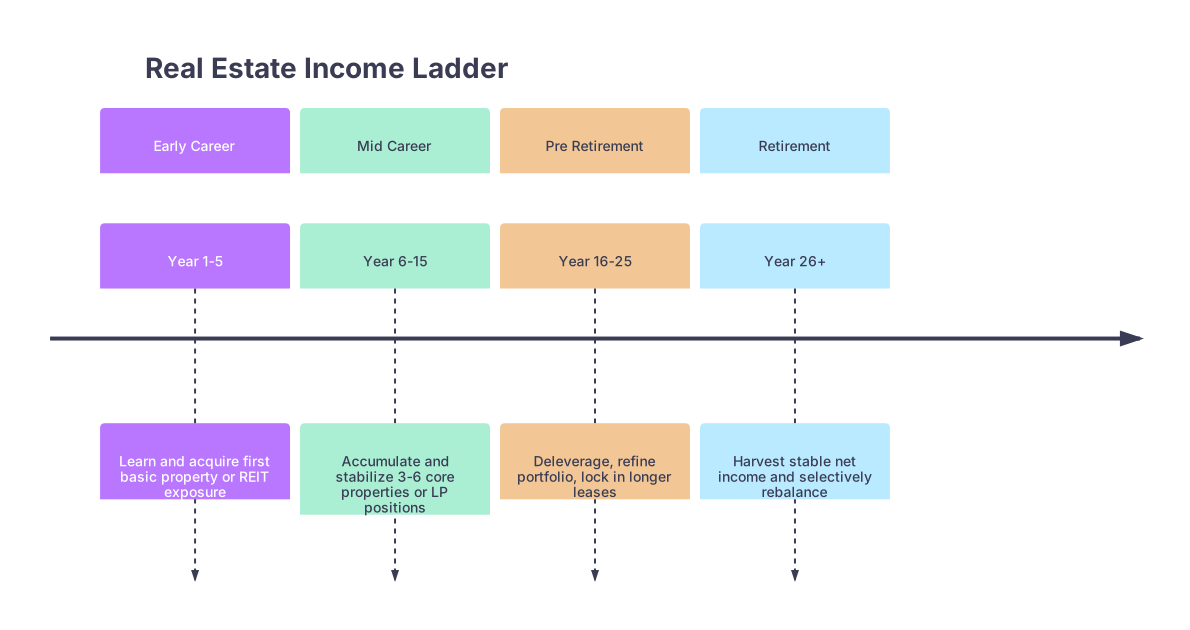
| Period | Event |
|---|---|
| Early Career - Year 1-5 | Learn and acquire first basic property or REIT exposure |
| Mid Career - Year 6-15 | Accumulate and stabilize 3-6 core properties or LP positions |
| Pre Retirement - Year 16-25 | Deleverage, refine portfolio, lock in longer leases |
| Retirement - Year 26+ | Harvest stable net income and selectively rebalance |
The practical version:
- Early: own 1–2 rentals or a modest LP stake; collect small cash flow and learn
- Mid: ramp to a target portfolio size, often with moderate leverage
- Pre‑retirement: aggressive principal paydown, refinancing into longer‑term fixed rates
- Retirement: prioritize stability and net yield over growth and appreciation
I have seen physicians hit retirement with 10 properties but no coherent ladder: half short‑term rentals dependent on algorithm changes, half C‑class apartments in marginal areas with 50% turnover. On paper, “lots of units”. In reality, a job.
The litmus test:
If you retired tomorrow, would your real estate portfolio run acceptably with a professional manager and a 30‑minute monthly review? If not, you have built yourself a second practice.
7. Operational Reality: Who Actually Does The Work?
You already have one demanding job.
Do not casually sign up for another.
7.1 Property management: in‑house vs third‑party
You want third‑party management for almost everything except:
- The home you live in (obviously)
- Maybe a basement unit or ADU you are willing to self‑manage in a very low‑key way
Performance hinges on the manager. You need:
- Clear reporting: monthly owner statements, P&L, rent rolls
- Explicit maintenance thresholds: what they can approve without calling you
- Leasing standards: credit criteria, eviction history policies
If you own medical office, your “management” can often be partially embedded in your practice staff (for day‑to‑day issues), with a good property management company handling common area, major repairs, and capital projects.
7.2 Decision cadence
I like physicians to compartmentalize real estate decisions into:
- Annual strategy review: portfolio size, leverage, markets, major hold/sell calls
- Quarterly performance review: rent growth, occupancy, known CapEx
- Monthly quick glance: cash flow, any anomalies
If your real estate life cannot fit into that level of touch, you have either chosen the wrong structures or you enjoy the business more than medicine. That is fine, but admit it and design accordingly.
8. Common Failure Patterns To Avoid
I will be blunt. These are the repeat offenders.
8.1 The late‑career scramble
A 60‑year‑old surgeon, burned out, feels behind. Goes all‑in on:
- Two syndications run by persuasive but unproven sponsors
- A ground‑up development project in a city he barely knows
- 80% leverage on a poorly underwritten strip mall
Why? Trying to “catch up” with double‑digit projected IRRs. Five years later, one deal is delayed, one is under water, headache is maxed. Retirement is not closer.
Lesson: if you are late, you need boring, predictable, lower‑risk cash flow. Not heroics.
8.2 The “my buddy’s deal” fallacy
I have literally heard in call rooms: “My anesthesiology group is all in this thing; it has to be good.” No, it does not. Herd behavior is brutal among physicians.
Evaluation rule:
If you would not invest on the numbers and sponsor record alone, pretending you did not know a single other LP, you should not invest just because your colleague is in.
8.3 Over‑concentration in one market or asset type
Owning five short‑term rentals in a single vacation town is not diversification. It is concentration roulette.
Better:
Spread across:
- Different cities / regions
- Different tenant bases (residential, maybe a sliver of medical office or self‑storage)
- A mix of direct and pooled structures
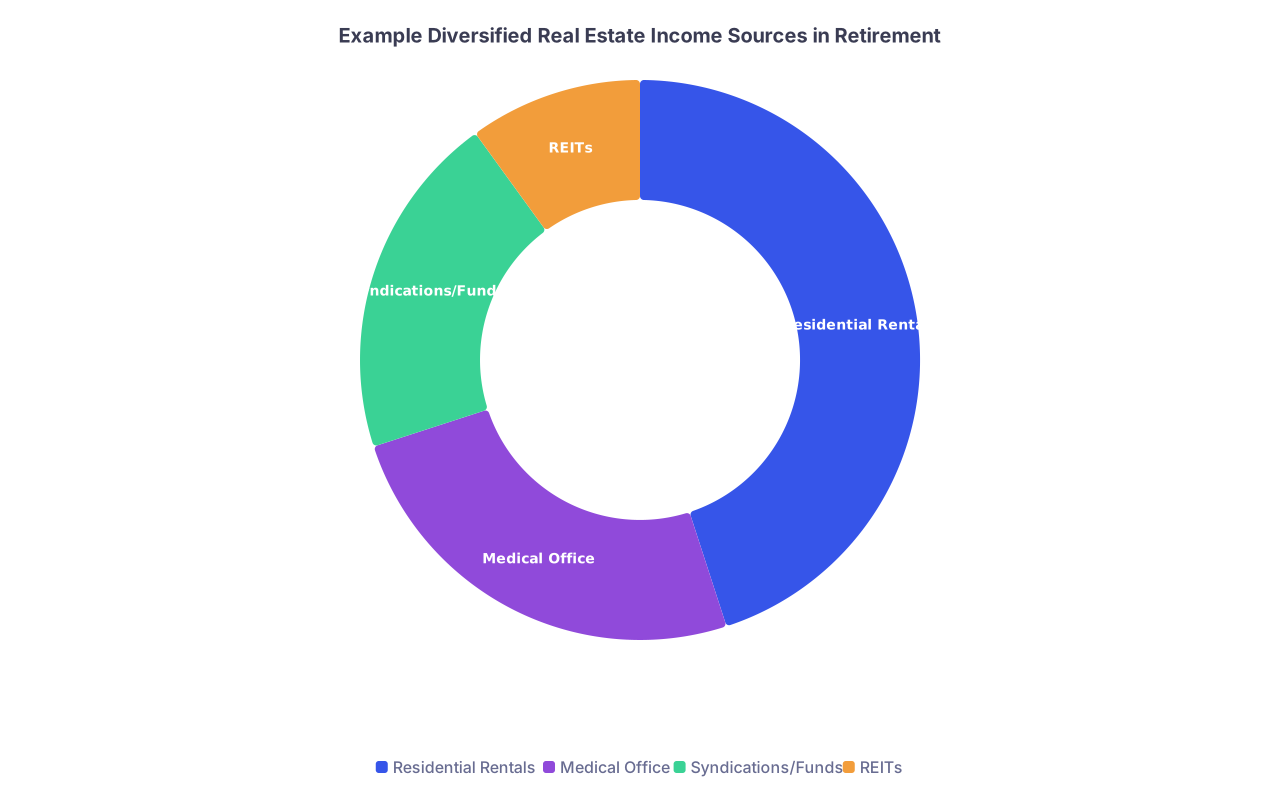
| Category | Value |
|---|---|
| Residential Rentals | 45 |
| Medical Office | 25 |
| Syndications/Funds | 20 |
| REITs | 10 |
9. Integrating Real Estate With Your Withdrawal Strategy
Last piece: retirement is about how you pull money out without lighting yourself on fire from a tax or risk standpoint.
9.1 The hierarchy of withdrawals
In a well‑built physician retirement, real estate cash flow sits near the top of the income stack.
Real estate net cash flow
(rents after expenses and reserves)Dividends/interest from taxable investment accounts
Systematic sales of taxable investments with capital gains planning
Distributions from tax‑deferred accounts (401(k), IRA, 403(b), cash balance)
Roth distributions last
Why?
Real estate income tends to be partially shielded by depreciation, giving you cash that is lightly taxed relative to your W‑2 years. That lets you control how much ordinary income you recognize from retirement accounts each year.
You can deliberately:
- Fill up lower tax brackets with IRA distributions
- Keep MAGI under thresholds that trigger Medicare IRMAA surcharges
- Spread Roth conversions over multiple lower‑income years
9.2 Planning for capital events
Properties will sell. Syndications will exit. These are tax bombs if you do not plan.
You want:
- A forward calendar of expected exit windows for big deals
- Coordination with your CPA to bunch or spread charitable giving, donor‑advised fund contributions, or 1031 exchanges around those years
- A clear rule: what percentage of each big capital event gets reinvested vs harvested for lifestyle or de‑risking
These are not abstract. I have seen retired physicians forced into unplanned Roth conversions or extra IRA withdrawals to pay capital gains tax from a deal they could have better structured with a 1031 or staged sales.
10. How To Actually Start Designing This—Stepwise
You do not need a 50‑page pro forma out of the gate. You need a spine you can refine.
- Define your target retirement spend and “real estate income goal” number. Not vague. A number.
- Inventory current assets and timeline: How many working years? What do you already own (including home equity and any practice building)?
- Choose a real estate approach lane for the next 3–5 years:
- Direct small portfolio builder
- Primarily passive LP/syndication investor
- Medical office / practice‑linked strategy
- Mixed, but with clear caps per bucket
- Get your legal/tax spine in place:
- Entities, basic asset protection structure
- CPA with both physician and real estate competence
- Make the first one or two moves small but real:
- One well‑underwritten rental or
- A modest LP check with a thoroughly vetted sponsor
- Review annually and adjust:
- Are you moving toward the income target?
- Is the complexity tolerable?
- Is the risk profile aligned with your age and goals?
If you are already 55+ and reading this, compress the early learning phase but do not skip structural sanity. You can buy into stabilized, lower‑risk assets, maybe accept lower returns, and still radically improve the resilience of your retirement.
Key Takeaways
- Real estate should not be a random side hustle; it can be a designed, tax‑efficient income engine covering 50–80% of your retirement spending if you start early enough and structure it correctly.
- The right mix for most physicians is a combination of direct, well‑managed properties and selectively chosen passive vehicles, built with clear legal entities and coordinated tax planning—never last‑minute, high‑leverage gambles.
- Your litmus test: by retirement, your real estate portfolio should run on professional management with a light oversight burden, throwing off stable net cash flow that lets you control when, how, and how much you tap your traditional investment accounts.