The default retirement advice most doctors get about Roth vs. pre-tax contributions is overly simplistic and often flat-out wrong for your actual tax reality.
You hear the same slogans: “You’re in a high bracket now, so always do pre-tax,” or “Roth is for residents, pre-tax is for attendings.” That kind of binary thinking leaves a lot of money on the table—especially once you layer in PSLF, state taxes, backdoor Roths, and future legislative risk.
Let me break this down specifically, by actual tax bracket and doctor situation, not vague rules of thumb.
The Core Trade-Off: Pay Tax Now vs. Later
At its core, Roth vs. pre-tax is not complicated.
- Pre-tax (traditional 401(k)/403(b)/457): You get a tax deduction today, growth is tax deferred, and you pay ordinary income tax when you withdraw.
- Roth (Roth 401(k)/403(b)/IRA): No deduction today, tax-free growth, no tax on qualified withdrawals.
The math hinges on one thing: your marginal tax rate now vs. your marginal tax rate in retirement.
If your marginal rate now > marginal rate later → pre-tax is usually better.
If your marginal rate now < marginal rate later → Roth is usually better.
But for doctors, that “now vs. later” is not a static comparison. It changes across four distinct phases:
- Med school and residency / fellowship
- Early attending years (often with loans and kids)
- Peak earning years
- Retirement / partial retirement / post-clinical income
You cannot pick one answer and blindly apply it from PGY-1 to age 70. That is how you end up with monstrous required minimum distributions (RMDs), Medicare IRMAA surcharges, and no tax flexibility.
Understanding Doctor-Specific Tax Realities
Let’s be concrete. When I say tax bracket, I mean the federal marginal bracket (ignoring 3.8% NIIT and phase-outs for a moment) plus a mental note of state tax.
For 2024 (single filers, as approximate ranges):
- 12% bracket: up to roughly $47k taxable income
- 22% bracket: roughly $47k – $101k
- 24% bracket: roughly $101k – $191k
- 32% bracket: roughly $191k – $243k
- 35% bracket: roughly $243k – $609k
- 37% bracket: above that
Most practicing attendings land in the 24–35% range, depending on marital status, practice type, and geography.
Now add state taxes:
- No income tax: TX, FL, TN, NV, etc.
- Moderate: CO, IL, PA (3–5%)
- High: CA, NY, NJ, OR, MN (7–13%)
Your true marginal rate on pre-tax vs. Roth decisions is federal + state on the way in, and federal + state (where you live in retirement) on the way out.
So an employed surgeon in California in the 35% federal bracket is not making a 35% vs. 22% Roth decision. They are making something closer to a 45–50% now vs. maybe 25–30% later decision. Totally different math.
| Scenario | Federal Bracket | Approx State | Combined Marginal |
|---|---|---|---|
| Resident in no-tax state | 12% | 0% | 12% |
| Resident in high-tax state | 12% | 5–6% | 17–18% |
| Attending FM in low-tax state | 24% | 0–3% | 24–27% |
| Subspecialist in high-tax state | 35% | 9–13% | 44–48% |
| Late-career doctor post-part time | 22% | 0–5% | 22–27% |
Those combined marginal rates are what you should anchor to, not just the federal headline bracket.
Phase 1: Residents and Low-Income Years (12% and Often 22% Brackets)
Let’s start where most rules of thumb are actually right: residents.
Making $60–75k as a PGY-2, filing single in a moderate-tax state, you are typically in the 12% federal bracket, occasionally touching 22% with moonlighting.
This is about as low as your lifetime marginal rate will ever be, unless you plan to live entirely off Social Security at 70.
Residents in the 12% Bracket
If you are solidly in the 12% bracket (even after moonlighting and your spouse’s income), Roth contributions are almost always the right move:
- Roth 401(k)/403(b) if your employer offers it
- Roth IRA directly (if income under limit) or via backdoor Roth IRA if needed later in residency
Why? Because:
- You pay 12–18% now, to avoid potentially 22–35% later.
- Your contributions have 40+ years to grow tax-free.
- Even if you end up in a “low” retirement bracket like 22%, locking in tax-free growth now is very favorable.
I have seen residents do pre-tax “to save on taxes now,” then graduate into a 37% bracket as attendings. They basically traded a 12% benefit today for a 37% liability later. That is backwards.
Residents in the 22% Bracket
If moonlighting or spouse income pushes you into the 22% federal bracket, you are in more nuanced territory—but most residents are still better off with Roth.
You ask one question:
Do I realistically expect to be in a higher lifetime bracket (say 32–37%) during my primary earning years?
For almost every future specialist, the answer is yes. If so, continue Roth. You are paying 22–27% combined now to dodge 35–45% later.
The rare exceptions:
- Older residents who will have a shorter investing runway and anticipate modest retirement income
- Residents with a high-earning spouse and a plan for geoarbitrage (high tax now, no tax state later) plus aggressive pre-tax saving
Those edge cases can justify some pre-tax even as a trainee, but that is not the median path.
Phase 2: Early Attending Years – 24% to 32% Brackets, Heavy Loans
Now it gets interesting.
You finish residency, go from $70k to $300k, and everyone tells you to “go all pre-tax, you’re in a high bracket now.” Sometimes correct. Sometimes expensive.
This phase is where the loan strategy and PSLF vs. aggressive payoff matter enormously.
Scenario A: Non-PSLF, Aggressive Loan Payoff
You are:
- EM doc in Texas making $350k, married, no PSLF
- Combined marginal rate about 32–35%
- Federal loans at 6–7%, refinancing to private at ~4–5%
In this scenario, I like a heavily pre-tax tilted mix:
- Max pre-tax 401(k)/403(b) and 457(b) if you have it
- Maybe some pre-tax defined benefit / cash balance plan if available
- Use tax savings to hammer loans and build taxable savings
Why? Because:
- You are in a very high combined marginal bracket now.
- In retirement you will almost certainly be in a lower bracket unless you oversave dramatically.
- Every pre-tax dollar reduces your current tax at 32–35% now and likely gets taxed at 12–22% later.
The only Roth I would prioritize here is:
- Backdoor Roth IRA annually (not optional; just do it) for you and spouse
Everything else: biased to pre-tax.
Scenario B: PSLF Track, Income-Driven Repayment
Completely different answer.
You are:
- Hospitalist in California, $260k starting, married to a non-earner
- $350k federal loans on SAVE, pursuing PSLF after 10 years
PSLF flips the script. Lower reported income → lower IDR payments → more forgiven at year 10. That pushes you toward pre-tax during the PSLF years to minimize payments and maximize forgiveness.
But the key subtlety: once you are clearly locked into PSLF (say, year 5–6 with solid certs and a stable 501(c)(3) employer), you have to think beyond year 10.
I often see a two-phase approach in PSLF doctors:
- Years 1–10 (PSLF build-up)
- Maximize pre-tax to lower AGI and reduce IDR payments
- Still do backdoor Roth IRA if possible
- Post-PSLF (loans gone, effective pay bump)
- Shift toward a mix: majority pre-tax, but start layering in some Roth 401(k) contributions, especially in lower brackets
If you are in a very high-tax state now and plan to retire in a no-tax state, pre-tax is especially powerful in this phase. You are dodging 40–45% now and may only face 22–24% later.
The 24% vs. 32% Decision Threshold
A mental anchor I use with early attendings:
- In the 24% bracket, Roth vs. pre-tax is a closer call. Blended strategy often makes sense.
- In the 32% bracket and above, absent PSLF or unusual circumstances, pre-tax is usually the clear workhorse. Roth is more of a supplemental diversification tool.
Phase 3: Peak Earning Years – 32%, 35%, 37% Brackets
This is the classic “high-income doctor problem.” You are making $400k–1M+, kids in school, still in a high-tax state because that is where the big hospital or group is.
This is where dogmatic “all Roth is better because tax-free growth” posts on the internet become actively harmful.
In the 32–37% federal brackets, especially with 5–10% state tax, pre-tax contributions are usually a massive arbitrage opportunity. You are getting a deduction at nearly the highest rates in the system.
Let’s quantify it.
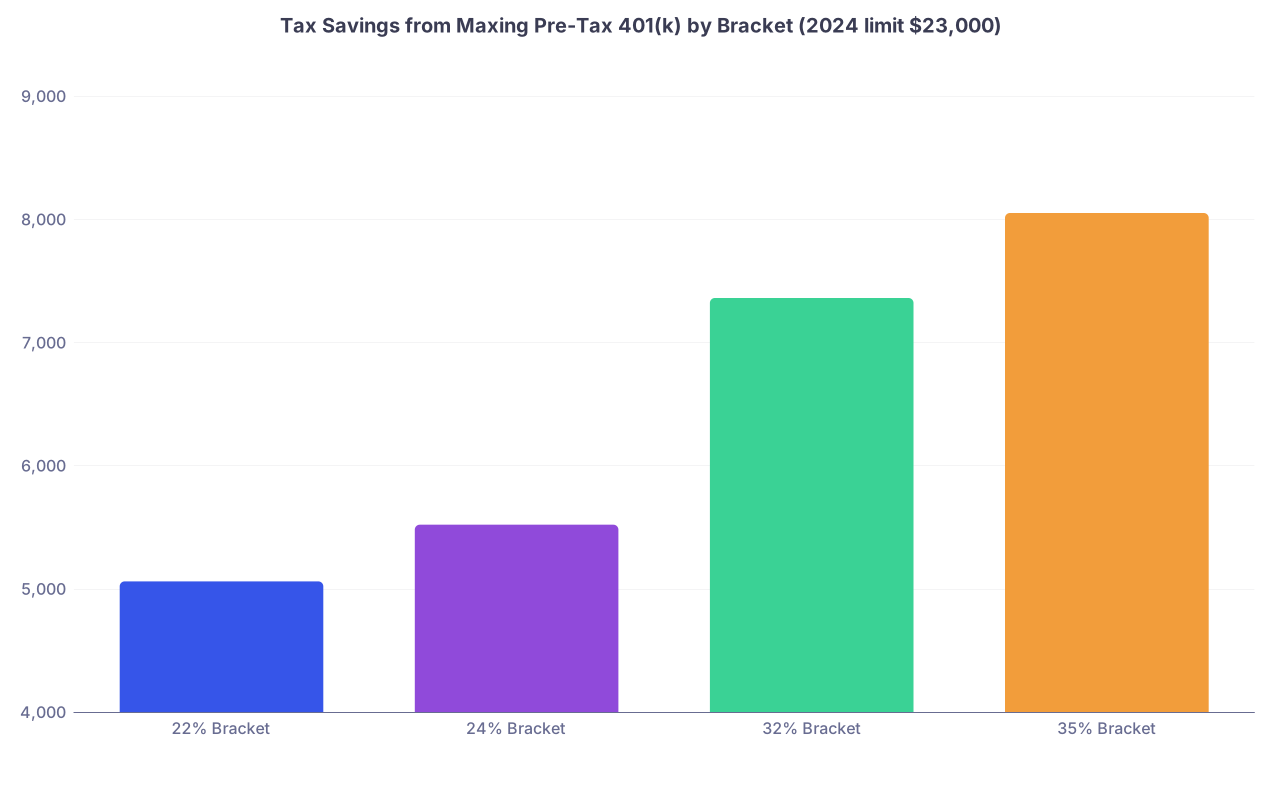
| Category | Value |
|---|---|
| 22% Bracket | 5060 |
| 24% Bracket | 5520 |
| 32% Bracket | 7360 |
| 35% Bracket | 8050 |
That chart ignores state tax. With a 10% state income tax, a 35% attending in CA effectively saves ~$10–11k per year by going pre-tax instead of Roth on a single $23k contribution. Double that if you have access to 401(k) + 457(b) and max both.
Will your retirement marginal rate realistically be as high as your current combined 45–50%? For most physicians, no.
Two ways peak earners should think:
- Default to pre-tax for all employer plans: 401(k)/403(b), 457(b), cash balance / defined benefit, SIMPLE, etc.
- Layer Roth in the margins:
- Always do backdoor Roth IRA annually for you and spouse
- Consider Roth 401(k) only if:
- You are already maxing all pre-tax spaces
- You are extremely high net worth and likely to face big RMDs
- Or you have a strong fear of future tax hikes / legislative risk and want political diversification
This is also where planning for future Roth conversions becomes crucial. You may intentionally build up large pre-tax balances now, expecting to convert chunks in your 60s when you drop to a lower bracket.
Phase 4: Retirement and the “Future Bracket” Question
The Roth vs. pre-tax decision for doctors in different brackets is ultimately about your future self.
Two questions drive the analysis:
What will my income sources be at age 60–80?
- Social Security
- Pensions (less common for private practice, more for some academic / VA positions)
- Pre-tax accounts (401(k)/403(b)/IRA, 457(b))
- Roth accounts
- Taxable accounts (dividends, capital gains)
- Side income, part-time locums, consulting
What do I want my spending level to be?
An oncologist planning to live on $300k per year in retirement will have a very different bracket outcome than a pediatrician happy at $120k.
This is where projections matter. But you do not need a 40-page Monte Carlo. Rough, directional thinking is usually enough.
A Clean Example
Take a married hospitalist:
- Retires at 65
- Wants $180k annual spending (today’s dollars)
- Has:
- $2.5M in pre-tax accounts
- $500k in Roth
- $500k in taxable
- Social Security: $40k combined
Very loosely, a safe withdrawal around 3.5–4%:
- From pre-tax: $87.5–100k annually
- From Roth: drawn as needed, maybe $10–20k annually
- From taxable: $20–30k
- Social Security: $40k
You are looking at taxable income in the 22–24% federal bracket territory. Maybe 20–27% combined with state.
If this person was contributing at 37–45% combined rates during peak years, they won that arbitrage by a mile.
Now compare to an academic neurosurgeon with:
- $7M in pre-tax accounts
- $1M in Roth
- $1M taxable
- Social Security: $50–60k
Even with similar spending, RMDs alone may push them into the 32–35% bracket in retirement. That is the profile where more aggressive Roth usage—even at high current brackets—starts to make sense, especially via Roth conversions in lower-income years.
Where Roth Clearly Wins for Doctors
Blanket anti-Roth sentiment in high-income physician circles is overcorrected. There are places where Roth is flatly excellent:
Residency / fellowship (12% bracket, maybe 22%)
You should be leaning heavily Roth. Full stop.Backdoor Roth IRA for attendings in any bracket
- You are not comparing Roth vs. pre-tax here. You are comparing Roth vs. taxable.
- For almost all attendings who have cleared emergency fund and high-interest debt, backdoor Roth IRA is a no-brainer.
Yes, you should fix your pro-rata issues and clean up old SEP/SIMPLE IRAs, but that is another article.
Lower-income years between “real career” and full retirement
- If you cut back at 55, do part-time locums, and live on taxable for a few years, your marginal bracket may drop into the teens.
- That is prime Roth conversion territory: move money from pre-tax to Roth at 12–22% while avoiding future RMDs at 24–32%.
Younger physicians very certain they will never retire in a lower bracket
This is a smaller group than people think. But it exists:- High-earning subspecialist
- Extreme savers
- Expect sizable practice sale or business income in retirement
For this group, a higher Roth allocation (even at 32–35%) can be justified.
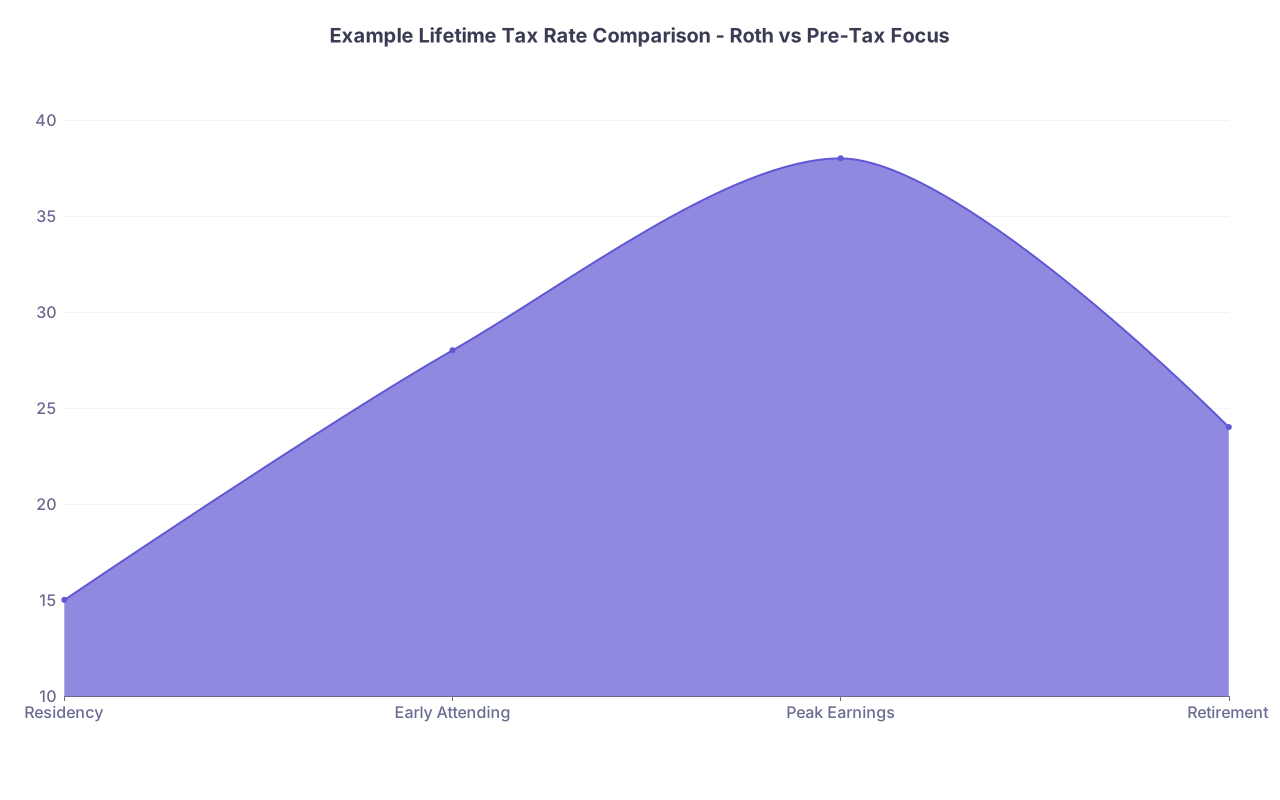
| Category | Value |
|---|---|
| Residency | 15 |
| Early Attending | 28 |
| Peak Earnings | 38 |
| Retirement | 24 |
That area chart mirrors what I see constantly: tax rates climb sharply from training to peak years, then fall in retirement. Aligning Roth contributions with low-rate years and pre-tax with high-rate years is the entire game.
Mixed Strategy: The Often-Ignored Best Answer
Every time someone tells me “all my retirement money is in pre-tax; Roth is dumb in high brackets,” I know they have not thought through sequence risk, legislative risk, or survivor situation.
You want tax diversification:
- Some pre-tax
- Some Roth
- Some taxable
So that in retirement you can choose where your spending money comes from each year to control your marginal bracket, avoid IRMAA cliffs, and manage capital gains.
A rational mixed strategy for a mid-career doctor in the 32–35% bracket might look like:
- Max pre-tax employer plans (401(k)/403(b), 457(b), cash balance)
- Do backdoor Roth IRA annually for you and spouse
- Build taxable brokerage with tax-efficient index funds
- In future low-income years, do Roth conversions from pre-tax to Roth
This gives you:
- Massive current tax savings
- Roth “buckets” for long-term tax-free growth
- Taxable accounts for flexibility before age 59½ and for capital gains management
Common Mistakes by Bracket and Phase
Let me call out the patterns I see repeatedly that cost doctors five and six figures over a career.
Residents / Fellows
- Doing pre-tax 403(b) contributions to “get a refund” at 12% while planning for a high-earning specialty.
- Skipping Roth IRA entirely during training because “I’ll do it when I’m an attending.”
Reality: training years are your Roth goldmine. Use them.
Early Attendings
- PSLF-track doctors using Roth 403(b) while on income-driven repayment, inadvertently raising IDR payments and lowering forgiveness.
- Overemphasizing Roth 401(k) in a 32–35% bracket while still carrying 6–7% student loans and not maxing pre-tax.
Reality: if your marginal combined rate is over 35% and you have big federal loans, pre-tax is usually your friend.
Peak Earners
- Going “all Roth” in 37% bracket in a high-tax state because of fear of “future tax hikes,” with no evidence they will face an equal or higher lifetime rate.
- Neglecting backdoor Roth IRA because “it’s only $7k, not worth the hassle.” Multiply that over 20 years with compounding.
Pre-Retirement / Retirement
- Never doing Roth conversions in low-income gap years between full-time work and Social Security / RMDs.
- Keeping all savings in pre-tax, then getting slammed by RMDs, IRMAA surcharges, and bracket creep as a widow/widower.
Putting It Together: By Bracket, By Stage
Let me give you a direct synthesis. This is not perfect for every edge case, but it is a strong default.
| Phase | Typical Bracket | Primary Choice | Secondary Choice |
|---|---|---|---|
| Med school / Residency | 12% (maybe 22%) | Roth | Pre-tax rarely |
| Early attending (no PSLF) | 24–32% | Pre-tax | Some Roth + backdoor |
| Early attending (PSLF) | 24–32% | Pre-tax (IDR) | Later Roth after PSLF |
| Peak earning | 32–37% | Pre-tax | Roth IRA + selective |
| Pre-retirement gap years | 12–24% | Roth conversions | Some ongoing pre-tax |
| Retirement | 12–24% typical | Draw from mix | Control brackets |
This is the kind of framework I wish more doctors saw instead of “Roth good / Roth bad” takes.
How to Decide for Your Specific Situation
If you want to stop hand-waving and actually decide:
List your current marginal rates
- Federal bracket
- State bracket
- Are you at a phase-out threshold (child tax credit, QBI, NIIT, etc.)?
Sketch your future
- Realistic earnings curve (resident → attending → peak → part-time)
- Likely retirement location (high-tax vs. no-tax state)
- Debt plan (PSLF vs. refinance and attack)
Match contributions to low vs. high rate years
- 12–22% years: lean Roth
- 24–32%: mixed, leaning pre-tax if you expect lower retirement rates
- 32–37%: primarily pre-tax, Roth via IRA and future conversions
Always maintain some Roth presence
- Backdoor Roth IRAs are your baseline
- Avoid ending up 100% pre-tax unless you plan active Roth conversion strategy later
Revisit every 3–5 years
Your bracket, loans, and goals will change. So should the mix.

| Step | Description |
|---|---|
| Step 1 | Current Year |
| Step 2 | Pre-tax for IDR, Roth IRA |
| Step 3 | Roth focus, some pre-tax |
| Step 4 | Pre-tax focus, Roth IRA, plan conversions |
| Step 5 | Mixed strategy, tilt pre-tax if expect lower retirement bracket |
| Step 6 | Bracket 24 or lower |
| Step 7 | On PSLF IDR? |
| Step 8 | Bracket 32 or higher |
Key Takeaways
- The Roth vs. pre-tax decision for doctors is fundamentally about matching contribution types to your marginal tax rate over time, not slogans.
- Residents and low-bracket years are Roth territory; peak-earning, high-bracket years heavily favor pre-tax—with Roth kept in the mix via IRAs and later conversions.
- The smartest physicians build tax diversification across pre-tax, Roth, and taxable accounts so their future retired self has options, not regrets.