
Most physicians are doing backdoor Roth IRAs wrong—and the IRS computer will absolutely catch it.
Let me walk you through how to do this correctly, step-by-step, and why the tax landmines are where they are. Because this is one of those areas where “close” still gets you audited.
Why Physicians Need the Backdoor Roth IRA
Physicians almost always get phased out of direct Roth IRA contributions by income limits. You know the numbers: for 2024, Roth IRA eligibility phases out at modified AGI of:
| Filing Status | Phaseout Range (MAGI) |
|---|---|
| Single | $146,000–$161,000 |
| Married Filing Jointly | $230,000–$240,000 |
| Married Filing Separately | $0–$10,000 |
If you are an attending making $250,000–$600,000, direct Roth contributions are basically off the table.
The backdoor Roth IRA is the legal workaround: you make a non-deductible traditional IRA contribution, then convert it to a Roth IRA, typically shortly after. Simple in concept. Easy to mess up in execution.
For high-income physicians, the backdoor Roth solves three big problems:
- Builds tax-free retirement space when tax-deferred space is already maxed (401(k), 403(b), 457(b), etc.).
- Creates future tax diversification—pre-tax, Roth, and taxable accounts.
- Protects Roth space from required minimum distributions (RMDs) later.
But you only get those benefits if you avoid the classic physician mistakes:
- Having pre-tax money in any traditional, SEP, or SIMPLE IRA and ignoring the pro-rata rule.
- Not filing Form 8606 (or filling it out incorrectly).
- Accidentally taking a deduction for the traditional IRA contribution when you are ineligible.
- Doing a “backdoor Roth” while also rolling over an old 401(k) into a traditional IRA in the same year.
Let me break this down in clinical detail.
Core Concept: Contribution vs Conversion (And Where People Screw Up)
Before the step-by-step, you must keep two actions separate in your head:
Non-deductible traditional IRA contribution
- Annual limit (2024): $7,000 under 50; $8,000 if 50+.
- Funded with after-tax dollars.
- Reported on Form 8606, Part I.
Roth conversion
- Moving money from traditional/SEP/SIMPLE IRA to Roth IRA.
- Taxability depends on pre-tax vs after-tax basis.
- Reported on Form 8606, Part II.
The backdoor Roth is just:
Step 1: Non-deductible contribution.
Step 2: Conversion of that specific amount.
What complicates things is the pro-rata rule and the December 31 balance rule. That is where almost all the pain lives.
Step-by-Step: Clean Backdoor Roth for a Physician With No Other IRAs
Assume this is you:
- High-income attending, ineligible for direct Roth IRA.
- No existing money in any traditional IRA, SEP IRA, or SIMPLE IRA.
- No intention of doing a rollover to an IRA this year.
That is the cleanest situation. Here is the sequence.
Step 1: Open (or confirm) the correct accounts
You need two accounts per person:
- Traditional IRA (sometimes labeled “rollover IRA” or just “IRA” at custodians).
- Roth IRA.
Each spouse does this separately. There is no “joint IRA.”
If you have an old empty traditional IRA from residency—fine. Zero balance is fine. What matters is the balance on December 31 of the tax year.
Step 2: Make a non-deductible traditional IRA contribution
For 2024, contribution limits:
- Age <50: $7,000
- Age ≥50: $8,000
Do not claim a tax deduction for this. You are making a non-deductible contribution.
At the custodian, you just select “traditional IRA contribution for tax year XXXX.” The tax treatment (deductible vs non-deductible) is chosen on your tax return, not at Vanguard/Fidelity/Schwab.
If your AGI is high (which it is), the deduction for a traditional IRA is phased out if you’re covered by a workplace retirement plan. So you should not be taking that deduction.
Cash source does not matter—checking, savings, taxable brokerage. What matters is:
- Same tax year (or by tax filing deadline if “prior year” contribution).
- Track the contribution amount exactly: $7,000, $8,000, whatever you use.
Most people leave it in a settlement fund or money market fund for 1–3 days before converting to minimize any gain.
Step 3: Wait (briefly) then convert to Roth IRA
This is the “backdoor” part. You convert the traditional IRA balance to your Roth IRA.
There is no required waiting period in the tax code. The old “step transaction doctrine” scare stories are overblown. Realistically, most major physician-focused CPAs are fine with same-day or next-day conversions.
Mechanically:
- At the custodian, choose “convert to Roth IRA”.
- Select the full amount of your traditional IRA balance (ideally exactly your contribution).
- Move it into your Roth IRA.
Two scenarios:
No investment gains (you waited 1 day, still in cash):
- You contributed $7,000.
- Value at conversion: $7,000.
- Taxable amount of conversion: $0 (assuming no other IRA balances).
Small gain (say it became $7,100):
- Basis (after-tax): $7,000.
- Total conversion: $7,100.
- Taxable ordinary income: $100.
- It is fine. Just report it.
Do not get hung up on the “pennies of interest” problem. Just report it correctly.
Step 4: Confirm no other pre-tax IRA balances by December 31
Here is where people silently blow themselves up.
On December 31 of that tax year, your total balances in:
- Traditional IRAs
- SEP IRAs
- SIMPLE IRAs
are all added together for Form 8606 Line 6. The IRS does not care which IRA the money “came from.” It aggregates everything.
If you rolled an old 401(k) into a traditional IRA that year, or you had a SEP IRA as a 1099 side gig, that money makes the conversion partially taxable via pro-rata rule.
So the clean backdoor Roth requires:
- December 31 balance in all traditional/SEP/SIMPLE IRAs = $0
(or at least very small and you understand the pro-rata consequences).
If you do have pre-tax IRA money, hold that thought; I will address the “IRA clean-up” strategy later.
Step 5: File Form 8606 correctly
This is where even decent CPAs screw up, especially if they do not handle a lot of physicians.
Form 8606 does three things:
- Tracks your non-deductible (after-tax) IRA contributions (your basis).
- Calculates how much of your Roth conversion is taxable using the pro-rata rule.
- Carries forward unused basis to future years.
In a clean backdoor Roth year with no other IRAs, here is the simplified flow for one person:
Part I
- Line 1: Non-deductible contribution amount (e.g., 7,000).
- Line 2: Prior year basis (usually 0 in first year).
- Line 3: Add lines 1 and 2.
- Line 14: Basis to carry forward (should be 0 if you converted all of it that year).
Part II
- Line 16: Total conversions to Roth IRAs (e.g., 7,000 or 7,100).
- Lines 17–18: Use pro-rata formula. If no other IRAs, almost all conversion is non-taxable (except little gain amount).
If this form is missing, wrong, or shows a deductible contribution when it should not, the IRS will assume the worst:
- They can treat your entire conversion as taxable.
- They can assume no basis was ever created, or that the basis is “lost”.
You keep Form 8606 for life. It is the record of after-tax money in all your IRAs.
The Pro-Rata Rule: Where Most Physicians Get Burned
Let me show you the math, because this is where confusion turns into tax bills.
The pro-rata formula for how much of a conversion is non-taxable:
Non-taxable portion = (Total basis in all traditional IRAs ÷ Total value of all traditional/SEP/SIMPLE IRAs on Dec 31 + distributions) × Amount converted
Simplify this with an example.
Example: The classic SEP IRA problem
You:
- Have a SEP IRA of $93,000 from prior 1099 work.
- Make a non-deductible traditional IRA contribution of $7,000 this year.
- Convert $7,000 to Roth the next day.
- December 31 total in all traditional/SEP/SIMPLE IRAs = $100,000 ($93,000 SEP + $7,000 newly contributed).
Your basis (after-tax) = $7,000.
Your total IRA value on Dec 31 (Line 6) = $100,000.
You converted $7,000.
Non-taxable portion of conversion:
7,000 / 100,000 × 7,000 = 490
So:
- $490 is non-taxable.
- $6,510 is taxable ordinary income.
- You still have $6,510 of basis remaining, spread across your IRAs.
That is the pro-rata rule. It ignores the story in your head: “But I only converted the new non-deductible contribution!” The IRS does not care. It is all one big bucket.
This is why you either:
- Keep all pre-tax IRA money out of IRAs (401(k)/403(b)/solo 401(k) instead), or
- Accept you are doing a partially taxable conversion each year.
Physicians almost always want the first option.
Fixing the Pre-Tax IRA Problem: The Rollover “Rescue”
If you already have a traditional IRA, SEP IRA, or SIMPLE IRA with pre-tax money and want to start doing clean backdoor Roth IRAs, your strategy is:
Move the problem out of IRA space and into 401(k) space.
Employer 401(k)/403(b) plans and solo 401(k)s do not count in the IRA aggregation for Form 8606. Only traditional/SEP/SIMPLE IRAs do.
So the usual sequence:
- Verify your current employer 401(k)/403(b) plan allows roll-ins (many do).
- Roll your pre-tax traditional IRA / SEP IRA balance into that 401(k)/403(b).
- Only pre-tax amounts can roll into pre-tax 401(k).
- After-tax/basis will usually need different handling; often converted to Roth.
- Confirm that by December 31, your traditional/SEP/SIMPLE IRAs have $0 pre-tax balance.
Once that is complete, you can do a clean backdoor Roth IRA in the same year if you time it correctly. The key is the December 31 snapshot.
If your current employer plan is terrible or does not accept roll-ins, a solo 401(k) from your 1099 income can sometimes rescue you. But that requires legitimate self-employment income and proper plan setup.
Built-In Tax Pitfalls Specific to Physicians
Let us be blunt about the real-world ways doctors screw this up.
1. Rolling an old 401(k) into an IRA after starting backdoor Roths
Scenario I see constantly:
- You did backdoor Roth IRAs cleanly for 3 years.
- Then HR tells you to rollover your old 403(b) into a traditional IRA with their “preferred provider.”
- You comply in July.
- No one remembers the backdoor Roth.
- December 31 you now have $250,000 in a traditional IRA.
Result: your Roth conversion done earlier in the year is now subject to the pro-rata rule. You just created a huge taxable conversion you were not planning on.
Solution:
Never roll a 401(k)/403(b) into an IRA if you are doing or plan to do backdoor Roths unless you understand the pro-rata impact and plan to roll that IRA into a 401(k) again in the same year.
2. SEP IRAs for moonlighting income
You do 1099 work and some accountant tells you, “Set up a SEP IRA, it’s easy.” Yes, easy. Also incompatible with clean backdoor Roths unless you later roll that SEP into a 401(k).
Better for high-income physicians who care about Roth flexibility:
- Use an individual/solo 401(k) for 1099 income instead of a SEP IRA.
- Most solo 401(k) providers do not trigger the pro-rata rule.
That one decision saves a lot of aggravation.
3. Not filing Form 8606 at all
Some people make non-deductible contributions and convert but never file Form 8606. Or they claim a deduction when they are not eligible.
If you skipped Form 8606 for multiple years, you:
- May have lost record of your basis.
- Might have already paid tax on dollars you are about to pay tax on again.
You can usually fix this by:
- Filing back Forms 8606 for prior years.
- Amending returns if needed.
Yes, it is annoying. It is better than paying tax twice.
4. Doing the backdoor Roth but accidentally trading in the traditional IRA
Another subtle screw-up:
- You contribute to traditional IRA.
- You convert only part of it.
- You leave a small non-zero amount in the IRA (say $23.47).
- Next year, you repeat.
Result: You create weird leftover basis and messy 8606 calculations. Not catastrophic, but messy.
Proper approach: convert the entire traditional IRA balance each year (or at least all after-tax basis each time) so you do not keep dragging small dollar amounts forward.
5. Mixing spouse and individual assumptions
Common confusion:
- “We each have IRAs of $X, so total basis is $Y.”
No. IRAs, basis, and 8606 are individual by person, not by couple.
Each spouse:
- Has their own contribution limit.
- Has their own Form 8606.
- Has their own pro-rata calculation based on their IRAs only.
You cannot “move” basis from your spouse to you. You cannot average it across the household.
Tax Reporting: What the IRS Actually Sees
Understand the information flow:
- Custodian generates Form 5498: reports IRA contributions, conversions, year-end balances (this goes to IRS).
- Custodian generates Form 1099-R: reports distributions and Roth conversions.
- You file Form 8606: explains which part of the transaction was after-tax basis and what is taxable.
If there is a mismatch—1099-R shows a Roth conversion, but no 8606 explaining basis—the IRS computers assume it is fully taxable. Later, you get an “underreported income” notice.
Your protection is a clean Form 8606 that:
- Matches your actual numbers.
- Carries basis correctly from year to year (line 14 forward to next year’s line 2).
Think of Form 8606 as your EHR for IRA basis. If it is wrong, every future “encounter” is off.
Timing Considerations: Year of Contribution vs Year of Conversion
Here is a nuance that trips people up.
You can:
- Make a prior year contribution (e.g., in March 2025 for tax year 2024).
- Convert it in 2025.
- Those are two different tax years for reporting.
Key points:
- Contribution is reported for the tax year it is designated for (2024 in that example).
- Conversion is reported in the year it actually happened (2025).
So you might have:
- 2024 Form 8606: shows a 2024 non-deductible contribution and basis carried to 2025.
- 2025 Form 8606: brings in basis from prior year and shows a 2025 Roth conversion.
Nothing wrong with that, you just have to track it correctly.
Because of this complexity, most physicians keep it simple:
- Decide: “I will do the contribution and conversion in the same calendar year every time.”
- If they are behind, they carefully document one catch-up year and then normalize.
Backdoor Roth vs Mega Backdoor Roth: Different Animal
Quick clarification because people mix these terms.
Backdoor Roth IRA:
- Uses a traditional IRA → Roth IRA conversion.
- Limit: standard IRA contribution limit ($7k/$8k).
Mega Backdoor Roth:
- Uses after-tax contributions to a 401(k) and then in-plan Roth conversion or in-service withdrawal to Roth.
- Potentially tens of thousands per year if your plan allows.
These are completely separate techniques. Both are attractive to high-income physicians. But when a CPA says “your plan allows a mega backdoor Roth,” that has nothing to do with your IRA Form 8606 mess.
Where This Fits in a Physician’s Overall Retirement Plan
Quick reality check. For most physicians, the retirement savings hierarchy looks something like:
- Max pre-tax / Roth options in employer plan (401(k)/403(b)/457(b)).
- If self-employed income: fund solo 401(k).
- Backdoor Roth IRA for you and spouse every year.
- Taxable brokerage with reasonable asset location.
Longevity of training, late start, and high future tax risk all make Roth space extremely valuable for physicians. Backdoor Roths are not optional luxuries. They are core infrastructure.
But they only work well if:
- You keep pre-tax IRA balances out of the picture (or accept pro-rata).
- You or your tax preparer actually knows how to handle Form 8606.
- You do not sabotage the plan later with a careless rollover.
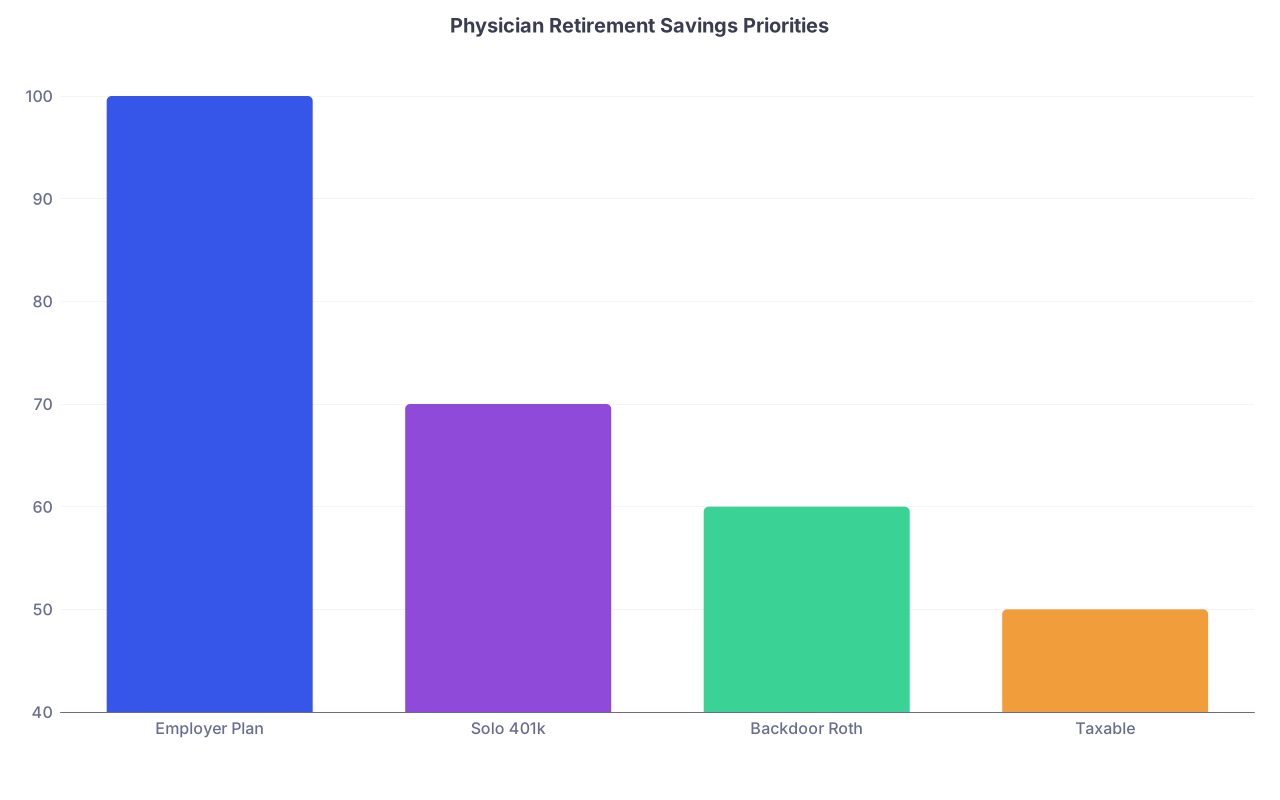
| Category | Value |
|---|---|
| Employer Plan | 100 |
| Solo 401k | 70 |
| Backdoor Roth | 60 |
| Taxable | 50 |
Concrete Example: Clean Backdoor Roth for a Dual Physician Couple
Let’s walk an example to tie it together.
- Two physicians, both in their 30s.
- Combined income: $550,000.
- No existing traditional/SEP/SIMPLE IRAs.
- Good 403(b) plans at academic hospitals.
- They want to maximize Roth space.
Year 1 plan:
Each opens:
- Traditional IRA at Vanguard.
- Roth IRA at Vanguard.
January:
- Each contributes $7,000 to their own traditional IRA (non-deductible).
- No deduction taken on the tax return.
Two days later:
- Each converts the full traditional IRA balance to Roth IRA (probably ~$7,000 unless tiny gains).
December 31:
- All traditional/SEP/SIMPLE IRAs have $0 balance.
Tax time:
- They or their CPA file:
- Two separate Forms 8606 (one for each spouse).
- Show $7,000 non-deductible contribution and $7,000 (or slightly more) conversion.
- No or minimal taxable income from the conversion.
- They or their CPA file:
They then repeat annually. After 10 years, they have:
- ~$140,000+ of Roth IRA contributions (plus investment growth), completely tax-free later, with no pro-rata headaches.

| Step | Description |
|---|---|
| Step 1 | Check for existing IRAs |
| Step 2 | Contribute to traditional IRA |
| Step 3 | Roll pre tax IRA into 401k |
| Step 4 | Confirm IRA balance is zero |
| Step 5 | Convert to Roth IRA |
| Step 6 | File Form 8606 correctly |
| Step 7 | Repeat annually |
| Step 8 | Any pre tax IRA balance? |
Common “Edge Case” Questions I See From Physicians
Let me hit the gray areas that come up in consults.
“I already have $200k in a traditional IRA and no good 401(k) to roll into. Should I still do a backdoor Roth?”
In most cases: no, not if you insist on clean conversion with no tax hit.
Options:
- Option 1: Skip the backdoor Roth and focus on maxing employer plans and taxable investing.
- Option 2: Accept a partially taxable conversion (pro-rata) and slowly whittle down the pre-tax IRA over years.
- Option 3: Hunt hard for a way to open a solo 401(k) via legitimate self-employment and roll your pre-tax IRA in there.
I generally prefer a clean fix (roll out to 401(k)) over multi-year pro-rata pain, but it depends on your age, income, and tax bracket.
“What if I convert immediately and the market drops—did I ‘waste’ my Roth space?”
No. You just converted at a temporarily high value. Annoying, but long-term irrelevant if your time horizon is decades.
You could wait and convert after a drop, but now you are market timing. For most physicians, the simplicity of “contribute and convert once per year on autopilot” is worth more than trying to optimize conversion dates.
“Can I recharacterize if I mess up the conversion?”
No. Recharacterizations of Roth conversions are no longer allowed under current law. Once you convert, it is done.
You can still recharacterize contributions between Roth and traditional in some cases, but conversions are permanent.
This is why getting the pro-rata situation clean before you convert is crucial.

Quick Reality Checklist Before You Do a Backdoor Roth
If you are about to set this up, run through this checklist like a pre-op timeout:
Do I have any money in:
- Traditional IRA
- SEP IRA
- SIMPLE IRA
on December 31 of this tax year?
Does my tax preparer:
- Know what a backdoor Roth IRA is?
- Have experience with Form 8606?
Have I:
- Opened both a traditional IRA and Roth IRA in my name (and spouse’s separately)?
- Selected non-deductible treatment for the traditional IRA on my tax return?
Will I:
- Convert the entire traditional IRA balance each year?
- Avoid rolling 401(k)/403(b)/TSP money into any IRA while doing backdoor Roths?
If any of that feels shaky, fix it now. It is far cheaper to get this right on the front end than to pay a CPA to clean up five years of botched 8606s.
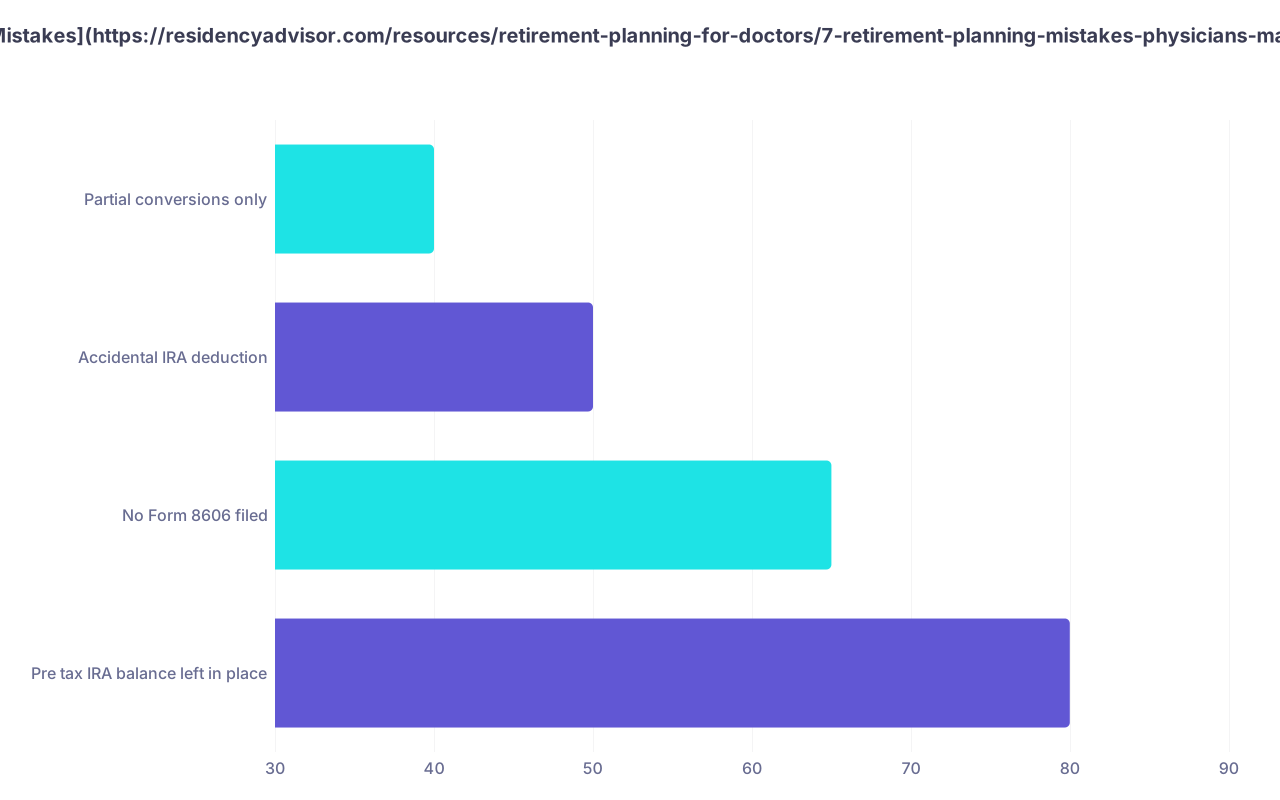
| Category | Value |
|---|---|
| Pre tax IRA balance left in place | 80 |
| No Form 8606 filed | 65 |
| Accidental IRA deduction | 50 |
| Partial conversions only | 40 |

FAQs
1. Can I still do a backdoor Roth IRA if my income drops below the Roth limit in some years?
Yes. In years when your modified AGI is below the Roth IRA phaseout range, just do a direct Roth IRA contribution instead of the backdoor route. No need to overcomplicate it. But keep tracking basis properly if you have any non-deductible traditional IRA from prior years.
2. What happens if I forget to convert in the same year as my contribution?
You can convert in a later year. The contribution year and conversion year can differ. You will then have basis on Form 8606 carried forward, and when you finally convert, the pro-rata rule will apply based on that future year’s total IRA balances and basis. It is fixable, just more paperwork.
3. My CPA says I do not need Form 8606 because ‘it’s all non-deductible anyway.’ Are they wrong?
Yes. If you make a non-deductible IRA contribution or do a Roth conversion from a traditional IRA, Form 8606 is required. If your CPA does not know this, they are not qualified to manage backdoor Roth reporting. I would strongly consider switching.
4. Can I fund my traditional IRA with appreciated securities (in-kind) from a taxable account and then convert?
Generally no. Traditional IRA contributions must be made in cash. You can sell investments in your taxable account, realize any capital gains, contribute the cash to a traditional IRA, then convert. Most backdoor Roth routines just use cash transfers from a bank account for simplicity.
5. How does this interact with my 457(b) plan at an academic hospital?
457(b) balances do not affect the backdoor Roth IRA pro-rata calculations. Only traditional/SEP/SIMPLE IRAs matter for Form 8606 aggregation. You can and should still optimize your 457(b) contributions separately; just keep rollovers from 457(b) out of IRAs if you want to maintain clean backdoor Roths.
Key takeaways?
First, backdoor Roth IRAs are essential for most high-income physicians, but only if you respect the pro-rata rule and keep pre-tax IRA balances out of the picture. Second, Form 8606 is non-negotiable—if your preparer cannot handle it, you need a different preparer. Third, every rollover decision you make (especially from old employer plans) must be filtered through one question: “Will this create an IRA balance on December 31 and screw up my backdoor Roth?” If you keep those three points straight, you will be ahead of 90% of your colleagues.