

Your partner’s 1099 just came in and the number swings wildly from last year. Again. You’re staring at your W‑2 from the hospital—steady, simple—and realizing your retirement plan is built on a paycheck that looks nothing like your spouse’s. You’re the physician with predictable income; they’re the freelancer/agent/entrepreneur/gig worker whose income chart looks like a roller coaster. Now you’re wondering: how do we coordinate retirement without feeling like we’re guessing?
Let me walk you through exactly what to do if that’s your life. Not in theory. In real, “we have to decide contributions by Friday” terms.
Step 1: Accept That One of You Is the “Anchor”
Your income is the anchor. Your spouse’s is the variable.
That’s not an insult to them. It’s a planning fact.
You have:
- A W‑2
- Benefit elections open once a year
- Access to employer retirement plans
- Often, predictable raises or at least a stable range
They have:
- 1099 income, commissions, self-employment, or project-based work
- Maybe big quarters, maybe dry spells
- Often no employer plan, unless they set it up themselves
So the structure is:
You = baseline retirement engine
Them = opportunistic turbo boost
Once you accept that, the strategy gets clearer: you build a plan where your retirement savings target is met primarily with your predictable contributions, and their contributions flex with their income.
Step 2: Lock In Your Side First (Physician Income)
Your retirement plan starts on your side of the ledger. You do not wait to “see how the year goes” with their income. That’s how people hit 50 and realize they never consistently saved.
Here’s the order of operations for you, the physician:
Max your workplace plan (if at all possible).
403(b), 401(k), or 457(b). In 2025, the employee deferral limit is usually in the low $20Ks (check exact current-year numbers). Set your contribution rate off your income alone.Take advantage of any match.
If there’s a match, you capture 100% of it. You never leave that on the table to “give more room” for your spouse. That’s backwards.If offered a 457(b), evaluate it.
Governmental 457(b) = generally good.
Non‑governmental 457(b) = case-by-case; there’s employer risk. But it can be powerful if stable system and you plan to stay for a while.Do backdoor Roth IRAs for both of you if eligible.
That means:- Each of you can do a nondeductible traditional IRA contribution
- Immediately convert to Roth, assuming no pre-tax money in traditional IRAs that will cause pro‑rata issues This is often one of the best, cleanest long‑term savings tools for high-income physician households.
HSAs if you’re on a high‑deductible health plan.
Think of this as a stealth retirement account for future medical expenses.
Your goal: between your workplace plans, Roths, and HSA, you’re already building a respectable retirement path—even if your spouse literally has a zero-income year.
That’s the psychological safety net.
Step 3: Treat Your Spouse’s Income in Tiers, Not Months
Your spouse’s biggest problem for planning isn’t the total annual income. It’s the volatility.
So you stop planning contributions monthly. You plan in tiers.
Create 3–4 income tiers for your spouse’s net business income (after business expenses, before personal taxes). For example:
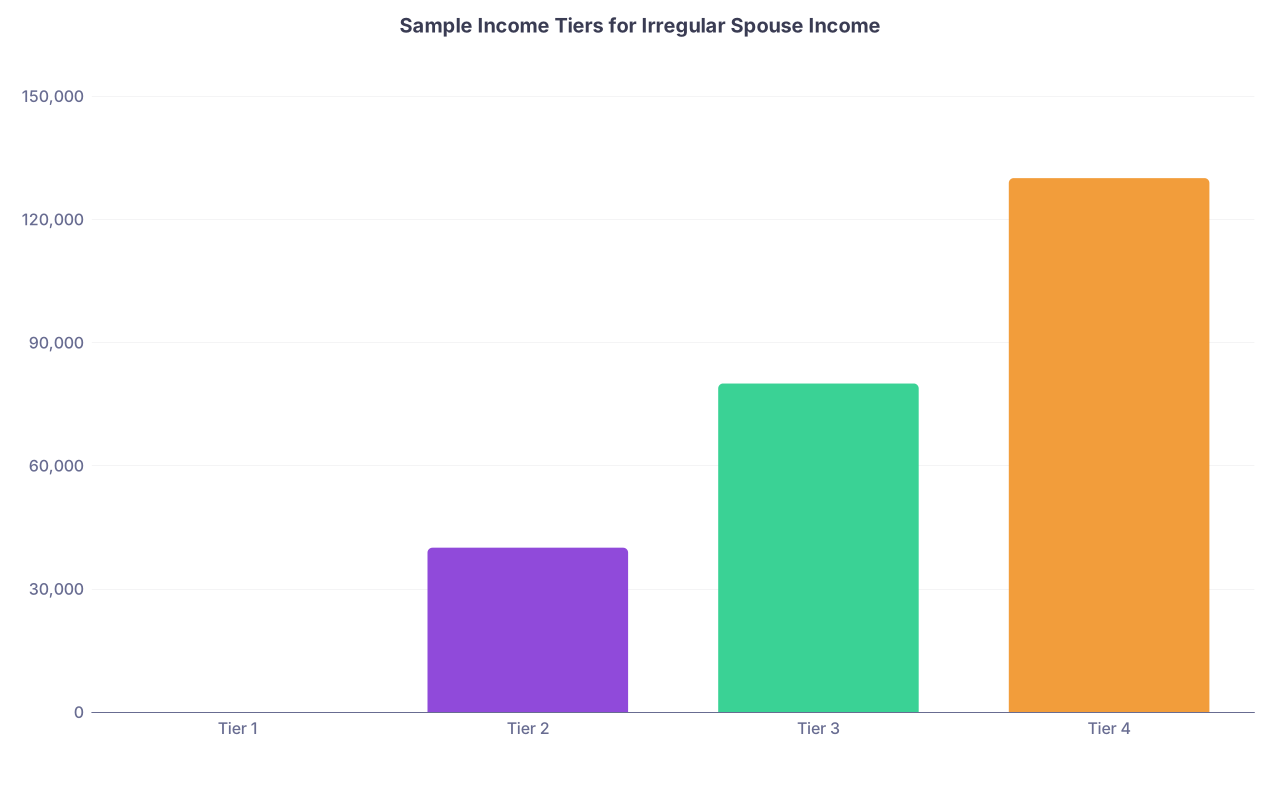
| Category | Value |
|---|---|
| Tier 1 | 0 |
| Tier 2 | 40000 |
| Tier 3 | 80000 |
| Tier 4 | 130000 |
You then decide ahead of time:
- Tier 1 (≤ $0): No contributions expected from them; all retirement saving is on your side.
- Tier 2 ($1–$40K): Small Roth IRA contribution if cash flow allows, maybe $100–$250/month to a brokerage.
- Tier 3 ($40K–$80K): Full IRA (or backdoor Roth) contribution, plus a percentage to their solo 401(k) or SEP-IRA.
- Tier 4 ($80K+): Max out their self-employed plan as much as is reasonable after setting aside for taxes.
You don’t guess each month. You have a pre‑agreed rulebook: “If your business profits are on pace for Tier 3 this year, we will do X, Y, and Z.”
That’s how you coordinate without fighting over every good or bad quarter.
Step 4: Build a Solo 401(k) or SEP for the Non‑Physician (and Choose Correctly)
If your spouse is 1099 / self-employed with no W‑2 benefits, they probably need their own retirement vehicle.
The two common choices:
| Feature | Solo 401(k) | SEP IRA |
|---|---|---|
| Employee deferral | Yes | No |
| Max flexibility | Higher at lower income | Better at very high net |
| Roth option | Often available | No |
| Backdoor Roth safe | Yes (no IRA balance) | No (creates pro-rata) |
Here’s the blunt truth:
If you want to do backdoor Roth IRAs for both of you, do not open a SEP-IRA for your spouse unless you understand the pro‑rata tax mess it creates.
Most physician households with a 1099 spouse are better off with a solo 401(k) for the spouse because:
- It allows an “employee” deferral out of their 1099 income.
- It avoids pre‑tax IRA balances that interfere with backdoor Roths.
- Some providers allow Roth solo 401(k) contributions, which can be great when income is lower.
You set this up at a brokerage (Fidelity, Vanguard, Schwab, etc.).
Then you tie contributions back to those income tiers you defined.
Step 5: Use a Yearly “Money Summit” Instead of Constant Stress
Irregular income couples fight about money when every new 1099 or check restarts the conversation.
You need one serious annual sit‑down and a couple of small check-ins, not 50 micro-arguments.
Here’s the basic structure:

| Step | Description |
|---|---|
| Step 1 | Pull last year numbers |
| Step 2 | Calculate savings rate |
| Step 3 | Set next year savings targets |
| Step 4 | Define spouse income tiers |
| Step 5 | Assign contribution plans per tier |
| Step 6 | Update account automations |
| Step 7 | Schedule midyear check in |
During that session, you:
- Look at how much you actually saved last year (not what you meant to save).
- Decide your target savings rate as a couple (e.g., 20–25% of gross combined).
- Reset the spouse’s income tiers for the year based on reality, not optimism.
- Update automatic contributions from your income.
- Decide triggers for “bonus” contributions from their side (e.g., if a particularly large check comes in, a set % goes directly to solo 401(k)).
This turns their income volatility from chaos into a series of automatic decisions you already agreed to when no one was emotional.
Step 6: Separate Three Buckets: Safety, Short-Term, Retirement
Couples in your situation often make a big mistake: treating every extra dollar as either “spend now” or “save for retirement.”
You need three distinct buckets:
Emergency/Safety Fund
This matters more with an irregular-income spouse.
Target at least:- 3–6 months of your fixed expenses if your income alone covers the essentials.
- 6–12 months if you currently rely on both incomes for living expenses.
Short- to Medium-Term Savings
Big items that regularly blow up budgets:- Home repairs
- Car replacements
- Maternity/paternity leave gaps
- Professional expenses (board exams, CME if not reimbursed)
This bucket should usually sit in high-yield savings or short-term bonds, not in retirement accounts.
True Retirement Accounts
401(k)/403(b)/457(b)/solo 401(k)/IRAs/HSA as quasi-retirement.
You never want to be raiding retirement accounts because your spouse’s income dipped and the roof collapsed the same year.
Step 7: Agree Up Front on Lifestyle Level Based on Your Income Alone
This one is non‑negotiable if you want long-term stability.
You base your core lifestyle (housing, car payments, recurring obligations) on:
- Your physician income alone
OR - Your physician income plus a very conservative floor for your spouse (for example, their 3-year average minus 30%).
That means:
- You do not buy the bigger house because your spouse had a great two years.
- You do not commit to two luxury car payments because their business “is really taking off.”
Your spouse’s higher-income years should show up in:
- Bigger retirement contributions
- Accelerated mortgage paydown (if that’s a goal)
- More travel or one-time experiences
Not in permanent fixed costs.
Step 8: Coordinate Taxes Intelligently (This Is Where You Can Mess Up)
When you mix W‑2 physician income with irregular 1099 income, the tax piece can wreck your savings if you ignore it.
Core moves:
Quarterly tax estimates for your spouse.
If they’re 1099 and not paying estimated taxes, your “surprise” bill in April will shred your savings plans. Use a simple rule like: 25–30% of each check goes into a “tax” savings account immediately.Align retirement contributions with tax reality.
In high-income years, prioritizing pre‑tax 401(k)/solo 401(k) may make more sense. In lower-income years, Roth contributions may be more valuable.File jointly? Almost always yes.
Joint filing usually gives better brackets, but work with a CPA familiar with physicians + self-employment. They can also help design the spouse’s retirement plan properly.
You don’t wing this. A one-hour conversation with a good CPA each year can easily be worth five figures to you over time.
Step 9: Protect Against Catastrophic Risk Before Optimizing Every Last Dollar
You’re both building a future on unstable ground if risk planning is weak.
Minimums I want to see for a physician married to a non‑physician with irregular income:
Own-occupation disability insurance for you.
Non-negotiable. Your income is the anchor.Life insurance on you (and often on them).
Term insurance, often 20- or 30-year. If their work provides childcare, household labor, or meaningful income, they need coverage too.Legal basics:
- Wills
- Healthcare proxies
- Guardians named if you have kids
- Beneficiaries properly set on all retirement accounts
This isn’t sexy. It’s adulting. But I’ve seen families financially destroyed by ignoring it while obsessing over Roth vs pre‑tax.
Step 10: Decide Your “Enough” Number and Work Backwards
At some point, you both need clarity on what you’re shooting for.
You don’t need it down to the dollar. But you do need ballparks:
- What age do you want to be able to step back?
- What yearly spending in retirement would feel comfortable in today’s dollars?
Say you think $180K/year in today’s dollars is about right.
Very rough rule: multiply by 25. That’s a ballpark nest egg target.
So you’re aiming for something like $4.5M in today’s dollars.
Then work backwards:
- How much have you already saved?
- How many years until 60 or 65?
- What annual savings rate (from both of you combined) gets you there with a conservative return assumption (say 4–5% real)?
This doesn’t need to be perfect. But it tells you whether:
- Your current path is fine.
- Or you need more from your spouse’s high-income years.
- Or you’re on a collision course with disappointment.
A basic projection done with a fee‑only planner once every few years can keep you honest.
Example: How This Plays Out for a Real Couple
Let’s put names on this.
- You: Hospitalist, W‑2, making $285K.
- Spouse: Freelance photographer, 1099, net income swings from $25K to $120K depending on the year.
You decide:
From your income:
- Max 403(b) pre‑tax.
- Backdoor Roth for you.
- HSA family contribution.
- Backdoor Roth for spouse funded from joint cash.
You live on:
- Your take‑home after retirement contributions and taxes.
- You do not need their income for basic necessities.
For spouse:
- Set up solo 401(k) at Fidelity.
- Income tiers:
- Tier 1 (0–$30K): no solo 401(k), just backdoor Roth you already funded.
- Tier 2 ($30K–$70K): 10% of net income to solo 401(k), done in chunks after major invoices get paid.
- Tier 3 ($70K+): 20–25% of net income to solo 401(k), prioritize pre‑tax in high years.
Big year: they net $95K.
- They contribute aggressively to the solo 401(k).
- You do an extra $10K taxable investing at year-end.
- You also throw $15K at your mortgage principal or a future college fund—because you already agreed that “big year” money is mostly for future goals, not just lifestyle creep.
Next year, they only net $35K.
No panic. Your core retirement savings still happen from your side. You dial back their contributions but not to zero because Tier 2 rules were set in advance.
That’s coordinated retirement with irregular income.
Visual: How Your Combined Retirement Savings Might Look Over 10 Years
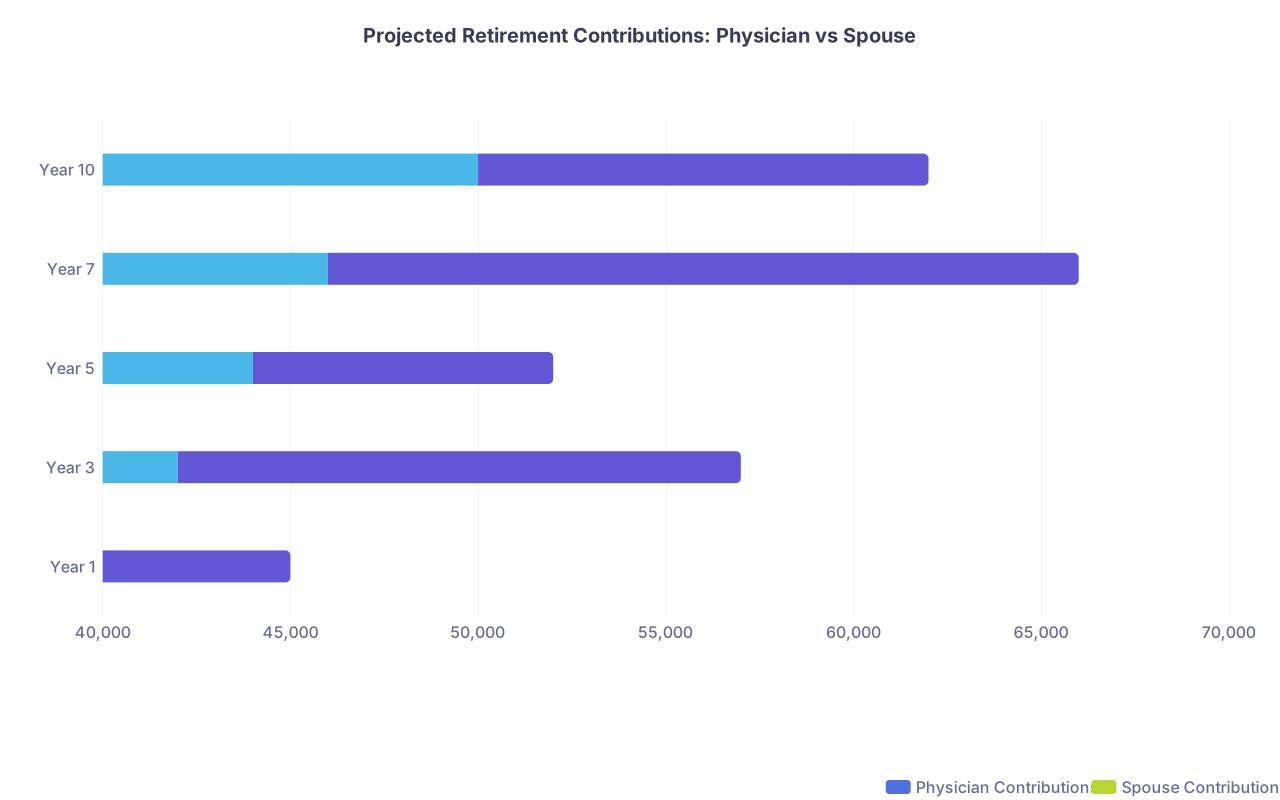
| Category | Physician Contributions | Spouse Contributions |
|---|---|---|
| Year 1 | 40000 | 5000 |
| Year 3 | 42000 | 15000 |
| Year 5 | 44000 | 8000 |
| Year 7 | 46000 | 20000 |
| Year 10 | 50000 | 12000 |
Notice: your bar is steady and rising slowly. Theirs is lumpy. But together, it’s powerful.
When to Pull in a Professional (and What Kind)
If you’re thinking, “We can’t even agree on which account is which,” it’s time for outside help.
You want:
- A fee‑only (not commission-based) financial planner
- Ideally with experience working with physicians and self-employed people
- Someone who will build a written plan and not just sell you products
Use them for:
- Setting the overall retirement target
- Structuring the spouse’s business retirement plan correctly
- Laying out that income‑tier contribution system
- Coordinating tax strategy with your CPA
You don’t need to be in a forever retainer relationship if you don’t want that. A one‑time plan plus check‑ins every 2–3 years can be enough if you’re disciplined.
Quick Mental Checklist for Your Situation
Before you close this, ask yourself:
- Are we currently living only on my stable income, or are we relying on their variable income for basics?
- Do we have a solo 401(k) or appropriate plan set up for the non‑physician?
- Have we defined income tiers and pre‑decided contribution rules?
- Are we doing backdoor Roths correctly, or did a SEP-IRA blow that up?
- Do we hold one yearly “money summit” to reset and coordinate?
If the answer to several of those is “no,” you know where to start.




FAQs
1. My spouse’s income is so unpredictable we can’t even define tiers. What do we do first?
Then you start cruder. Step one: live entirely on your physician income if at all possible and treat all of their income as “extra” for at least 12 months. During that year, track their monthly net numbers carefully. At the end of that year, look at their low month, typical month, and high month. Use those three realities—not feelings—to create your first set of income tiers and contribution rules. You don’t have to get it perfect; you just need a first version you can improve.
2. We already opened a SEP-IRA for my spouse. Does that ruin backdoor Roths forever?
It doesn’t ruin anything forever, but it complicates things until you fix it. The SEP-IRA balance gets pulled into the pro‑rata calculation when you do a backdoor Roth, meaning you’ll usually owe tax on part of the conversion. The way out is often to roll the SEP-IRA into a solo 401(k) (or a workplace 401(k) if available) so that there’s no pre-tax IRA balance on December 31st of the year you do backdoor Roths. A good planner or CPA can help you execute that cleanly.
3. Should we prioritize paying off our mortgage or maxing all possible retirement accounts?
If you’re a high-income physician household, retirement contributions usually beat extra mortgage payments until you’re at least hitting the big targets: maxing your workplace plan, both backdoor Roths, and a reasonable solo 401(k) contribution in good years for your spouse. Once you’re consistently saving 20–25% of gross income for retirement, then an aggressive mortgage payoff can make emotional and financial sense. But paying off a 3–4% mortgage while underfunding tax-advantaged retirement space is usually backwards.
Key points:
Use your physician income as the stable retirement backbone, and structure your spouse’s contributions using pre-agreed income tiers. Protect your ability to do backdoor Roths, favor solo 401(k) over SEP for the irregular-income spouse, and base your lifestyle on your predictable income—not on their best year.


